
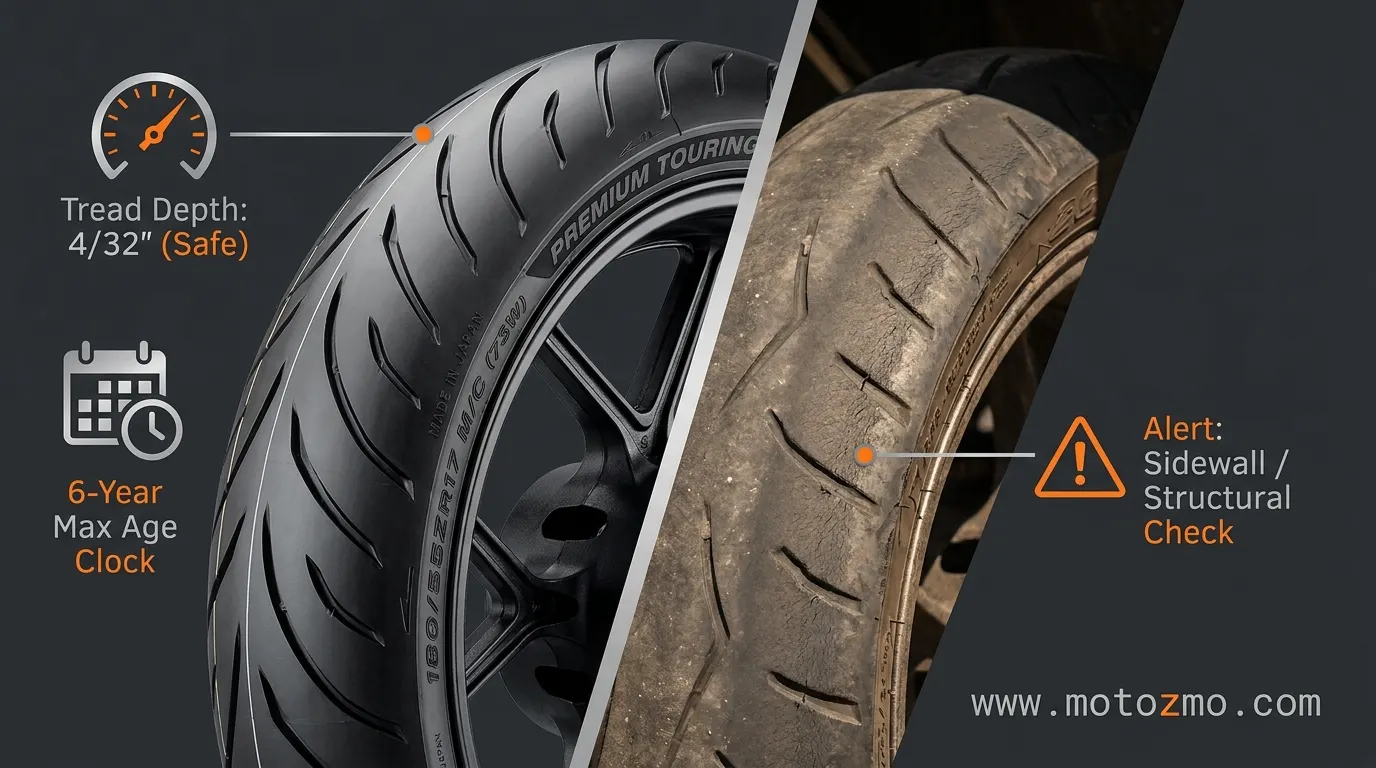
Replace a motorcycle tire when tread depth, tire age, or visible damage crosses one of three thresholds, whichever comes first: tread worn to your state’s legal minimum (or sooner), six years from the manufacture date even if tread looks fine, or any sign of a sidewall bulge, deep cracking, or cords showing through the rubber.
Most riders only track one of these three and get caught by one of the other two, usually tire age, since a tire can look perfectly good with plenty of tread and still be past the point of being trustworthy.
Here’s how each threshold actually works, and where common advice about motorcycle tires borrows too directly from car tire rules that don’t quite apply.
Key Takeaways
- The 3 Replacement Triggers: Replace tires when tread drops below minimum depth, age reaches 6 years from manufacture, or structural/surface damage appears—whichever occurs first.
- Tread Depth Minimums: Federal motorcycle minimum is 1/32″ (with NY and TX requiring 2/32″), but safety experts recommend replacing at 3/32″ to 4/32″ for wet-weather braking.
- The Aging Timeline: Rubber oxidizes over time. Have tires inspected annually at 5 years, replace them by 6 years (per manufacturer standards like Harley-Davidson), and never ride past 10 years regardless of tread depth.
- Decoding DOT Codes: Check the last 4 digits on the sidewall (e.g., “3522” = 35th week of 2022). A 3-digit code means the tire predates 2000 and must be replaced immediately.
- Critical Warning Signs: Sidewall bulges, dry rot/cracking, visible cords, and deep cupping require immediate replacement; tire plugs are temporary get-home repairs only.
- Wear & Lifespan Dynamics: Rear tires wear roughly 2x faster than front tires. Motorcycle tires wear faster than car tires because they use softer rubber compounds on a card-sized contact patch.
Checking Tread Depth, and the Legal Minimum Most Guides Get Wrong
A lot of tire content quotes 2/32 of an inch as “the” legal tread minimum, and for passenger cars in most states, that’s correct. Motorcycles are different: the federal minimum for motorcycle tires is actually 1/32 inch, about half of what’s commonly cited, with New York and Texas being the notable exceptions that require 2/32 inch specifically for motorcycle tires.
Most motorcycle tires have built-in wear indicator bars, small raised sections molded into the tread grooves, that sit flush with the surface once you’ve reached that legal minimum.
The penny test still works as a rough home check: insert a penny with Lincoln’s head facing down into the tread groove, and if you can see the top of his head, you’re below 2/32 inch, past even the stricter state standard.
But “legal” and “safe” aren’t the same threshold. Wet stopping distance increases sharply as tread thins, and the real safety minimum most tire engineers point to is closer to 4/32 inch, not the 1/32 or 2/32 inch legal floor. If you commute daily or ride in the rain regularly, replacing at 3/32 to 4/32 inch rather than waiting for the legal minimum buys real margin on a surface where your two tires are your only contact with the road. For the full walkthrough of checking your tires properly before every ride, here’s a complete guide to that process.
Racing and track tires wear dramatically faster than touring tires and often need replacement within a few thousand miles of aggressive use, while a quality touring tire can exceed 10,000 miles before hitting the same tread depth.
Tire Age Matters as Much as Tread, and Here’s the Actual Timeline
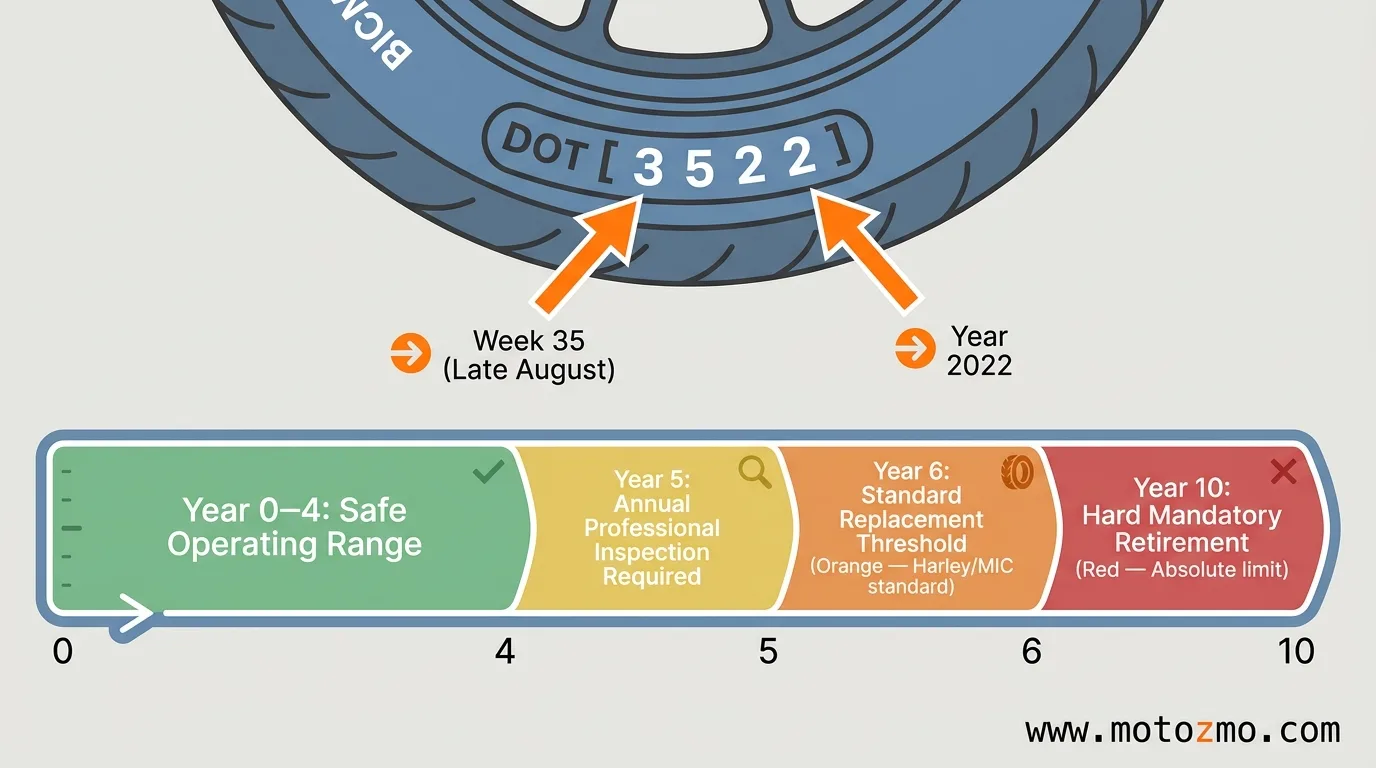
Rubber oxidizes from exposure to air, heat, and UV light regardless of whether the tire ever touches the road, which is why a tire with plenty of tread can still be unsafe. The guidance from tire manufacturers breaks cleanly into three stages, not one flat number:
- 5 years from manufacture: start getting the tire professionally inspected annually, even if it looks fine.
- 6 years from manufacture: the point where most manufacturer guidance, including Harley-Davidson’s own recommendation, suggests replacement regardless of remaining tread or apparent condition.
- 10 years from manufacture: the hard outer limit cited by Bridgestone, Michelin, Dunlop, and Continental. No tire should stay in service past this point no matter how it looks.
Every tire displays a DOT code on the sidewall, and the last four digits reveal the manufacturing date: the first two digits are the week, the last two are the year. A code ending in “3522” means the tire was built in the 35th week of 2022. If you find a three-digit date code instead of four, the tire predates 2000 and is old enough that its exact age barely matters, replace it.
Warmer climates and UV-heavy storage accelerate this aging process, so a bike parked outside in Arizona ages its tires faster on the calendar than the same tire on a bike kept in a cool garage in the Pacific Northwest.
Unmounted spare tires stored in genuinely cool, dark, dry conditions can hold up reasonably well for a few years before mounting, but treat any specific “X years on the shelf” number with some skepticism, since it depends heavily on storage conditions and isn’t something any single government agency formally regulates; the tire manufacturers themselves are the actual source for these recommendations, not a federal safety agency.
Warning Signs That Mean Replace Now, Tread, and Age Aside
Some damage overrides both the tread and age clock entirely.
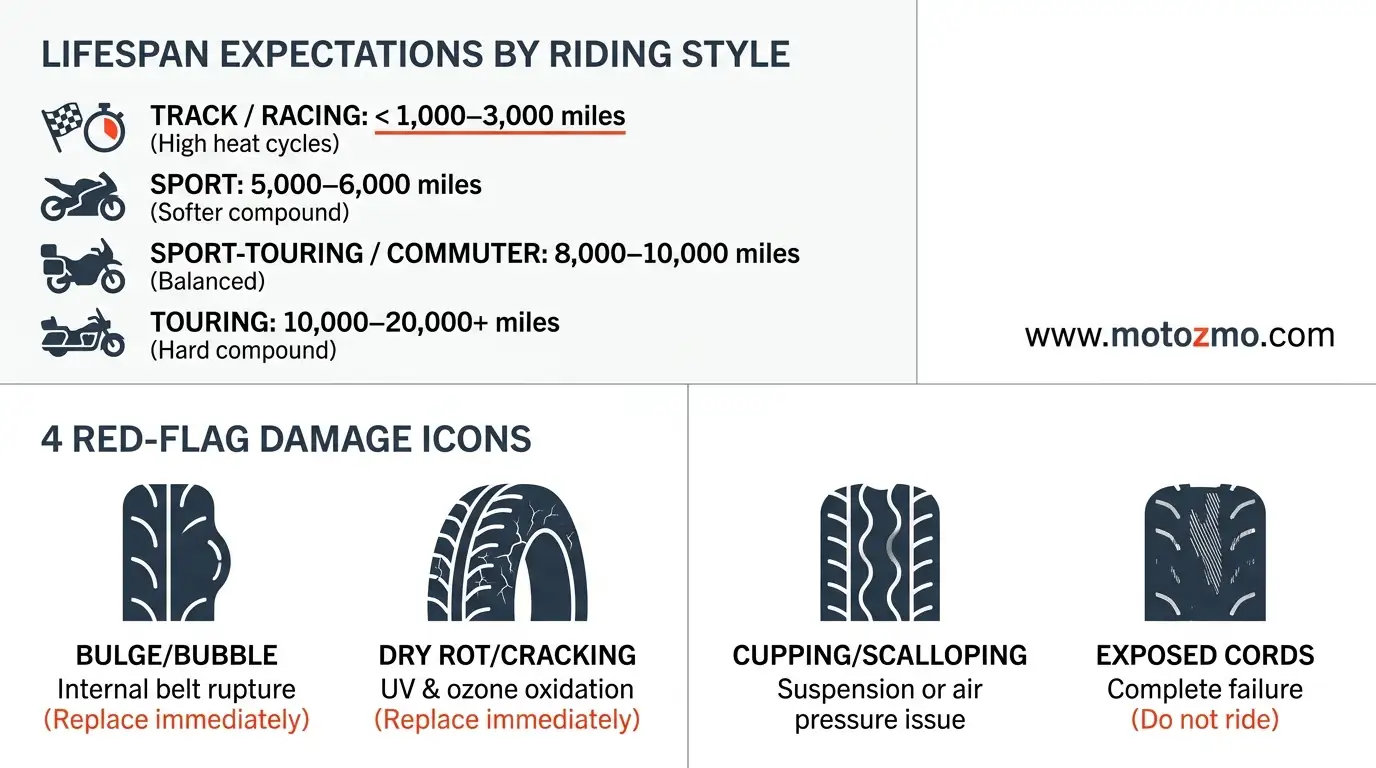
Sidewall bulges mean internal air pressure has pushed through a weakened area, and these can rupture without warning. Don’t ride on a bulging tire; get the wheel off and transport it separately rather than risk the ride to a shop.
Cracking and dry rot, typically showing up on the sidewall near the rim first but capable of appearing anywhere, signal aging rubber that’s lost its flexibility and is at risk of a slow leak or sudden failure.
Cupping or scalloping, uneven high and low spots around the tire’s circumference, usually points to a suspension issue or aggressive riding rather than the tire itself, and causes vibration and instability at speed until addressed.
Flat spots develop from extended storage without the tire off the ground or properly inflated. If this is why you’re here, proper winter storage technique prevents this specific problem far more reliably than hoping a flat spot works itself out once you’re riding again.
Punctures compromise a tire’s speed rating even after a repair. A plug works as a genuine “get home” solution, but it’s not a permanent fix; treat a repaired tire as reduced-speed only until you can get a proper patch-plug combination repair from the inside or, more reliably, a full replacement. For prevention rather than repair, here’s how to reduce your odds of a flat in the first place.
Visible cords or fabric through the rubber mean the tire has already failed structurally. Don’t ride on it at all, even to move the bike a short distance.
Uneven wear, excessive center wear, or unusual vibration while riding are the symptom-level warnings that something above is already happening, worth catching before you’re staring at exposed cords.
What Shortens Tire Life
Riding frequency and mileage matter, but so does the opposite problem: a bike that sits unused for months develops oxidation and flat-spotting even without a single mile added. Rough or gravel roads wear tires faster than smooth highway riding, and incorrect tire pressure, in either direction, wears tires unevenly while reducing the contact patch you’re actually riding on.
Aggressive cornering and braking accelerate wear too; sport riders who consistently lean to a similar angle develop flattened rings near the tire’s edges, while more conservative riders wear a flat strip down the center instead.
Climate plays a real role independent of mileage, since warmer weather and prolonged sun exposure accelerate the same oxidation process covered above, which is one more reason garage storage matters even for a bike that gets ridden regularly in the off-season.
Expected Mileage by Tire Type
| Tire type | Typical mileage before replacement |
|---|---|
| Race/track compounds | Often under 1,000 miles of aggressive use |
| Sport tires | 5,000–6,000 miles |
| Sport-touring tires | Around 10,000 miles with proper maintenance |
| Touring tires | 10,000–20,000+ miles for premium models |
Do Front and Rear Tires Need Replacing Together?
No. Rear tires wear roughly twice as fast as front tires, since the rear carries more of the bike’s weight and transmits all the engine’s power to the road through a wider contact patch. Most riders go through two rear tires for every front tire they replace.
Check both independently rather than replacing them as a set on a schedule, but when you do replace one, match the brand and model of the tire still on the bike; manufacturers design tire pairs to complement each other’s handling characteristics, and mismatched fronts and rears can behave unpredictably mid-corner.
Why Motorcycle Tires Wear Faster Than Car Tires
A motorcycle’s contact patch with the road is roughly the size of a credit card, dramatically smaller than a car tire’s footprint, which means motorcycle tires rely on softer rubber compounds to generate enough grip for acceleration, cornering, and braking through that small contact area.
A harder compound with more surface area works fine on a car; the same hardness on a motorcycle’s small footprint would slip more than it grips. That softer compound is also why aged motorcycle tires lose grip more noticeably than aged car tires do: softer rubber degrades faster, which is exactly why the age-based replacement clock matters more here than most riders coming from cars expect it to.
Long-Lasting Touring Tire Options
| Michelin Pilot Road 6 GT | Metzeler ME888 Marathon Ultra | Bridgestone Exedra G851 | |
|---|---|---|---|
| Best for | Heavy touring, all-weather | High-mileage cruisers | Large-displacement cruisers |
| Key strength | Wet-surface braking and grip | High-speed stability | Water and slush drainage |
| Typical mileage | Strong wet-weather longevity, model-dependent | Commonly cited as industry-leading for the category | 10,000+ miles reported |
| Drawback | Premium pricing | More road grime accumulation than some rivals | Fitment limited to specific cruiser models |
| Price | Check Price | Check Price | Check Price |
The Pilot Road 6 GT is the current generation in Michelin’s touring lineup, built on the wet-braking and stability improvements the Road 5 introduced, with the GT casing specifically reinforced for heavier touring bikes carrying luggage or a passenger. If you’re shopping based on an older review mentioning the Pilot Road 4 GT, know that Michelin has released two full generations since then.
If you’re doing the swap yourself rather than paying shop labor, here’s what to look for in a motorcycle tire changer if you want to add that capability to your own garage.
Replacement Schedule by How You Actually Ride
Track and sport riders should watch performance degradation, not just tread depth. The heat generated by aggressive riding breaks down the compound faster than mileage alone suggests, and many track riders replace tires every 2,000 to 3,000 miles even with tread remaining.
Touring riders should weight age alongside mileage more heavily than other rider types. A touring tire can show adequate tread after five years while the rubber itself has aged enough to meaningfully compromise wet-weather grip and raise blowout risk.
Commuters come out ahead replacing at 3/32 inch rather than waiting for the legal minimum, given how much daily traffic exposure and unpredictable weather stack the odds toward needing that extra safety margin.
Off-road riders should watch the knobs specifically. Once they round off and lose their sharp edges, effectiveness drops even if the tire’s overall height still looks adequate.
Bottom Line
Track all three thresholds, not just the one that’s easiest to eyeball. Tread depth is the obvious one, but tire age quietly catches more riders off guard, since a tire with good-looking tread can still be past its safe service life. When in doubt, check the DOT code before you check the tread.
FAQs about When to Replace Motorcycle Tires
How long do motorcycle tires actually last?
Sport tires typically run 5,000–6,000 miles, touring tires 10,000 miles or more, and premium touring models can exceed 20,000. Tire age matters independently of mileage: most manufacturers recommend replacement at 6 years regardless of remaining tread.
Can I ride on 10-year-old motorcycle tires?
No. Ten years is the hard outer limit cited by major tire manufacturers including Bridgestone, Michelin, and Continental, regardless of how the tread looks. Most guidance suggests replacing well before that, around 6 years.
What is the actual legal tread depth minimum for motorcycles?
The federal minimum is 1/32 inch, half of the commonly cited car standard of 2/32 inch. New York and Texas require 2/32 inch specifically for motorcycles. The real safety minimum, regardless of what’s legal, is closer to 4/32 inch.
Do motorcycle tires age even without being ridden?
Yes. Oxidation from air, heat, and UV exposure happens regardless of mileage, which is why a low-mileage bike can still need new tires based on age alone.
Should I replace both tires at the same time?
Not necessarily. Rear tires wear roughly twice as fast as front tires, so most riders replace rears more often. Check each independently, but match brand and model when you do replace one.
How do I read a tire’s manufacture date?
Find the DOT code on the sidewall. The last four digits show the week and year: a code ending in “3522” means the 35th week of 2022. A three-digit ending means the tire predates 2000.