
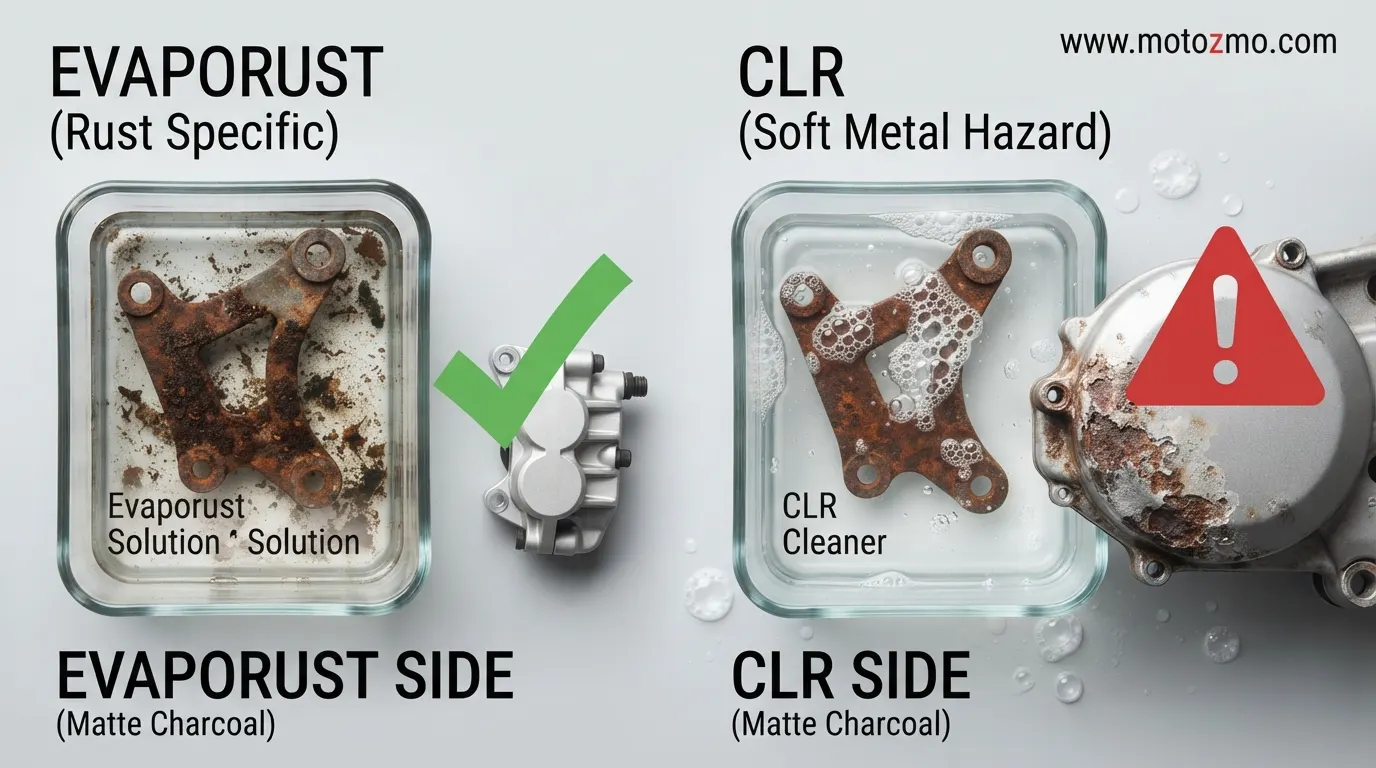
Evaporust is the safer, more broadly useful choice for motorcycle parts, since it’s built for long submerged soaks and won’t attack aluminum, brass, or chrome, while CLR is formulated as a short-contact household lime and rust-stain remover that its own manufacturer says to keep off aluminum, brass, copper, and galvanized metal entirely.
I was freshening up an old Kawasaki with a decade of winters behind it, plenty of surface rust on the usual suspects: calipers, fasteners, exhaust. Before reaching for a wire brush, I wanted to know exactly what each of these products was actually built to do, not just what the label promises in bold letters. What I found changed which one I’d actually reach for on a lot of these parts.

- Selective chelation, pH-neutral (6.1–7)
- Contact time is minutes to overnight, fully submerged
- Safe for aluminum, brass, copper
- Can be used for calipers, fasteners, tank interiors, mixed-metal assemblies

- Mild acids (lactic acid, gluconic acid) acting as chelating agents
- Contact time is about 2 minutes per the label, then rinse
- Manufacturer says avoid contact entirely
- Can be used for plain steel surface rust with a quick wipe and rinse
What Each Product Is Actually Built For
Evaporust: A Purpose-Built Submersion De-Ruster
Evaporust works through selective chelation, a chemical process where a synthetic molecule bonds specifically to iron oxide and pulls it into solution, largely leaving unrusted metal alone.
It runs pH-neutral, close to water itself, which is exactly why it’s built to be safely submerged for hours or even overnight without you needing to babysit it. It’s genuinely formulated for this job, fully immersed parts, extended contact time, minimal supervision.
CLR: A Household Lime and Scale Remover, Not an Automotive Soak
This is where the real difference from most comparisons of these two shows up. CLR stands for Calcium, Lime, and Rust remover, and reading its actual formulation and label tells a different story than “tough acid that eats through corrosion.”
Its active ingredients are lactic acid and gluconic acid, both mild, food-derived acids that function as chelating agents, chemically closer to Evaporust’s category than the harsh-acid framing suggests.
CLR’s own manufacturer instructs applying it directly to a stain, letting it sit for about two minutes, and rinsing promptly, not submerging parts for hours the way Evaporust is designed for. It’s built primarily for bathroom and kitchen mineral deposits, with surface rust on hard household surfaces as a secondary use case, not automotive parts restoration.
The Aluminum Warning Almost Nobody Mentions
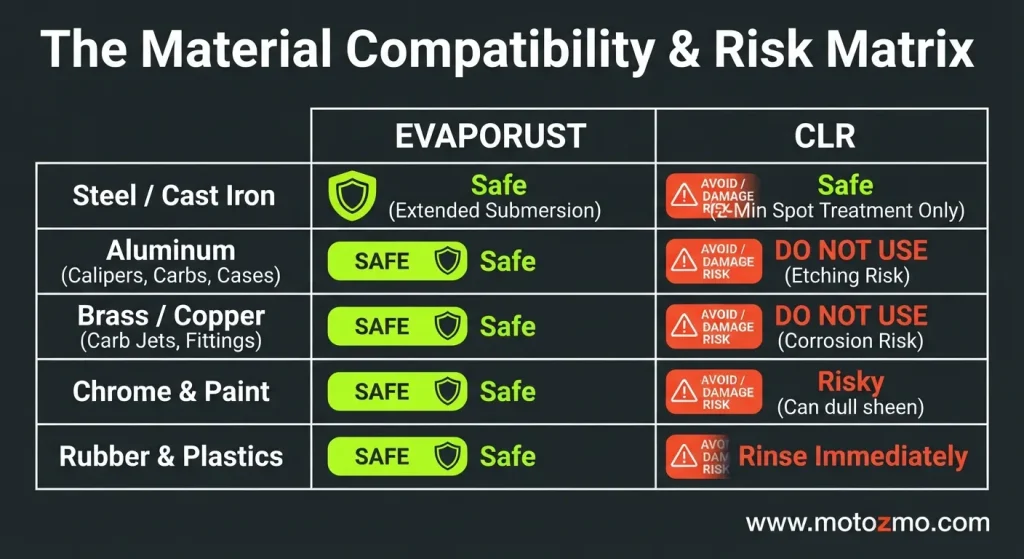
Here’s the correction that matters most if you’re about to reach for CLR on motorcycle parts. CLR’s own product label is explicit: avoid contact with brass, copper, aluminum, and galvanized metals entirely. That’s not a minor footnote, it directly rules out or seriously complicates using it on a lot of what actually needs de-rusting on a bike.
Brake calipers are very often aluminum. Carburetor bodies frequently use aluminum, pot metal, or zinc alloy castings. Fork lowers and triple clamps are commonly aluminum or anodized aluminum. Engine cases are aluminum on the overwhelming majority of motorcycles built in the last several decades.
Treating any of these the way an earlier version of this comparison suggested, soaking or slathering CLR on calipers, carbs, forks, or engine internals, runs directly against the manufacturer’s own printed warning, and it’s genuinely possible to etch, dull, or damage those surfaces as a result.
Where CLR does make sense on a bike: plain steel hardware, some frame sections without a painted or anodized finish, or light surface rust stains on hard, non-metal-sensitive surfaces, applied briefly and rinsed promptly, exactly as directed. For anything aluminum, brass, or copper, which covers a lot of a modern motorcycle, Evaporust is the manufacturer-approved and genuinely safer choice.
Effectiveness and Contact Time
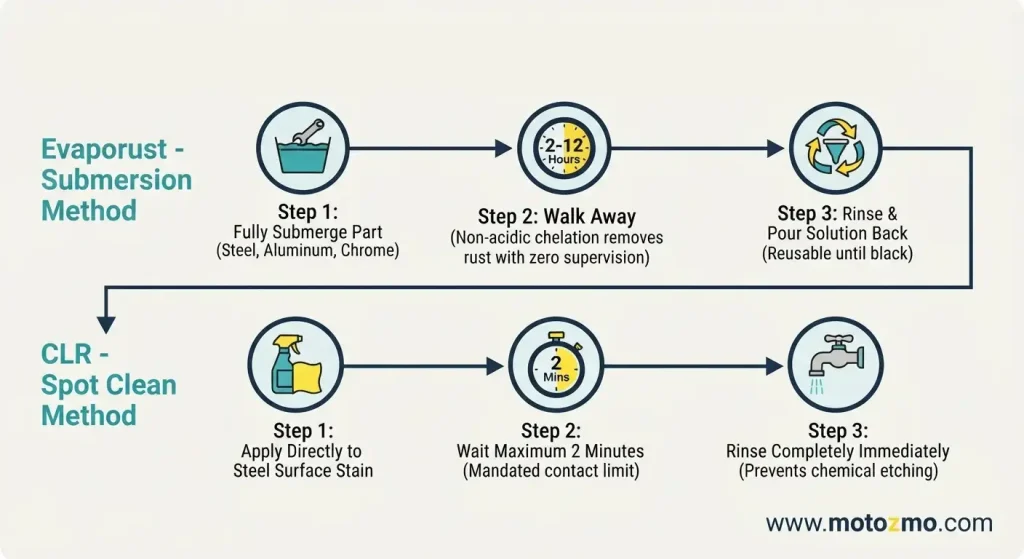
Evaporust’s real strength on a motorcycle project is that you can submerge a caliper, a fastener, or a mixed-metal assembly and walk away for hours without supervision, and it comes out with the rust genuinely lifted rather than just stained lighter. It handles pitted or heavier corrosion competently, though a true submersion soak, not a wipe-on application, is what it’s built around.
CLR’s short two-minute contact window means it’s realistically suited to lighter, more surface-level rust staining rather than the kind of embedded, pitted corrosion a decade of winters leaves on exposed hardware.
If a spot needs more than a couple of minutes and a rinse to actually clear, that’s a sign the job has outgrown what CLR is designed to do, not a reason to leave it on longer than the label recommends.
Safety: What the Actual Warnings Say
Evaporust’s safety profile is genuinely strong for a reason covered above: it’s pH-neutral, non-flammable, and doesn’t produce the fumes associated with acidic cleaners, which is a real advantage if you’re working in an enclosed garage.
CLR’s label carries warnings worth knowing before you use it: it’s an eye and skin irritant, gloves are recommended, and it should never be mixed with bleach or other household cleaners, since that combination can produce harmful fumes. It’s also explicitly not meant for prolonged surface contact.
None of that makes it a dangerous product used as directed, but “as directed” here means a quick, targeted application, not a multi-hour automotive soak.
Cost Comparison
A gallon of Evaporust runs roughly $25–35 and is reusable until the solution turns dark and stops working, which brings the effective cost per job down significantly over multiple projects.
CLR is cheaper per bottle, generally in the $6–10 range, but it’s sold and used as a spot-treatment product rather than something you’d buy in gallon quantities to submerge a full assembly, so the two aren’t really priced for the same kind of job in the first place.
Best Applications for Each
Evaporust is the right call for: calipers, fasteners, chain hardware and other tight-fitting components, tank interiors, and any mixed-metal assembly where aluminum or chrome is involved alongside steel.
CLR is a reasonable call for: light rust staining on plain steel tools or hardware, applied briefly and rinsed promptly per the label, where aluminum, brass, copper, or galvanized components aren’t in the mix.
Skip CLR entirely for: carburetors, calipers, fork components, engine cases, or anything else with aluminum, brass, or copper in the assembly. This is the single biggest correction worth taking away from this comparison.
Bottom Line
The real story here isn’t “gentle chemistry versus tough acid,” it’s “a product built for submersion versus a household spot-treatment that was never meant to replace it.” Evaporust is the genuinely versatile pick for motorcycle parts, aluminum, brass, chrome, and steel alike, while CLR’s own label steers it toward brief, targeted use on plain steel surfaces only. If you’re weighing Evaporust against other dedicated options, we’ve also compared it to vinegar, Metal Rescue, and Rust 911. And once the rust is gone, the right anti-corrosion spray is what keeps you from doing this again next winter.
FAQs
Is CLR safe to use on motorcycle carburetors?
Generally, no. Carburetor bodies commonly use aluminum or zinc alloy castings, and CLR’s own label warns against contact with aluminum. Evaporust is the safer choice for carb components.
Can I soak parts in CLR overnight like I would with Evaporust?
No. CLR’s label specifies roughly a two-minute contact time before rinsing. It isn’t formulated or labeled for extended submersion the way Evaporust is.
Will CLR damage brake calipers?
It can, if the caliper is aluminum, which many are. CLR’s manufacturer explicitly advises against contact with aluminum, brass, and copper.
What’s actually in CLR?
Lactic acid and gluconic acid, both mild organic acids that act as chelating agents, along with a surfactant and water. It’s a milder formulation than “harsh acid” framing suggests, but it’s still labeled for short contact only.
Which product is better for a full de-rusting project on a motorcycle?
Evaporust, in almost every case. It’s built for submersion, safe on the mixed metals common in motorcycle assemblies, and reusable across multiple projects.