
Top Picks For You
CRC Throttle Body and Air-Intake Cleaner
A zero-guesswork maintenance aerosol designed for hassle-free use. It offers universal 50-state compliance and sensor-safe peace of mind, making it ideal for quick, damage-free, on-bike intake cleaning.
Check Price
Berryman B-12 Chemtool
A ultra-potent solvent spray built specifically to break down years of dried, rock-hard varnish. It delivers workshop-grade stripping power for restoring neglected bikes without a full teardown.
Check Price
Gumout Carb & Choke Jet Spray
An affordable, fast-evaporating maintenance spray. It provides maximum direct-blast pressure to remove fresh road film and light carbon between rides without breaking the bank.
Check Price
Motorex Carburetor Clean
A specialized powersports cleaner engineered for motorcycle carbs. It provides consistent, emissions-compliant cleaning power designed to keep high-revving engines idling smoothly.
Check Price
Sea Foam Motor Treatment
A gentle, pour-in petroleum treatment that prevents fuel breakdown. It cleans internal passages continuously while riding, making it the ultimate tool for hassle-free winterization.
Check Price
The best all-around motorcycle carburetor cleaner is CRC’s Throttle Body and Air-Intake Cleaner, currently the top seller in its category for good reason: it cuts through carbon and varnish, it’s safe around oxygen sensors and catalytic converters, and it’s compliant everywhere in the US, so you don’t need to check your state’s rules before buying it.
If your carb has sat for a season and has real varnish built up, Berryman’s B-12 Chemtool hits harder. If you just want a cheap can to spray through the throat every few months as maintenance, Gumout does that job fine for a few dollars less.
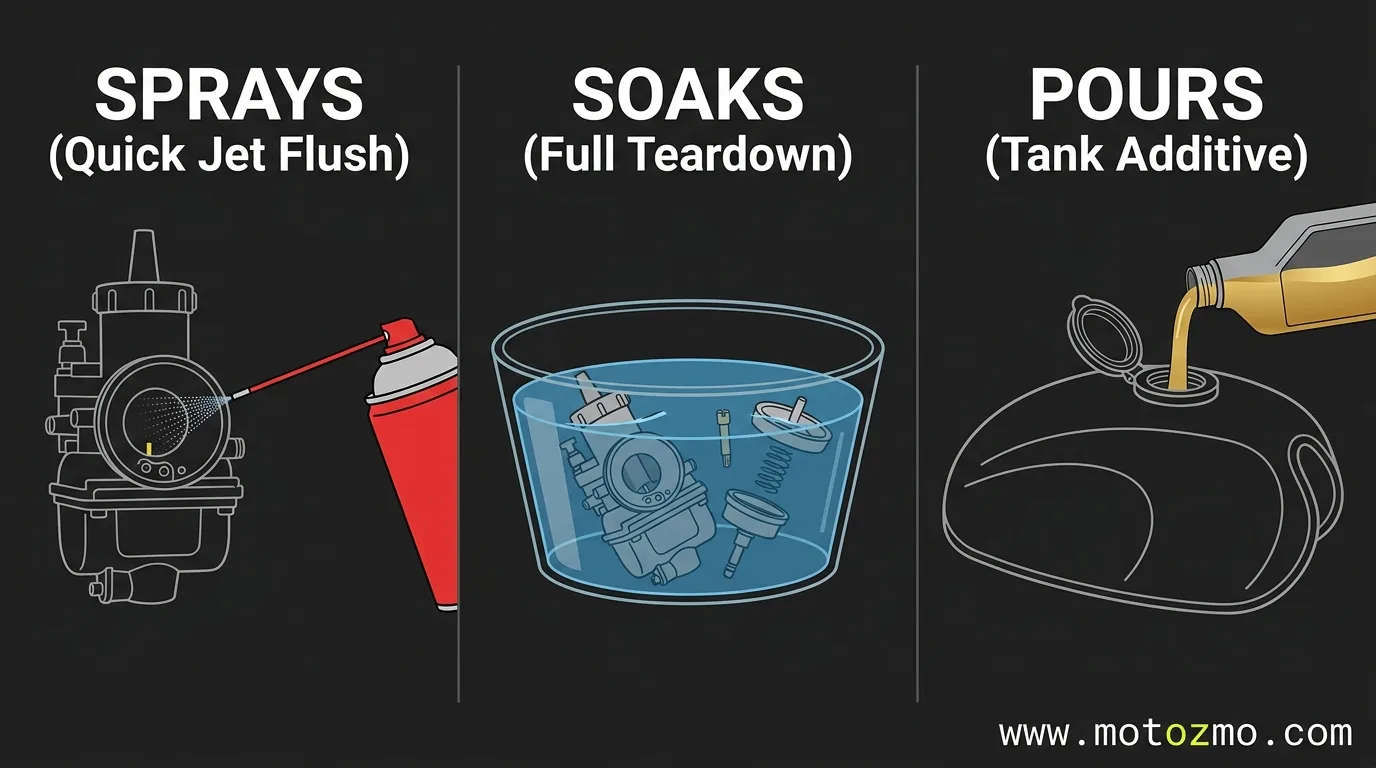
What actually matters more than which brand you grab: whether you’re spraying it into a running engine’s throat, soaking a fully disassembled carb, or adding it to a tank as a preventive additive, since those are three different jobs that call for different products.
Here’s how to pick the right one, and a regulatory shift worth knowing about before you buy.
Which Rider Are You?
| Your situation | Best pick |
|---|---|
| Want the safest, most widely available default | CRC Throttle Body and Air-Intake Cleaner |
| Carb has real varnish from sitting all winter | Berryman B-12 Chemtool |
| Spraying every few months as routine upkeep | Gumout Carb & Choke Jet Spray |
| You live somewhere with strict VOC rules | Motorex Carburetor Clean |
| Want ongoing prevention without spraying anything | Sea Foam Motor Treatment |
Spray or Soak: Two Different Ways to Clean a Carb
Most riders reach for an aerosol can, and for good reason: it forces cleaner into jets and passages without pulling the carburetor off the bike. That works for the pilot circuit and needle circuit specifically, since understanding where fuel actually travels through a carburetor tells you where to aim the straw for the best result.
A full dip-tank soak is the more thorough option, submerging a fully disassembled carb in cleaner for hours, and it’s genuinely better for a carburetor that’s been sitting for years or is headed for a full rebuild. Most riders doing routine maintenance will never need it; it’s really a tool for restorers and full teardowns.
About “Chlorinated” Cleaners and a Regulatory Shift Worth Knowing
Older carb cleaner formulas relied on methylene chloride, an aggressive solvent that cuts through baked-on varnish faster than almost anything else.
Two separate things have made this a moving target for buyers: state-level VOC content rules (California and several other states have restricted or capped certain solvents in aerosol products for years, which is why some cans are labeled “not VOC-compliant in some states”), and a newer, bigger federal action specifically targeting methylene chloride.
In 2024, the EPA finalized a rule banning methylene chloride from consumer retail sale nationwide, rolling out in phases through 2025 and 2026, after the chemical was linked to dozens of deaths from acute exposure. That means the old advice of “just order the strong stuff from a state without restrictions” doesn’t really apply anymore; this isn’t a patchwork of state rules to shop around, it’s a national phase-out of one specific ingredient.
If cleaning power is what you’re after, look for terms like “high-solvent” or “professional-strength” on the label rather than assuming a chlorinated formula is still sitting on a shelf somewhere.
One more label to check regardless of which cleaner you buy: carb cleaner is not the same thing as fuel injector cleaner, and using it on an EFI system’s injectors can damage seals that carb cleaner was never formulated for. If you’re not sure which fuel system your bike actually has, check before you spray.
The 5 Best Motorcycle Carburetor Cleaners
CRC Throttle Body and Air-Intake Cleaner — Best Overall
Format: Aerosol spray; VOC-compliant everywhere: Yes
Key Features
- 360-degree spray valve for hitting awkward carb angles and tight under-tank clearances
- Protective lubricating residue for preventing linkage binding
- Safely flushes idle control valves and intake passages
CRC’s spray is currently the best-selling product in its Amazon category, and it earns that spot by being genuinely versatile: it’s rated safe around oxygen sensors and catalytic converters, it’s compliant across all 50 states so there’s no fine print to check, and it cuts through the moderate carbon and varnish buildup most riders are actually dealing with.
It’s not the most aggressive option here, so a carburetor that’s been sitting untouched for two or three years might need something stronger first.
Berryman B-12 Chemtool — Best for Heavy Varnish
Format: Aerosol spray; VOC-compliant everywhere: Check your can
Key Features
- Uses High-Energy Solvent Technology to rapidly dissolve stubborn, hardened fuel deposits
- Clears clogged jet orifices to instantly fix lean-condition hesitation
- Serves as a heavy-duty bench-top parts washer solvent when sprayed into a catch container
Berryman has built a genuine following among mechanics for a reason: this is one of the strongest carb cleaners you can buy without stepping up to a dip tank, and it’s the one riders reach for when a carburetor has sat dormant long enough to grow real amber varnish on the float needle and jets.
Some Berryman spray SKUs currently carry a “not VOC-compliant in some states” label, so check your can before you buy if you’re in a restricted state. Mask off rubber seals and painted surfaces before spraying, since this formula is aggressive enough to affect both.
Gumout Carb & Choke Jet Spray — Best Budget
Format: Aerosol spray; VOC-compliant everywhere: Mostly
Key Features
- Targeted high-pressure nozzle concentrates fluid velocity to blast away loose surface grime
- Evaporates completely within seconds
- Instantly cuts through external grime on engine cases, throttle linkages, and metal carb bodies
At roughly the price of a fast-food value meal, Gumout is the can worth keeping a few of on a shelf for routine spray-downs between rides rather than emergency intervention.
It’s rated safe on oxygen sensors and leaves no residue, and for light, regular maintenance it performs close enough to pricier options that the savings add up if you’re doing this every few months. It’s not the pick for a carburetor that’s already gummed up badly; that’s a job for something stronger.
Motorex Carburetor Clean — Best VOC-Compliant Option
Format: Aerosol spray; VOC-compliant everywhere: Yes
Key Features
- Formulated exclusively for high-revving 2-stroke and 4-stroke motorcycle and ATV carburetors
- Concentrates on dissolving fuel films inside air passages and Venturi throats to stabilize idle RPM
- Cleans needle valve seats and fine air-mixture screw threads without galling delicate bras
- Meets all stringent European and North American low-emission standards right off the shelf
Motorex is a Swiss brand that shows up specifically through motorcycle dealers and powersports parts counters rather than general auto parts stores, and it’s explicitly labeled VOC-compliant, which makes it a straightforward choice if you’re in a state with tighter aerosol restrictions and don’t want to cross-check a label every time.
It’s tested safe with catalytic converters and handles the fuel system components most riders actually need cleaned, without the guesswork.
Sea Foam Motor Treatment — Best for Ongoing Prevention
Format: In-tank additive; VOC-compliant everywhere: Yes
Key Features
- Contains zero harsh synthetic detergents or alcohols
- Coats upper cylinder walls and valve stems with protective oil
- Cleans the entire fuel circuit, from gas tank to carb jets, continuously as you ride without tools
Sea Foam works differently from the other four: instead of spraying it directly into the carb throat, you add it to a tank of gas, and it cleans gradually from the inside as you ride.
It’s been around for more than 65 years for a reason, it’s a low-effort way to keep varnish from building up in the first place, especially useful before winter storage or after a bike’s sat for a few weeks. It’s not a substitute for a direct spray cleaning if the carb is already gummed up; think of it as prevention rather than a cure.
Safety Basics Before You Spray
Work outdoors or with real airflow moving through the space; solvent vapors like these are often heavier than air and can displace oxygen in an enclosed area, which is worth taking seriously rather than cracking one window.
Wear safety glasses, since splashback happens more often than you’d expect, and nitrile gloves, since prolonged skin contact dries out and irritates skin. Keep cans away from heat and direct sunlight, the propellant inside is pressurized and can rupture if it gets hot enough.
Most formulas will also strip paint, degrade rubber seals, and cloud plastic on contact, so mask off anything you’re not actively cleaning rather than assuming overspray won’t matter.
Cleaning Alone Won’t Fix Everything
A clean carburetor solves deposit and varnish problems, but it won’t fix a mechanical issue underneath one.
If your bike still runs rough after a proper cleaning, the next place to look is the idle mixture screw, since removing years of buildup changes how the passages flow and often calls for a re-adjustment. If fuel is actively leaking from the carb rather than just running poorly, that’s a float or needle valve problem that cleaner won’t touch.
And if you’d rather stay ahead of all of this than react to it, routine carburetor maintenance on a regular schedule is what actually keeps you out of heavy-varnish territory in the first place.