Affiliate disclosure: This post may contain affiliate links. If you buy through a link on this page, MOTOZMO may earn a small commission at no extra cost to you. It helps keep our guides free. How we test and choose products.
A motorcycle that jerks when you feather the clutch is almost always one of five things: worn or notched clutch components, idle speed set too low, an air-fuel mixture that’s off, weak ignition, or valve clearances out of spec.
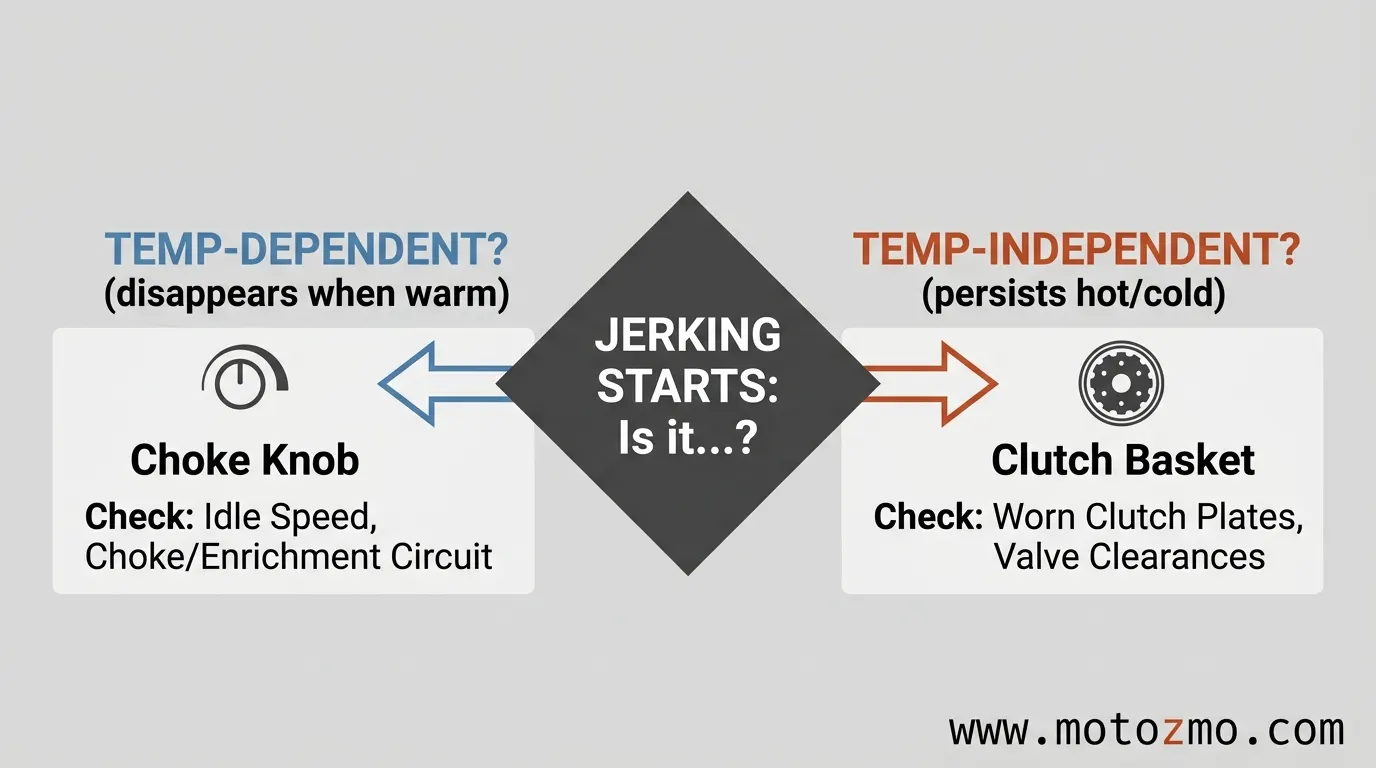
In practice, the fastest way to narrow it down is a single test: does the jerking disappear once the engine’s fully warm? If yes, you’re chasing a cold-running issue like idle speed or choke enrichment. If it persists hot and cold, the problem is more likely mechanical, in the clutch itself or somewhere in valve timing.
Either way, the friction zone, that narrow window where the plates are only partially engaged, demands smooth, consistent power, and anything that makes your engine’s output uneven shows up right through the lever and the seat.
Here’s how to work through it in the order that actually finds the answer fastest.
Quick Diagnostic Reference
| Symptom | Most likely cause | Quick check |
|---|---|---|
| Jerking disappears once warm | Rich cold mixture, low idle | Check choke operation, verify idle RPM |
| Jerking persists at all temperatures | Worn clutch plates, valve clearance | Inspect clutch, check valve gaps |
| Jerking plus engine stumbles | Ignition or fuel delivery | Test spark plugs, check fuel flow |
| Jerking plus clutch slips at high RPM | Worn friction plates, weak springs | Measure plate thickness |
| Jerking only in 1st and 2nd gear | Basket notching, cable adjustment | Check basket fingers, adjust cable |
| Jerking plus rough idle | Vacuum leak, carb issue | Spray carb cleaner around intake seals |
| Jerking that started after an oil change | Wrong oil in a wet clutch | Check the oil’s API rating (see below) |
Start Here: The Warm-Engine Test
Ride for a solid 10 minutes of varied riding, enough for the engine to reach full operating temperature, and pay attention to whether the jerking fades. If it does, focus on the cold side of things: the choke or cold-start enrichment circuit, and idle speed.
Cold engines run richer than warm ones by design, and oil hasn’t reached its working viscosity yet, both of which make power delivery lumpier right when you need it smoothest.
If jerking persists no matter how warm the engine gets, skip ahead to the clutch and valve sections below, since a temperature-independent problem is rarely a fueling issue.
Worn or Notched Clutch Hardware
Clutch plates wear down over thousands of engagements: friction material thins, steel plates warp from repeated heat cycles, and springs lose tension. Worn plates grab and release unevenly instead of engaging smoothly, which is exactly what jerking in the friction zone feels like.
Watch for jerking that gets worse as the engine heats up, an engagement point that seems to wander on the lever, a burning smell after slow-speed riding, or slipping under hard acceleration. Most friction plates wear down to somewhere around 2.8–3.0mm before needing replacement, though the exact number is in your service manual; measure with a caliper rather than guessing.
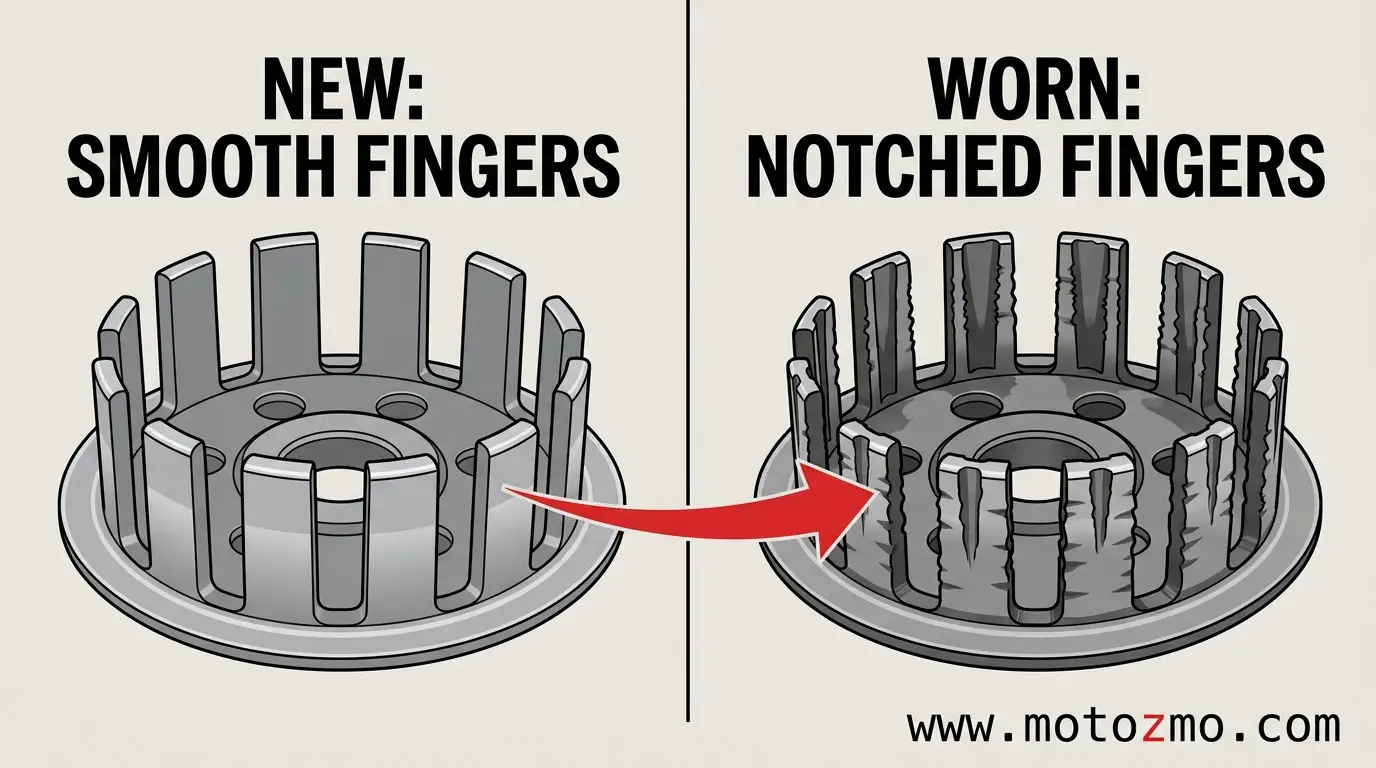
Clutch basket notching is a related but distinct problem. Over enough miles, the tabs on the friction plates carve grooves into the basket fingers that hold them, and those notches trap the plates instead of letting them slide freely during engagement.
Run a finger along the basket fingers; ridges or steps mean it needs filing or replacement. This tends to show up on higher-mileage bikes, though the exact mileage varies enormously with riding style and clutch abuse.
Clutch cable free play matters more than most riders realize, and it’s worth double-checking which spec your manual is actually giving you, because there are two completely different, equally common ways to measure it.
Most factory manuals measure from the end of the lever to the grip, which typically calls for 10 to 20mm of play. A smaller but arguably more reliable number comes from measuring the gap directly behind the lever at the perch, which is usually only 2 to 4mm, and doesn’t change if you’ve swapped to an aftermarket lever.
Check which measurement your manual specifies before you assume your cable is out of adjustment. If your bike has a hydraulic clutch instead of a cable, there’s no free play to adjust at all; grabbiness there points toward air in the line or a worn master cylinder instead.
Wrong Engine Oil (Wet Clutch Bikes)
This one gets skipped constantly, and it’s worth checking before you touch anything mechanical if the jerking started right after an oil change.
Most motorcycles run a wet clutch, meaning the clutch plates sit in the same oil that lubricates the engine. Automotive oils formulated for fuel economy contain friction modifiers that reduce friction between moving parts, which is exactly the opposite of what a wet clutch needs to grip consistently.
Run car oil, or any oil carrying the API “Energy Conserving” designation, through a wet clutch, and the plates can grab and slip unevenly, which shows up as exactly this kind of jerky, inconsistent engagement.
If this happened right after switching what you put in the crankcase, a fresh change with a motorcycle-specific oil is worth trying before you assume you need new clutch plates.
Idle Speed and Air-Fuel Mixture
An idle that’s set too low leaves the engine without enough torque to pull smoothly through the friction zone, and it bogs between power strokes instead.
There’s no reliable rule tying idle speed to engine displacement, it’s set by each manufacturer’s own design, so check your owner’s manual for the actual spec rather than assuming based on how big your engine is. Bumping idle toward the higher end of the specified range often clears up jerking immediately.
An engine running rich or lean delivers power just as unevenly. Rich mixtures stumble and load up, with black exhaust smoke as the tell; lean mixtures surge and hesitate, often with popping on deceleration.
On carbureted bikes this is usually the biggest single low-speed culprit, and it’s worth walking through the mixture adjustment properly rather than guessing at the screw. Fuel-injected bikes rarely develop mixture problems on their own; when they do, it’s usually a sensor or an ECU that needs attention rather than anything you can adjust with a screwdriver.
Weak Ignition and Valve Clearance
Weak spark means an incomplete burn on some cycles, and each slight misfire transmits straight through the clutch as unevenness. Check spark plugs for a tan or light brown electrode, which indicates healthy combustion; black, oily, or white deposits point to a problem worth chasing further. Worn plugs, failing coils (test resistance against your manual’s spec), and damaged plug caps or wires are the usual suspects.
Valve clearances drifting out of spec shift valve timing in a way that disrupts combustion consistency: tight clearances hold a valve slightly open and bleed off compression, while loose clearances delay opening and reduce how well the cylinder fills.
Most motorcycles need this checked every 12,000 to 26,000 miles; if you can’t remember the last time, it’s overdue. This one takes real tools and time, so it’s usually the last thing to check rather than the first.
Fixes You Can Handle at Home
Most of the causes above have a straightforward home fix. Adjust idle in quarter-turn increments and test-ride between changes rather than guessing at a big correction.
Set clutch cable free play using whichever measurement method your manual specifies, and use the barrel adjuster at the lever for small corrections before touching the cable’s other end.
A clogged air filter richens the mixture by restricting airflow; hold it up to light; if none passes through, replace it. Fresh spark plugs run under $15 for most bikes and take minutes to swap.
Carbureted twins, triples, and fours drift out of sync over time; a vacuum leak or a dirty carb can mimic the same rough-running symptoms, so rule those out before assuming a full sync job is needed.
When to Take It to a Mechanic
Some of these need specialized tools or engine teardown: clutch plate replacement often means splitting the cases, basket repair, shim-under-bucket valve adjustment, a carburetor rebuild, or ECU diagnostics on a fuel-injected bike. Rough, current estimates for the US:
| Repair | Parts | Labor | Total range |
|---|---|---|---|
| Clutch plate kit | $80–$200 | $150–$400 | $230–$600 |
| Valve adjustment | $0–$50 | $150–$350 | $150–$400 |
| Carburetor rebuild | $30–$80 | $100–$250 | $130–$330 |
| Ignition coil replacement | $40–$150 | $50–$100 | $90–$250 |
Prices vary by make and local labor rates, and European or high-performance bikes typically run higher.
Is It Actually Technique?
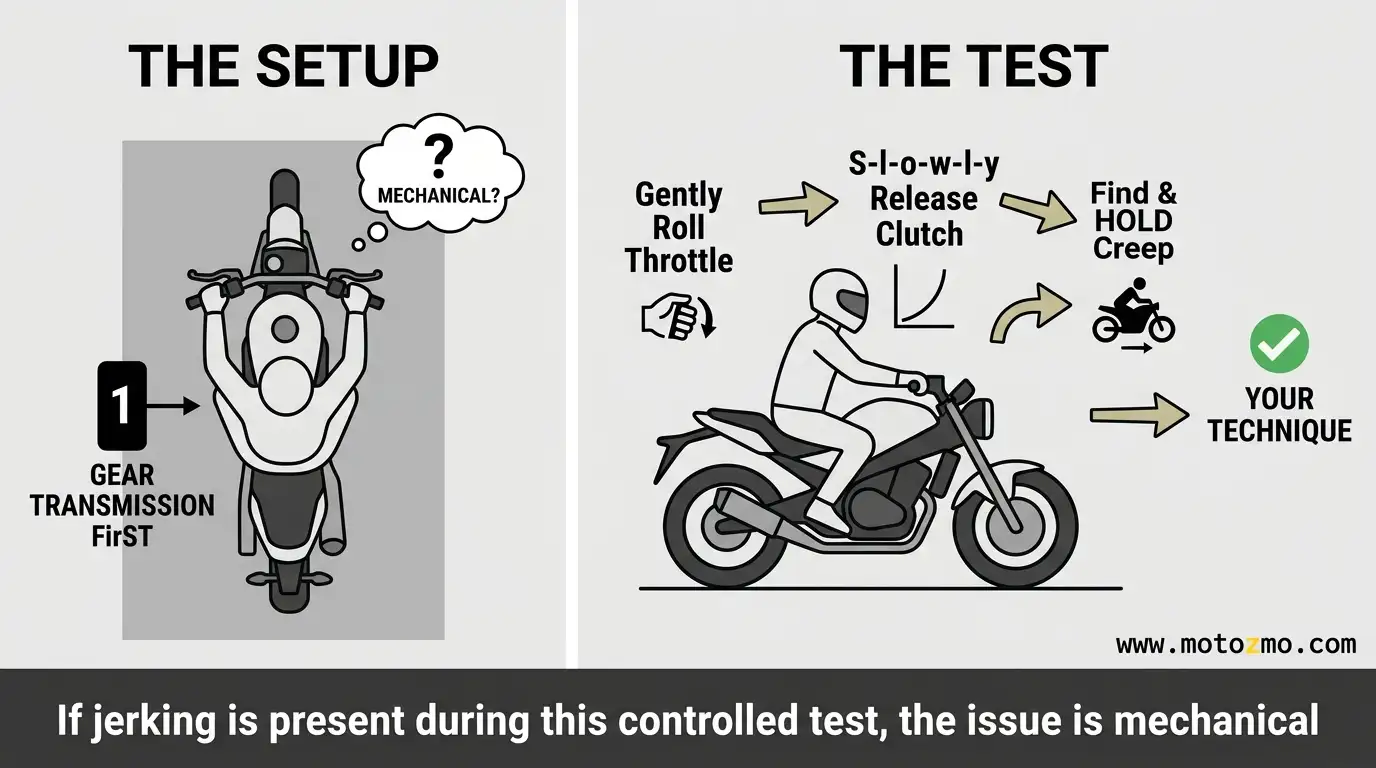
If the bike checks out mechanically, the jerking might be how you’re releasing the lever rather than anything on the bike. Three common habits cause exactly this feeling:
- Releasing the clutch too fast without giving the friction zone time to engage progressively
- Releasing at pure idle with no throttle input to prevent bogging
- Jerky, inconsistent lever pressure instead of a smooth, steady release
A useful drill in an empty parking lot: pull the clutch fully in, shift to first, and release slowly until the bike just starts to creep, holding that exact point for five seconds and repeating until you can find it reliably every time. Then practice blending a slight throttle roll-on with the release so the two inputs happen together rather than one after the other.
Dumping the clutch at high RPM rather than matching engine speed to road speed produces the same lurch through a different mechanism, so that’s worth ruling out too if the jerking only shows up on aggressive starts. If the jerking is just as present with careful, deliberate technique, the problem lives in the machine, not the rider.