
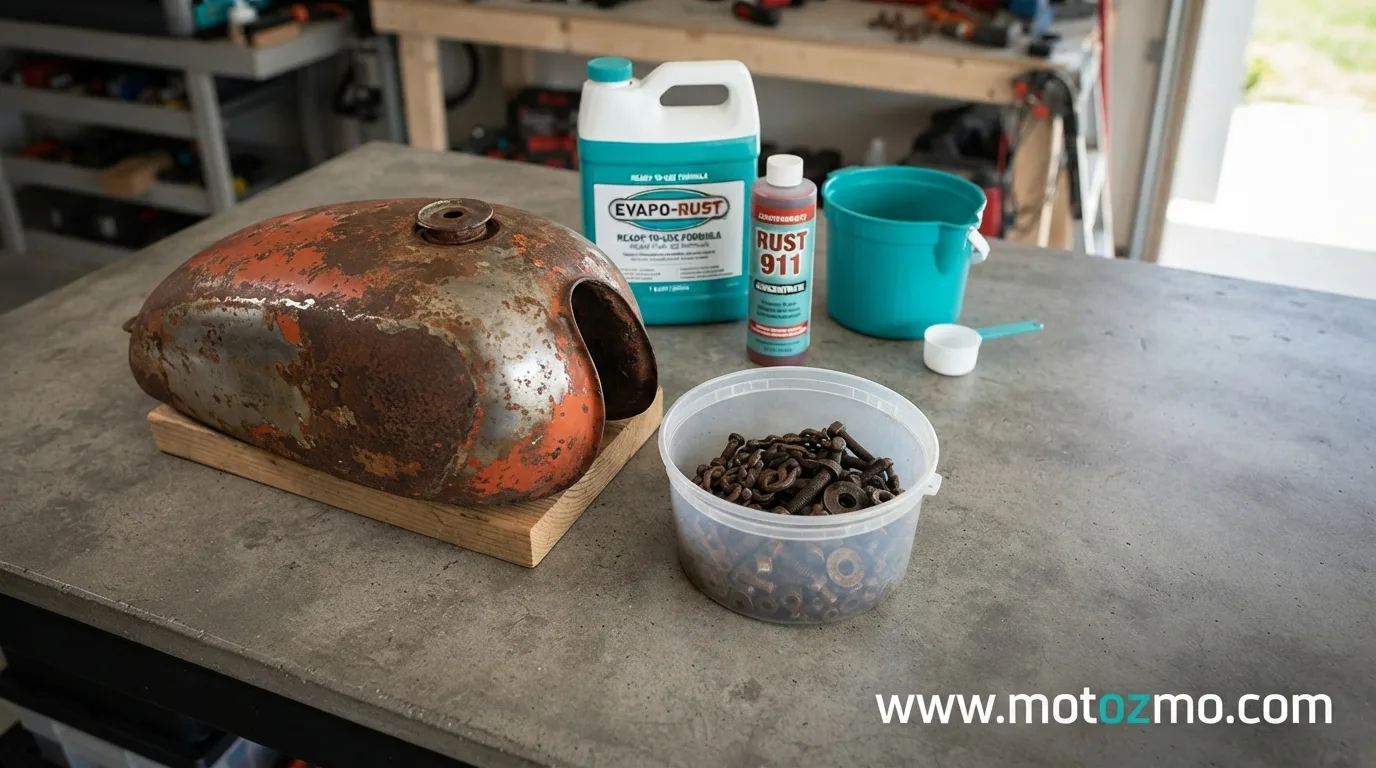
Rust 911 and Evapo Rust both remove rust the same way, through chelation chemistry that targets iron oxide specifically, so the real decision isn’t about which one is chemically stronger, it’s about format: Evapo Rust is ready to use straight from the jug, while Rust 911 is a concentrate you dilute yourself, which makes it genuinely cheaper per gallon of working solution once you’re tackling a bigger job.
Rust doesn’t stay put once it starts, and if you’re not on top of it, something important on a bike that’s been sitting can fail at the worst time. I tested both products on a genuinely rough batch of parts, cylinder head bolts, a clutch basket, chain links, suspension hardware, a gas tank strap, to see how they actually stack up.

- Concentrate, mix roughly 1 part to 15 parts water
- Gentle on steel, aluminum, brass, chrome
- Requires mixing, but stretches much further
- Good for large jobs, gas tanks, repeat use

- Ready to use, straight from the jug
- Gentle on steel, aluminum, brass, chrome
- No mixing required
- Good for small jobs, grab-and-go convenience
Same Core Chemistry, Different Delivery Format
This is worth establishing clearly before anything else. Rust 911’s own FAQ confirms its concentrate uses chelant technology, the same category of chemistry Evapo Rust and other major rust removers rely on, not a fundamentally different or more aggressive chemical process.
Neither product is an acid. Both work by targeting iron oxide specifically and pulling it into solution while leaving the base metal largely alone.
The real difference is delivery. Evapo Rust ships pre-mixed and ready to pour over your parts, no math required. Rust 911 ships as a concentrate, roughly 8 ounces mixed into a gallon of water for a standard working solution, which means one gallon of concentrate can make up to 16 gallons of usable rust remover. That’s the actual distinction that matters here, not one product being chemically “stronger” than the other.
Why the Cost Math Genuinely Favors Rust 911 for Big Jobs
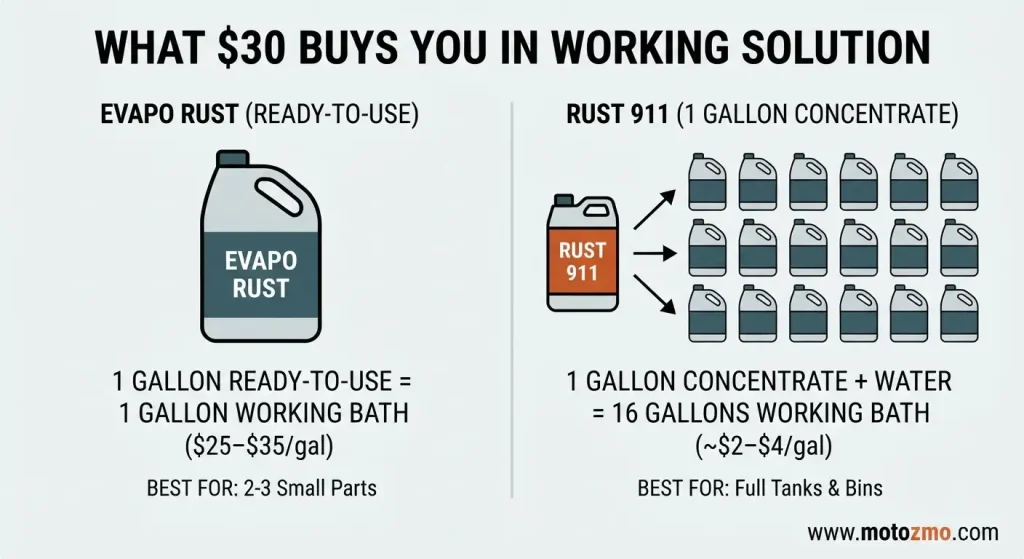
This is the one area where a real, defensible advantage shows up, not because of chemistry, but because of concentration. Since you’re only paying to ship and store the concentrated liquid, Rust 911’s dilution economics work out to a small fraction of the per-gallon cost of a pre-mixed product once you’re filling a gas tank or soaking a whole bin of parts. For a single small part or two, that difference barely registers. For a full restoration project with dozens of components, it adds up fast.
Evapo Rust’s advantage runs the other direction: no mixing, no ratio to get right, no concentrate to store separately from water. For a rider tackling a handful of parts who values grabbing a jug and going, that convenience is worth something too.
Effectiveness: Closer Than a Dramatic Head-to-Head Suggests
Both products handled light surface rust on bolts, brackets, and hardware equally well in testing, generally clearing overnight or faster. On heavier corrosion, like a genuinely rusted clutch basket or a gas tank strap, both needed extended soak times, several days rather than hours, and both got the job done.
Any comparison claiming one pulls dramatically ahead on tough rust deserves some skepticism, given they’re working from the same core chemistry. Real-world results vary by part, by rust severity, and by how fresh the specific batch of solution is, more than by brand. If you see a specific edge reported for one product on a specific part, treat that as one data point rather than a universal rule.
One genuinely useful tip from Rust 911’s own documentation that applies to either product: warming the solution, up to about 160°F for Rust 911 specifically, meaningfully speeds up the reaction if you’re in a hurry or dealing with stubborn corrosion.
Metal Compatibility and the Residue Question
Both products are formulated to be gentle across steel, aluminum, brass, and chrome, and neither should meaningfully attack the base metal during a normal soak.
If parts come out with a slightly darker tint rather than a bright shine, that’s carbon migration, a real effect where carbon naturally present in steel surfaces once the rust layer above it is removed, not leftover chemical residue or a sign either product failed. It wipes off with a cloth or light degreaser.
Reusability
Both solutions are designed to be reused until they’re visibly spent. Evapo Rust is used until the liquid turns dark and stops actively cutting new rust. Independent testing of Rust 911 similarly reports getting three to four full batches out of a mixed solution under normal conditions before it turns dark and needs replacing.
Neither product is a one-and-done purchase, which meaningfully changes the real cost of ownership for either one over multiple projects.
Best Applications for Each
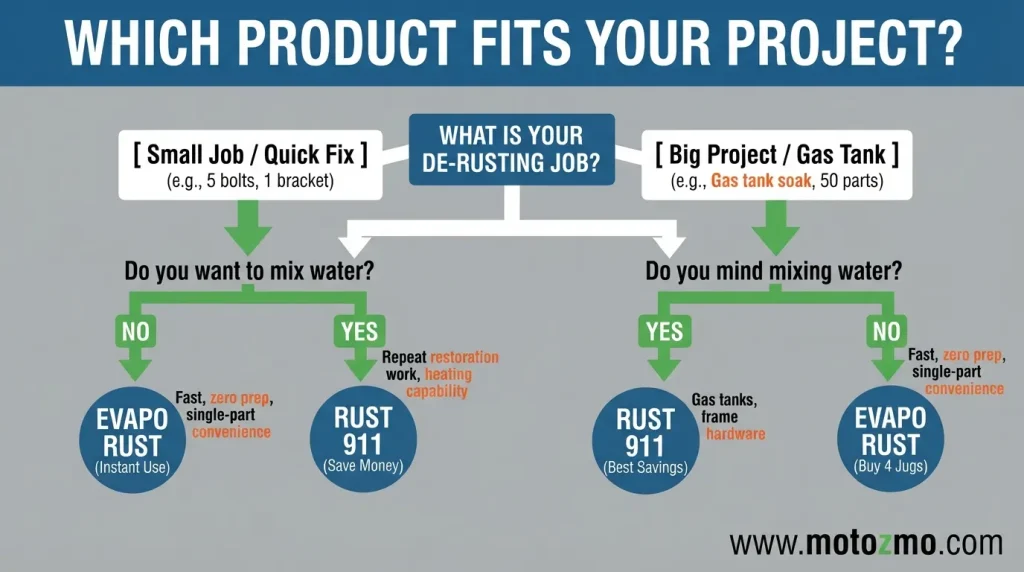
Reach for Evapo Rust when: you’re treating a handful of parts, want zero mixing involved, and value simplicity over squeezing out the lowest possible cost per gallon.
Reach for Rust 911 when: you’re filling a rusted gas tank, soaking a full bin of hardware, or working through tight components like chain links as part of a longer restoration project where the concentrate’s dilution economics genuinely pay off.
Bottom Line
These two aren’t really rivals in the sense of one being chemically superior, they’re the same category of chemistry in two different packages. Evapo Rust wins on convenience for smaller jobs, Rust 911 wins on real, verifiable cost savings once you’re tackling something bigger. If you’re still weighing your options, we’ve also compared Evapo Rust to vinegar, CLR, and Metal Rescue. Whichever you land on, the right anti-corrosion spray is what keeps the rust from coming back once it’s gone.
FAQs
Is Rust 911 chemically stronger than Evapo Rust?
No. Both use chelation chemistry to target rust specifically. The meaningful difference is format, ready-to-use versus a concentrate you dilute, not chemical strength.
Which one is actually cheaper?
It depends on job size. For a small part or two, the difference is minor. For a large job, like a full gas tank or a bin of hardware, Rust 911’s concentrate format works out to a noticeably lower cost per gallon of finished solution.
Can either product damage aluminum or chrome parts?
No, both are formulated to be safe on steel, aluminum, brass, and chrome during normal submerged use.
Why did my parts come out slightly darker after soaking?
That’s carbon migration, a natural result of rust removal exposing more carbon at the metal’s surface. It’s cosmetic and wipes off easily, not a sign either product failed.
Does heating the solution actually help?
Yes. Warmer solution speeds the chemical reaction for either product, which is useful for stubborn rust or when you’re short on time.