
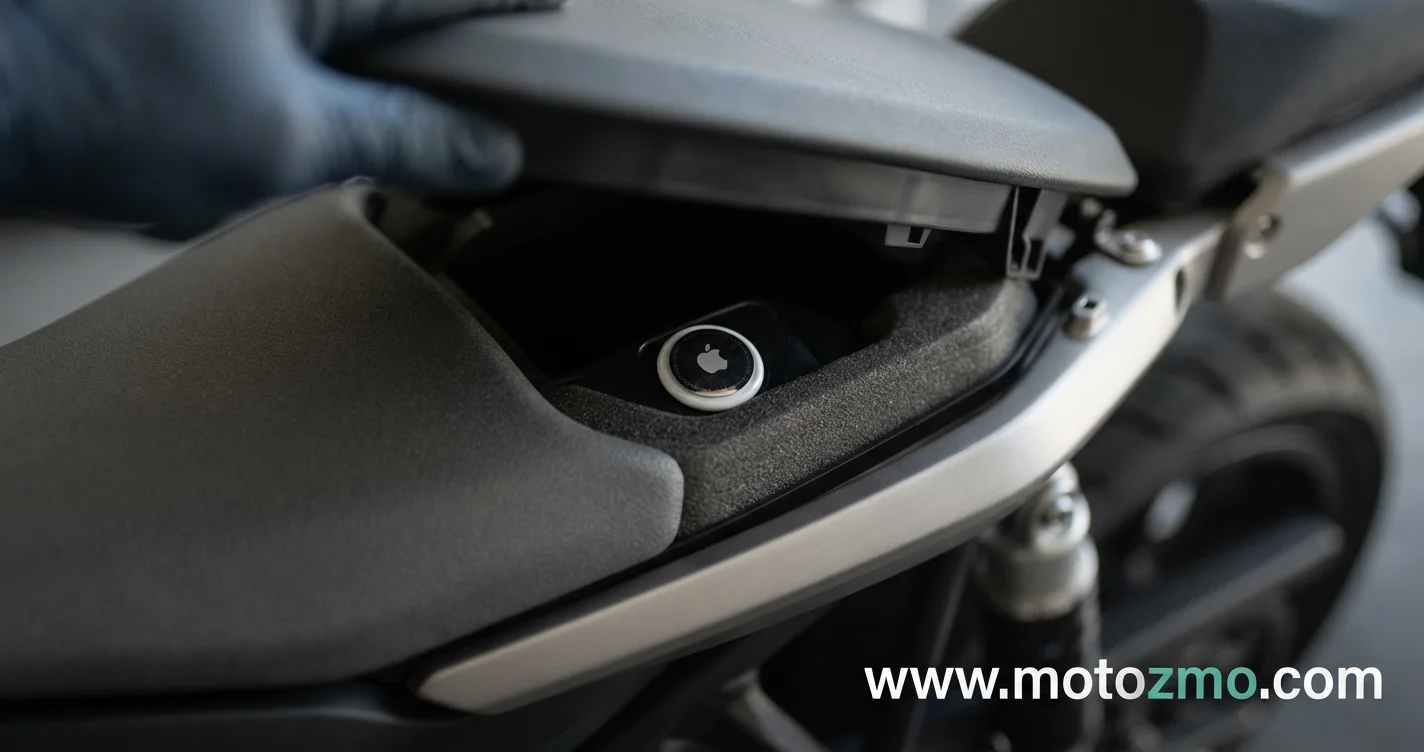
An AirTag can help you recover a stolen motorcycle if you live somewhere with plenty of iPhones around, but it is not a real anti-theft device. There’s no live GPS, no automatic movement alert by default, and it goes completely silent the moment your bike is out of Bluetooth range of other Apple devices.
You should understand it’s full functions before you decide whether a $29 tag has any business protecting a bike worth thousands. Below is how it works, where it realistically helps, where it fails, and whether it’s worth using at all.
Key Takeaways
- An AirTag has no GPS. It relies entirely on nearby iPhones relaying its Bluetooth signal through Apple’s Find My network.
- It works well in dense urban areas with heavy iPhone traffic.
- It goes completely silent in rural areas, closed garages, or anywhere with few nearby Apple devices, with no way to know it’s failing in real time.
- There’s no automatic movement alert by default, and anti-stalking protections can actually tip off a thief to search for and discard it.
- If you use one, hide it deep, such as inside a handlebar tube, airbox, or frame cavity — never on an exterior magnetic mount.
- It’s a cheap backup layer at best, never a replacement for a real lock, alarm, and dedicated GPS tracker.
How an AirTag Works (There’s No GPS Involved)
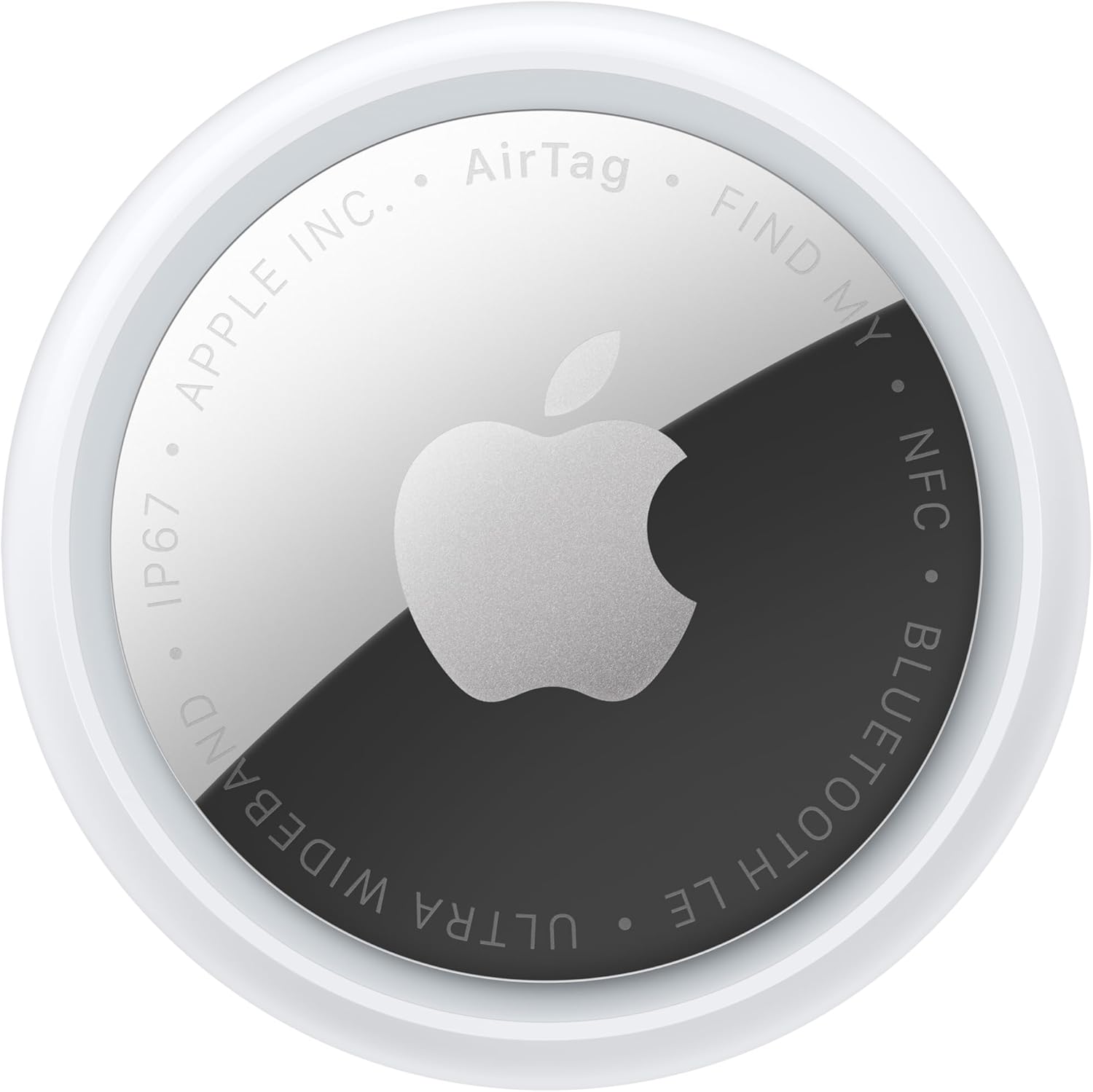
Key Features
- Track anything using Find My app
- A speaker 50% louder than the previous version
- Upgraded Bluetooth chips with enhanced range
An AirTag has no GPS chip, no cellular connection, and no independent way to report its own location. Instead, it broadcasts a low-power Bluetooth signal that any nearby iPhone (belonging to a complete stranger, with no interaction required) anonymously detects and relays to Apple’s servers through the Find My network. Your Find My app then shows you that relayed location.
That’s a fundamentally different mechanism than a real GPS tracker, and it matters enormously for how reliable this is. A dedicated tracker reports its own location directly over a cellular network, on its own schedule, regardless of who happens to be nearby. An AirTag only reports when some other Apple device passes within Bluetooth range. Its reliability depends entirely on the density of iPhones around wherever your bike ends up, not on the AirTag itself.
Where an AirTag Actually Helps
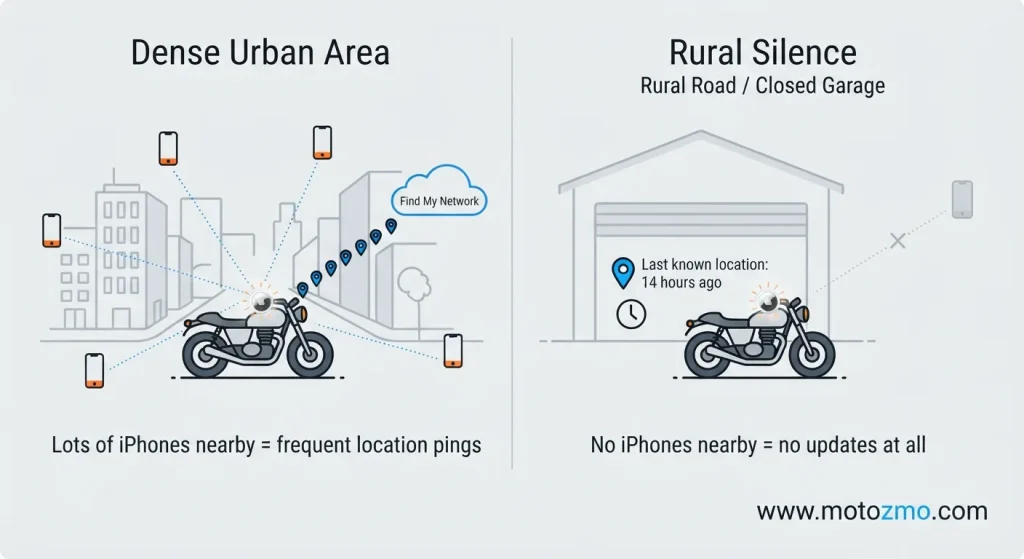
In a dense city with heavy iPhone traffic, this system works better than the mechanism alone might suggest. Enough passing phones means frequent, near-continuous location pings, close to real-time tracking in practice even without true GPS.
There are documented cases to back this up, not just theory. A Renton, Washington rider recovered his stolen motorcycle after an AirTag hidden on the bike relayed its location back to him within the same day it was taken. In the UK, police in Leicestershire followed AirTag pings from under a stolen motorcycle’s seat directly to the thief’s own bedroom, leading to a guilty plea.
These aren’t guaranteed outcomes. Plenty of thefts don’t resolve this cleanly, but these are real, verifiable cases, not marketing anecdotes.
Where It Goes Completely Dark
The same mechanism that makes an AirTag work in a city is exactly what makes it fail elsewhere. Rural areas, closed garages, and the enclosed vans or storage units organized theft rings commonly use as a first stop all share one thing: low or zero iPhone density. No nearby Apple devices means no relay, which means no location update.
The unsettling part is that there’s no way to know in real time that it’s failing. Your Find My app will simply show the last known location, potentially frozen for hours or days, with nothing distinguishing “the bike hasn’t moved” from “the bike is somewhere with no iPhones nearby and the AirTag has no idea where it is now.”
What an AirTag Won’t Do (The Limitations)
An AirTag has no live, continuously updating map. It shows a location at the moment of the last relay, not a real-time position you can watch move. It also has no automatic movement or theft alert out of the box. Without manually setting up a geofence-style notification, you won’t know your bike has moved until you happen to check the app yourself.
The most important nuance, and the one that even competing GPS tracker companies fairly acknowledge: Apple builds in anti-stalking protections specifically to prevent AirTags from being used to secretly track people.
After a period of separation from its owner’s paired device, a nearby iPhone (and, through a cross-platform standard, many recent Android phones too) will surface an “unknown tracker detected” style warning to whoever is carrying it. That’s a good feature for personal safety, and it’s also exactly the kind of notification that can tip off a thief to search for and discard the very device you’re relying on for recovery.
What’s Changed With Newer AirTag Hardware
Apple has continued to iterate on the AirTag since its original release, with reporting pointing to improvements including more responsive tamper-detection alerting, a louder integrated speaker, and a more tamper-resistant battery cover on newer hardware. These are real, incremental improvements to the limitations above, worth factoring in if you’re buying new, though they don’t fundamentally change the core mechanism.
It’s still Bluetooth-and-relay, not GPS, and the anti-stalking alert behavior described above still applies. Confirm current specifics against Apple’s own listing at the time you buy, since this is a product line that keeps changing.
How to Actually Use an AirTag If You Try It
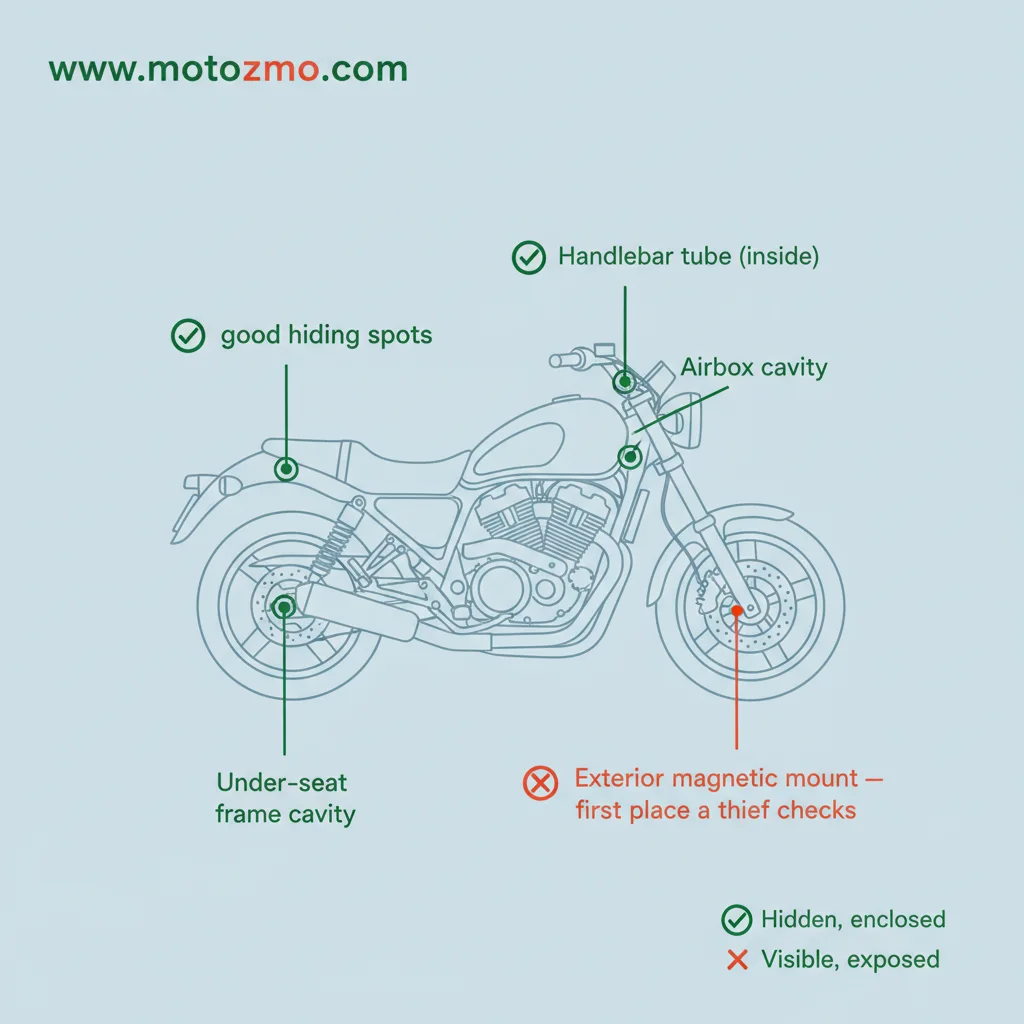
Placement is the single most important decision if you go this route. Hide it deep, inside a handlebar tube, tucked in an airbox, or in a frame cavity, rather than on an exterior magnetic mount, which is the first place any thief checking for trackers will look.
A hidden AirTag under the seat, as in the Leicestershire recovery case above, is much harder to find than one stuck to the outside of the bike with a magnet.
And never treat it as your only layer. Pair it with an actual lock and alarm. An AirTag does nothing to prevent the theft itself, only to potentially assist recovery afterward, and only under the right conditions.
AirTag vs a Real GPS Tracker
The cost comparison is stark on paper: roughly $29 one-time for an AirTag versus $100–200+ for a dedicated GPS tracker plus an ongoing annual or monthly subscription.
But that comparison misses what you’re actually paying for. A real tracker reports its own location on its own schedule over a cellular network. It doesn’t depend on a stranger’s iPhone happening to walk by.
The threshold: if the bike itself represents real money, a dedicated GPS tracker should be the primary recovery tool, with an AirTag treated at most as a cheap, redundant backup layer, never as the primary plan for something you can’t afford to lose.
The Bottom Line
An AirTag is a real, if limited, tool. It’s useful as a cheap supplemental layer in the right conditions, and backed by real recovery cases to prove it. But it is not a substitute for an actual anti-theft plan, and treating a $29 tag as your primary defense for a bike worth real money is a mistake this article is specifically trying to help you avoid. See the full layered approach to motorcycle security for how a real lock, an alarm, and a dedicated GPS tracker all fit together, with an AirTag, if you want one, as the cheap extra layer on top, not the plan itself.
FAQs
Does an AirTag notify me automatically if my motorcycle moves?
Not by default. You need to manually configure a “notify when found” or geofence-style alert in the Find My app. Out of the box, it only shows location when you actively check it.
Can a thief detect and remove an AirTag?
Yes, especially if it’s mounted somewhere visible or if enough time passes for an anti-stalking alert to surface on the thief’s own phone. Hidden, deep placement significantly reduces this risk but doesn’t eliminate it entirely.
Is an AirTag enough theft protection on its own?
No. It provides no deterrent and no prevention whatsoever. It may help with recovery after a theft, and only under the right conditions (dense iPhone traffic, successful concealment). It should never be your only layer of protection.
Where’s the best place to hide one on a motorcycle?
Deep, enclosed spaces a casual search won’t reach, inside a handlebar tube, an airbox, under the seat, or in a frame cavity, rather than anywhere accessible from the outside or attached with a visible magnetic mount.