The hardware on the Cardo PACKTALK EDGE is close to the best you can buy, and the companion app is where that good work comes undone, especially if you ride with an iPhone in your pocket.
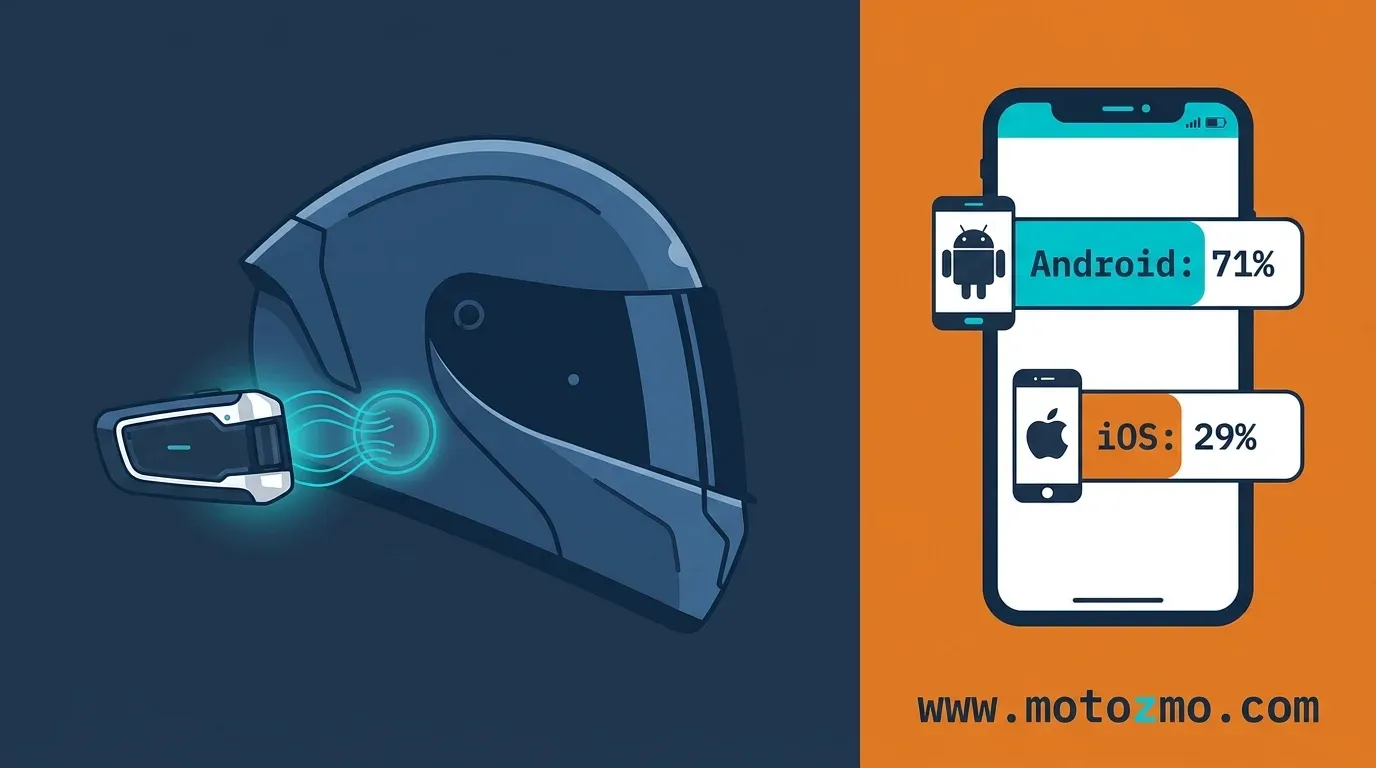
Owner data on the Cardo Connect app puts it at roughly 71 percent positive feedback on Android and only 29 percent positive on iOS, a real, measurable gap that no spec sheet mentions.
This review covers what that gap looks like in practice, the wind-noise habit several long-term owners report, and the buying decision most people skip: whether you actually need the Edge or if Cardo’s own cheaper Spirit HD covers what you ride for.
For where the Edge sits against the rest of the field, our complete buyer’s guide to motorcycle Bluetooth communication systems covers the wider comparison.
What You Get and What It Costs
The PACKTALK EDGE ships as a single unit or a duo pack, built around JBL-tuned speakers, a magnetic Air Mount, three glove-friendly buttons, a roller wheel, and voice control that recognizes 25 spoken commands.
List price sits around $439 for a single unit, though it’s commonly found between $380 and $440 depending on the retailer. Check current price and stock on Amazon.

Key Features
- Magnetic Air Mount: Snaps onto helmets instantly for effortless multi-helmet swaps
- 15-Rider Dynamic Mesh: Self-healing network connects groups seamlessly over distance
- JBL Audio & Voice Control: Clear highway sound with 25 hands-free commands
- IP67 Waterproof Rating: Full weather-sealing for dependable riding in heavy rain
Where the Edge Earns Its Price
The Air Mount is the feature owners bring up first, and for good reason: bring the unit near the cradle and it clicks into place, so switching it between a full-face helmet and an open-face lid takes seconds once you own a second mount kit.
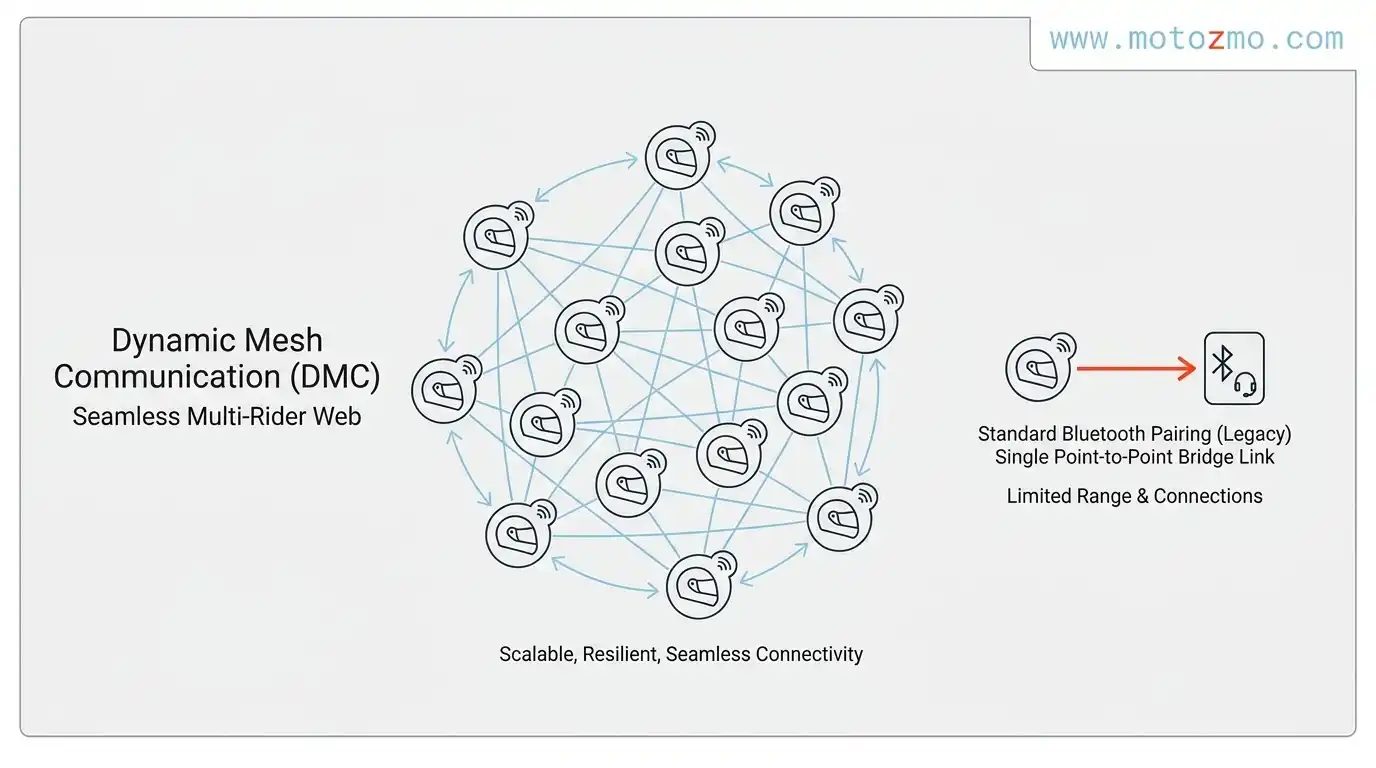
JBL’s speakers push loud, detailed sound at highway speed, and the mesh network, Dynamic Mesh Communication, connects up to 15 riders and reroutes around anyone who drops signal.
Cardo’s technical rundown confirms what owners already notice in practice: the Edge stays backward compatible with the rest of the Packtalk line and older Cardo Bluetooth units, and it can bridge non-Cardo headsets through a basic Bluetooth pairing when mesh isn’t an option.
The App Is Where Things Go Wrong, Especially on iPhone
Here’s the part almost no review digs into: the Cardo Connect app, the one you need to update firmware, adjust settings, and pair some features, gets rated well on Android and poorly on iOS.
Data on real app store feedback puts positive sentiment at 71 percent for Android users against 29 percent for iOS users, and the complaints line up with what shows up in owner reviews: the app failing to recognize a headset that’s already connected over Bluetooth, sync issues that clear up only after a restart, and firmware updates that occasionally introduce new bugs instead of fixing old ones.
The good news: once you’re paired and the firmware is current, most owners report the unit runs fine without touching the app again for months. The bad news: getting to that point on an iPhone takes more patience than it should for a product costs around $400.
One iPhone-specific quirk worth knowing before it confuses you on a ride: background music can drop to a near-silent volume the moment a mesh connection opens, even with nobody talking.
Owners who’ve hit this point to a setting buried in the app, a background music level slider, that needs to be raised manually to fix it.
The Wind-Noise Habit
Several long-term owners, including a group of three riders on the same forum thread, report the microphone picking up wind noise and passing it to the rest of the group every couple of seconds at speed, not constant, just frequent enough to notice.
Other owners on the same thread report never running into it at all, so this isn’t universal, it’s inconsistent enough to depend on your helmet, your riding position, and possibly your specific unit.
The fix riders settle on is the same one Cardo suggests: mute the mic manually when wind noise gets bad rather than trying to talk over it.
If hearing protection matters to you as much as call quality does, our guide to motorcycle earplugs covers options that still let intercom audio through.
PACKTALK EDGE or Spirit HD? Settle This Before You Buy
Both wear the Cardo name, and that leads some buyers to assume the cheaper Spirit HD is just a stripped-down Edge. It’s closer to a different product built for a different rider.
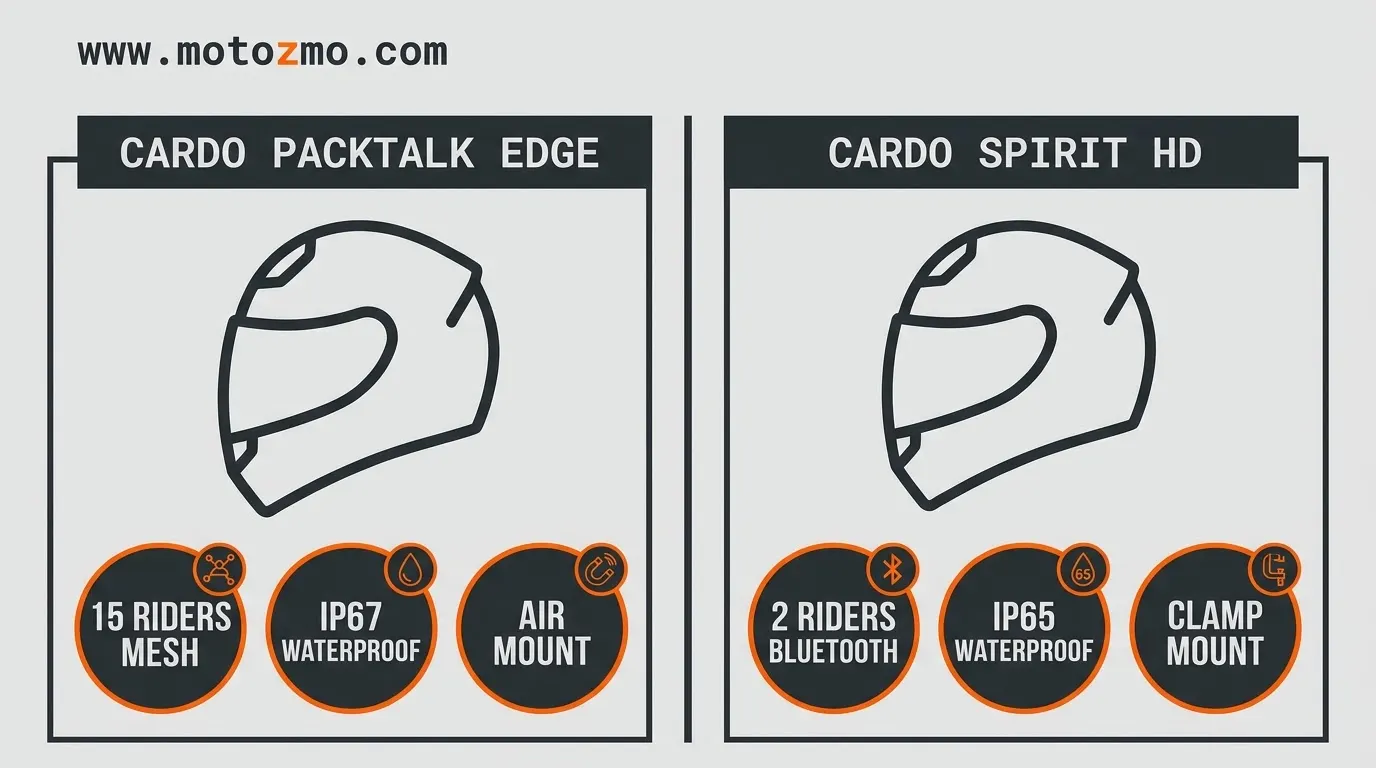
- Connection: the Edge runs Dynamic Mesh Communication, connecting up to 15 riders who can all talk and hear each other at once. The Spirit HD connects exactly two riders over standard Bluetooth, full stop, no mesh, no group.
- Waterproofing: the Edge carries an IP67 rating. The Spirit HD is rated IP65, a real number too, just a step below.
- Mount: the Edge’s magnetic Air Mount swaps between helmets in seconds with a second mount kit. The Spirit HD uses a more standard clamp mount.
- Price: the Spirit HD runs less than half the Edge’s typical price.
If you ride with three or more people on a regular basis, the Edge is the one built for that. If you mainly ride with one other person and don’t need mesh, the Spirit HD gets you most of the sound quality for a lot less money, and skips the app headaches that come with a device this feature-heavy.
Who Should Buy the Cardo PACKTALK EDGE
Buy it if you ride with a group of three or more regularly, you’re on Android or don’t mind occasional app friction on iPhone, and the Air Mount’s quick-swap convenience matters to how you ride, moving between two helmets, for instance.
It’s also the stronger pick if a published IP67 rating is a hard requirement for how often you ride in the rain.
Skip it if your riding group already runs Sena mesh, since the two won’t connect in full mesh mode; our Cardo vs Sena comparison walks through that decision directly.
Skip it too if you’re not sure you need a communication system at all, or if you mostly ride with one steady partner and would rather save $250 with the Spirit HD, or look at our budget motorcycle intercom picks if even that feels like more than you want to spend.
And if a comm system isn’t solving a real problem for you yet, our guide on whether you need one is worth five minutes first.
Spec Snapshot
| Spec | Cardo PACKTALK EDGE |
|---|---|
| Connection | Dynamic Mesh Communication + Bluetooth |
| Max mesh group | 15 riders |
| Rider-to-rider range | ~1 mile (open terrain) |
| Waterproof rating | IP67 |
| Battery life | ~13 hours |
| Price (single) | Around $380–440 |
FAQs
Why does my music go quiet when I connect to a mesh group on the Edge?
This is a known quirk, more common on iPhone. Open the Cardo Connect app, find the background music volume setting, and drag it back up. It resets to a low default when a new mesh connection opens.
Does the PACKTALK EDGE work with older Cardo headsets?
Yes. The Edge stays backward compatible with the rest of the Packtalk lineup and older Cardo Bluetooth-only units, so you don’t need to replace an entire group’s gear at once to add one Edge to the mix.