
Top Picks For You
Alpine MotoSafe Pro
Designed specifically for riders who want one versatile set. The dual filters let you easily switch between casual cruising and high-speed highway runs without losing critical traffic awareness.
Check Price
Decibullz Custom Molded
The ultimate pick for total silence and maximum noise reduction. Its custom-molded shape locks out high-decibel wind roar on long touring days or unfaired naked bikes.
Check Price
Vibes High-Fidelity Earplugs
Engineered specifically for riders using Bluetooth comms or helmet speakers. It drops dangerous wind roar while keeping voice calls, music, and GPS prompts clear and natural.
Check Price
EarPeace Moto Pro V2
The most comfortable option under tight full-face and track helmets. It eliminates hotspots and ear fatigue over long journeys while maintaining full environmental awareness.
Check Price
Mack’s Ultra Soft Foam Earplugs
Unbeatable raw noise protection at a fraction of the cost. Ideal for long, high-speed highway stretches when pure isolation and budget value matter more than intercom clarity.
Check Price
The best motorcycle earplugs for hearing protection cut wind roar down to a safe level while still letting through the sounds that keep you alive out there: horns, sirens, engine notes, an intercom.
That’s a harder balance than it sounds. Block too little and you’re doing nothing for your ears on a two-hour highway stretch. Block too much and you’ve traded hearing damage for reduced awareness, which isn’t really a trade at all.
I’ve tested a dozen-plus pairs over the years, on city commutes, mountain twisties, and full-day highway runs, after one too many rides that left my ears ringing for hours afterward. Some muffled everything into mush. A few actually changed how I ride. This guide covers the ones worth your money.
If you’re still deciding whether earplugs are worth the hassle at all, here’s the full case for wearing them, the short version is that wind noise alone at highway speed is loud enough to cause real, permanent damage well before you’d expect.
What Actually Matters Before You Buy
NRR vs. SNR (same idea, different scale)
NRR (Noise Reduction Rating) is the U.S. standard; SNR (Single Number Rating) is the European equivalent, and it usually reads 2 to 3 dB higher than NRR would for the same physical plug. Don’t compare a 30 dB SNR plug against a 30 dB NRR plug and assume they block the same amount of noise. They don’t, quite.
Neither number tells the whole story anyway. Lab ratings assume a perfect seal, and most riders don’t get one on the first try. Real-world attenuation usually lands somewhat below the number on the package.
Foam, silicone, or filtered
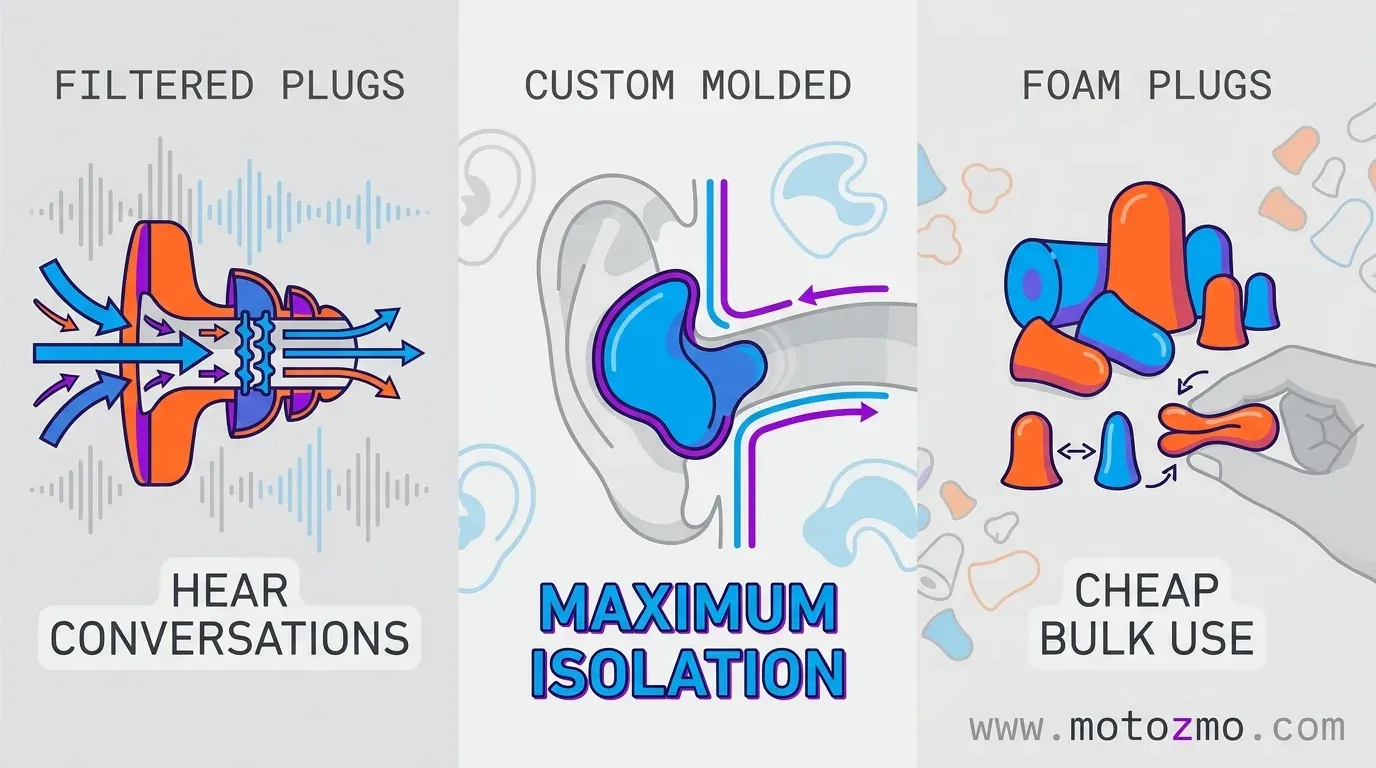
Foam blocks the most sound for the least money but muffles everything equally, engine, wind, horn, GPS voice, all at once. Filtered plugs use a small acoustic channel to cut wind roar selectively while letting speech and mid-range sounds through more naturally, which matters if you run an intercom or just want to still hear traffic. Custom-molded plugs split the difference: foam-level protection, but shaped to your specific ear canal instead of a generic size.
There’s no universally correct choice here. It’s genuinely about what you’re doing on the bike.
Test the fit with your actual helmet on
A plug that sits comfortably on its own can turn into a pressure point the second you clamp a helmet down over it. Insert whatever you’re considering, then put your helmet on and move your jaw around like you’re talking. If you feel a hot spot within a minute, you’ll feel it a lot more three hours into a ride.
Foam is disposable, everything else needs cleaning
Foam plugs are single-use, full stop. Silicone and filtered plugs should get a wipe with warm soapy water on a regular basis and a full replacement every few months once the material starts feeling less pliable. An earplug that’s lost its shape doesn’t seal properly no matter what its rating says.
Best Overall: Alpine MotoSafe Pro
SNR 30 dB · Reusable · Swappable Tour and Race filters
Key Features
- Dual-Filter System: Includes interchangeable Tour (medium protection) and Race (high protection) acoustic filters
- ThermoShape Material: Softens with ear canal body heat to eliminate pressure points under tight helmet shells
- Frequency Selective: Cuts damaging high-frequency wind shear while keeping intercom and engine notes crisp
- Minigrip Removal Stem: Flexible stem designed for easy removal, even with gloved hands
This is the pair I reach for on most rides, and it’s the one I’d tell a friend to buy first if they only wanted one set. The Tour and Race filters swap in and out depending on how much sound you actually want let through, so the same pair works for a relaxed weekend ride and a genuinely loud highway stretch without buying two products.
The ThermoShape material softens slightly with body heat and molds into a flush fit under nearly any helmet, which matters more than it sounds like it should when you’re eight hours into a trip. You still hear your engine and your GPS clearly with either filter in, just without the wind roar drowning everything else out.
The filters themselves take a little practice to seat correctly the first few times, and if total silence is what you’re after, this isn’t the plug for that. It’s built for balance, not maximum isolation.
Highest Noise Blocking: Decibullz Custom Molded
NRR 31 dB · Heat-moldable · Washable and reusable
Key Features
- DIY Thermo-Fit: Easily moldable at home using warm water for a true custom audiologist-style fit
- Solid NRR 31 Isolation: Provides near-maximum physical sound blockage for extreme wind-noise protection
- Triple-Flange Silicone Tips: Combines a custom outer ear mold with deep-canal sealing tips
If total quiet is genuinely the goal, this is the pair that gets you there. You heat the tips briefly, press them into your own ears, and they set into a shape that’s yours specifically, not a generic small-medium-large guess. Once molded, the seal rivals what you’d get from an audiologist-fitted plug, at a fraction of the cost.
That custom fit is what makes the highest NRR number in this roundup actually mean something in practice rather than just on paper. For long touring days or anything approaching race-bike wind noise, this is the pair I’d trust the most.
The molding process takes a few careful minutes to get right the first time, and once it’s done, you’ve essentially locked in that fit. For some riders that near-total isolation is more than they want day to day. If you like hearing a little of the world around you, look elsewhere on this list.
Best for Intercom Use: Vibes High-Fidelity Earplugs
NRR ~22 dB · Reusable, filtered · Multiple tip sizes included
Key Features
- Acoustic Sound Filters: Lowers overall decibels equally across frequencies without muffling audio clarity
- Low-Profile Clear Stem: Virtually invisible and won’t snag or push against helmet speaker cutouts
- Multi-Size Fit Pack: Includes small, medium, and large interchangeable silicone ear tips in the box
If you’re running a Bluetooth intercom or listening to music through your helmet speakers, this is the pair built around keeping that audio clear rather than just cutting volume across the board. The filtered design lowers harmful wind frequencies while leaving speech and mid-range tones largely intact, so a phone call or a riding buddy’s voice through your intercom doesn’t come through as mush.
The lower profile stem is a real advantage if you’re also running helmet speakers or any kind of communication setup, since bulkier plugs can interfere with speaker placement inside a tight-fitting helmet.
The silicone tips shift slightly over a long ride, and this isn’t the plug for maximum isolation on an unfaired bike at highway speed. It’s built for clarity first, protection second, and it delivers exactly that.
Best Helmet Comfort: EarPeace Moto Pro V2
NRR ~26 dB · Interchangeable filters · Aluminum keychain case
Key Features
- Zero-Pressure Profile: Ultra-slim contour sits completely flush inside the ear canal to prevent helmet bite
- Precision Mesh Filters: Tuned acoustic membrane provides balanced noise reduction without audio distortion
- Medical-Grade Silicone: Hypoallergenic material prevents ear canal itching during extended all-day rides
Designed specifically for motorcyclists rather than adapted from a general hearing-protection line, this one’s whole pitch is fitting under a helmet without you noticing it’s there. The ultra-slim profile avoids the pressure points that thicker plugs create once a snug helmet clamps down, and the filtering strikes a genuinely balanced middle ground between blocking wind and staying aware of what’s around you.
The included aluminum case clips onto a keyring, which sounds minor until you’re the rider who’s actually got their plugs on them instead of sitting in a drawer at home.
It costs more than a basic pair, and getting the filter seated correctly takes a bit more care on insertion than a simple foam plug does. Worth it if helmet comfort over a long ride is your main priority.
Best Budget: Mack’s Ultra Soft Foam Earplugs
NRR 33 dB · Disposable foam · 50 pairs per pack
Key Features
- Highest Raw Protection: Delivers a maximum NRR 33 dB rating to tackle extreme wind noise
- Comfy Foam Formulation: Low-pressure, slow-release polyurethane foam expands gently inside sensitive canals
- Bulk Value Pack: 50-pair tub lets you scatter fresh pairs across jackets, tank bags, and panniers
Sometimes you just want maximum protection at the lowest possible price, and this is that pair. The NRR here is the highest in this entire roundup, and the soft foam is genuinely comfortable for long stretches, not the stiff, itchy kind that has you fidgeting an hour into a ride.
Fifty pairs means you can keep a stash in your jacket pocket, your saddlebag, and your tank bag and never be caught without a pair. They’re also the obvious backup to whatever nicer pair you’re actually running day to day.
They muffle everything indiscriminately, music, intercom, conversation, right along with the wind. If situational clarity matters to you, these aren’t the answer. If pure protection at the lowest price is what you want, nothing else here beats them.
The Real Noise Numbers (and Why “It’s Just Wind” Is Wrong)
Wind noise at highway speed is the actual threat here, more than your engine most of the time. Harley-Davidson’s own testing found wind noise reaching roughly 98 dB at 60 mph, with permanent hearing damage possible in about eight minutes at that level, and closer to four minutes by 70 mph. That’s a lot faster than most riders assume.
For context on what’s actually safe, OSHA’s workplace noise standard sets 90 dBA as the permissible limit over an 8-hour day, with a stricter 85 dBA “action level” where hearing protection becomes necessary at all. Highway wind noise blows past both thresholds almost immediately once you’re moving.
One thing worth being clear about: earplugs don’t need to eliminate sound to do their job, just bring it down under those thresholds. A well-fitted pair with a 20 to 30 dB rating typically gets highway wind noise into a range you can ride in all day without doing damage, while still leaving you enough awareness to hear a horn or a siren.
Does Wearing Earplugs Make You Less Aware on the Road?
This is the concern I hear most from riders who’ve never tried them, and it’s backwards. Constant wind roar inside a helmet actually masks a lot of what you need to hear, sirens, horns, another vehicle’s engine. Cutting that roar with a good filtered plug often makes those specific sounds easier to pick out, not harder, because your ears aren’t already maxed out fighting the wind.
Foam plugs are a different story since they cut everything more or less equally. If total situational awareness through your ears matters to you specifically, a filtered pair is the better call.
Bottom Line
Motorcycle hearing protection isn’t optional if you’re riding real miles, and the right pair depends entirely on what you’re doing on the bike. Want one pair that adjusts to the ride? Alpine MotoSafe Pro. Riding hard and want the quietest possible helmet? Decibullz. Running an intercom and need to stay clear on calls? Vibes. Tight helmet and long days? EarPeace. Just want cheap, effective backup protection? Mack’s foam. Any of these beats riding without protection at all.
FAQs
What are the best earplugs for motorcycle riding?
It depends on what you need most. The Alpine MotoSafe Pro is the strongest all-around pick, Decibullz wins for maximum isolation, and Vibes is the better choice if you run an intercom or music.
Are filtered earplugs better for motorcycling than foam?
For most riders, yes. Filtered plugs cut harmful wind noise while preserving speech and important road sounds. Foam blocks more overall but muffles everything equally, including your intercom or GPS.
Is it legal to wear earplugs while riding a motorcycle?
There’s no federal ban, but a handful of states have older laws written around blocking both ears with a “headset.” Check your specific state’s vehicle code before riding with plugs regularly.
How do I know earplugs will fit under my helmet?
Insert them, put your helmet on, and move your jaw around for a minute before committing. A pressure point that shows up early only gets worse over a long ride. Low-profile plugs like EarPeace or Vibes generally fit tighter helmets better than bulkier foam.