
Top Picks For You
Kuryakyn Road Thunder
Built explicitly to cut through highway wind with high-volume output, making it the top pick for long-distance turnpike riders needing maximum clarity at speed.
Check Price
Kicker PSMB32
Ideal for audiophiles seeking crystal-clear mids without bulky amps, offering low-distortion clarity for cruisers who prioritize vocal and instrument definition over heavy bass.
Check Price
JBL Wind 3
Perfect for commuters wanting off-bike versatility, combining quick-release docking with standalone digital playback so you never lose music when cell service drops.
Check Price
Boss Audio MCBK520B
An all-in-one audio solution for stripped-down bikes, delivering complete multimedia connectivity and multi-input freedom straight out of the box without complex custom wiring.
Check Price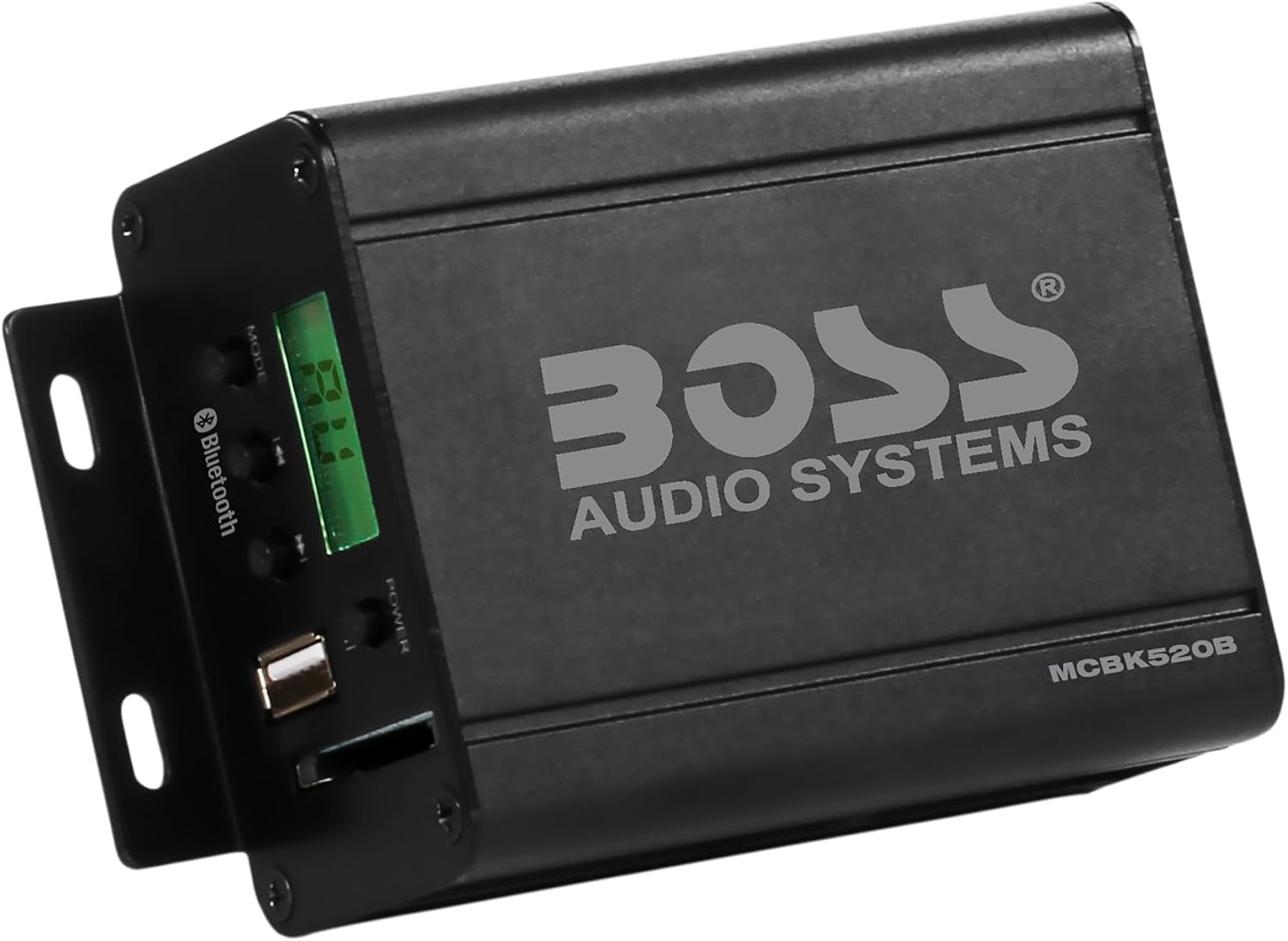
GoHawk TN4-Q
Great for multi-weather commuting on tight budgets, delivering a quad-speaker layout with real particulate protection for wet, dusty off-highway backroad adventures.
Check Price
The best motorcycle handlebar speakers for most riders are Kuryakyn’s Road Thunder sound bar, which is built specifically to stay audible at highway speed rather than just around town.
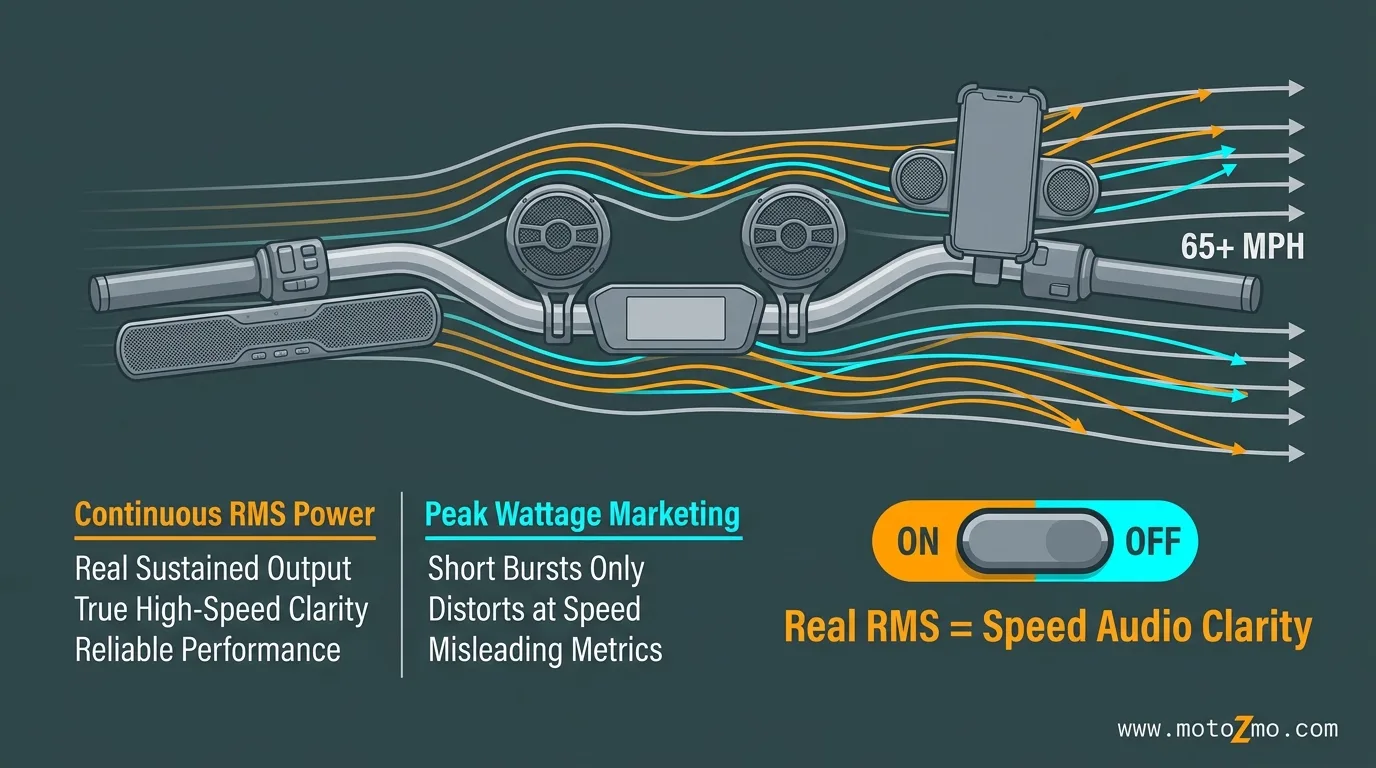
That’s the real problem this whole category exists to solve: plenty of handlebar speakers sound fine sitting on a workbench and turn to mush the moment wind and engine noise hit 50 mph. The spec that actually predicts this, real RMS power output, gets buried under inflated “peak” wattage numbers on almost every listing, which is worth understanding before you buy any of these.
Here’s what to look for, and five picks that cover the real tradeoffs: highway power, portability, all-in-one convenience, and weatherproofing on a budget.
Which Rider Are You?
| Your situation | Best pick |
|---|---|
| Ride highway speeds regularly and need volume that actually cuts through | Kuryakyn Road Thunder |
| Want clean, accurate sound and don’t need to blast it at 80 mph | Kicker PSMB32 |
| Want to pop the speaker off and take it with you at the end of the ride | JBL Wind 3 |
| Bike has no stereo and you want one box that does everything | Boss Audio MCBK520B |
| Want real weatherproofing without paying a premium for it | GoHawk TN4-Q |
Watts, RMS, and IP Ratings: Ahat the Listing Doesn’t Tell You
Nearly every speaker in this category is marketed with a big wattage number, and nearly all of those numbers are “peak” or “max” power, a rating that has little to do with how loud the speaker can run continuously without distorting.
RMS power is the number that actually matters, and it’s often a fraction of what’s printed on the box; a speaker marketed at “1,000W” might deliver closer to 25 watts per channel of real, continuous output. That doesn’t necessarily make it a bad speaker, but it does mean two “1,000W” speakers can sound wildly different at highway speed, so treat the headline wattage as marketing and look for the RMS figure specifically if you can find it.
IP ratings matter almost as much. It’s a two-digit code: the first digit covers dust resistance (0–6), the second covers water resistance (up to 9). An “X” means that part wasn’t tested at all, so “IPX7” is water-rated with no dust claim either way.
A speaker that’s going to live on your handlebars through rain and road grime deserves a real IP rating rather than a listing that just says “weatherproof” with no number behind it.
The 5 Best Motorcycle Handlebar Speakers
Kuryakyn Road Thunder — Best for Highway Speed
Key Features
- Dual full-range drivers with four silk dome tweeters
- Heavy-duty 4-channel internal power amplifier
- Wide-compatibility mounting bracket (7/8” to 1.5”)
- Auxiliary pass-through input/output connectivity
This is the pick built around solving the actual highway-noise problem: a 4-channel amplifier driving two boosters and four tweeters, rated IP66 for real dust and water protection, with universal mounting clamps that fit 7/8″ to 1½” bars.
It’s Bluetooth 4.1 with AUX in and out, and RevZilla’s testing notes it’s genuinely one of the louder, clearer-sounding options in this category at speed rather than just in a quiet garage.
The tradeoffs are size (it’s a wide bar across your handlebars) and price, this is a premium pick, not a budget one.
Kicker PSMB32 — Best Sound Quality
Key Features
- High power-efficiency driver structure
- Direct phone-to-speaker Bluetooth playback capability
- Low total harmonic distortion at high outputs
- Fits non-standard bar diameters easily
Kicker’s 3-inch pods are rated 50 watts RMS (100 peak, an honest, not wildly inflated spread compared to some competitors), and they’re efficient enough to sound clean and distortion-free even running off a phone’s Bluetooth output with no separate amp. The clamps fit almost any bar diameter.
What you give up: there’s no official IP rating despite a water-resistant build, and 3-inch drivers aren’t going to deliver real bass, this is a clarity-first pick, not a bass-first one.
JBL Wind 3 — Best for Portability
Key Features
- Quick-snap quick-detach handlebar bracket
- Integrated LED screen for station tracking
- Built-in microphone for hands-free calling
- Onboard Sport/Bass outdoor equalizer presets
The Wind 3 is built to dock and undock quickly, so you can pull it off the bars and bring it with you, useful for anyone who stops somewhere they’d rather not leave a speaker mounted. It adds FM radio and microSD support alongside Bluetooth, which matters more than it sounds like it should if your phone ever dies or loses signal mid-ride.
It’s IP67 rated and has genuinely good sound for its size, though it won’t out-muscle a dedicated sound bar like the Road Thunder at full highway speed, and some owners report the mounting hardware feeling less sturdy than the speaker itself.
Boss Audio MCBK520B — Best All-In-One Kit for a Bike with no Stereo
Key Features
- Wireless keychain remote control included
- Direct USB media file drive support
- Multi-pod expanding installation capability
If your bike doesn’t already have a stereo to plug into, this is the simplest fix: a pair of 3-inch pods plus a built-in amplifier with Bluetooth, an FM transmitter, a 3.5mm jack, and USB/SD playback, all in one kit with a keychain remote.
Worth knowing upfront: the “600W” figure on the box is inflated marketing, not a real output spec, though the amp is genuinely loud enough for casual riding. Like the Kicker, it has no official IP rating, and bass is limited by the small driver size.
GoHawk TN4-Q — Best Weatherproofing on a Budget
Key Features
- Expanded 4-pod multi-angle audio coverage
- Larger 4-inch speaker cone housing
- IP56 dust and water jet protection
The TN4-Q’s real selling point is an IP56 rating, genuine dust and water sealing that’s rare to find at this price point in this category. You get four 4-inch pods, a built-in amp, Bluetooth, and USB/SD/3.5mm inputs with all the mounting hardware included.
The caveat: the “1,000W” marketing claim works out to roughly 25 watts per channel in real output, so volume and bass are modest rather than highway-conquering, and the amplifier itself isn’t sealed the way the speakers are.
For a quieter bike or lower-speed riding, it’s a genuinely good value; for sustained highway volume, look at the Road Thunder instead.
Handlebar Speakers vs Helmet Bluetooth Systems
These solve different problems, and it’s worth being clear about which one you actually need before you buy either.
Handlebar speakers play from the bike itself, audible to a passenger or anyone riding next to you, and they don’t require anything in your helmet. Helmet-mounted Bluetooth communication systems (Sena, Cardo, and similar) pipe audio directly into speakers built into your helmet’s liner, private to you, generally clearer at speed since the sound source is inches from your ears instead of fighting wind the whole way there, and they add rider-to-rider intercom, which handlebar speakers can’t do at all.
If you ride solo and mostly want music playing, a handlebar speaker is the simpler, cheaper answer. If you ride with a group and want to talk to each other, or you want the clearest possible audio at real highway speed, a helmet communication system is the better tool for that job, even though it costs more and means wiring something into your helmet.
One Tradeoff Worth Thinking About: Situational Awareness
Music playing loud enough to beat wind and engine noise is also loud enough to compete with a horn, a siren, or the sound of your own engine telling you something’s wrong. This isn’t a reason to skip music on a bike, plenty of riders do it safely, but it’s worth being deliberate about volume in traffic and unfamiliar roads specifically, rather than just turning it up until you can hear it over the wind.
If you already wear earplugs to protect your hearing on longer rides, know that stacking loud handlebar speakers on top of earplugs changes that calculation again, you’re deliberately raising volume to compete with hearing protection that’s specifically designed to lower it.
Before You Buy: Measure Your Bars
Handlebar diameter varies more than people expect, and a clamp that’s rated for one range won’t necessarily fit a bike outside it. Measuring your handlebar diameter before you order saves the hassle of returning a speaker that showed up and simply didn’t clamp on.