
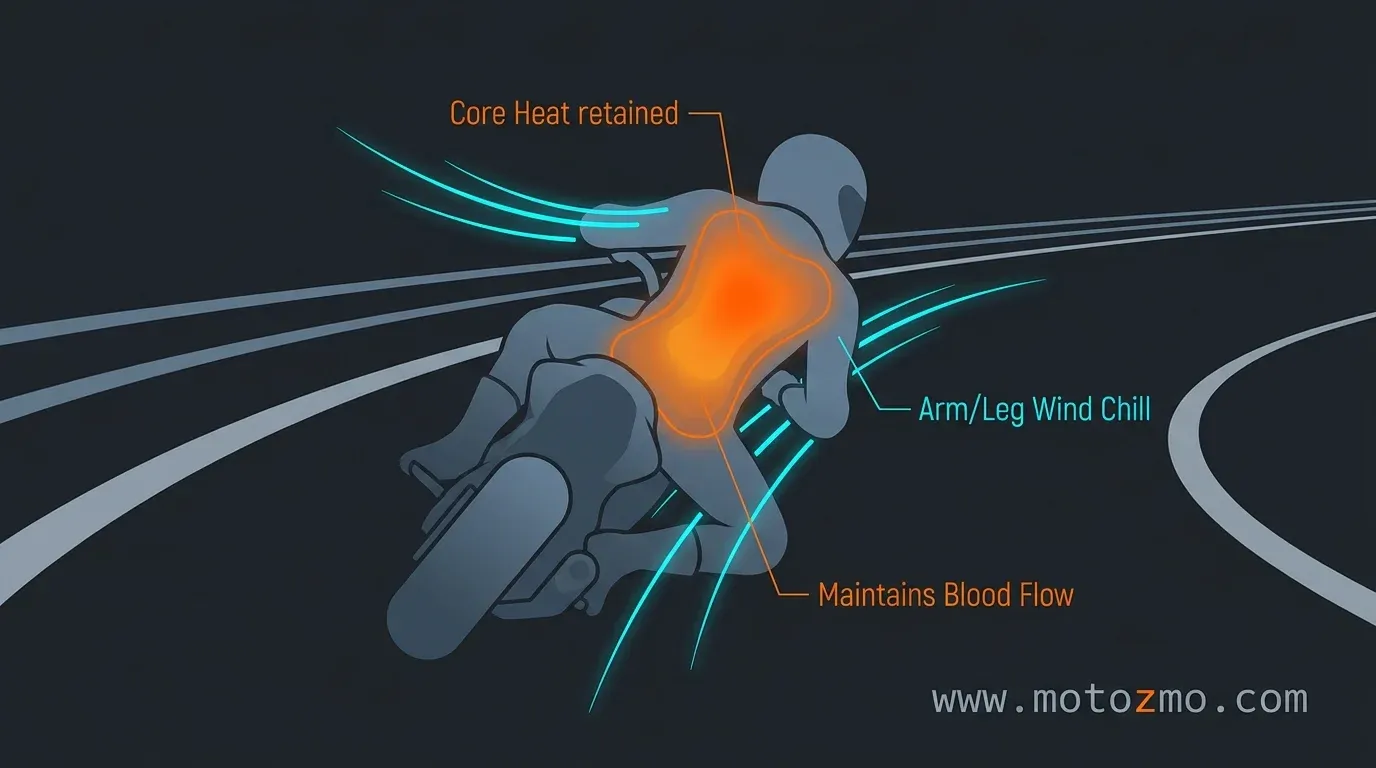
A heated vest is worth it if you ride through real cold on a regular basis and your current jacket still leaves your core cold. For occasional short rides in mild weather, it usually isn’t.
That’s the answer, and it depends on how you ride, not on how good the vest looks in a review. A $150 to $250 vest that sits in a drawer from November to March is a poor buy, no matter how well it heats.
This guide walks through the real signs you’ll use one, the signs you won’t, what a vest fixes and what it leaves alone, and what it costs once you add the battery or wiring. For the full lineup of heated gear beyond just vests, see our heated motorcycle gear guide.
The Answer: It Depends on Three Things
Three things decide whether a heated vest earns its keep:
- How often and how long you ride in the cold
- How cold those rides get
- Whether your current jacket already solves the problem
Get honest about all three before you spend $150 or more.
Riding frequency matters because a vest pays off across many cold rides, not one or two. Ride twice a month in winter, and the discomfort ends the moment you park the bike. Commute five days a week from October through March, and that discomfort compounds every day.
Temperature matters because a vest fixes a real problem in real cold but adds little in mild weather. Below roughly 45°F (7°C), wind chill at highway speed turns a jacket that felt fine standing still into one that leaves your core cold within twenty minutes. Above that range, a good non-heated jacket usually does the job on its own.
Your current gear matters because a heated vest fixes a gap. It doesn’t replace a jacket that already works. If you’re already warm in your current setup, a vest adds bulk and cost without adding comfort.
Signs a Heated Vest Is Worth It for You
- You ride at least once a week through fall and winter, not just on the occasional sunny day.
- Your commute or regular ride runs 30 minutes or longer.
- Wind chill at highway speed leaves your core cold even in your warmest non-heated jacket.
- You’ve cut a ride short before because your torso got too cold to focus on the road.
- You already have, or plan to buy, a jacket snug enough to layer a vest underneath.
Signs You Can Skip It
You can skip buying the heated vest when:
- You ride only a handful of times each winter, and one cold ride doesn’t bother you.
- Rides run under 20 minutes, so the cold never has time to set in.
- Winters rarely dip below the mid-40s°F, and a good jacket keeps you warm already.
- Your current jacket already handles the cold — test a ride in your existing gear before you assume it doesn’t.
- You’re not ready to also budget for a battery pack or wiring harness, since the vest alone won’t run itself.
What a Heated Vest Fixes, and What It Doesn’t
A heated vest warms your chest, back, and sometimes your collar. That’s it. It does nothing for your arms, hands, or feet on its own.
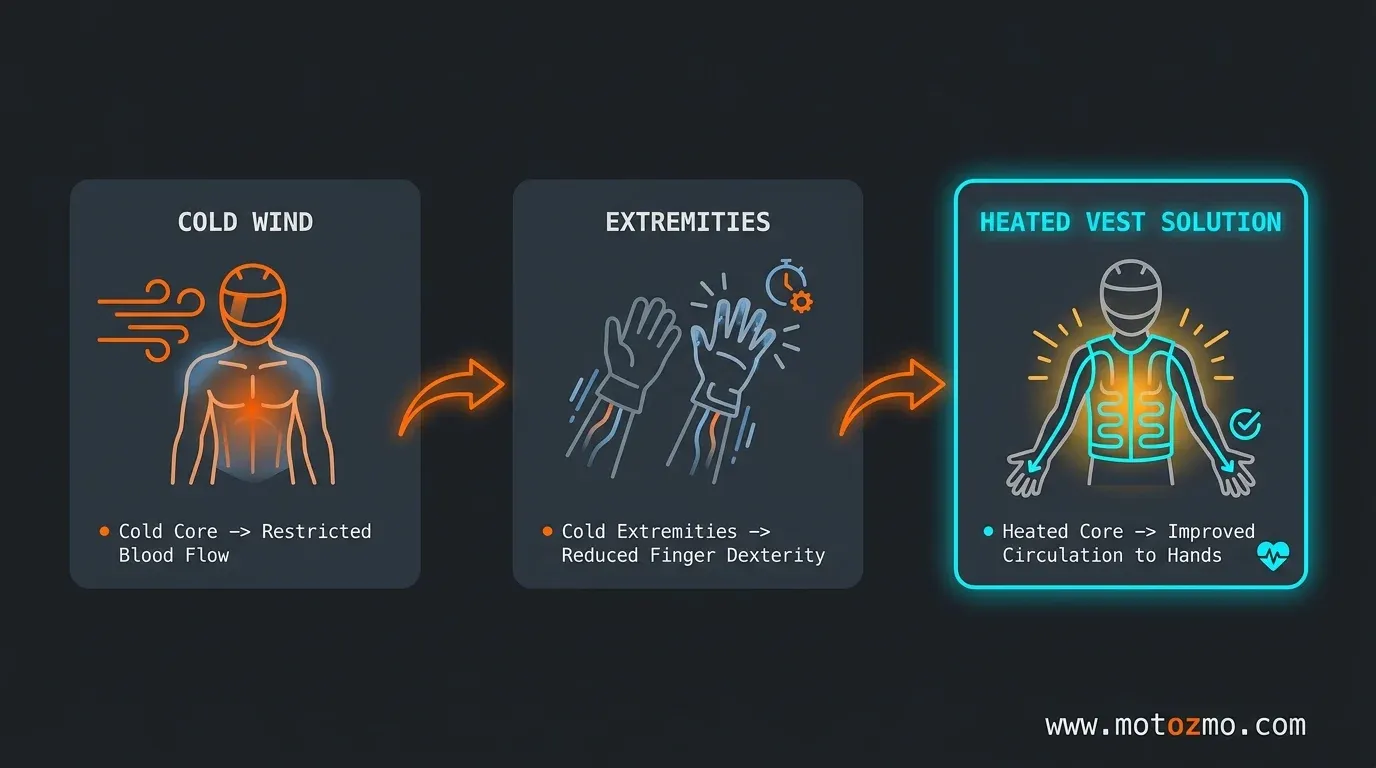
There’s a real reason a warm core can still help your hands, even though the vest never touches them. When your body senses cold, it pulls blood away from your skin and extremities to protect your core temperature, a response called vasoconstriction.
Keep your core warm and that response eases, which can leave more blood flow reaching your fingers. It won’t replace heated gloves or heated grips if your hands are the main problem, see our heated gloves vs heated grips comparison if cold hands are what’s driving you to consider heated gear.
If your arms suffer most, a vest won’t fix that either. A heated jacket liner covers the sleeves a vest leaves bare. And a heated vest doesn’t replace a proper non-heated base layer underneath your riding gear, check our motorcycle winter base layer guide for the layer that goes on first.
What It Costs
| Cheap generic heated vest | Motorcycle-specific 7V (battery) vest | Motorcycle-specific 12V (wired) vest | |
|---|---|---|---|
| Price | $20 to $40 | $130 to $180 | $180 to $250 |
| Built for | Casual wear, not road vibration or constant strain | Real riding gear from an established brand | Same, plus continuous power |
| Runtime | Unknown, often inconsistent | Around 5 to 8 hours on low | Unlimited while the engine runs |
| Real risk | Weak, unbranded batteries with a documented fire and burn history in similar cheap heated gear | Low, from a brand with a track record | Low |
The U.S. Consumer Product Safety Commission has issued repeated warnings about cheap imported heated apparel with unbranded lithium-ion batteries overheating and igniting.
Those warnings cover insoles, not vests, but the batteries inside a $25 generic heated vest come from the same kind of supply chain. That risk sits against your body for hours on a moving motorcycle, which makes it a poor place to save $100.
One more cost factor: quality heated gear holds resale value better than most riding gear, since demand for used heated vests stays steady through every cold season. If a vest turns out not to be for you, a barely-used one from a known brand usually sells for most of what you paid.
Vest, or Something Else First?
A vest is not always the right first buy. Our heated motorcycle gear guide breaks down which piece to buy first based on where you get cold: your core, your hands, or your feet.
If your hands or feet are the real problem and your core already holds up fine, start there instead.
If You Decide Yes: What to Buy
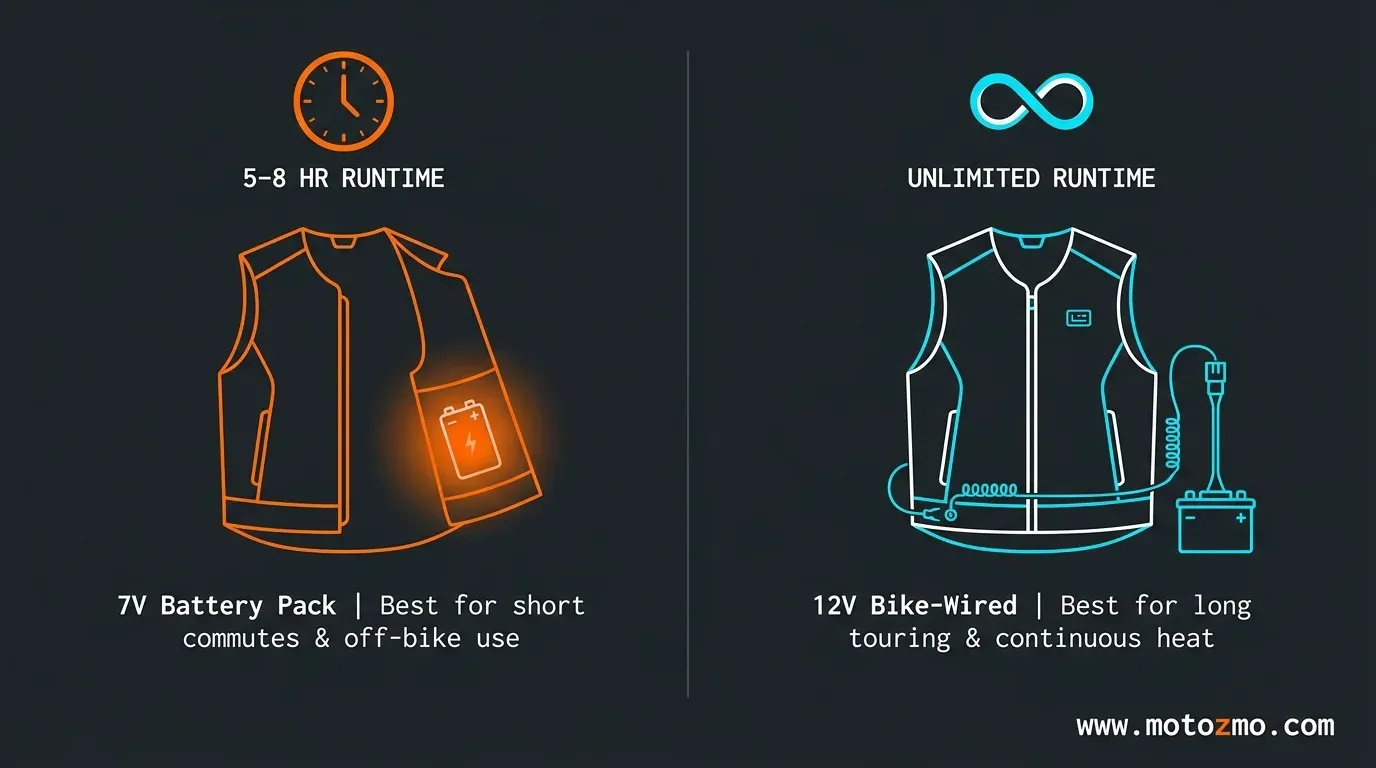
Once you’ve confirmed a vest earns its place in your gear bag, the next decisions are battery power or a bike-wired setup, and vest or jacket liner.
Check our heated vest roundup for specific picks, and our heated vest vs jacket liner comparison if you’re still deciding between the two.
FAQs
How cold does it need to be before a heated vest makes sense?
Most riders feel a real benefit below 50°F (10°C), and the case gets stronger the longer the ride and the faster the highway speed.
Will a heated vest make me sweat once I stop riding?
It can, if you leave it running at a stoplight or after you park. Turn the heat down or off whenever you’re not moving at speed, the same way you’d unzip a jacket.
Can I try a heated vest before committing to a full setup?
Yes. A 7V battery-powered vest lets you test the idea for a season without wiring anything into your bike. You can move to a wired 12V setup later if you decide to keep it.