
Affiliate disclosure: This post may contain affiliate links. If you buy through a link on this page, MOTOZMO may earn a small commission at no extra cost to you. It helps keep our guides free. How we test and choose products.
Top Picks for You
Maxima Racing Oils 55916 10WT Standard Hydraulic Fork Oil
The safe default. Works in cartridge and conventional forks, costs very little, and has years of rider trust behind it.
Check Price
Motul Fork Oil Factory Line Light 5W
Full-synthetic race fluid for modern USD and cartridge forks, with real fade resistance on track days.
Check Price
Bel-Ray High Performance Fork Oil 20W
The cheap firming fix for heavier riders and loaded cruisers that dive under braking.
Check Price
PJ1 2-05W 5W Fork Tuner Oil
The cheapest way to keep fork oil fresh. Buy two bottles and change it every year.
Check Price
Maxima Racing Fork Fluid 5W
The closest aftermarket match to Yamaha 01 for cartridge-fork sportbikes, without the dealer price.
Check Price
Match the oil to your fork type, not the number on the bottle: light 5W fluid for cartridge and USD forks, 10W for most conventional forks, and 15W to 20W for heavy cruisers and damper-rod forks that need more damping.
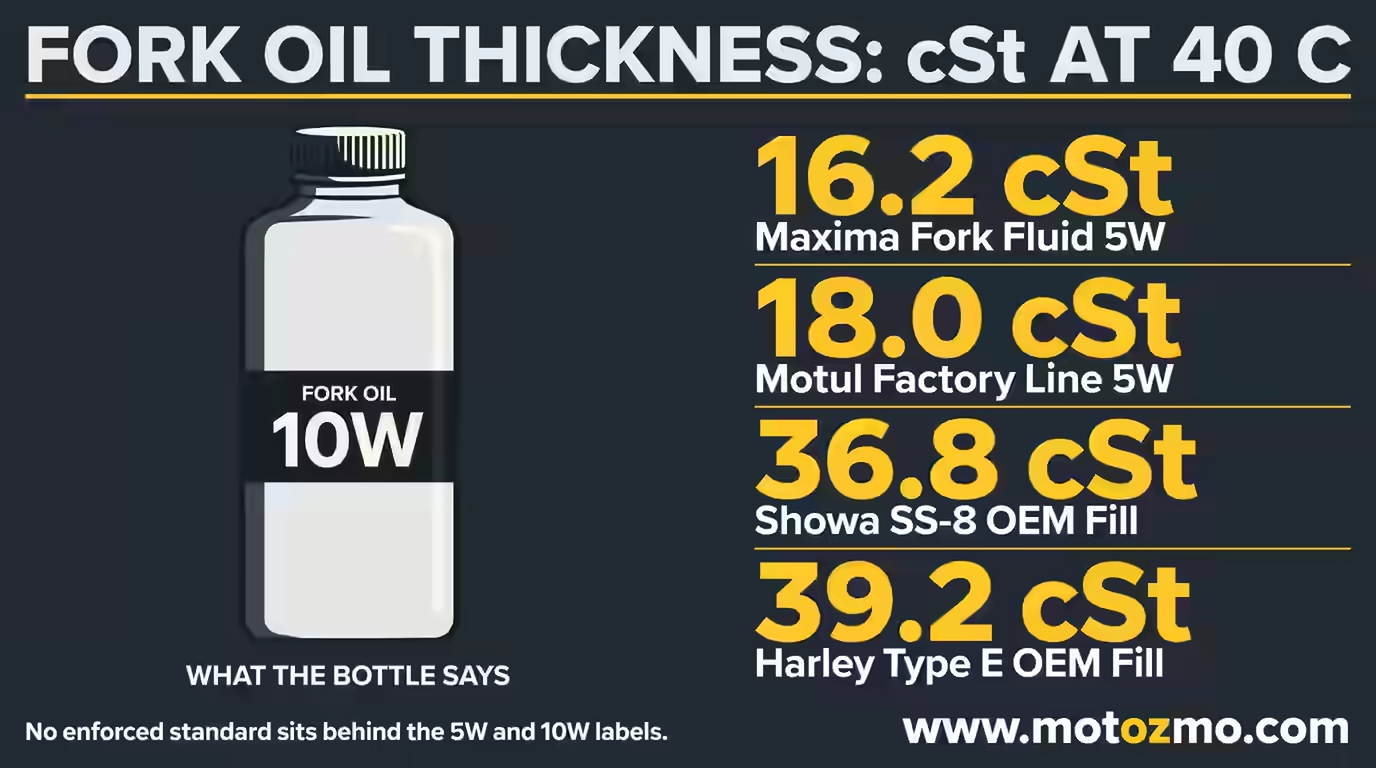
A bottle labeled 10W once behaved nothing like the 10W my manual called for. Fork oil has no enforced viscosity standard, so the printed weight tells you less than you think. The number that matters is centistokes at 40 C (cSt), the lab-measured thickness of the oil.
This guide lists real cSt figures where brands publish them and pairs each pick with the fork design it suits. If your seals have started weeping or your oil is leaking or burning, a fresh fill of the right weight is the cheapest handling upgrade you can buy. Below: five oils, from a budget 5W to a heavy 20W, lined up by cSt.
Why the Number on the Bottle Lies
There is no enforced standard behind the 5W and 10W labels on fork oil. One brand’s 10W can sit at the same thickness as another brand’s 5W, which makes cross-brand weight shopping a coin flip.
The number is centistokes at 40 C, or cSt: a lab measurement of how thick the oil actually is. Brands do not always publish it, but where they do, you can line oils up side by side and see what you are really buying.
| Oil | Labeled weight | cSt at 40 C | What it tells you |
|---|---|---|---|
| Maxima Racing Fork Fluid 5W | 5W | 16.2 | near match for Yamaha 01 (15.6) |
| Motul Fork Oil Factory Line Light 7.5W | 7.5W | 24.6 | thicker than Honda/Yamaha/Showa OEM fills (15.5 to 16.6) |
| Maxima 55916 10WT Standard Hydraulic Fork Oil | 10W | not published | mid-range mineral fork oil |
| PJ1 2-05W 5W Fork Tuner Oil | 5W | not published | light 5W service oil |
| Bel-Ray High Performance Fork Oil 20W | 20W | not published | heavy cruiser range; Harley Type E sits near 39.2 |
| Yamaha 01 (OEM reference) | — | 15.6 | the cartridge-fork benchmark |
| Showa SS-8 (OEM reference) | — | 36.8 | heavier OEM fill |
| KYB G10S (OEM reference) | — | 37.2 | heavier OEM fill |
| Harley Type E (OEM reference) | — | ~39.2 | cruiser-weight fluid |
| Harley Type B (OEM reference) | — | ~34.3 | cruiser-weight fluid |
What Weight Suits Your Fork Type?
Forks fall into three camps, and the right weight follows the camp, not the brand on the bottle.
Conventional damper-rod forks (most older bikes and many cruisers) push oil through fixed holes. They forgive a lot: the usable weight band runs wide, from 10W to 20W, and you can fine-tune the ride by changing the oil level instead of changing the oil. This is why the Maxima 10WT and the Bel-Ray 20W both live here comfortably.
Cartridge forks and USD (upside-down) forks on modern sportbikes are the opposite. Their damping rides on small valving and tight orifices, so they respond to small changes. They want lighter oil matched by cSt to the OEM fluid, which is why the two 5W picks on this list exist.
Pour 10W or heavier into these and damping slows while seal pressure climbs; forum riders keep tying heavy oil in small-orifice forks to weeping and blown seals. 50factory’s fork-oil guide walks through the inverted-versus-conventional split in more detail.
If your seals already weep, fork seal replacement is the real fix; oil weight is just triage.
Which Fork Oil Works in Almost Any Bike?
Key Features
- 10WT weight, part number 55916, on a mineral base oil with a 182 viscosity index
- Lubricinol anti-friction additive cuts sliding drag inside the fork
- Anti-foam chemistry plus seal conditioners keep damping steady and seals supple
- Blends with the same-series 5W for a custom 7.5-weight fill
I reach for Maxima Racing Oils 55916 10WT Standard Hydraulic Fork Oil when a buddy asks what to pour and does not want a lecture. At around $15 a bottle it is the safe default for conventional and cartridge forks alike.
Riders on vintage Honda damper-rod forks swear by it, and forum posts keep saying it outlasts the factory fill that came in the bike. It is mineral-based, so it thickens more on cold mornings than a synthetic would, and the 16 oz bottle means most full-size bikes need two bottles for a complete change.
My take: if you ride a standard street bike and change fork oil once a year, you will never out-ride this oil. The real trade-off is heat: cheap and universal up front, but racing synthetics hold damping consistency better when the oil gets hot.
Best for: the everyday street rider who wants a safe default for conventional or cartridge forks.
Fork oil is only half the fluid story; the crankcase wants a proper 4-stroke motorcycle engine oil too.
What Is the Best Synthetic Fork Oil for a Modern Sportbike?
Key Features
- 18.0 cSt at 40 C, published in Motul’s September 2025 data sheet
- 100% synthetic base stock for fade-free damping at track temperatures
- Seal-safe formula tuned for Showa, Kayaba, Ohlins, and WP forks
- Mixes with Motul Expert-line fork oil for in-between grades
If you ride a modern sportbike with Showa or Kayaba USD forks, Motul Fork Oil Factory Line Light 7.5W is the oil your suspension was tuned around. It is 100% synthetic, and its anti-friction additive cuts stiction, the static friction that makes small bumps feel harsh.
The oil’s cSt figure runs way thicker than Honda, Yamaha, and Showa OEM fills at 15.5 to 16.6 cSt, so it firms stock damping a little more than a true OEM-match oil.
At around $27 to $33 per liter it costs two to three times the Maxima Standard. On track it earns its keep: anti-foam chemistry keeps the air chamber from aerating, so damping stays the same from the first lap to the last.
I would buy this for any cartridge-fork sportbike I planned to ride hard, and buy the Maxima below for a commuter. The trade-off is honest: premium race-grade consistency at a premium price, and it is not the thinnest option on the shelf.
Best for: sport riders and track-day riders on modern cartridge/USD forks who want fade-free damping.
Which Fork Oil Suits a Heavier Rider on a Cruiser?
Key Features
- 20W weight from a line spanning six grades, 5W through 30W
- Every grade blends with the others for custom in-between weights
- Formulated for cartridge and dual-chamber systems as well as conventional forks
- Fade-resistant base oils keep action smooth over long, hot descents
Two-up touring on a cruiser with stock 10W feels like a pogo stick after every hard brake. Bel-Ray High Performance Fork Oil 20W is heavy enough to firm the front end under braking without touching the valving.
Bel-Ray builds this oil in a wide grade range; the current product sheet lists every grade and its specs. I would not pour it into a USD sportbike. Heavy oil in small-orifice forks brings harshness and real seal risk; forum riders keep tying 20W swaps to blown fork seals.
Watch out for the lookalike: Bel-Ray V-Twin 20W-50 engine oil shows up right beside the fork oil in search results, but it is engine oil, not fork oil, and it has no business inside your forks.
For a 190-plus-pound rider on a cruiser, a 20W fill beats a valving kit dollar for dollar. The trade-off cuts the other way too: an ideal cheap firming fix for heavy bikes, and the wrong oil entirely for sportbikes.
Best for: heavier riders and touring/cruiser owners who need firmer front-end control.
Bikes that bake in summer traffic need hot-weather engine oil thinking too; heat thins everything, forks included.
What Is the Cheapest Way to Refresh Fork Oil?
Key Features
- 2-05W part number; high-viscosity-index 5W base for easy cold starts
- Anti-seal-swell additive keeps fork seals soft and sealing
- Anti-foam chemistry holds damping steady through long rides
- Line spans eight weights, 5W to 30W, for step changes as needs shift
Fork oil is the most neglected fluid on the bike, and the reason is cost and hassle. PJ1 2-05W 5W Fork Tuner Oil answers the cost half, it makes the annual fork-oil change a no-brainer. It is a high-VI 5W, and riders report smoother action right after a flush.
Two catches: the half-liter bottle means most full-size bikes need two, and PJ1 has a thinner review footprint than Maxima or Motul, so you are buying on formula rather than reputation.
I would rather see fresh PJ1 5W in a bike every year than three-year-old premium oil. The trade-off: lowest cost per service, a small bottle, and less brand track record.
Best for: budget-conscious riders and small-bike owners doing their annual fork-oil refresh.
Which Aftermarket Oil Matches Yamaha OEM Fork Fluid?
Key Features
- 85/150 grade, part number 59901-5; full 1-liter bottle
- Friction reducers plus rust and corrosion inhibitors for long oil life
- Viscosity index over 190 keeps damping steady as the oil warms
- Every grade blends with the others for custom in-between weights
Cartridge-fork sportbike owners who want factory damping feel without the dealer parts-counter price land on Maxima Racing Fork Fluid 5W. The 85/150 grade measures 16.2 cSt, the closest aftermarket match to Yamaha 01’s 15.6 cSt, and forum riders have confirmed it in 07 R1 forks.
It is mineral-based rather than full synthetic, and it runs about $16 to $24 per liter. Two limits: a 5W this light is the wrong pick for damper-rod cruisers that want 15W to 20W.
If your manual calls for Yamaha 01, this is the bottle I would grab off the shelf. The trade-off: the closest OEM feel for modern sportbike forks, and the wrong oil for heavy cruisers.
Best for: sportbike owners with cartridge forks who want OEM-spec damping without the dealer price.
How Much Oil Goes in Each Leg?
Do not pour a fixed volume and walk away. The right way: springs out, forks fully compressed, then set the oil level as a measurement in millimeters from the top of the tube. That distance sets the air gap, and the trapped air works like a progressive spring that ramps up as the fork compresses.
Two riders on the same 10W can run different ride heights just by changing the oil level, which is why conventional forks tune partly by oil level. A fixed volume gets you close on a first fill, but the millimeter measurement is what makes both legs match. Mismatched legs are how you get a bike that steers oddly.
Check your manual for the spec; most bikes list it as ‘oil level’ in millimeters. Remember that more oil is not always better; too much oil has its symptoms.
Frequently Asked Questions
How often should fork oil be changed?
Every 10,000 miles or once a year, whichever comes first. Fork oil is the most neglected fluid on most bikes: it shears down and collects wear particles long before it looks dirty. If you cannot remember the last change, it is overdue.