
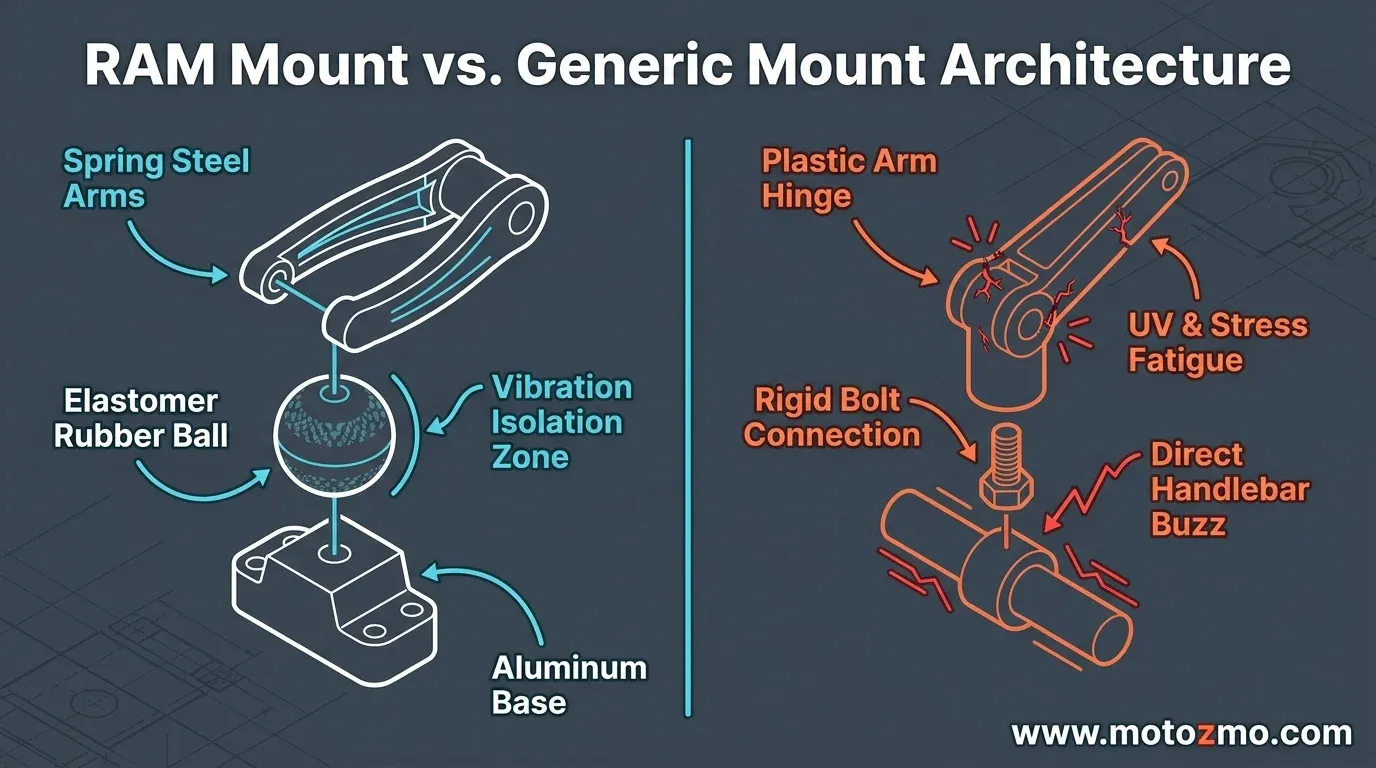
For most motorcycle riders, a RAM Mount is worth the extra cost over a generic phone mount, because the two aren’t built to the same standard even when they look almost identical.
A lot of buying guides stop at “RAM costs more but it’s better,” which doesn’t tell you much. The real question is what that extra money buys, and whether your bike and your riding need it.
Below, I break down what’s different inside these mounts, where generic mounts fail on a motorcycle, and the riders who can skip RAM and save the money without regretting it.
Most “Generic” Mounts Are Copies of RAM’s Design
Here’s something worth clearing up first, because it trips people up in reviews: RAM’s own universal cradle is called the X-Grip, and it’s a genuine RAM Mounts product, not a knockoff brand.
The four spring-loaded arms that grip your phone from the corners are RAM’s design. Nearly every generic phone mount you’ll find on Amazon or at a gas station copies that same four-arm layout, because it’s a good design and it isn’t patented in a way that stops copying.
So the shape isn’t the difference. The difference is what the copy is made from, how it’s tested, and what happens to it after a summer of engine vibration.
Where the Extra Money Actually Goes
A RAM Mount and a generic copy can look nearly the same in a product photo. Three things set them apart in practice.
Material and spring tension. RAM’s arms use a specific spring steel and a grip material chosen to hold tension through thousands of open-close cycles and years of UV exposure. Generic copies often use a softer plastic that works fine on day one, then loses grip strength within a season as the plastic fatigues and the sun breaks it down.
Testing. RAM publishes documentation for how its mounts hold up under vibration and shock, citing recognized test methods like MIL-STD-810, the U.S. military’s standard framework for environmental durability testing.
That standard isn’t a stamp any company can slap on a product; it defines specific test procedures, and passing them means something concrete. Most generic sellers use words like “shockproof” or “heavy duty” on the packaging with no test data behind either word.
The ball-and-socket connection. RAM’s arm connects to its base and cradle through a rubber ball that a single knob locks down. That rubber ball absorbs some vibration before it reaches your phone.
Most generic mounts skip the rubber ball entirely and bolt the cradle straight to a rigid plastic or metal arm, so whatever your engine sends through the handlebar goes straight into your phone.
Where Generic Mounts Fail on a Motorcycle
A car dashboard barely moves. A bicycle only vibrates when you hit a bump. A motorcycle handlebar vibrates for as long as the engine runs, and that’s the environment most generic mounts were never designed around.
The most common failure is cracking at the stress points. Reviewers describe mounts that snapped at the screw thread or the arm joint within days of being bolted to a motorcycle, sometimes before the mount ever left the garage. Constant vibration finds the weak point in cheap plastic fast, and once it cracks, the mount doesn’t loosen gradually; it lets go all at once.
The second failure is grip fatigue. A generic mount might hold a phone tight for the first month, then loosen up as the plastic arms lose their spring tension. You won’t notice at a stop light. You’ll notice on the highway, when the phone starts to wobble in its cradle.
The third issue skips the mount and goes straight for your phone. Apple has published a warning that mounting a phone on a motorcycle with a high-power engine can damage the camera’s image stabilizer over time, and recommends a vibration-dampening mount even on lower-vibration machines like scooters.
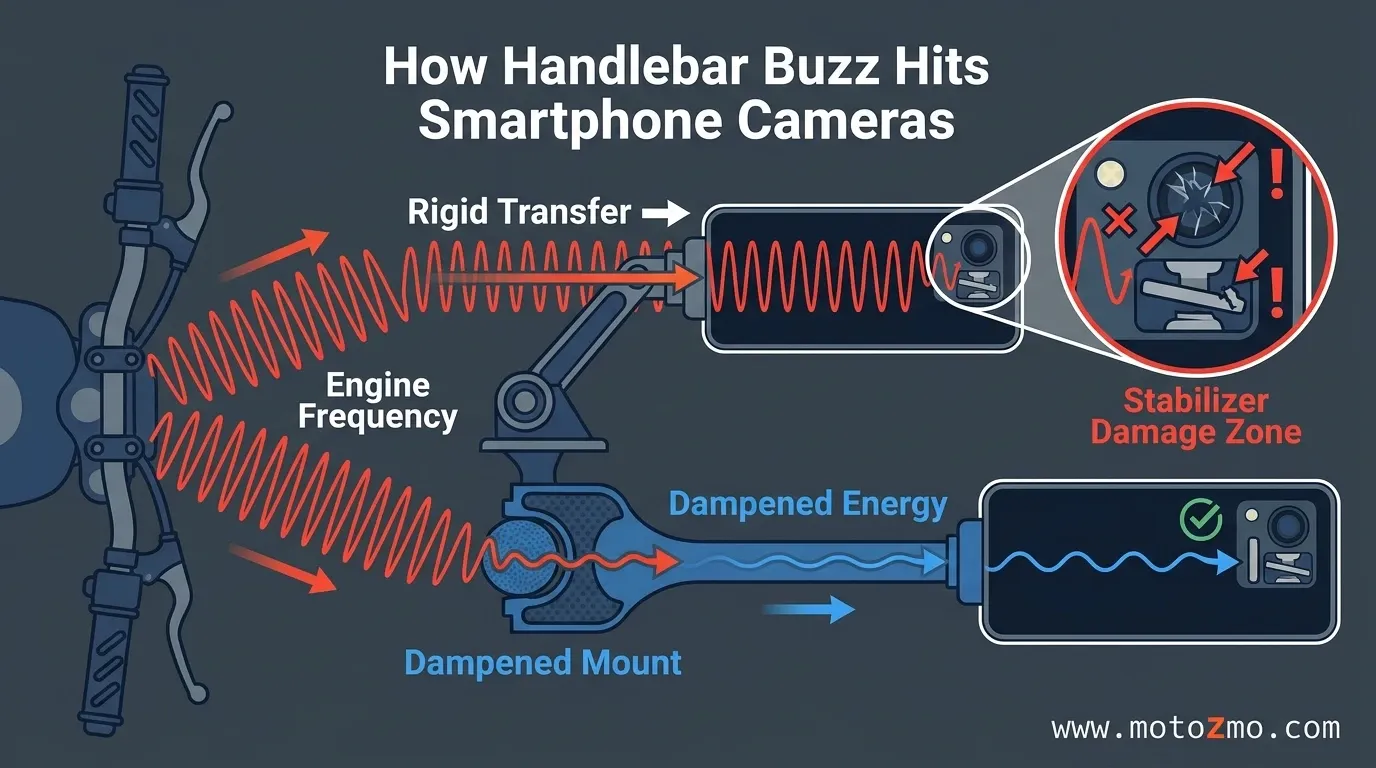
A mount with no isolation built in sends that vibration straight through, whether it’s RAM or a copy; the difference is that RAM at least engineers for it, while most generic mounts don’t address it at all.
The Decision Matrix
| What matters | RAM Mount | Generic mount |
|---|---|---|
| Price | $30–70 for a complete kit | $10–20 |
| Build material | Spring steel arms, rubber ball joint | Molded plastic, often no rubber isolation |
| Published vibration testing | Yes, cites recognized standards | Rarely, if ever |
| Modularity | Mix and match arms, bases, and cradles for different bikes | Usually one fixed unit |
| Quick-release for parking | Yes, cradle detaches from the arm | Rarely |
| Long-term grip retention | Holds tension for years, per long-term owner reports | Often loosens within months |
| Warranty | Manufacturer-backed | Varies by seller, often none |
Who Should Skip RAM and Buy the Cheap One
RAM isn’t the right answer for everyone, and it’s worth saying so plainly. If you ride a low-vibration bike like a scooter, an electric motorcycle, or a smooth-running touring bike, and you reach for a phone mount only a few times a summer, a generic mount should hold up fine and save you real money. The same goes for a bike you’re planning to sell soon, or a mount you need for one trip and don’t expect to rely on long-term.

Skip the cheap option if you ride daily, put real highway miles on the bike, or own a bike with a rougher-running engine, a big single, a V-twin, or anything that buzzes hard through the bars at speed. That’s the environment where generic plastic arms fail fastest, and where a cracked mount at 65 mph turns from an inconvenience into a real hazard.
If you’re not sure which category your bike’s clamp needs, check your handlebar diameter before you buy either option; RAM’s bases and most generic clamps are sized differently, and our handlebar diameter guide covers how to measure it in a few minutes.
The Other Reason Riders Choose RAM: It Comes off with You
RAM’s ball-and-socket design means the cradle and arm detach from the base with a twist, so you can take your phone with you when you park and leave just the base bolted to the bike.
That’s a small thing, but it fits into a broader anti-theft habit, alongside the rest of your parking routine. If you want to go deeper on locks, alarms, and trackers, see our motorcycle theft prevention guide.
Your cockpit’s vibration problem is bigger than the phone mount, too. If your bike already buzzes enough to bother your hands or mirrors, our motorcycle vibration dampener roundup covers options for the rest of the cockpit.
The Bottom Line
A generic mount isn’t a scam, and plenty of riders get away with one for years on the right bike. But on a motorcycle that vibrates hard and rides in real weather, you’re testing a $15 piece of plastic against thousands of miles of engine buzz, sun, and rain, and your phone is what hits the pavement if that plastic loses. RAM costs more because it’s built and tested for exactly that environment. Pay for it if your riding matches the problem it solves, and save the money if it doesn’t.