
Affiliate disclosure: This post may contain affiliate links. If you buy through a link on this page, MOTOZMO may earn a small commission at no extra cost to you. It helps keep our guides free. How we test and choose products.
For most riders, I would buy fuel injection, and it is not close.
It starts on the first press on a January morning, fixes its own mixture on a mountain pass, and shrugs off a month in the garage. I have owned and liked carbureted bikes too, so let me be fair about what you give up.
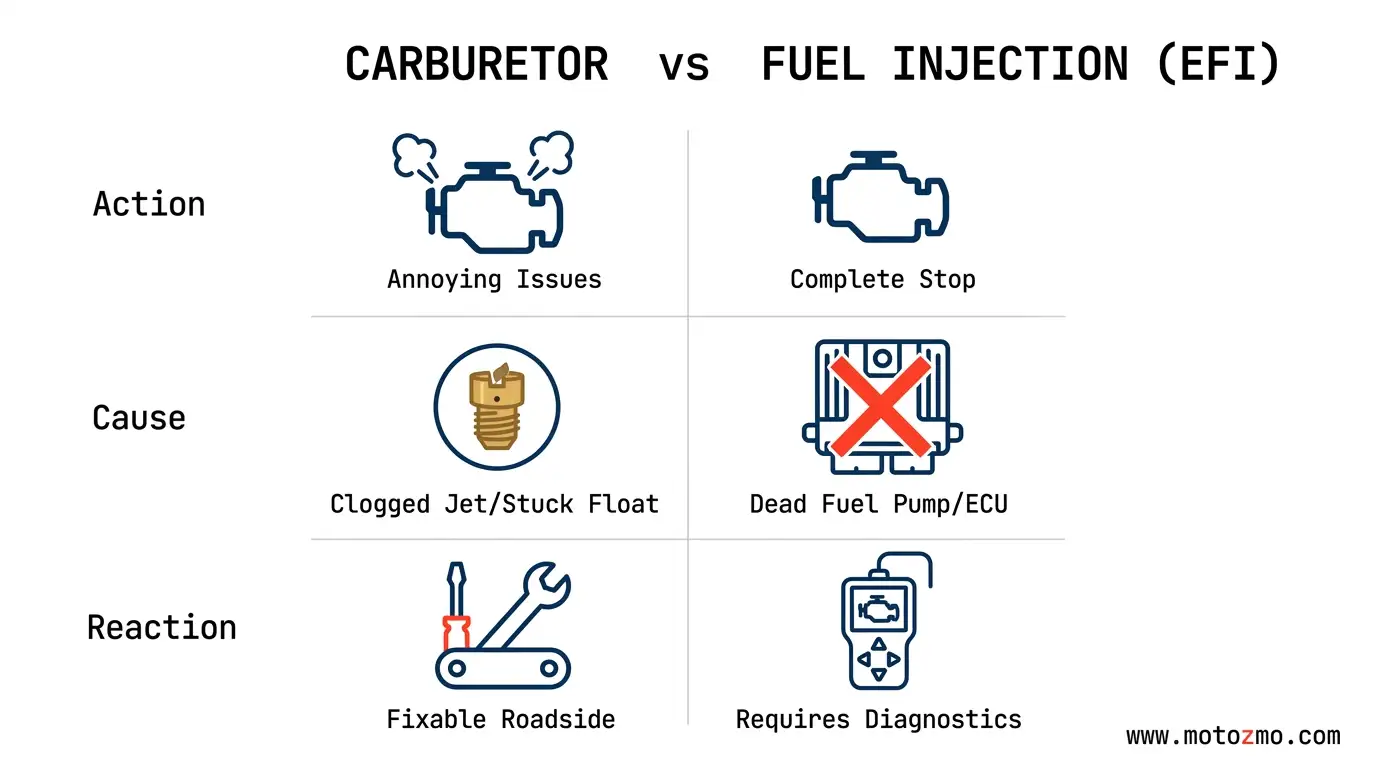
The two systems make near-equal power. They part ways on failure. A carb fails in small, cheap ways that annoy you in your own driveway. Fuel injection fails so rarely that most riders never see it happen, but a dead pump or ECU ends the ride and bills you like it.
Pick by how each one breaks, and the choice makes itself. Here is the full picture.
How Each System Works
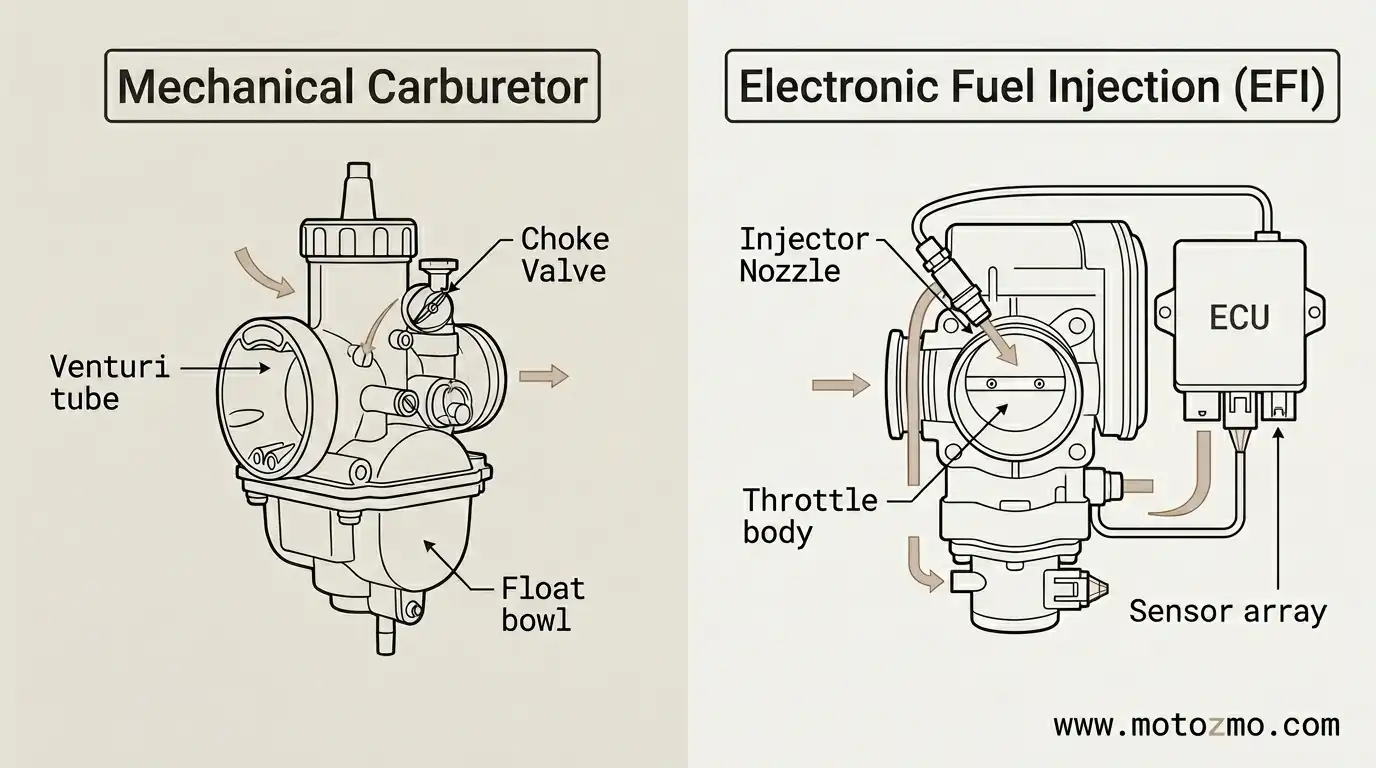
A carburetor is a fixed recipe. Air rushes through a narrow throat called a venturi, the fast air drops in pressure, and that vacuum pulls fuel up from a float bowl through brass jets.
The mix of air and fuel is set by the size of those jets, and it stays set until someone takes the carb apart and changes them. No wires, no sensors, no computer. That is why a carbureted bike with a weak battery can still bump-start and run: the fuel system asks for nothing from the battery.
We cover each circuit and part in our guide to how a motorcycle carburetor works.

Fuel injection writes the recipe fresh, many times a second. Sensors report throttle position, air temperature, and intake pressure to the ECU, the bike’s computer. The ECU picks a fuel amount for that moment and fires the injector, a nozzle that sprays fuel under pressure from an electric pump.
Honda explains in its description of programmed fuel injection how the ECU reads manifold pressure and engine speed to meter fuel, and how automatic cold-start enrichment replaces the choke lever. The system measures, adjusts, and measures again, all ride long.
The Differences that Decide It, Side by Side
Most comparison tables stop at starts and mileage. Those rows matter, but the storage and failure rows below are the ones that decide how ownership feels in year three.
| Factor | Carburetor | Fuel injection |
|---|---|---|
| Cold start | Choke routine, and a flooded engine if you rush it | Press the button; the ECU adds fuel on its own |
| Climbing to altitude | Mixture goes rich; swap jets to fix it | Sensors trim the fuel as the air thins |
| A month in the garage | Stale fuel clogs the tiny pilot jet; expect a cleaning | Starts fine in most cases; watch the battery instead |
| When it fails | Runs worse over days or weeks | Stops the bike on the spot in many cases |
| Fix it yourself | Screwdriver, cleaner, and a $20-$100 kit | Scan tool for most faults; parts cost more |
| Fuel use | Burns a bit more, and the tune drifts with wear | Often 5-15% better, and holds its tune |
| Tuning | Swap jets with hand tools | Needs a tuner, a flash, or a piggyback unit |
Cold Starts and Altitude, with Real Numbers
A cold engine needs extra fuel, because part of the fuel condenses on cold metal before it can burn.
On a carb, you supply that extra fuel by hand: pull the choke, start the engine, then feed the choke back in as the engine warms. Rush the routine and the plugs foul, or the engine stalls at the first stop sign.
On an injected bike the ECU reads engine temperature and adds the extra fuel itself, then backs it off as the engine warms. There is no routine to learn and no lever to forget.
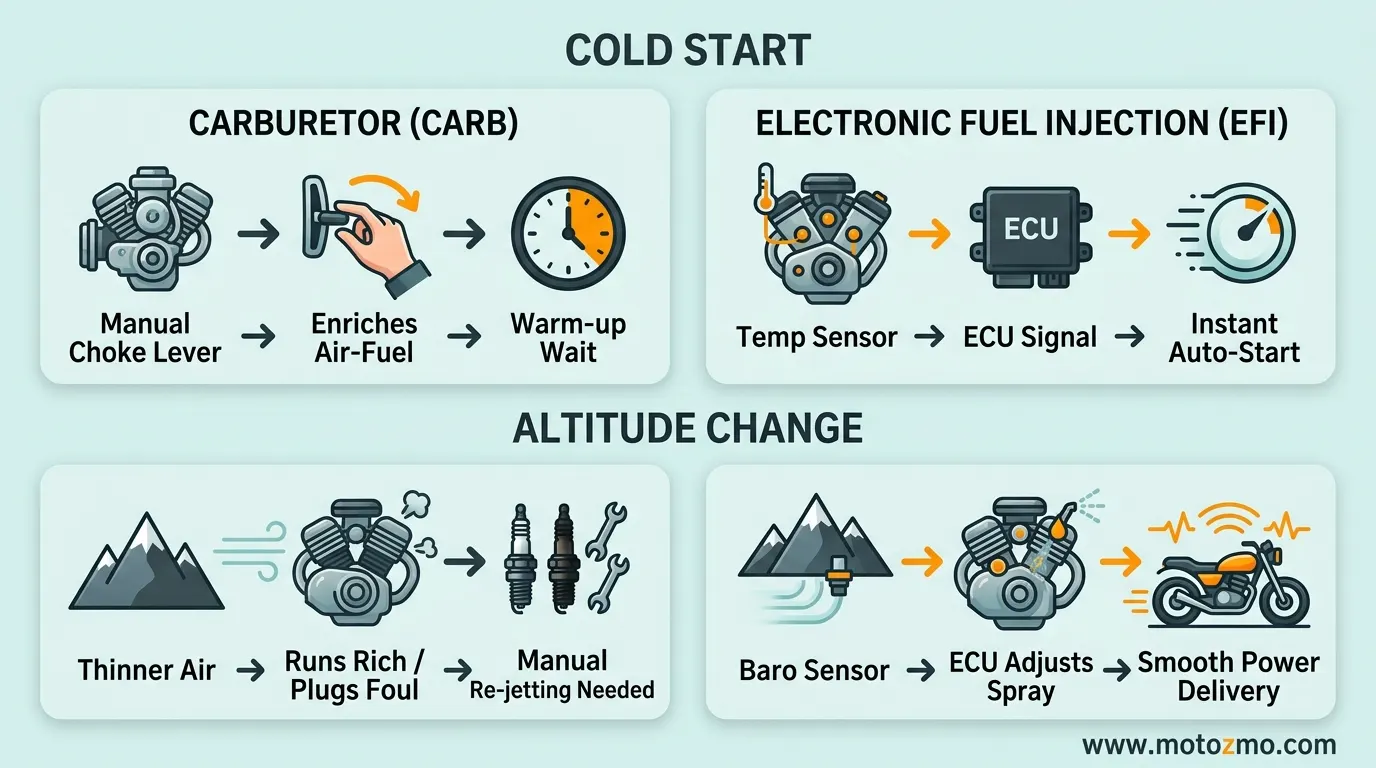
Altitude is a math problem a carb cannot solve. Air loses about 3 percent of its density for every 1,000 feet you climb. At a 10,000-foot pass, each breath the engine takes holds about a quarter less oxygen than it did at sea level.
Your jets do not know this. They keep metering fuel for sea-level air, so the mix runs rich: power drops, the throttle feels soft, and plugs can foul.
Riders who live in the mountains re-jet for home altitude and accept a rich bike on trips down or a lean one on trips up. The pressure sensor on an injected bike feels the thin air and cuts fuel to match, corner after corner, with no stop at the summit to swap brass.
The Storage Test Nobody Runs
Park both bikes for six weeks on the fuel in their tanks, the way most bikes in the US spend the winter, and the carbureted bike is the gamble. Pump gas carries ethanol, and ethanol pulls moisture from the air.
In a vented float bowl, fuel goes stale fast and leaves varnish on the smallest passages first, and the pilot jet is the smallest passage of all. The bike that ran fine in October cranks and cranks in April.
The fix is a cleaning, and a light clog can be cleared without removing the carb from the bike.
The injected bike stores better because its fuel sits in a sealed system under pressure, with no vented bowl breathing damp air. Its storage weak point is the battery, which feeds the pump and the ECU. A battery tender beats a carb rebuild on price and effort by a wide margin.
How Each One Breaks, and What the Fix Costs
Carb failures creep in. A float sticks and you find gas leaking from the carburetor above a hot engine. The pilot jet clogs and the idle goes rough. A rubber diaphragm tears and the bike bogs when you open the throttle.
Each fault makes the bike run worse, and each one costs little to put right. One more deserves a mention: on cold, wet days near freezing, moisture in the intake air can freeze at the venturi and choke the engine at idle.
Carb icing is rare on a bike that keeps moving, but it is real, and no spec sheet lists it.
Fuel injection failures arrive all at once. Injectors and sensors can last the life of the bike, but a dead fuel pump means no pressure, no spray, and no start, in your driveway or two states from home.
Diagnosis starts with a scan tool or a dealer visit, not a wrench. This is the honest trade at the center of the whole comparison: the carb asks for your Saturday mornings in small doses, and fuel injection asks for nothing for years, then wants one large check.
| Carburetor | Fuel injection | |
|---|---|---|
| Routine upkeep | A cleaning when the bike sits or runs rough | Fuel filter change and injector service at long intervals |
| DIY parts | Rebuild kit, roughly $20-$100 per carb | Few parts an owner can service at home |
| Shop bill | About $100-$150 per carb for a clean and sync | $100-$300 or more if an injector fails |
| The bad day | A season of small fixes | A pump or ECU at several hundred dollars |
Add it up over five years and the totals land closer than the reputations suggest. Carbs spend your time. Fuel injection spends your money, once.
Maintenance and Tuning: Your Time or Your Money
If you own a carb, put cleaning on the calendar instead of waiting for symptoms. A steady carburetor maintenance routine and a can of carburetor cleaner keep most trouble away, and draining the float bowls before winter storage does more than any fuel additive on the shelf.
Tuning splits the same way. Fit a new pipe or move to a new altitude on a carb and you can adjust the air-fuel mixture with screws and jets for the price of lunch.
On an injected bike the same change means an ECU flash, a plug-in tuner, or a dealer’s tool. The carb rewards riders who like to wrench. The injected bike rewards riders who would rather spend that Saturday on the road.
Why New Bikes All Use Fuel Injection
Riders ask if the EPA banned carburetors. It did not. The US emissions standard for highway motorcycles caps the gases that leave the tailpipe and says nothing about the hardware that feeds the engine.
The catch is the catalytic converter. It cleans well only inside a narrow band around the ideal air-fuel mix, and an open-loop carb with no oxygen sensor wanders out of that band as conditions change.
Injection with sensor feedback holds the band, so builders switched. Harley-Davidson, the last big holdout, went all-injection in 2007.
Conversion kits for older bikes exist, but at roughly $1,500-$4,000 in parts and labor, a conversion costs more than many of those bikes are worth.
Buying Used: The Fuel System Picks Your First Repair
Shop for a carbureted bike and assume the carbs need a cleaning unless the seller can prove recent work. Budget the job into the price, check the tank for rust, and ask when a multi-cylinder bike last had its carbs synced.
None of this breaks a deal. It is known work at a known price, and a clean set of carbs makes the bike honest.
Shop for an injected bike and watch the cold start. It should fire in about two seconds, idle steady, and show no warning light. Ask if the bike has stored fault codes, and when the fuel filter last changed.
The risk flips here: a neglected injected bike can hide a pump or injector bill that eats a large share of a cheap bike’s value, and a warm test ride will not show it. A neglected carb bike shows its faults in the open and charges you less to forgive them.
Who Should Skip Each System
Skip the carburetor if:
- Your bike sits for weeks between rides
- Your rides cross big altitude swings, like coast to mountain pass in one day
- You want to press a button and go, in January too
- You have no interest in cleaning jets, ever
Skip fuel injection if:
- You ride far from parts and tow trucks, and you need to fix fueling with the tools on the bike
- You are buying a very cheap bike, where one pump or ECU bill could pass the bike’s value
- You tune for fun and want jets and screws, not software
My verdict stands: fuel injection for most riders, most of the year. It wins on starts, altitude, storage, and time. The carburetor keeps a smaller, real win.
It fails cheap, in the open, and lets a skilled rider fix it where it stops. Buy the failure style you can live with, and neither system will disappoint you.