
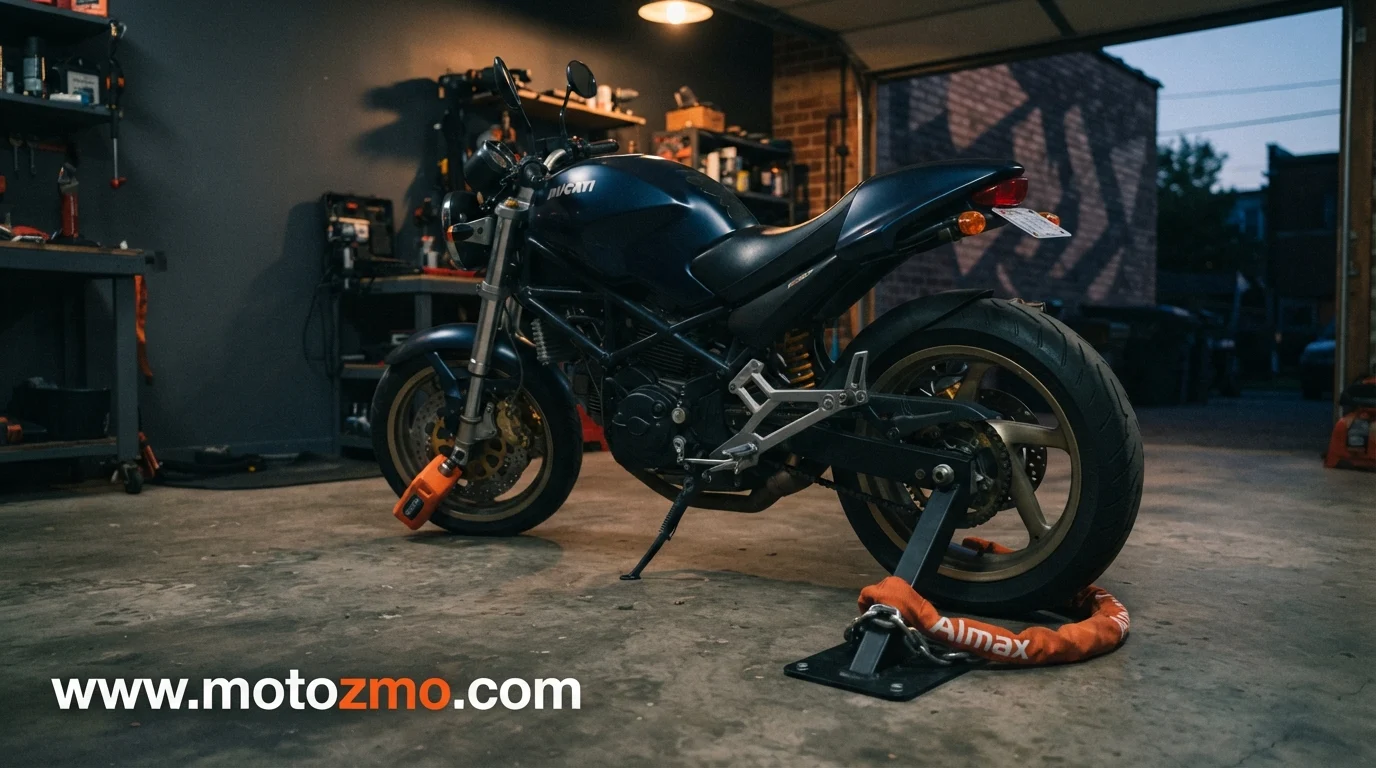
No single lock, alarm, or tracker makes a motorcycle theft-proof, but layering a solid lock, an alarm, a GPS tracker, and smart parking habits makes your bike a harder target and sharply improves your odds of getting it back if it’s stolen anyway.
Motorcycle theft is a real, ongoing problem in the U.S. The National Insurance Crime Bureau has reported well over 50,000 motorcycles stolen nationwide in a single recent year, with less than half ever recovered. That’s the honest starting point. This guide walks through what actually works, layer by layer, and exactly what to do in the first hour if it happens anyway.
Key Takeaways
- No Single Fix Works Alone: Complete protection requires a layered defense (parking habits + locks + alarms + GPS).
- Smart Parking First (Free): Park in well-lit, busy areas, use an unbranded cover, block garage access with another vehicle, or lock bikes together when riding in groups.
- Combine Mechanical Locks: Use a portable disc lock for quick stops to stop roll-away thefts, and a heavy hardened chain + ground anchor at home to prevent lift-away thefts.
- Use Alarms as Deterrents: Loud alarms (100–120 dB) attract immediate attention and disrupt opportunistic thieves. Look for disc locks with built-in alarms.
- Trackers Enable Recovery: GPS trackers (hardwired or battery-powered) are your best chance of recovery, especially since thieves often stash bikes for a few days to see if they are tracked.
- Act Fast in the First Hour: If stolen, immediately file a police report, notify your insurance (if you have comprehensive coverage), and share live GPS tracking data directly with the police.
Why “Just Lock the Ignition” Isn’t Enough Anymore
Most motorcycle thefts don’t involve anyone defeating a locked ignition at all. They happen because the bike was left with the ignition off but unlocked, or because the lock alone doesn’t stop the method being used. Three distinct theft patterns show up again and again:
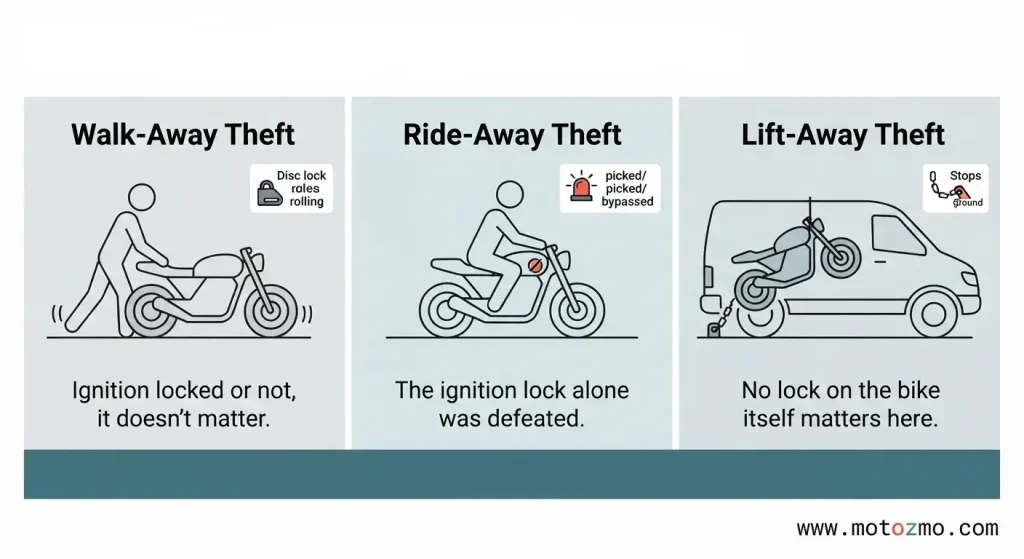
- Walk-away theft: a thief pops the bike into neutral and simply pushes it away, sometimes posing as a stranded rider asking for a “push” to make it look ordinary.
- Ride-away theft: the ignition lock is picked, bypassed, or simply wasn’t engaged, and the bike is ridden off directly.
- Lift-away theft: a van or two people physically carry the bike into a vehicle, which defeats any lock that doesn’t anchor the bike to something fixed.
That third category is the one most riders don’t plan for, and it’s exactly why this guide is built around layers instead of a single product. Nothing below solves all three theft modes on its own.
Start With Where and How You Park (Free, No Purchase Required)
Before any product decision, parking habits are the highest-leverage, zero-cost layer:
- Park in well-lit, visible, high-traffic areas rather than dark or secluded spots
- Choose a garage over a street or open driveway whenever possible
- If garage-kept, park so another vehicle blocks direct access to the bike
- Use a plain, unbranded cover. A visible logo or shape can advertise exactly what’s underneath.
- When riding in a group, lock bikes together so a thief can’t simply roll one away alone
None of this costs anything, and it changes how attractive your bike looks to an opportunistic thief before they’ve even considered your lock.
Mechanical Locks: Disc Locks, Chain Locks & Ground Anchors
Disc Locks
Fast to use and easy to carry, a disc lock threads through your brake disc and physically prevents the wheel from turning. It’s effective against ride-away and roll-away theft. It does nothing against lift-away theft, since the bike can still be picked up and carried with the disc lock still attached.
Chain Locks and Ground Anchors
Heavier and less convenient to carry, but a hardened chain locked to a fixed ground anchor is what actually stops lift-away theft. The bike is now attached to the building, not just to itself. This is the better choice for overnight parking or any spot where the bike sits unattended for extended periods.
Using Both Together
The strongest real-world approach isn’t picking one. It’s stacking two different lock types. If a thief can defeat a disc lock with bolt cutters, that same tool likely won’t touch a hardened chain, and vice versa.
Every additional lock of a different type multiplies the time, tools, and noise required, which is exactly what discourages all but the most determined thief.
We go deeper on this decision, including which lock actually holds up under real testing, in our full comparison.
Alarms: The Deterrent Layer
An alarm isn’t a standalone defense. It’s a deterrent that works in combination with a physical lock. A loud alarm in the 100–120 decibel (dB) range, roughly as loud as a chainsaw or a rock concert, draws immediate attention the moment someone touches or moves the bike. That attention is exactly what an opportunistic thief doesn’t want, and it buys real time if the theft attempt continues anyway.
Many disc locks now come with a built-in alarm, combining the physical and deterrent layers into one product. We break down the disc lock alarms we’d trust in a full roundup, and if you want the deepest look at the category leader specifically, our review of the category leader covers what separates a premium alarm lock from a cheap one.
GPS Trackers: Your Best Shot at Recovery
Locks and alarms deter theft and slow a thief down. A tracker is what makes a stolen bike recoverable at all.
One behavioral pattern to know: thieves increasingly stash a stolen bike for a few days first, specifically to check whether it’s being tracked, before moving it further. That means a tracker’s value isn’t just the initial theft, it’s the days afterward.
Trackers generally split into battery-powered units (easier to install, need periodic charging) and hardwired units (tap into the bike’s electrical system, run continuously without maintenance).
Most come with a subscription for live location data. A real motorcycle GPS tracker is a very different product than a repurposed item-finder. Before you reach for the cheap option, it helps to understand exactly where that difference matters. For the trackers actually built for this job, see the trackers that actually work.
The Layered Setup We’d Actually Run
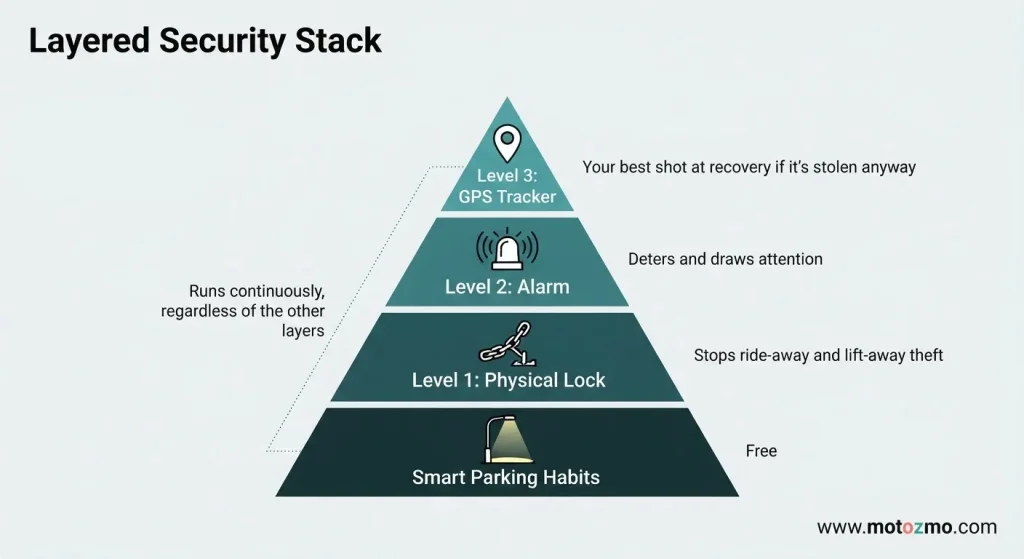
Put together, an effective setup looks something like this: a chain locked to a ground anchor at home, a disc lock alarm for stops away from home, and a GPS tracker running continuously in the background regardless of where the bike is parked.
The honest tradeoff: security cost and hassle scale together. Most riders won’t carry a heavy chain everywhere they stop for coffee, and that’s fine.
The right setup matches where your bike actually spends most of its time, not a maximalist ideal nobody will maintain. A tracker running at home and on the road, paired with a lighter lock for quick stops and a heavier one overnight, covers the realistic pattern of how most people use their bike.
If Your Motorcycle Is Stolen Anyway
Most prevention guides treat this as an afterthought. It shouldn’t be. What you do in the first hour affects your odds of recovery.
- File a police report immediately. Reporting quickly is directly tied to better recovery odds, not just a formality.
- Have your registration and VIN accessible from home, not only stored on the bike itself. If the bike is gone, so is anything left on it.
- Contact your insurer if you carry comprehensive coverage. Theft generally isn’t covered by liability-only policies. Comprehensive is specifically the layer that responds to a stolen bike, and it’s worth confirming you actually have it before you need it.
- Check local pawn shops, parts listings, and online marketplaces for your specific make and model in the days and weeks after.
- If you have a GPS tracker installed, pull the location data immediately and hand it directly to police rather than confronting anyone yourself. Recovery is the goal, not a confrontation.
The Bottom Line
No single device stops a determined thief, but layered security changes the odds, both of the theft happening at all and of getting your bike back if it does. Start with the free layer (parking smart), add a solid lock matched to how and where you park, and if you’re ready to look at specific products, the disc lock alarms we’d trust and the trackers that actually work are the two next steps worth prioritizing.
Motorcycle Theft Prevention FAQs
Does motorcycle insurance cover theft?
Only if you carry comprehensive coverage. Liability-only policies generally don’t cover your own bike being stolen. Confirm your specific policy includes it before you need it.
Do disc lock alarms actually deter thieves, or do people ignore them?
They work as a deterrent for opportunistic theft. A loud, sudden alarm draws attention most thieves specifically want to avoid. They’re not effective alone against a determined, prepared thief, which is why pairing an alarm with a solid physical lock matters.
What’s the single best anti-theft device if I can only buy one thing?
A quality lock beats a tracker alone, since a tracker only helps after the theft already happened. But if forced to choose only one layer, a hardened lock anchored to something fixed stops the most common theft methods outright.
How often are stolen motorcycles actually recovered?
Historically under half. Recovery rates for motorcycles are much lower than for cars, largely because bikes are easier to disassemble, transport, and resell in parts.
Is a GPS tracker worth it if I already have a lock and an alarm?
Yes. A lock and alarm are both about preventing or slowing theft. A tracker is the only layer of the three that helps you get the bike back once it’s already gone, which makes it a different kind of protection, not a redundant one.