Top Picks For You
ANCEL MT700
The ultimate choice for serious DIY mechanics wanting dealer-level ECU resets, ABS bleeding, and full-system depth without paying recurring dealership service fees.
Check Price
ANCEL MT500 Plus
Delivers unmatched out-of-the-box value by bundling nine expensive manufacturer adapters, making it perfect for multi-bike owners needing active diagnostic testing on a budget.
Check Price
TOPDON TopScan Moto
An ultra-portable, smartphone-powered scanner ideal for touring riders who want fast code diagnosis and routine service resets without carrying bulky garage hardware.
Check Price
The ANCEL MT700 is the best overall pick if you want full-system diagnostics (engine, ABS, TPMS, and more) across a wide range of major motorcycle brands.
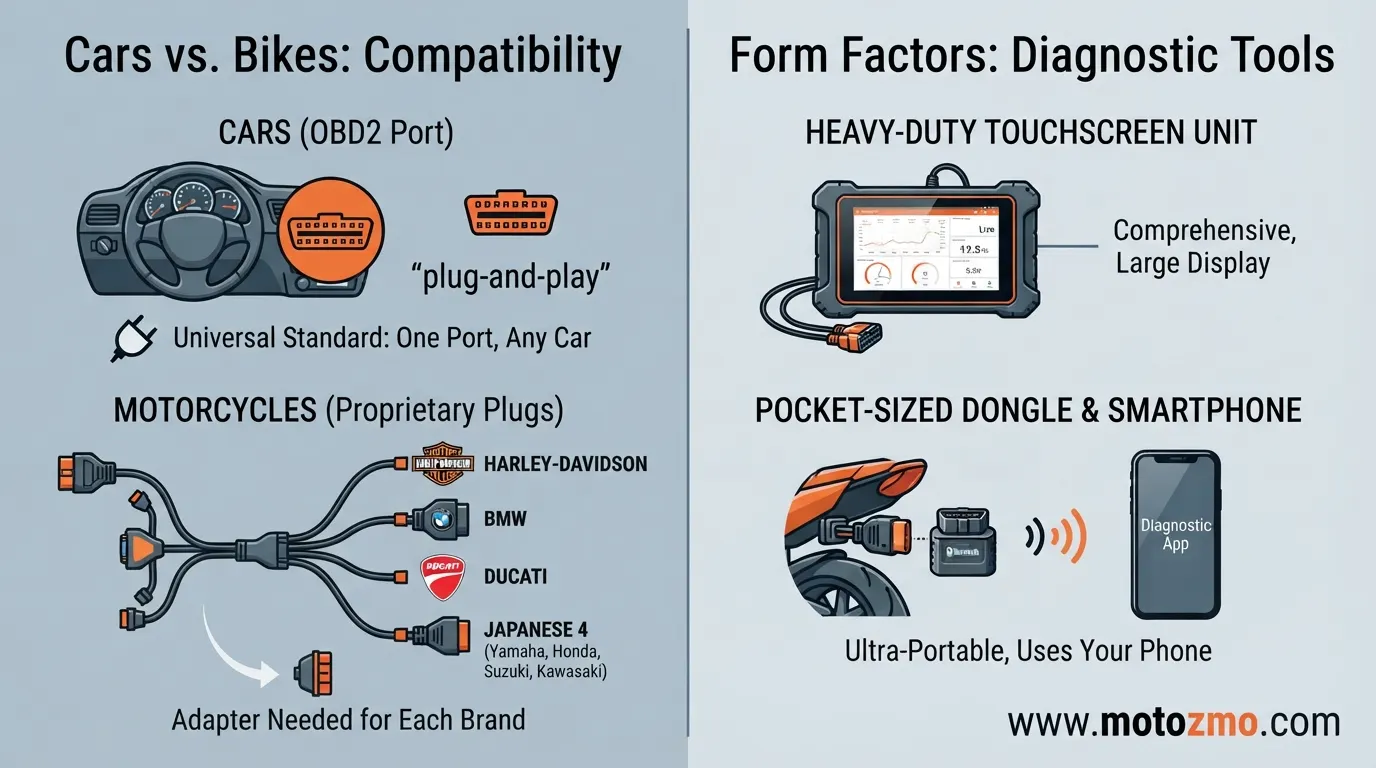
But before you buy any scanner on this list, know one thing. Cars have used a single standardized diagnostic port and protocol since 1996. Motorcycles have no universal standard. Confirm a scanner actually talks to your specific make, model, and year before anything else. “OBD2 scanner for motorcycles” is a much looser category than it sounds.
What Actually Matters Before You Buy
Compatibility Isn’t Universal, and That’s the Real Catch
This is the most important thing to understand before you spend a dollar. A car built after 1996 will talk to almost any OBD2 scanner through the same standardized port. Your motorcycle almost certainly won’t.
Some modern bikes use OBD-II-compatible ECUs for basic engine diagnostics. But ABS and deeper service functions often require a motorcycle-specific tool, and major manufacturers like Harley-Davidson, Ducati, and BMW commonly need their own brand-specific adapter or connector rather than a generic port at all.
Check your bike’s exact make, model, and year against a scanner’s compatibility list before you buy. Don’t assume “it says motorcycles” on the box means it covers yours. If your actual problem is a starter-circuit issue rather than something a scan tool would catch, start with the right diagnostic order instead. A scanner won’t help you there.
Basic Code Reading vs Full-System Diagnostics
Decide what you need before paying for capability you won’t use. A basic scanner reads and clears engine fault codes. That’s useful but limited. A full-system tool goes further, covering ABS, TPMS, service resets, and sometimes bi-directional active tests that let you command a component directly rather than just reading data about it.
If your bike is throwing a backfire-related code or a warning light you can’t diagnose by eye, understanding what’s actually causing it first will help you figure out which tier of scanner you need.
Standalone Handheld vs Bluetooth/App-Based
A dedicated handheld unit with its own screen is more self-contained. It doesn’t depend on your phone’s battery or a stable Bluetooth connection.
An app-based scanner trades that self-sufficiency for a much smaller size. It’s pocketable in a way a 7-inch touchscreen unit never will be. Neither is objectively better. It’s a real tradeoff between portability and having a dedicated screen you’re not sharing with phone notifications.
Update Policy Matters More Than You’d Think
Every tool on this list includes some period of free software updates. Every one of them eventually asks you to pay to keep that database current.
Check what happens to the features you already have after that free period ends. A tool where your existing functions keep working without renewal is a better long-term buy than one that locks you out entirely.
Best Overall / Full-System: ANCEL MT700
7-inch touchscreen · 35+ service functions · AutoVIN · Wide brand coverage
Key Features
- AutoVIN rapid vehicle identification & 16+ manufacturer software pre-installed
- Advanced ECU coding, throttle relearn, and active ABS pump bleeding
- Heavy-duty, shockproof 7-inch sunlight-readable touchscreen interface
- One-touch Wi-Fi updates with no mandatory annual lockout subscriptions
This is the pick for you if you want professional-grade capability without paying dealer diagnostic fees every time a warning light comes on.
Beyond basic code reading, the MT700 covers engine, ABS, TPMS, instrument panel, suspension, ignition, and more across 16+ motorcycle brands. It offers 35+ service functions, including oil resets, throttle learning, ECU reset, and odometer writing.
This earns its price on exactly the kind of job a basic reader can’t touch. You can use it to reset a maintenance light and clear stubborn engine codes after a stall on a current-model Triumph. It’s also useful in properly activating an ABS module pump in service mode on a BMW adventure bike. That’s the kind of full-system access that would otherwise mean a dealer visit.
If you’re an independent mechanic, a serious DIY builder, or you own more than one bike and want one tool that covers most of what you’ll encounter, the upfront cost is worth it because of how much dealer-only work it lets you skip.
Best Value Full-System: ANCEL MT500 PLUS
5-inch screen · 9 brand-specific adapters included · Bi-directional control
Key Features
- Includes 9 proprietary brand-specific adapter cables right in the box
- Full bi-directional active component testing (relays, fuel pumps, injectors)
- Multi-vehicle coverage including motorcycles, ATVs, UTVs, and snowmobiles
If the MT700’s price is more than you need, this covers most of the same ground for considerably less. It does that by including exactly what most motorcycle scanners force you to buy separately: nine brand-specific adapters right in the box.
They cover Harley-Davidson, Honda, Yamaha, Kawasaki, Suzuki, Indian, Polaris, BRP, and Victory across more than a thousand motorcycles, ATVs, and UTVs.
Beyond code reading, this tool supports bi-directional control and active tests. That’s the ability to send a command directly to a component, like a pump or relay, and watch how it responds in real time, rather than just reading a code and guessing at the cause. That’s a useful step up from a basic reader.
It lets you confirm a suspected failure before you spend money replacing a part that was never the problem. The device also provides consistent, reliable results across a range of makes and models, with an interface simple enough to use without digging into the instructions first.
Build quality here is solid for the price, though it’s a step below what you’d find in a dedicated shop-grade tool. Expect years of use out of it, just don’t toss it around carelessly.
Best Portable / App-Based: TOPDON TopScan Moto
2.8-inch screen · Bluetooth 5.0 · Smartphone app · 20 system modules
Key Features
- Ultra-compact Bluetooth 5.0 dongle fits easily into a jacket pocket
- One-touch oil reset and basic fault clearing for quick road trip checks
- Real-time live data graphing directly on your iOS or Android phone
- Deep scans across 20 system modules including smart key and audio
If a 5- or 7-inch handheld feels like overkill for what you need (the occasional code check, not a full shop workflow), this is built for exactly that. It pairs over Bluetooth with a smartphone app.
It covers engine, ABS, smart key, and entertainment systems across 20 internal systems, all from a device small enough to disappear into a jacket pocket or tank bag.
Get it if you want to check a warning light or reset a service indicator without hauling out a full diagnostic kit. Use it to reset an oil service light directly from an iPhone on a BMW, along with reading and clearing codes. It’s functional for the kind of quick check most riders need most of the time.
The tradeoff: getting the most out of it on brands like Ducati, Harley, or BMW requires optional brand-specific adapters sold separately. Factor that into the real total cost rather than judging by the base unit’s price alone. The instructions are not quite detailed, though the app itself is easy enough to figure out without much trouble.
Which Tool Could Be the Best for a Specific Brand?
If your bike already requires a brand-specific adapter anyway, which, as covered above, is common for Harley, Ducati, and BMW, it’s worth asking whether a dedicated, brand-specific diagnostic tool actually outperforms a general-purpose scanner for your bike, rather than defaulting to whichever “universal” tool has the widest marketing claim.
A tool built and maintained around one manufacturer’s protocols often accesses deeper, more reliable functions for that brand than a general multi-brand scanner will, precisely because it isn’t trying to cover a dozen other manufacturers at the same time.
If you own a single brand and don’t need multi-bike coverage, research what exists specifically for your bike before defaulting to a general-purpose pick.
The Bottom Line
Confirm compatibility with your exact bike before you compare anything else on this list. That single check matters more than any feature comparison between these three tools. The ANCEL MT700 is the strongest full-system pick if your budget allows it. The MT500 PRO delivers most of that capability with adapters included at a lower price. The TOPDON TopScan Moto is the right call if portability matters more to you than a dedicated screen. Whichever you choose, remember it’s a tool for confirming and narrowing down a problem, not a substitute for the diagnostic order that actually solves one.
FAQs
Does my motorcycle even have an OBD2 port?
Not necessarily, and definitely not a standardized one the way a car does. Some modern bikes use OBD-II-compatible connectors for basic engine diagnostics, but many others use manufacturer-specific ports that require a dedicated adapter. Confirm this for your specific bike before assuming any scanner will simply plug in.
Can a scanner diagnose a clicking, no-start issue?
Generally not directly. A clicking-but-not-starting symptom is almost always a starter-circuit issue: battery, connections, or relay. A multimeter diagnoses that far more directly than a scan tool does.
Do I need a brand-specific adapter for my bike?
Often, yes, especially for Harley-Davidson, Ducati, and BMW. Check the exact compatibility list for any scanner you’re considering rather than assuming broad “motorcycle” compatibility covers your brand.
What’s the real difference between basic code reading and full-system diagnostics?
Basic code reading covers engine fault codes only. Full-system diagnostics extend to ABS, TPMS, service resets, and on some tools, bi-directional active tests. That’s useful if you’re doing more than checking why a warning light came on.