

A clicking noise when you hit the starter almost always means the starter isn’t getting enough current to turn the engine over.
The most likely causes, in order, are a weak battery (even one that looks charged), corroded or loose connections, or a failing starter relay or solenoid.
Most of these are simple and cheap to fix. A rare few aren’t. Here’s the right order to check things, so you’re not guessing or replacing parts that were never the problem.
Key Takeaways
- Clicking almost always means insufficient current (the starter isn’t getting enough power to turn the engine over, not that the starter itself has failed).
- Check the obvious 30-second items first: kill switch position, neutral/clutch engagement, and side stand position rule out the most common non-issues before any tools come out.
- A battery reading 12.6V at rest can still collapse under cranking load; the cranking voltage test (below 9.5V while starting = failing battery) is the test that actually matters.
- Corroded or loose connections are the cheapest fix, and the relay tap test is your fastest relay check.
- A basic multimeter is all you need. An OBD2 scanner does not diagnose starter circuit problems; resting voltage, cranking voltage, and relay continuity cover the entire diagnostic sequence.
- Repeated start attempts make things worse. Each attempt drains a weak battery further and builds heat in a struggling relay or starter motor; diagnose first, crank second.
Rule Out the Obvious First
Before you touch a wrench or a multimeter, confirm the basics. Make sure the kill switch hasn’t been bumped to off. Check that the bike is in neutral, or that the clutch is pulled in on bikes that need it.
On bikes with a side stand safety switch, make sure the stand is up. Many motorcycles refuse to start with the stand down, and it’s easy to miss when you’re focused on the clicking noise.
This takes thirty seconds. It rules out the most common non-issue before you go any further.
Why a “Good” Battery Can Still Cause This
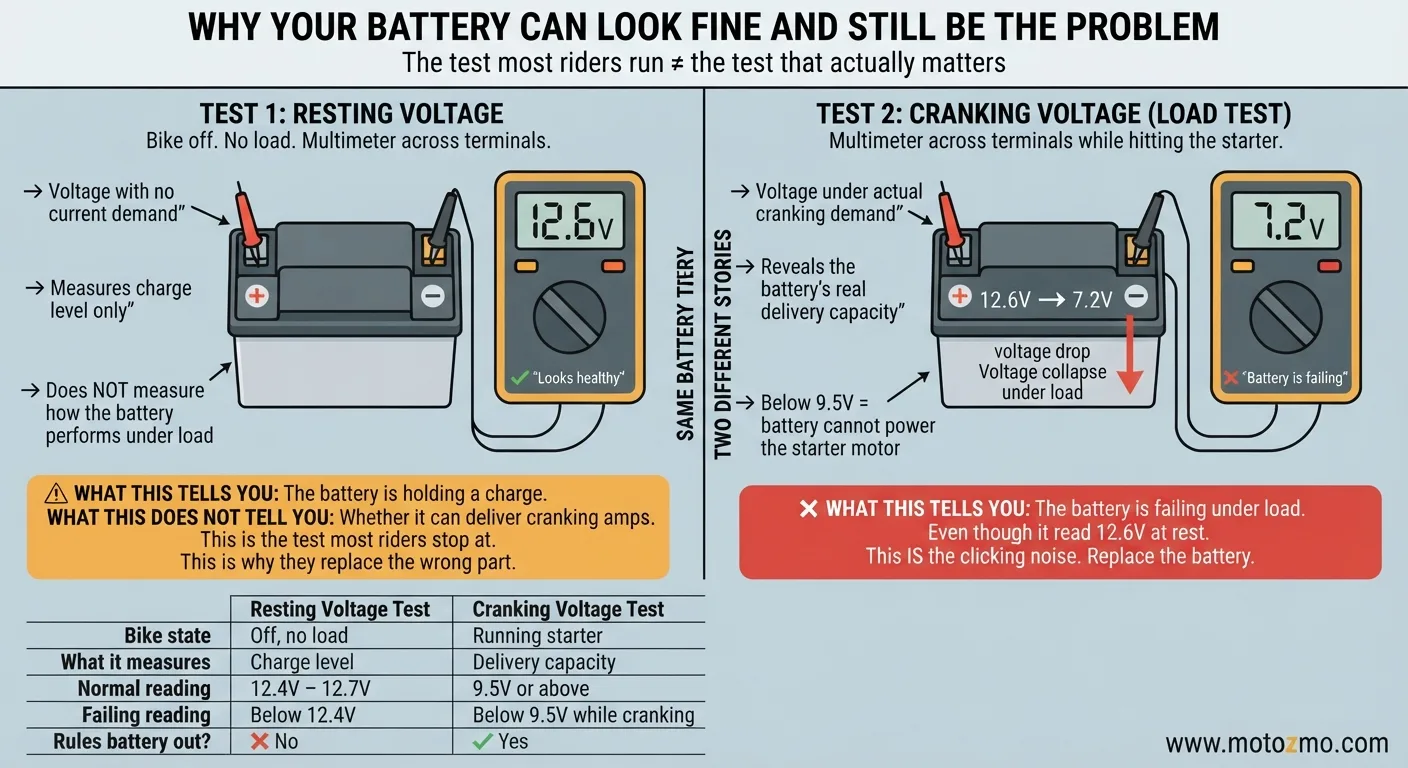
Most troubleshooting guides skip this part, and it’s the most important one to understand. A battery can hold a completely normal resting voltage, say 12.6V with the bike off, and still collapse the moment it has to deliver the much higher current a starter motor demands.
Resting voltage tells you the battery is holding a charge. It doesn’t tell you whether the battery can deliver real cranking amps under load. That’s a different test.
So “I checked the battery and it’s fine” doesn’t rule the battery out. For the full diagnostic, including how to test cranking voltage and not just resting voltage, the full battery diagnostic covers how to confirm this one way or the other before you move on.
Check the Connections Next
If the battery checks out, this comes next, and it’s the most common and cheapest fix on this list. Corroded or loose battery terminals add resistance at the exact point where your starter needs every amp.
A frayed or loose ground strap between the engine and frame breaks the circuit just as effectively as a dead battery, even with a good battery installed.
A visual inspection catches most of this. Look for white or greenish crust on the terminals. Wiggle the connections to check for looseness. Trace the ground strap for any obvious fraying or corrosion. A wire brush, a bit of cleaning, and a snug reconnection fixes this in minutes. It costs nothing beyond your time.
The Starter Relay and Solenoid
If the battery delivers real cranking voltage and the connections are clean and tight, the relay or solenoid is the next suspect. The click you’re hearing is often the relay trying to engage without passing enough current through to the starter motor. Worn internal contacts, a weakening coil, or a failed relay all produce the same symptom.
A simple field test can point you in the right direction before you buy anything. Have someone hit the starter button while you gently tap the relay itself. It’s usually a small, boxy component near the battery. If the engine suddenly turns over the moment you tap it, that’s a strong sign the relay’s internal contacts are the problem rather than anything upstream.
For a firmer answer, a continuity test across the relay’s main terminals with the coil energized will confirm it directly. A working relay should show continuity when powered and none when it isn’t.
When It’s Something More Serious: A Seized Engine
If the battery delivers real cranking voltage, the connections are clean, and the relay tests fine, there’s one more possibility. It’s rare, but real. A seized engine means the internal parts (pistons, bearings, the crankshaft itself) are physically locked in place.
This almost always comes from severe overheating or a long lack of lubrication. Here the starter has power and is trying to engage, which is the click you hear, but the crankshaft can’t rotate no matter how much current reaches the starter motor.
Engine seizure is caused by overheating or a lack of proper lubrication. Be clear about how rare this is compared to everything above. The vast majority of clicking-but-not-starting cases are electrical, not mechanical. Don’t jump to this conclusion until you’ve ruled out the battery, connections, and relay first, in that order.
Diagnosing With the Right Tools
For this problem, a basic multimeter is the tool that matters. Checking resting voltage, cranking voltage under load, and continuity through the relay covers everything above. You don’t need anything more sophisticated to work through this checklist.
Be honest about where an OBD2 scanner does and doesn’t help. On fuel-injected bikes, a scan tool can help rule out certain ECU-side issues. But it won’t diagnose a starter-circuit problem directly. That’s not what it’s built to check.
If you’re looking at scan tools for other electrical work down the road, here’s what to look for, with that caveat in mind. For the clicking-and-not-starting symptom, your multimeter is doing the real work.
The Bottom Line
Work through this in order (battery, connections, relay) and you’ll find the actual cause without replacing parts that were never the problem. Most of the time this is a weak battery or a corroded connection. Both are cheap and simple to fix. If you’ve ruled all of that out and you’re still hearing a click, the rare mechanical explanation above is worth another look before you assume the worst.
FAQs
Why does my motorcycle click but not start even with a new battery?
A brand-new battery rules out age and internal wear, but not a bad connection or a failing relay. Both can still cause clicking no matter how new the battery is. Work through the connections and relay checks even after a battery swap.
Can a bad ground cause a motorcycle clicking, no-start condition?
Yes. A loose or corroded ground strap between the engine and frame breaks the circuit just as effectively as a weak battery, even when the battery itself is in perfect condition.
How do I tell if it’s the bike’s starter relay or the starter motor itself causing the clicking sound?
The tap test is the fastest first check. If tapping the relay while someone hits the starter makes the engine suddenly turn over, the relay’s contacts are the likely cause. If tapping the relay changes nothing, the issue may be further downstream at the starter motor itself.
Is it safe to keep trying to start a bike that’s just clicking?
Repeated attempts drain an already weak battery further. They can also build up heat in a struggling starter motor or relay. Work through the diagnostic order above rather than hitting the starter and hoping.