
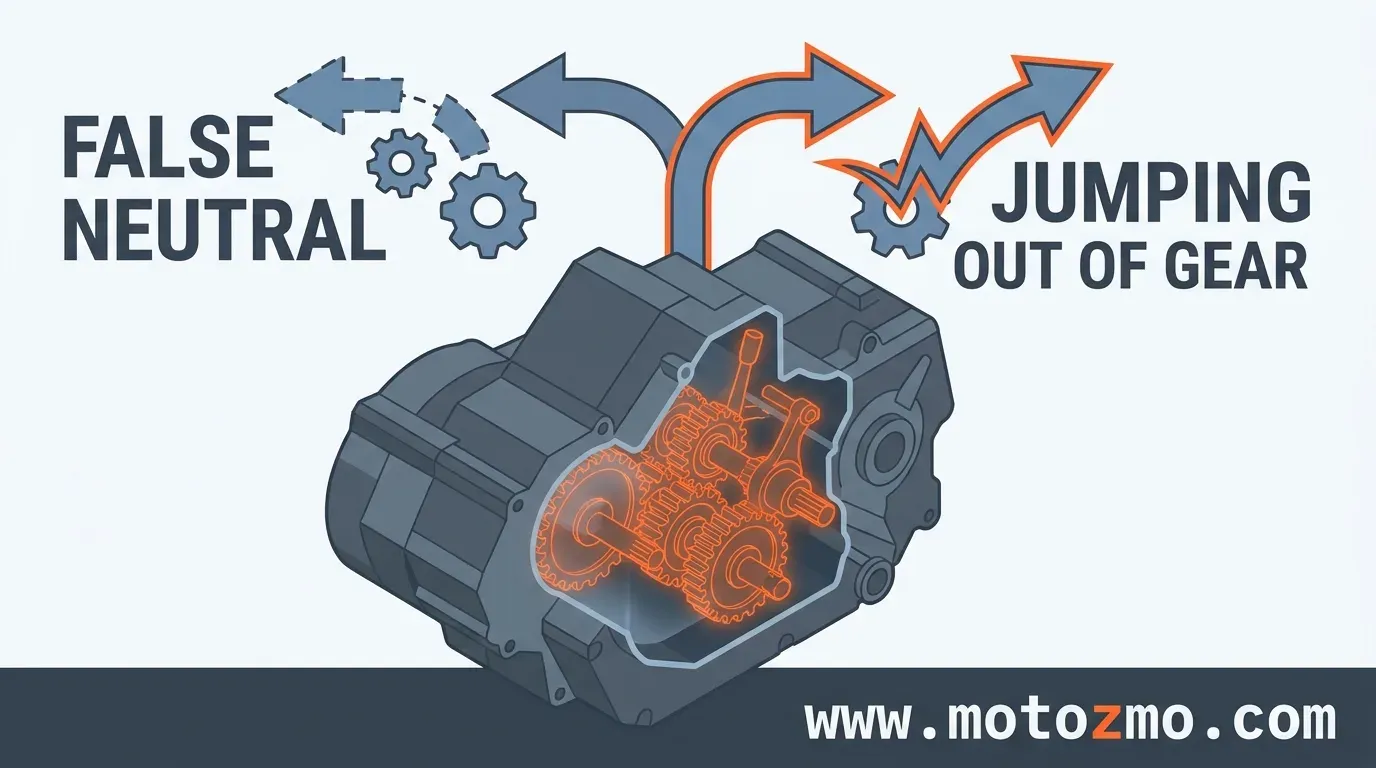
A gear that pops itself out while you’re riding, especially under acceleration or engine braking, is almost never the clutch. It’s the transmission itself, and it means something inside the gearbox has worn enough to stop holding a gear the way it’s supposed to. That’s a different issue from a clutch that won’t fully disengage at a stop, which is dragging, not this. Our clutch and transmission problems pillar covers both, along with slipping, so you can confirm which one you’re actually dealing with.
This article goes deep on the one that’s mechanical: what’s happening inside the box, what causes it, and why it’s worth taking seriously.
Symptom-to-Cause Quick Reference
| What you’re noticing | Likely cause |
|---|---|
| One or two isolated false neutrals, different gears, no pattern | Normal, especially on a bike you don’t know well yet |
| Same gear, same load direction, every time | Worn dogs on that gear pair |
| Gear pops out under acceleration specifically | One dog face worn, likely from hard upshifts |
| Gear pops out under engine braking specifically | The opposite dog face worn |
| Shift lever feels loose or has extra play before it does anything | External linkage, worth checking yourself first |
| Problem is getting worse over a short number of rides | The wear cycle is compounding; don’t keep riding it hard |
Two Things That Get Lumped Together, and Shouldn’t Be
A false neutral happens during a shift. You go for the next gear, the selector doesn’t quite seat it, and you land in the gap between two gears with the engine free-revving and no drive to the wheel. Every rider hits this occasionally, especially on a bike they don’t know well or during a rushed shift, and one or two isolated false neutrals on an otherwise healthy bike usually isn’t a sign of anything wrong.
Jumping out of gear is different. The gear was fully engaged, you were riding along in it normally, and it kicks itself back out on its own, no shift involved. This one doesn’t happen on a healthy gearbox. If it’s happening in the same gear, under the same kind of load, more than once, that’s mechanical wear talking, not a fluke.
What’s Holding a Gear Engaged
Motorcycle gearboxes use dog engagement rather than the synchromesh most car transmissions use, which is why you can bang off a full-throttle upshift on a motorcycle without needing to match revs the way a car’s synchros would force you to.
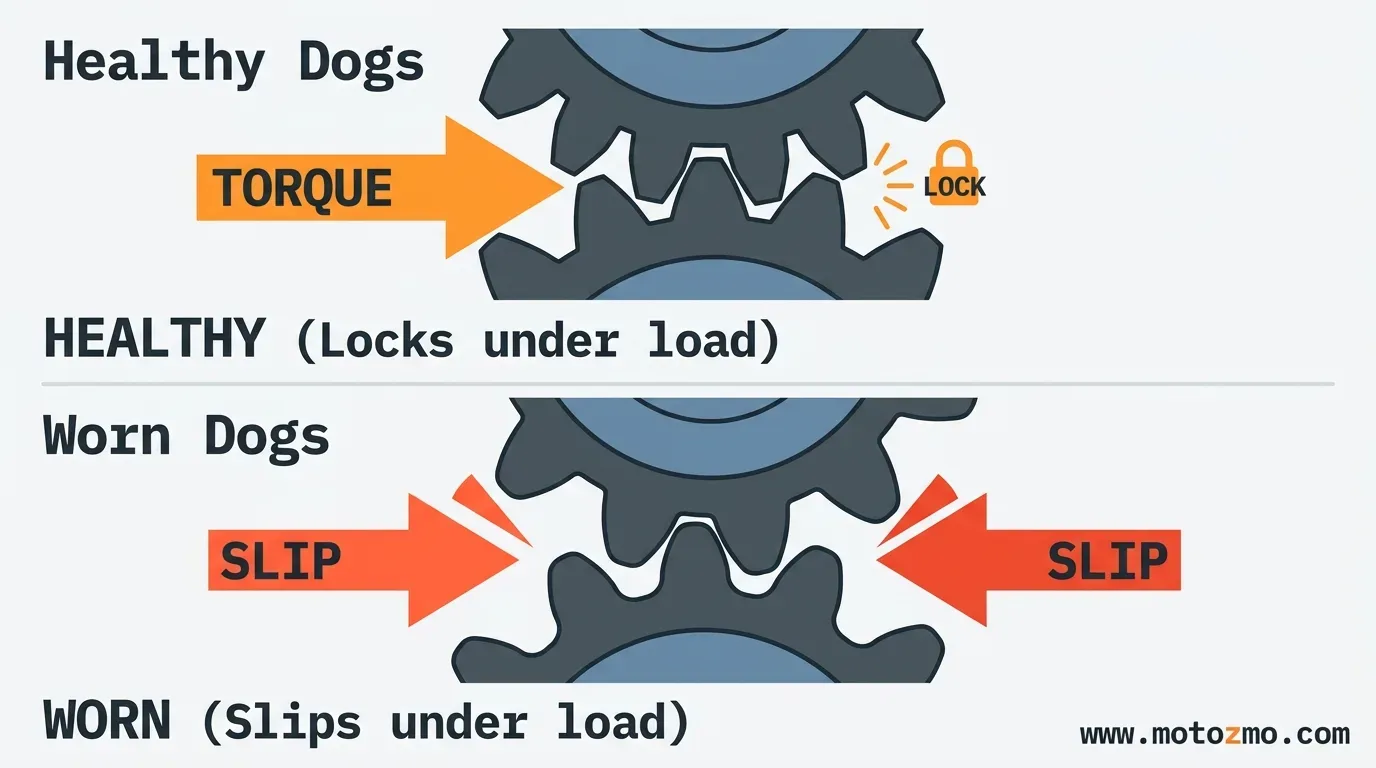
Each gear pair locks together through a set of dogs, blocky teeth that interlock rather than smooth cone-shaped rings. Most motorcycles have used this type of gearbox since the 1930s, and it’s part of why motorcycle shifts happen so much faster than a car’s.
Here’s the part that explains why a worn gearbox pops itself out of gear: the engaging faces of those dog teeth aren’t cut flat. They carry a slight back-cut, an angled taper that means once two dogs lock together, the engine’s own torque is what holds them engaged rather than fighting to push them apart. It’s a self-locking geometry. That taper is doing real work, and it’s also exactly what wears away first. Round off that back-cut edge through enough miles of hard use, and the geometry that used to hold the gear together under load starts doing the opposite: instead of torque locking the dogs in, it starts levering them apart.
What Causes It
Worn or rounded gear dogs. This is the root cause behind most true jump-out cases, and it’s a wear problem, not a defect. Aggressive shifting, especially hard, fast upshifts under full throttle repeated over and over, rounds off that self-locking taper faster than normal riding does. Second gear tends to take the worst of it on a lot of bikes, since it’s the gear most riders are in when they’re accelerating hardest away from a stop, whether that’s commuting through city lights or launching off the line. Worn dogs let go earliest under the load direction they’re weakest against, which is usually acceleration for one set of dog faces and engine braking for the opposite set.
A bent or worn shift fork. The fork’s job is to deliver the dog ring into position, not to hold it there once it’s engaged; that holding job belongs entirely to the dogs themselves. But once dogs start rounding off and the gear starts trying to kick back out under load, the fork takes the side-load and heat of that repeated near-disengagement, and it wears too. Once you find one worn, expect to find the other, and most shops replace them as a set rather than one at a time.
A worn or damaged shift drum. The drum’s grooves are what position every fork at every gear change, so wear or damage here throws off how fully each fork seats its gear, even if the dogs and forks themselves are otherwise fine.
A misadjusted or worn external shift linkage. This is the one part of the chain you can actually inspect yourself without opening the cases. A linkage that’s loose, bent, or out of adjustment can prevent the shift lever’s movement from fully rotating the drum, which means the gear never gets the full throw it needs to seat properly.
Excessive chain slack, as a contributing factor. This one surprises people. A chain that’s running loose transmits a jolt of slack-then-shock every time you get on and off the throttle, and that repeated shock loading through the drivetrain can aggravate a gear that’s already marginal. It’s rarely the sole cause on its own, but it’s cheap and worth ruling out, especially since keeping your chain in spec matters for plenty of other reasons too. Our guide to motorcycle chain skipping and slack covers how to check and adjust it.
A Clue That Costs You Nothing: Which Direction of Load
Pay attention to whether the gear lets go under acceleration, under engine braking, or both. Dog teeth have two engaging faces, one for each direction of torque, and they don’t necessarily wear evenly. A gear that only pops out when you chop the throttle and let engine braking take over is telling you something different than one that only pops out when you’re accelerating hard.
Neither tells you the exact part without opening the case, but it’s a genuinely useful clue to bring to whoever ends up doing the diagnosis, and it costs you nothing but paying attention on your next few rides.
What You Can Check Yourself, and What You Can’t
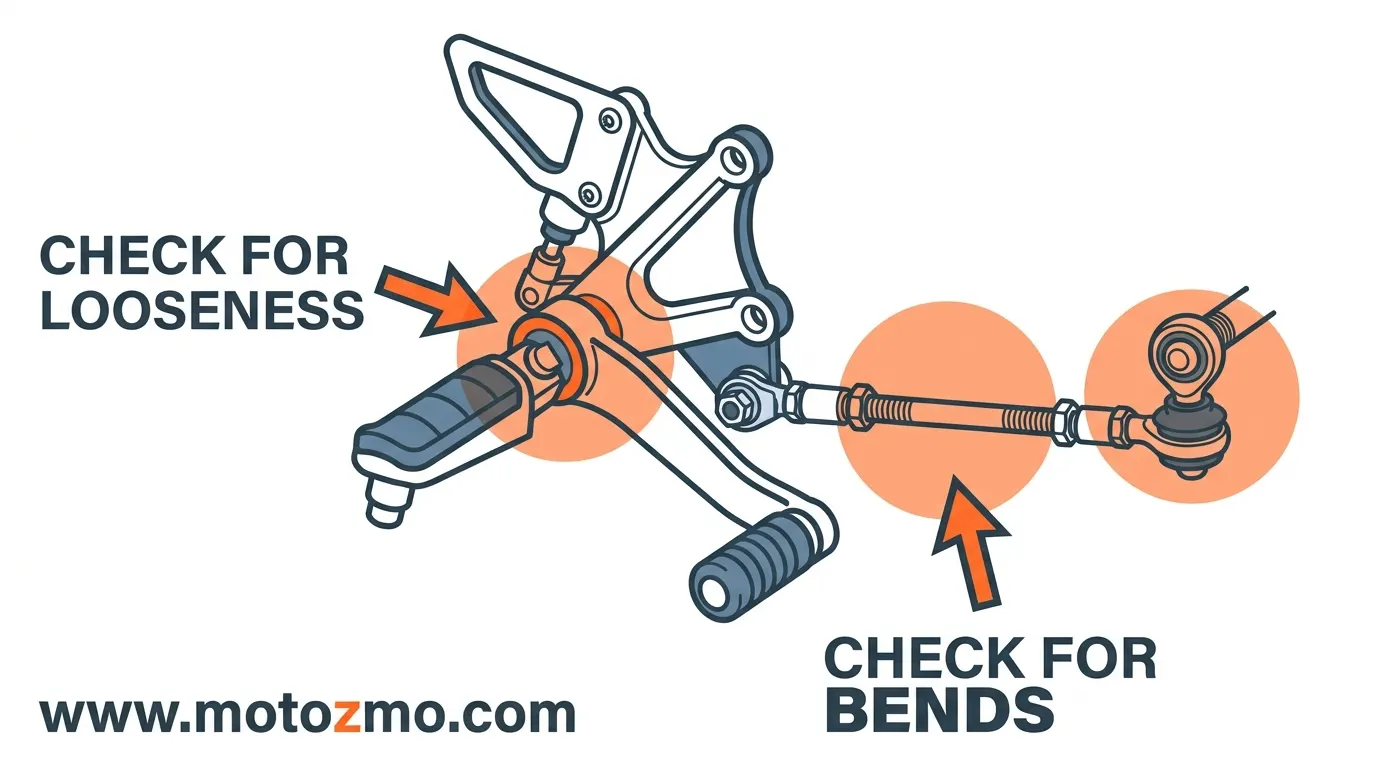
The external shift linkage is realistically the only part of this you can inspect without splitting the cases. Look for a bent linkage rod, a loose pivot, or play in the joints, and confirm the shift lever has its full range of motion.
If that all checks out, everything else, gear dogs, shift forks, the shift drum itself, lives inside the engine cases. Diagnosing those means a teardown, and that’s a shop job for the overwhelming majority of riders, not a driveway one.
How Dangerous This Is
This is the one clutch-adjacent problem on this site where the safety framing isn’t hedged. Losing drive suddenly, mid-corner or mid-acceleration, is a genuinely dangerous way to have a bike behave, and it’s not a problem that improves with time or gentle riding.
Once dogs start rounding off, the wear compounds itself: a marginal gear kicks out under load, that kicking-out event puts extra shock on the fork and drum, and the next occurrence tends to come sooner than the last one did.
If your bike is repeatedly popping out of the same gear, get it looked at before you put more miles on it, and avoid riding it hard, especially in the gear and load direction where it’s happening, in the meantime.
What the Repair Involves
Once you’re past the external linkage check, this is teardown territory, splitting the cases to get at the dogs, forks, and drum directly. It’s a bigger job than a clutch kit swap, and realistically not a first attempt at engine work for most home mechanics.
For where this repair typically lands cost-wise compared to the other clutch and transmission fixes, the clutch replacement cost article has the full cost breakdown.
The Short Version
An occasional false neutral during a shift is usually nothing. A gear that pops itself out on its own, in the same spot, more than once, is the transmission telling you its dog teeth, shift fork, or shift drum have worn past holding a gear the way they’re designed to. Whether it happens under acceleration or engine braking is a genuinely useful clue, even before anyone opens the case. The external shift linkage is the one thing worth checking yourself. Everything past that needs a shop, and it’s worth getting there before you put more hard miles on a gear that’s already telling you it’s failing.