
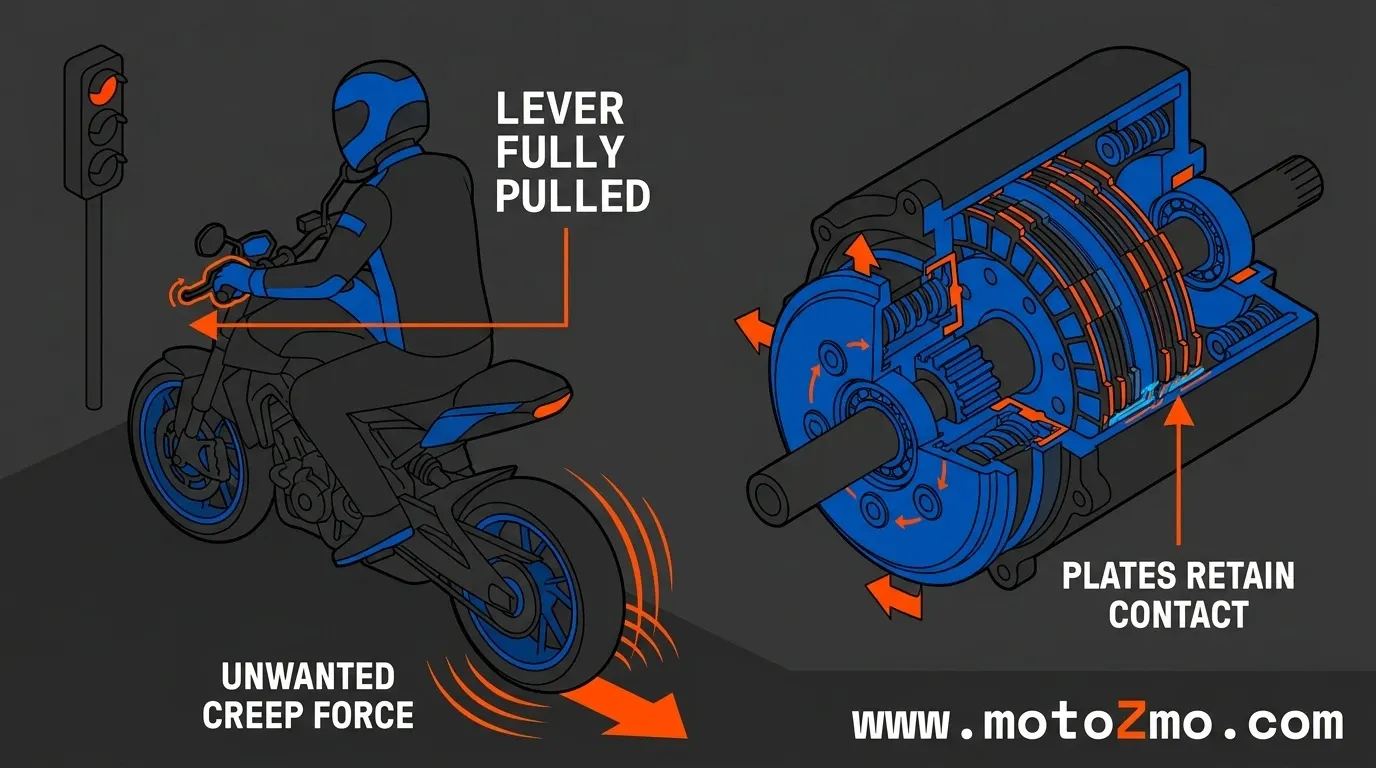
A dragging clutch is one that stays partially locked even with the lever pulled all the way to the bar. You’ll feel it as the bike creeping forward at a stop with the clutch in, gears going in with a notchy or grinding feel, and neutral getting hard to find, sometimes only showing up with the engine off. It’s the mirror image of a slipping clutch, which won’t grip hard enough. A dragging one won’t let go.
If you’re not sure which of the two you actually have, our guide to clutch slipping covers that side of it, and our clutch and transmission problems sorts out both against a third possibility: a transmission fault that has nothing to do with the clutch at all. This one is just about drag: what causes it, how to confirm it, and what you can fix yourself.
How It Shows up
The most obvious sign is the bike wanting to creep forward at a stop even with the lever held in, which is more than just annoying. It’s a real hazard in traffic, since it means you’re managing forward motion with the front brake or your foot on the ground instead of the clutch doing what it’s supposed to do. You’ll usually notice it alongside gears that go in with more resistance than normal, a grinding or notchy feel on downshifts especially, and neutral becoming genuinely hard to find at a stoplight when it used to click right in.
Drag often behaves differently depending on temperature and how long the bike has sat. Some drag clears up noticeably after a few minutes of riding as things warm up and free themselves; some is there cold and stays there all ride. That difference matters for diagnosis, which is why the next section splits into two tests instead of one.
Confirming It
The center stand test. Put the bike on a center stand, shift to neutral, and start it. Pull the clutch lever in and shift into first. If the rear wheel tries to turn with the lever held in, the clutch isn’t disengaging. That’s drag, confirmed.
The warm-up test. If the center stand test shows drag, ride it gently for five or ten minutes and repeat the test. Drag that noticeably improves or disappears after the bike warms up points toward plates that are temporarily stuck rather than a true mechanical problem, which changes what you should try first. Drag that’s identical cold or warm points toward cable adjustment, hydraulic fluid, or a genuinely worn part instead.
What’s Causing It
The causes split cleanly by how your bike actuates the clutch, plus a couple that apply either way.
If you’ve got a cable clutch
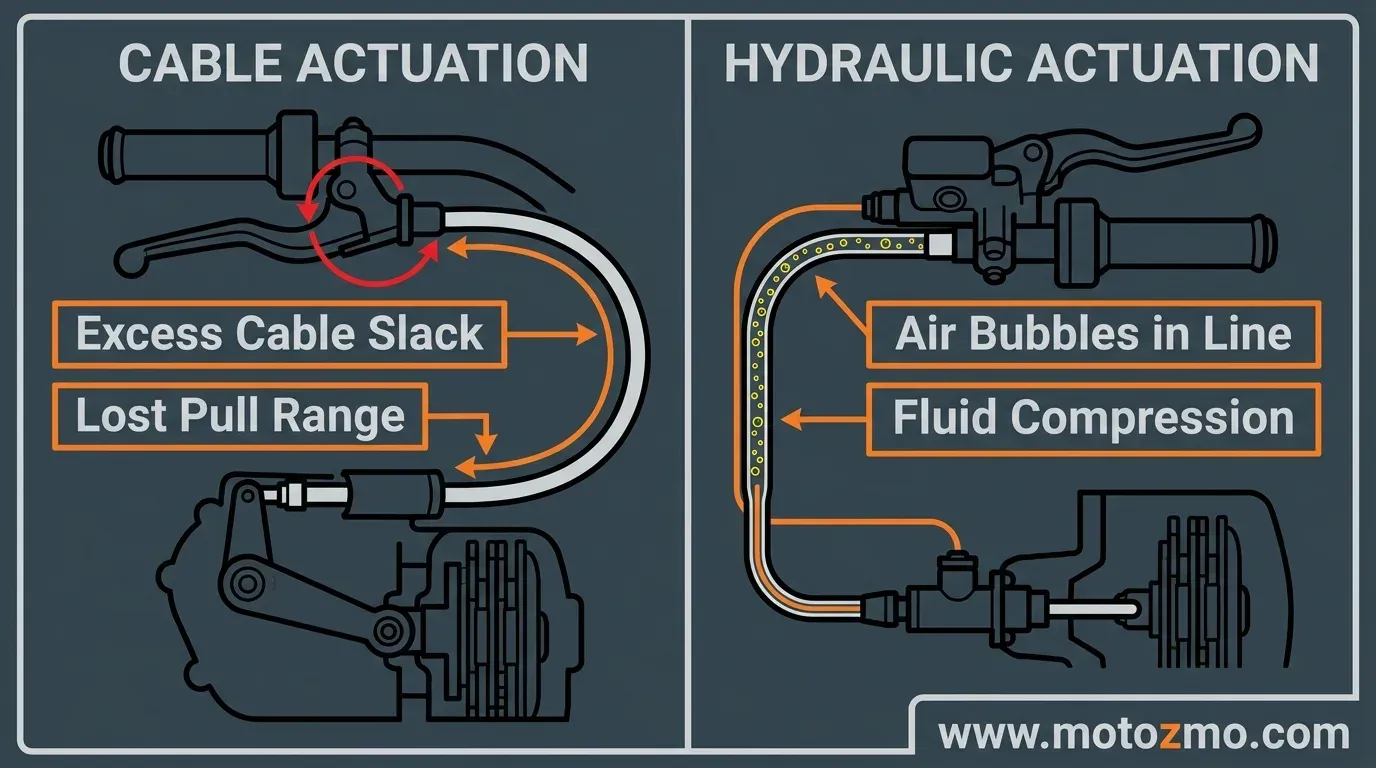
Too much slack in the cable is the most common cause by a wide margin. Free play at the lever is supposed to exist, but too much of it means pulling the lever in doesn’t fully relieve the spring pressure clamping the plates together. This is also the cheapest fix here: adjusting the cable is a five to ten minute job with a wrench, and it’s worth ruling out before anything else.
A cable that’s fraying or binding inside its housing can cause the same symptom even at the correct adjustment, since the housing itself is absorbing some of the pull instead of transmitting all of it to the clutch arm.
If you’ve got a hydraulic clutch
Air trapped in the line, or fluid that’s old and has absorbed moisture, is the hydraulic equivalent of cable slack. Both show up as a lever that feels spongy or inconsistent rather than firm, and both mean the clutch isn’t fully disengaging even though the lever travels normally.
Bleeding the system clears trapped air: crack the bleed valve at the slave cylinder, slowly pull the lever, close the valve, then release, repeating until no more bubbles show up in the line, and keep the reservoir topped off throughout so you’re not sucking fresh air back in.
One detail worth knowing before you touch the fluid: DOT 3, DOT 4, and DOT 5.1 are all glycol-based and compatible with each other, but DOT 5 is silicone-based and will damage the seals in a system designed for the others.
Check your manual before topping off with whatever’s on the shelf. A worn or leaking seal in the master or slave cylinder causes the same spongy symptom and doesn’t respond to bleeding, since the system just sucks air back in through the failing seal.
Either system
Plates stuck together from sitting. This is extremely common on a bike that’s been parked for weeks or months, and it’s usually not a real problem. Friction plates and steel plates can adhere to each other slightly from residual oil film when nothing’s moved them for a while. The fix is often just riding it: get to open space, pull the clutch in, put it in gear, and gently roll on the throttle while working the lever, which typically breaks the plates loose within a minute or two. If that doesn’t do it, popping the bike into gear on a center stand with the engine idling and the lever held in, as described above, will often free them the same way. Only if neither works are you looking at pulling the clutch cover to separate and clean the plates by hand.
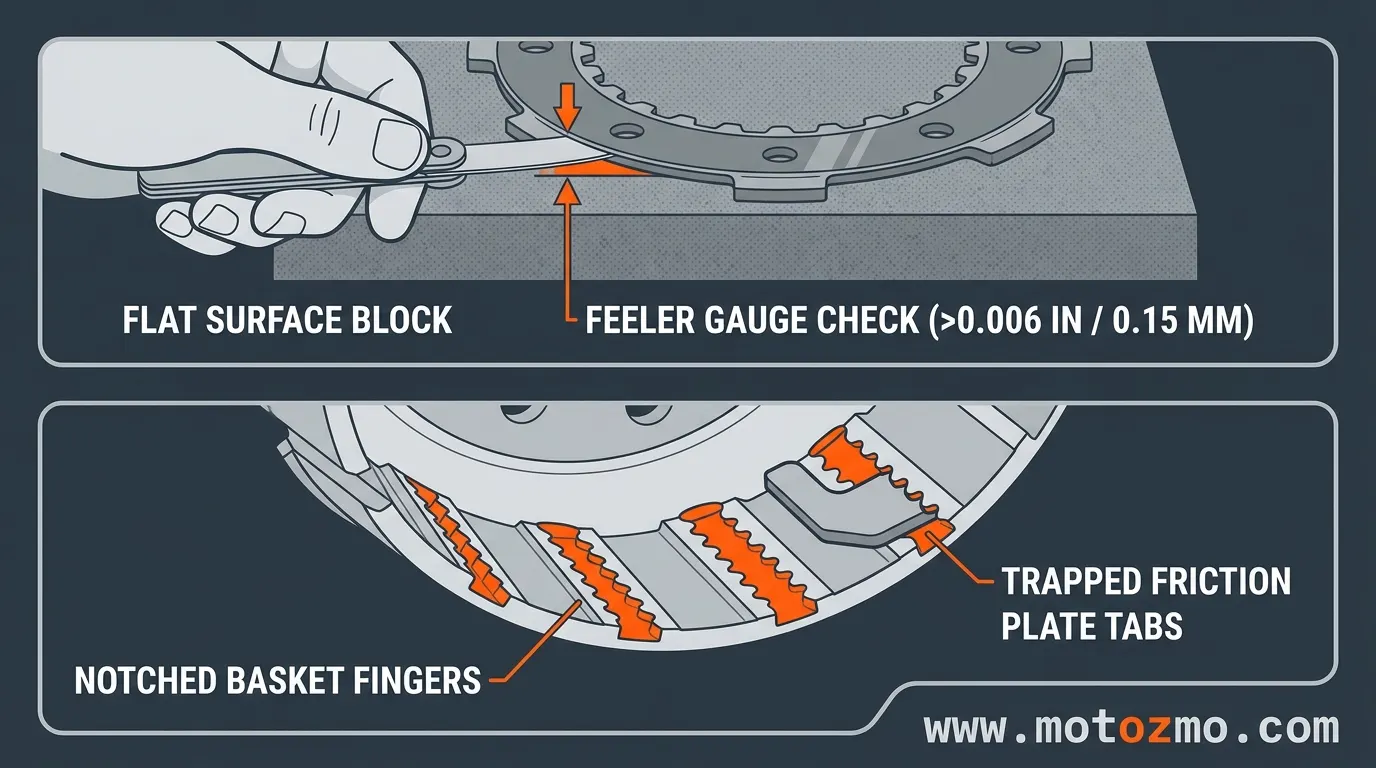
Warped plates. This one’s different from sticking. Warping comes from heat, usually the aftermath of a clutch that’s been slipping and running hot for a while, and it doesn’t clear up with riding the way stuck plates do. A warped plate can’t seat flat against its neighbors, so the stack never fully separates even under full spring release. Checking for it means pulling the clutch cover, laying each plate on a flat surface, and sliding a feeler gauge underneath at a few points around the edge. Most service manuals put the maximum acceptable warpage somewhere around 0.006 inches (0.15mm), though the exact number varies by bike, so confirm against your own manual rather than assuming. If a plate’s warped, it needs replacing. There’s no straightening it back to flat.
Basket notching. Grooves worn into the clutch basket fingers by the friction plate tabs, after years of use, can catch the plates and keep them from sliding freely even when everything else checks out. This tends to show up as drag paired with a grabby, jerky feel specifically during feathering, rather than a clean, steady creep. We cover that combination in more depth in our piece on why a motorcycle jerks when feathering the clutch.
For a deeper look at how cable and hydraulic systems differ in general, not just for this one symptom, our cable vs hydraulic clutch comparison breaks down which one fails how and which is easier to deal with roadside.
Symptom-to-Cause Quick Reference
| What you’re noticing | Likely cause |
|---|---|
| Drag is worse cold, improves after riding | Plates stuck from sitting |
| Drag is identical cold or warm, cable clutch | Cable slack or a binding cable housing |
| Drag is identical cold or warm, hydraulic clutch, lever feels spongy | Air in the line or old fluid |
| Drag persists after bleeding, hydraulic | Worn master or slave cylinder seal |
| Drag paired with a jerky, grabby feel during feathering | Basket notching |
| Bike has a history of slipping or overheating before drag showed up | Warped plates |
Don’t Confuse It with This
Hard-to-find neutral at a stop is a clutch symptom. A gear that pops out on its own while you’re riding, especially under power, is not. That’s almost always a transmission fault, worn gear dogs, a bent shift fork, or a loose shift drum, and it’s a different repair entirely from anything in this article.
We go into that one specifically in our piece on motorcycles jumping out of gear.
Is It Safe to Keep Riding on
Depends on which cause. Drag from cold plates that clears up after a few minutes of riding isn’t dangerous, it’s just a cold-start quirk, though a persistently sticky clutch is worth keeping an eye on over time. Drag from a cable or hydraulic issue is more of a nuisance than a hazard by itself, but it tends to get worse, not better, if you ignore it.
The genuine safety concern is the creeping-forward behavior at stops: if you’re relying on the brake alone to hold position at a light or in stop-and-go traffic because the clutch won’t fully disengage, that’s worth fixing sooner rather than later, especially if you ride in heavy traffic regularly.
Fixing It
Cable adjustment and a hydraulic bleed are both same-day, low-cost fixes, and worth trying first since they explain most cases of drag that aren’t just cold plates settling in.
Stuck plates from storage usually sort themselves out with a short ride. Warped plates, a failing master or slave cylinder, and basket notching all mean actual parts, in which case our guide to the best motorcycle clutch kits is a reasonable next stop.
For what any of these repairs typically cost, DIY versus a shop, the clutch replacement cost article has the full breakdown.
The Short Version
Drag means the clutch won’t let go, and the cause usually comes down to which actuation system you have: cable slack on a cable clutch, air or old fluid on a hydraulic one. Stuck plates from sitting are common and usually resolve with a short ride. Warped plates and basket notching are less common but need actual parts once you’ve ruled out the cheaper causes. The center stand test tells you if you’re dealing with drag at all, and riding it gently before you assume the worst tells you whether you’re looking at a five-minute fix or a teardown.