
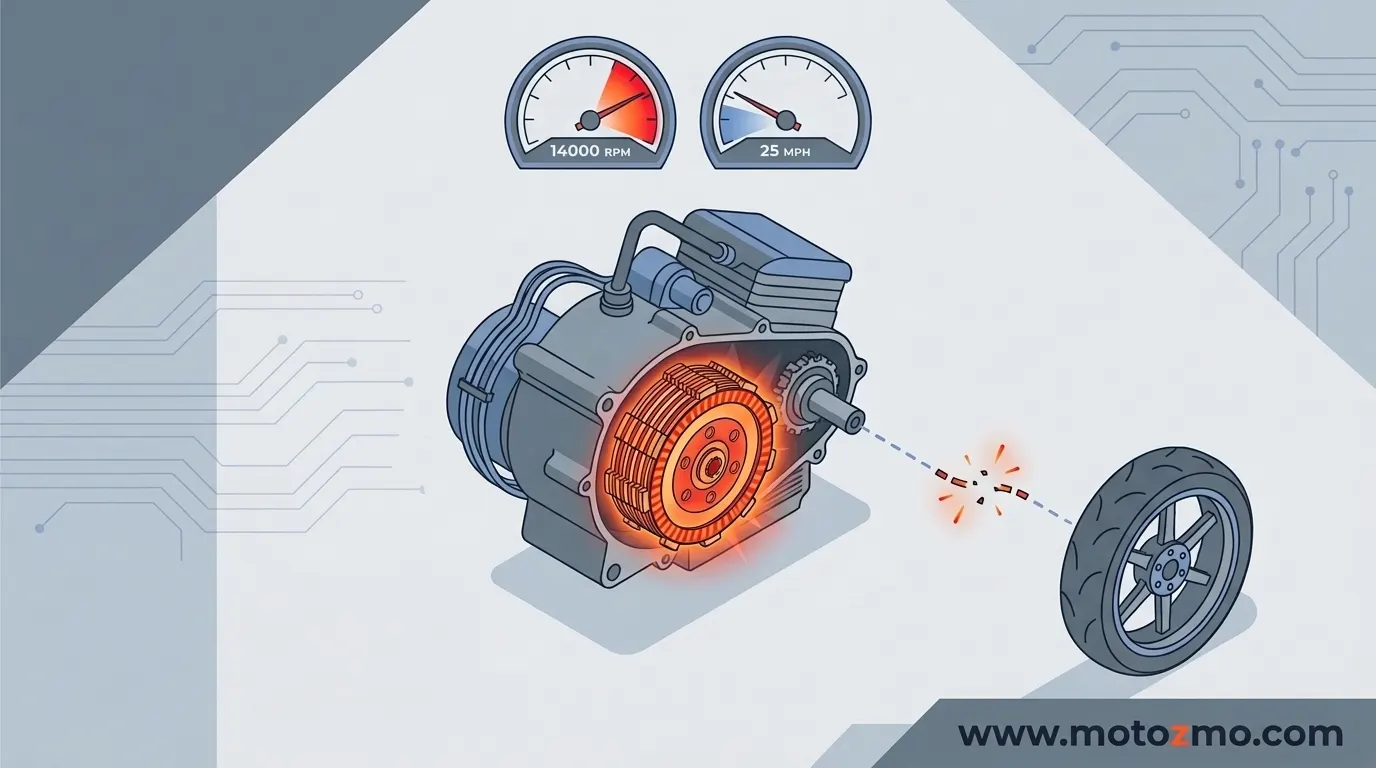
A slipping clutch feels like this: you roll on the throttle, the engine revs climb, and the bike just doesn’t pick up speed to match. It’s the sensation of power going in and not quite coming out the other end. Sometimes it only shows up under hard acceleration or going uphill; sometimes it’s there all the time and comes with a burning smell after a few minutes of riding. This is one piece of a bigger topic.
If what you’re feeling sounds more like the bike creeping forward at a stop with the lever pulled in, that’s the opposite problem, and our clutch dragging guide covers it. Not sure which one you’ve got, or wondering whether it’s actually a transmission fault instead? Our clutch and transmission problems pillar sorts out which is which.
Here, we’re going deep on slipping specifically: how it progresses, how to confirm it in your driveway, and the five things that cause it.
How It Usually Shows up First
Slipping rarely arrives all at once. The earliest tell most riders notice isn’t slip itself, it’s a change in where the clutch lever engages. If the bite point used to be near the middle of the lever’s travel and now it’s creeping out toward the grip, that’s often the clutch pack telling you it’s thinning before you ever feel a power loss. A lever that’s gone soft or a little vague, instead of the firm, springy resistance you’re used to, is another early flag.
From there it tends to show up first as a subtle lag under hard acceleration or on a grade, the kind of thing you might chalk up to a headwind or a heavy load before you recognize it for what it is.
Left alone, it progresses: slipping starts happening at lighter throttle, in more gears, and eventually you’ll get the burning smell as the friction material overheats sliding against the steel plates instead of gripping them. By that stage it’s not subtle anymore.
Two Ways to Confirm It
The stall test. With the bike stationary and the rear brake held firmly, put it in second gear and slowly roll on the throttle while easing the clutch lever out. If the RPM climbs noticeably without the bike straining hard against the brake, that’s slip. Keep it brief. You’re generating exactly the heat that’s already wearing the clutch down.
The rolling test. At a steady speed in a higher gear, quickly pull the clutch lever in and let it back out while holding the throttle steady. A healthy clutch will bog the engine slightly on release, since you’re asking it to instantly reconnect to the load of the moving bike. A slipping clutch just lets the revs climb instead, with no bog at all, because the plates are sliding rather than locking up.
Either test gets you a yes-or-no answer. Neither tells you which of the five causes below is responsible, that takes a bit more digging.
The Five Things That Cause It
These five causes account for the vast majority of clutch slip complaints, and they line up with what repair-manual publisher Haynes Manuals sees across brands and models.
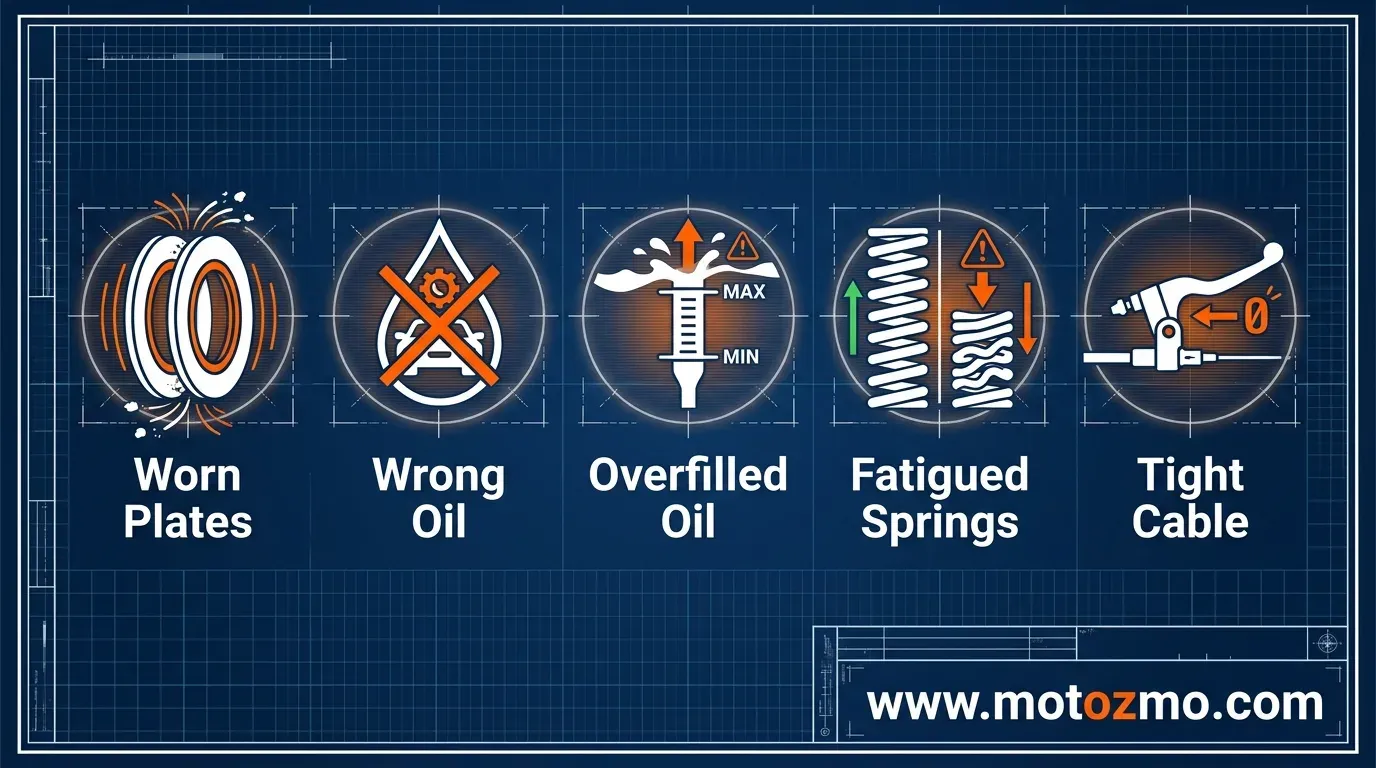
Worn friction plates. This is the one people assume by default, and it’s often right, but it’s earned by mileage and riding style rather than just age. Aggressive launches, quick clutch releases at high RPM, and a lot of stop-and-go riding all wear the friction material down faster than steady highway miles do.
The wrong engine oil. This one catches people off guard because the bike runs fine on the fresh oil, right up until it doesn’t. Motorcycle oil rated JASO MA or MA2 is formulated to keep friction where a wet clutch needs it. Automotive oil, especially anything marketed as energy-conserving, is loaded with friction modifiers built to reduce friction for fuel economy, which is exactly the wrong property for a clutch pack. If you recently switched oil brands or grabbed a bottle of car oil in a pinch, rule this out before you assume the clutch itself is worn.
Overfilled oil. Too much oil in the crankcase can interfere with how the clutch pack operates. If you topped off recently, check the dipstick before you look at anything else.
Fatigued springs. Heat is what does this in. A clutch that’s already been slipping and running hot wears its own springs out faster, which makes the slipping worse, so this one often shows up as a secondary cause riding shotgun with worn plates rather than as the original problem.
An over-tightened cable. Too little free play at the lever means the clutch never fully clamps down, even with your hand off it. It mimics worn plates almost exactly, but it’s a five-minute adjustment instead of a teardown.
One more thing worth a mention here, even though it’s more of a dragging symptom than a slipping one: a notched clutch basket (grooves worn into the basket fingers by the friction plate tabs over years of use) can make engagement feel inconsistent and grabby rather than a clean slip. If your symptom is specifically a jerk during feathering rather than a steady rev-speed mismatch, that’s a different animal. We cover it in our piece on why a motorcycle jerks when feathering the clutch.
Confirming It with a Ruler Instead of a Guess
If you’re already comfortable pulling the clutch cover, two measurements will tell you more than any symptom checklist can.
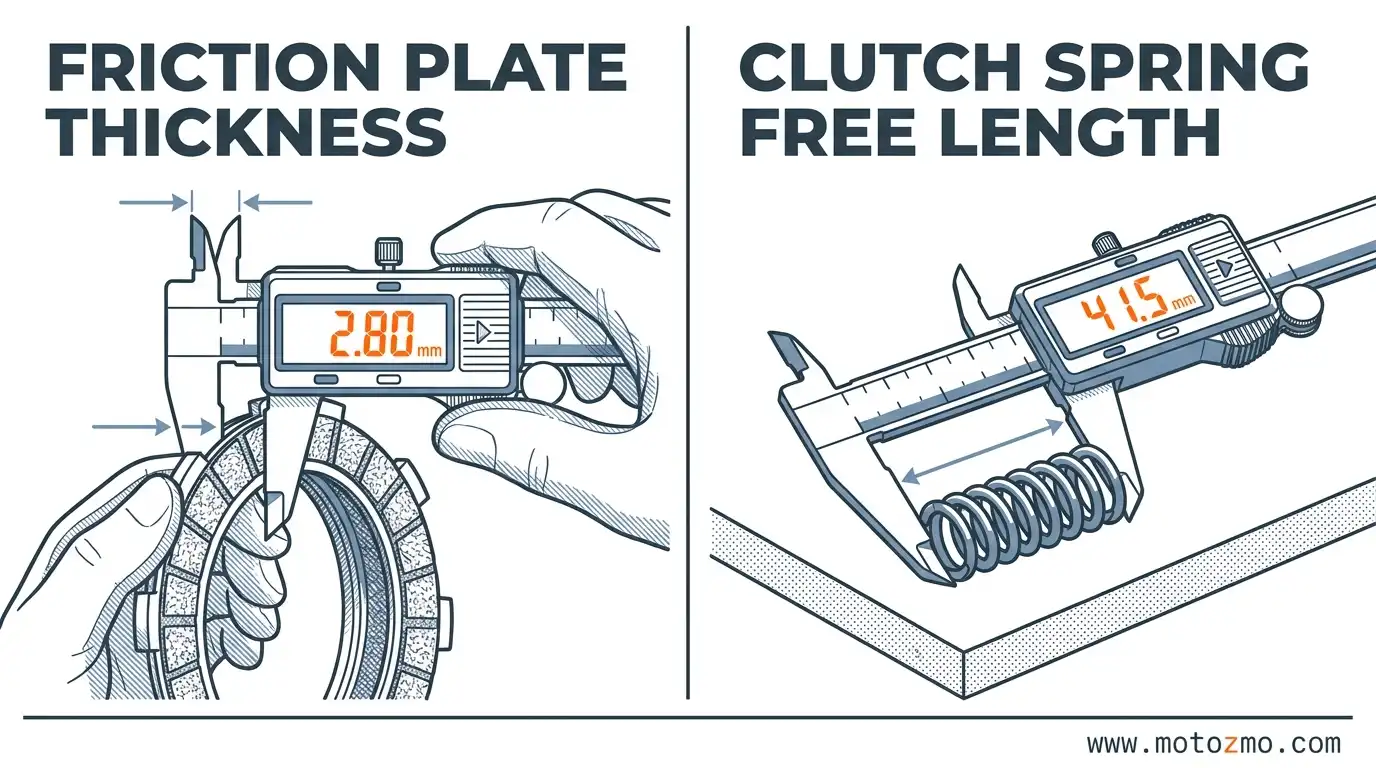
Friction plate thickness. Service manuals spec both a new thickness and a minimum service limit for each plate, and the gap between them varies a lot by model. As one real example, a popular Ducati twin runs 3mm friction plates with a 2.8mm service limit, while its thinner plates are speced at 2.5mm new with a 2.3mm limit. Other bikes allow a wider margin. There’s no universal number here, which is exactly why guessing at “how worn is too worn” without your specific manual in hand is a bad idea. Measure at two or three points around each plate, since wear isn’t always even.
Spring free length. Remove the springs and measure each one end to end with a caliper while it rests on a flat surface, then compare against the new spec in your manual. As springs fatigue they get physically shorter, and a shorter spring can’t supply the clamping force the clutch pack needs, even if the friction plates themselves still have life left in them. This is worth checking even when the plates measure fine, since spring sag is easy to miss if you’re only looking at plate wear.
A feeler gauge or a set of calipers earns its keep here.
Symptom-to-Cause Quick Reference
| What you’re noticing | Most likely cause |
|---|---|
| Bite point has crept toward the grip over time | Friction plates thinning |
| Slip appeared right after an oil change | Wrong oil, or overfilled oil |
| Slip appeared right after a cable adjustment or service | Cable too tight |
| Slip that’s gotten steadily worse over months, with a burning smell now | Worn plates, likely with fatigued springs alongside |
| Grabby, jerky engagement rather than a clean rev-speed mismatch | Probably not slip. Check basket notching |
Don’t Mistake It for This
A couple of engine problems can feel a little like a slipping clutch if you’re not paying close attention, and chasing the wrong one wastes time and money.
A misfire from a fouled plug or a fuel delivery problem causes power loss too, but it feels different under close attention: the engine stumbles, hesitates, or misses as you open the throttle, rather than revving up cleanly with nothing to show for it. A slipping clutch, by contrast, revs freely and smoothly. It just doesn’t connect that smooth rev to the road.
Low compression shows up as general weak acceleration everywhere, not the specific rev-without-speed disconnect that’s the signature of a slipping clutch, and it usually comes with harder starting and rougher idle too. If your bike is also missing, stumbling, or hard to start, look at the ignition and fuel side before you assume it’s the clutch.
How Urgent Is This, Really
Not every slipping clutch needs attention today. Mild slip that only shows up under hard acceleration or going uphill, with no burning smell, is something you can plan around: get the cause diagnosed and scheduled, but you’re not stranding yourself by riding it for a week or two while you sort out parts.
Slip that’s happening under light-to-moderate throttle, in multiple gears, or that comes with a burning smell, is a different situation. At that point you’re actively grinding down friction material every time you ride, and what might have been a cable adjustment or an oil swap a month ago can turn into a full plate-and-spring replacement if you keep putting miles on it.
Fixing It
Two of the five causes above are same-day fixes: a cable adjustment takes about ten minutes, and swapping to a JASO MA or MA2-rated oil is as quick as your next oil change. Worn plates or fatigued springs mean an actual clutch kit, which is a bigger job but still reasonable for a home mechanic on most standard-layout bikes.
For the full cost breakdown across all of these repairs, DIY and shop pricing both, check our article on the clutch replacement cost.
The Short Version
Slipping almost always traces back to one of five things: worn plates, the wrong oil, overfilled oil, tired springs, or a cable that’s too tight. Two of those are cheap, fast fixes. The other two mean a clutch kit. A stall test or a rolling test at steady speed will confirm you’re actually dealing with slip in the first place, and if the numbers are important to you, a caliper and your bike’s service manual will tell you exactly how much life is left rather than leaving you to guess.