
Most motorcycle clutch replacements land somewhere between $600 and $1,100 at a shop, parts and labor combined, though the real number depends far more on what kind of bike you ride than most cost guides let on. A naked Japanese standard, a fully-faired sportbike, a Harley, and a performance Ducati can all need “a clutch replacement” and end up with four completely different bills, because what actually drives the price is how much has to come apart before a wrench ever touches the clutch itself.
Our clutch and transmission problems pillar has a quick summary table across every repair in this cluster; this is the full breakdown, real ranges by bike type, what the parts themselves cost, and where DIY actually saves you money versus where it doesn’t.
What to Choose: Plates Only or the Full Kit
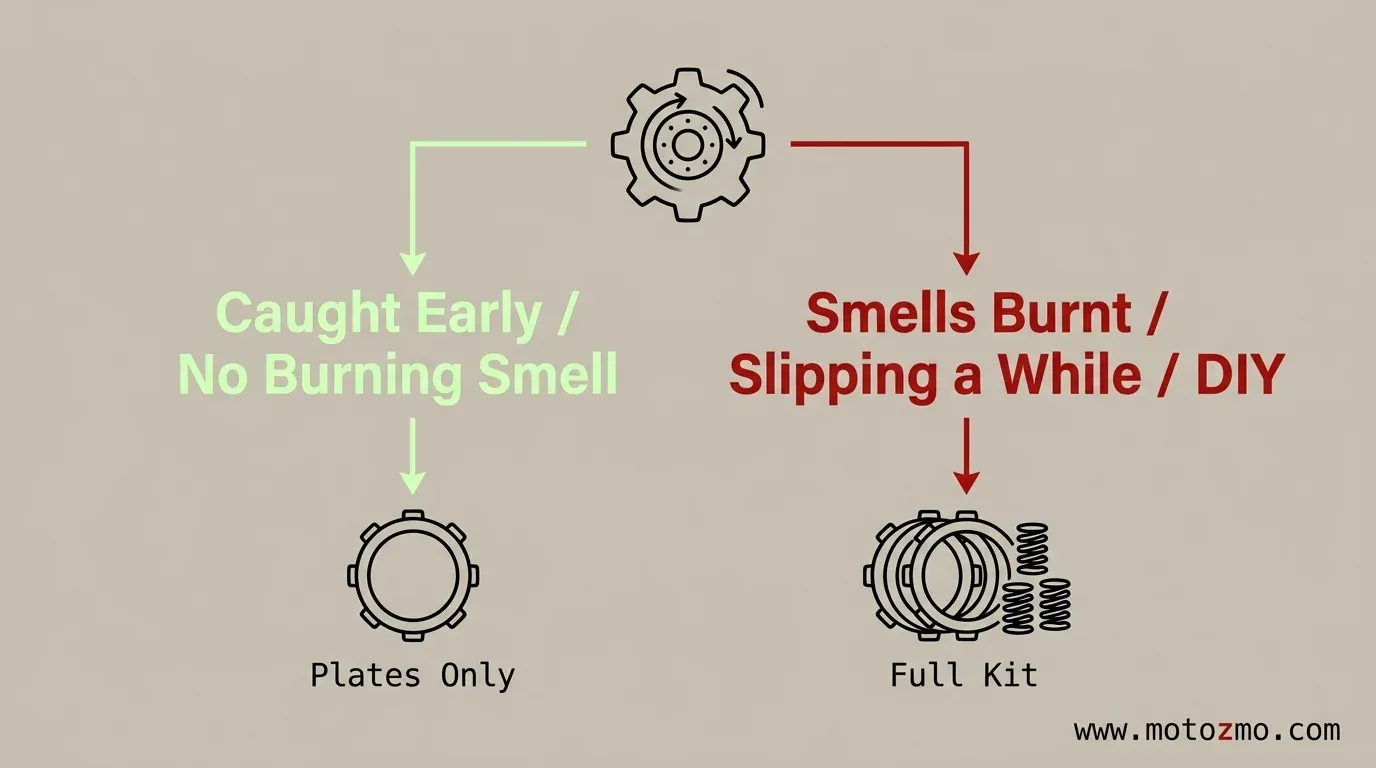
| Situation | What makes sense |
|---|---|
| Clutch was slipping, no burning smell, caught it early | Plates-only can be reasonable if springs test within spec |
| Clutch was slipping for a while, or you smelled it burning | Full kit. Heat that’s already worn the plates has likely started on the springs too |
| You’re already this far into the job | Full kit. The labor to get back in and do it again dwarfs the price difference between plates-only and a complete kit |
| Basket shows notching or grabby engagement | Budget for the basket too, not just the pack |
What Drives the Price: Access, Not Parts
The clutch pack itself, plates, springs, a basket, is a modest expense on almost every bike. What varies wildly is how many things have to come off before a mechanic can reach it, and that’s a function of engine layout, not brand loyalty or build quality.
Harley-Davidson big twins and Sportsters keep the clutch on the outside of the primary case, on the right side of the bike, with nothing else blocking access. Drain the primary fluid, pull the cover, and you’re looking at the clutch directly. That’s a big part of why a Harley clutch job, despite the reputation, often runs 1 to 2 hours of labor rather than half a day.
Japanese standards and naked bikes are similar in spirit: the clutch cover sits on the side of the engine with minimal bodywork in the way, so labor time stays close to the Harley end of the spectrum. Fully-faired sportbikes are the same mechanical layout underneath, but you’re paying for fairing removal first, and that alone can add real labor time before anyone even reaches the clutch cover. It’s the same reason a spark plug swap on a naked bike takes ten minutes and the identical job on a fully-faired inline-four can run over an hour.
Ducati is the outlier worth knowing about specifically. Certain performance models, historically the Monster S4R, older Superbikes, and the Panigale V4, use a dry clutch instead of the wet, oil-bathed clutch nearly everything else on the road runs.
A dry clutch never touches engine oil, which cuts one whole step (drain and refill) out of a DIY job, but the parts themselves cost dramatically more, and dry clutch plates wear faster under street use than a wet clutch’s do. Most other Ducatis, including anything built since around 2011, use a conventional wet clutch and price out closer to the Japanese numbers below.
Real Ranges by Bike Type
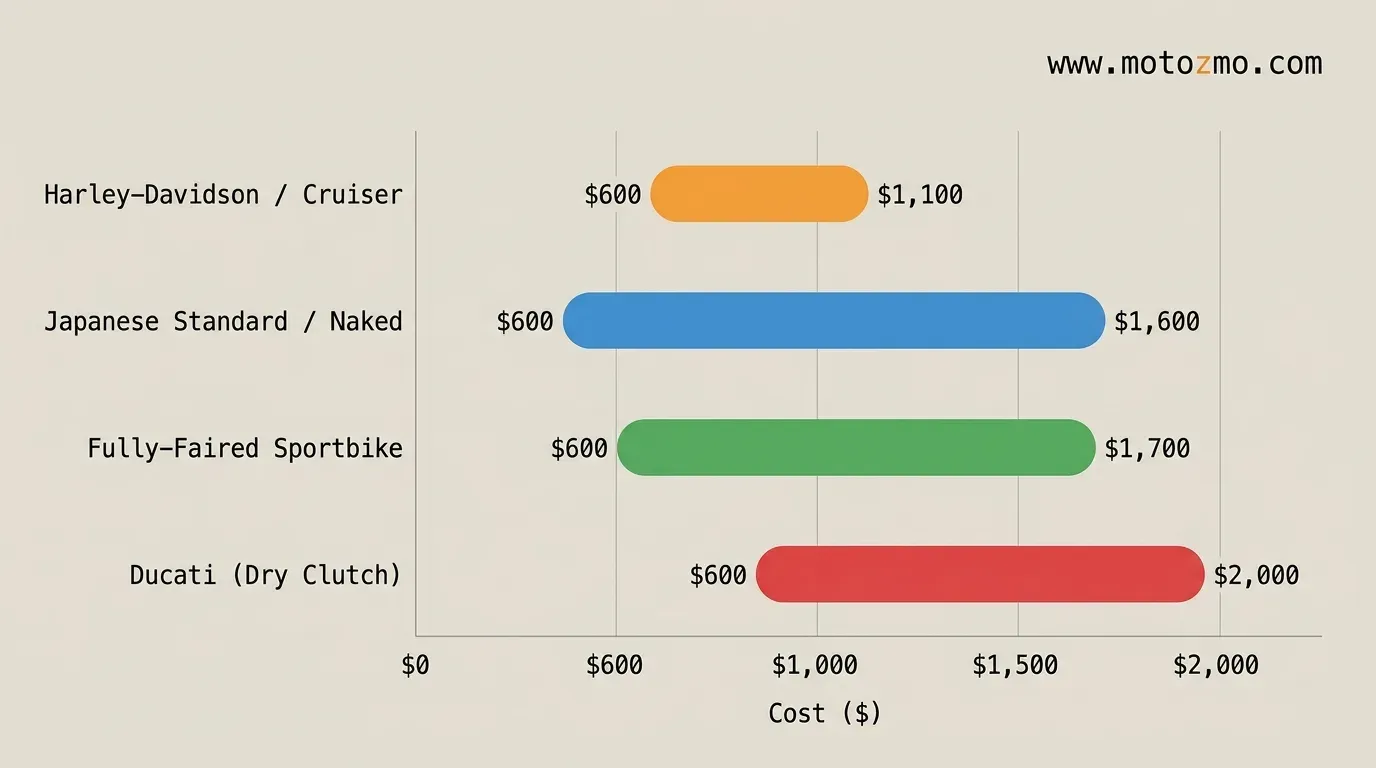
| Bike type | Typical parts cost | Typical shop total |
|---|---|---|
| Harley-Davidson / cruiser | $150–$300 | $600–$1,100 |
| Japanese standard or naked | $100–$250 | $600–$900 |
| Fully-faired sportbike | $150–$250 | $700–$1,000+ |
| Ducati dry clutch (select performance models) | $900–$1,400 | $1,200–$1,800+ |
Treat these as a realistic starting point, not a quote. Shop labor rates vary by region: independents typically run $75–$120 an hour, dealerships $100–$150, and metro-area shops can push past $160. A rural indie shop and an urban dealership can land a bill that differs by hundreds of dollars for the exact same job.
What the Parts Cost, Broken Down
Friction plates only. A basic set of replacement friction plates, no springs, no steel plates, typically runs $50 to $150 for most mainstream bikes, with premium or carbon-fiber-lined options running higher. This is the cheapest way in, but it comes with a catch below.
A complete kit (plates and springs together). Most kit manufacturers, EBC and Barnett among them, recommend replacing the springs at the same time as the plates, since a spring that’s already partway fatigued undercuts the benefit of fresh friction material. Complete kits typically run $100 to $250 for standard bikes and $200 to $400 for high-performance or premium options. Given how cheap springs are relative to the labor of getting back into the clutch a second time, buying the full kit the first time is usually the better trade.
Extras that add up. A primary or clutch cover gasket runs $5 to $20. If you’re draining and refilling gear oil or primary fluid as part of the job, add the cost of that fluid. None of this is expensive on its own, but a shop quote that only lists “clutch kit” without these line items is worth asking about before you approve the work.
DIY: What You Save, and Where It Stops Paying off
The labor line is the whole story here. Do the plates-and-springs swap yourself on a standard-layout bike and you’re saving the $300–$800 gap between parts cost and a shop’s total bill, assuming you already own or are willing to buy basic tools. A service manual for your specific model is worth the $20–$40 it costs, since torque specs and stack-height details vary enough between models that guessing is a bad idea.
On bikes with a compensator or clutch hub nut torqued to a high spec, an impact gun makes the job dramatically easier than trying to break it loose with hand tools alone, and it’s worth adding to your essential motorcycle tool kit if you plan on doing this more than once.
One detail that’s easy to miss and genuinely matters: soak new friction plates in the same oil your bike uses for a few hours before installing them. Dry plates installed straight from the box can scorch on first use before they’ve had a chance to absorb oil, which shortens the life of parts you just paid for.
DIY stops paying off once you’re past a straightforward plates-and-springs swap. If the basket itself is notched or the pressure plate is warped, you’re now measuring tolerances against a service manual rather than just bolting parts in, and a mistake there costs more to fix than the labor you were trying to save.
If you already know or suspect the problem is inside the transmission rather than the clutch pack, that’s a different job entirely; our guide to motorcycles jumping out of gear covers what that repair actually involves and why it costs more.
Where the Bill Jumps
A quoted $300–$500 job can turn into $800 or more once a mechanic is actually inside the case, and it’s worth knowing the usual reasons before you’re surprised by them.
A notched basket. If the friction plate tabs have worn grooves into the basket fingers, discussed in more depth in our guide to clutch dragging, the basket needs replacing alongside the plates. Budget an extra $250–$400 for that.
Something found during teardown that wasn’t in the original quote. A leaking primary or gearbox seal, a worn shift linkage part, or a compensator that’s due for replacement are all common finds once a mechanic already has the cover off. Reputable shops call before doing extra work; it’s fair to ask for that up front.
It turns out to be the transmission, not the clutch. If what looked like a clutch problem is actually worn gear dogs or a bad shift fork, that’s a full case-split job, and it sits well above clutch-kit money, typically $600–$2,500 or more depending on what’s actually worn.
A quote that doesn’t separate parts from labor, or that can’t tell you what specifically is being replaced, is worth a second opinion. Get two quotes on anything over a few hundred dollars: one independent shop, one dealership, and use them to sanity-check each other.
The Short Version
What you actually pay depends more on how your bike is built than on the clutch pack itself: Harleys and naked standards keep the clutch easy to reach and the labor bill modest, faired sportbikes add fairing-removal time, and performance Ducatis with a dry clutch cost dramatically more in parts even though the labor skips an oil drain. Buying a complete kit instead of plates-only is usually worth the small extra cost. DIY makes sense for a straightforward swap on a standard-layout bike and stops making sense the moment you’re measuring a warped plate or a notched basket instead of just bolting parts in.