
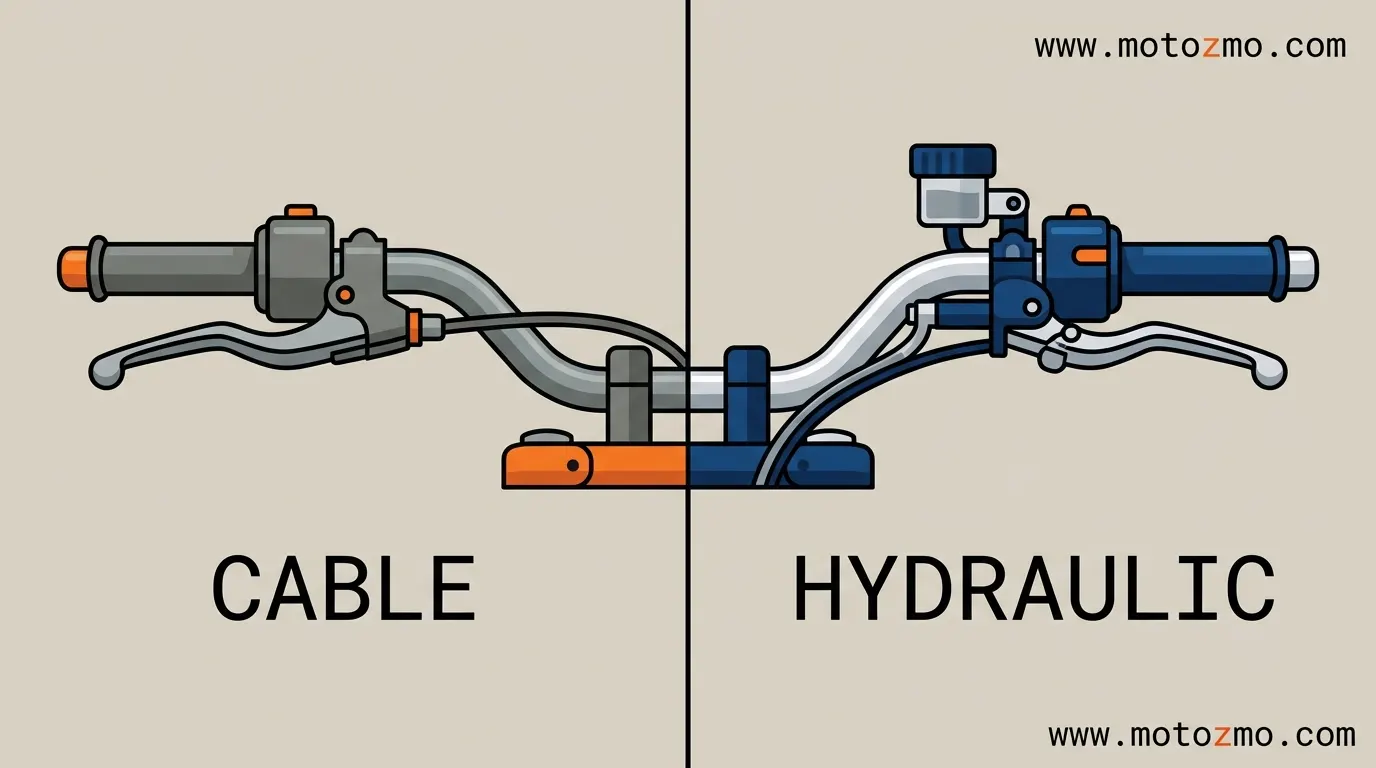
A cable clutch fails more often than a hydraulic one, but almost always gives you some warning first, and when it finally lets go, you can fix it temporarily on the shoulder of the road. A hydraulic clutch fails less often, but it tends to fail without warning, and fixing it takes tools and fluid you almost certainly aren’t carrying. That trade-off, not lever feel or looks, is the real difference between the two systems, and it matters most exactly when you can least afford it: on a ride, away from home, with no clutch.
Our clutch and transmission problems pillar covers the broader troubleshooting picture; this is specifically about how each actuation type fails and what you can actually do about it when it does.
What Each System Is Doing
A cable clutch is a length of steel wire in a housing, pulling the release mechanism directly when you squeeze the lever. A hydraulic clutch replaces that wire with fluid under pressure, pushed by a master cylinder at the lever and received by a slave cylinder at the engine.
Both end up doing the same job at the clutch pack; they just get there differently, and that difference is what determines how each one breaks.
How a Cable Fails
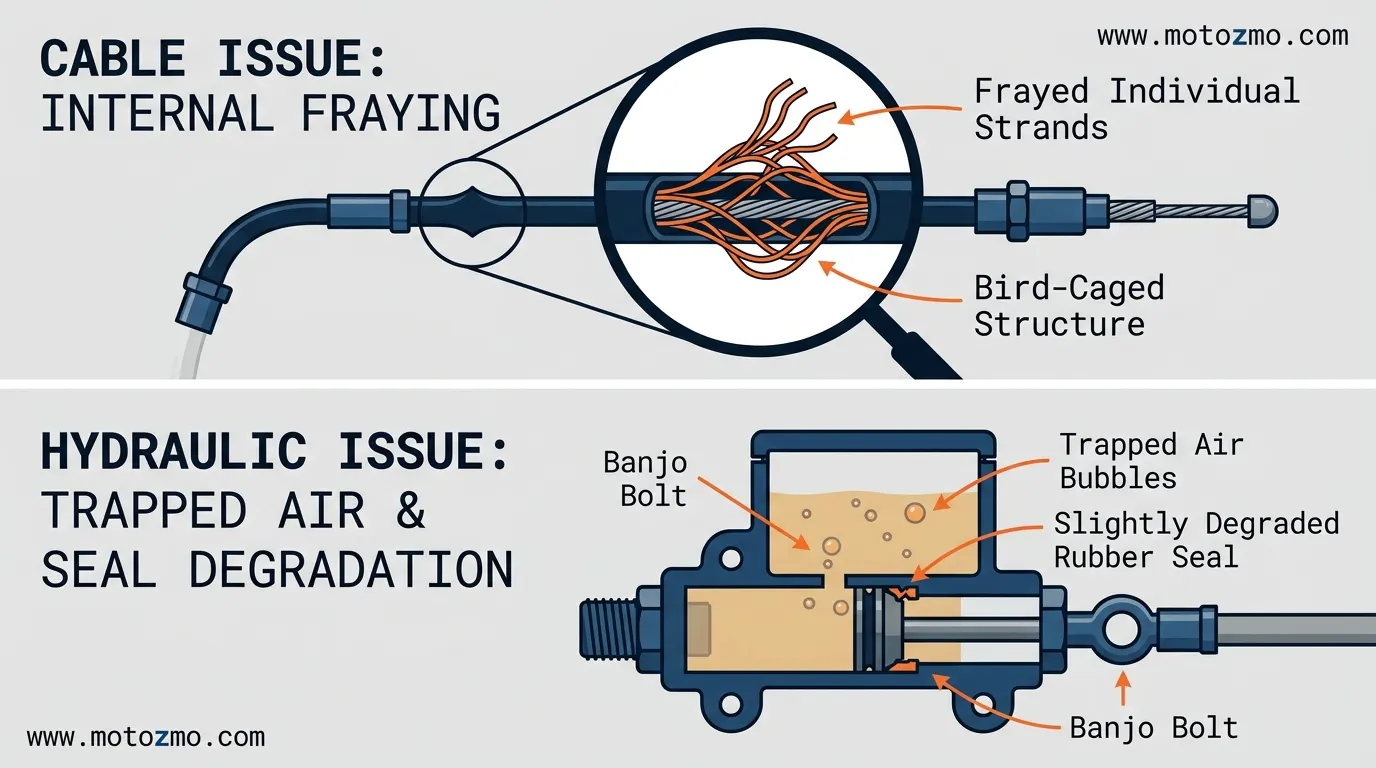
Cables mostly fail the way you’d expect a piece of stranded steel wire to fail: gradually, and visibly, if you know where to look. Individual strands fray and start to “bird-cage” near the ends, the cable stiffens as it dries out inside the housing, and free play at the lever creeps out of spec as the cable stretches with age.
All of that is detectable before it becomes a problem. A full snap, when it happens, usually happens right up near the lever, and it’s often the last stage of fraying you’d have caught if you’d looked closely on your last pre-ride check rather than the first sign of anything wrong.
There’s a separate failure that isn’t really about cable versus hydraulic at all: the lever itself. A low-speed drop can snap a clutch or brake lever clean off, and it happens to both systems equally, since the lever assembly at the bar is the same either way regardless of what’s downstream of it.
Some manufacturers actually engineer a deliberate weak point into the lever so it’s more likely to break in a way that leaves you enough lever remaining to still operate the clutch, rather than losing it entirely. It’s a small design detail, but it’s the difference between limping home and being stuck.
How a Hydraulic System Fails
Hydraulic failures are the mirror image: rarer, but far less polite about it. Brake and clutch fluid is hygroscopic, meaning it gradually absorbs moisture from the air over time, and once enough moisture is in there, a system that worked perfectly on Tuesday can go soft or dead by Wednesday with no crash, no leak, and no warning. Riders troubleshooting a sudden loss of clutch pressure often report exactly that pattern: nothing changed, and then suddenly there’s no pressure at the lever at all.
The other common hydraulic failure is a seal going bad in the master or slave cylinder, which lets air into a system that’s supposed to stay sealed, or lets fluid leak out entirely. Heat can cause a temporary version of the same symptom on some bikes under hard, sustained use, where the fluid expands enough to affect pressure until things cool back down, though that’s more of a track-day concern than something most street riders will ever see.
What all of these share is the absence of a warning sign. There’s no fraying to notice, no stiffening lever creeping up on you over weeks. It works until the moment it doesn’t.
The Roadside Test: What You Can Do
This is where the two systems really diverge, and it’s the part most comparisons skip entirely.
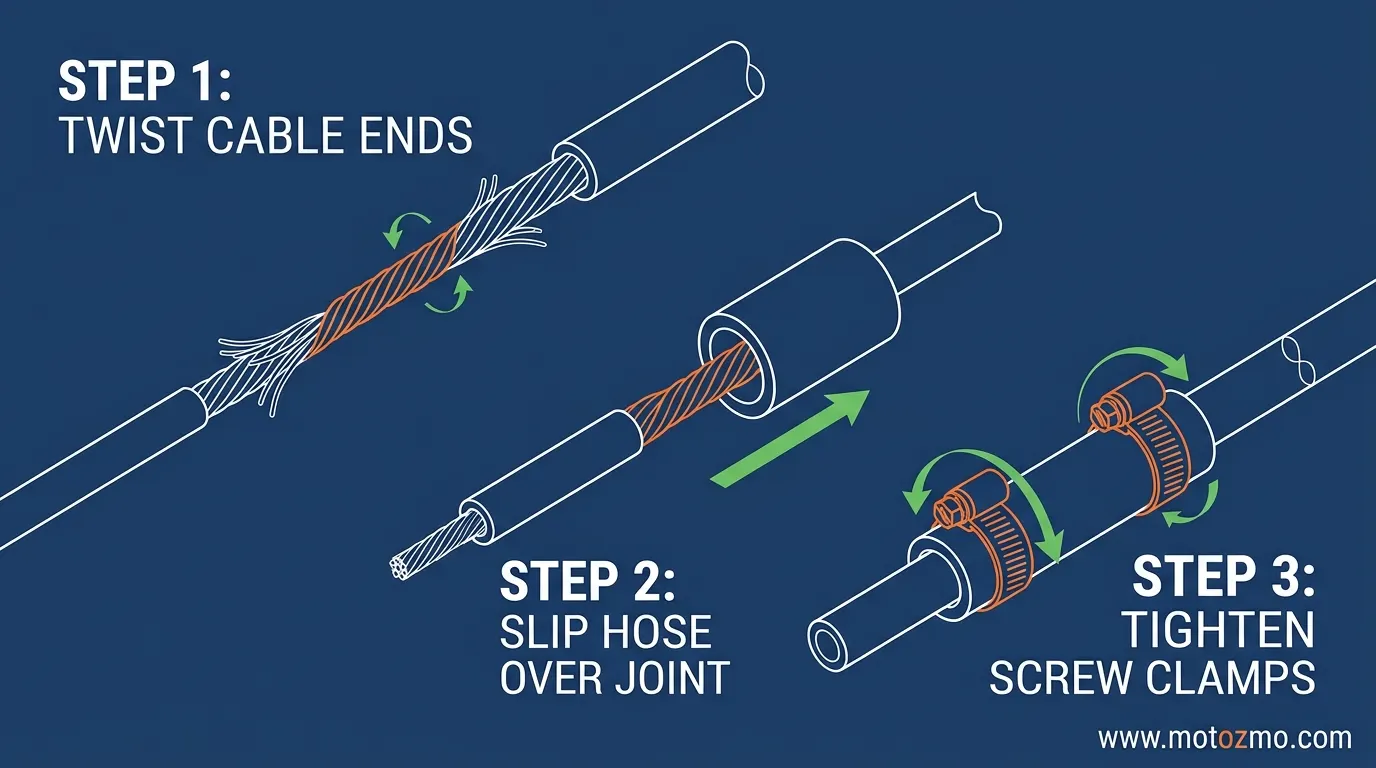
A dead cable is genuinely fixable on the shoulder. The classic trick, still passed around in owner forums decades after it was first published in print, is carrying a short length of hose and a small screw clamp: loosen the cable adjusters to expose enough of the frayed cable end, twist the broken strands back together, and clamp the hose over the joint tightly enough to transmit some pull to the lever. It’s not pretty and it’s not permanent, but it’s enough to get you somewhere safer than the spot you broke down in. Riders who plan ahead carry a spare cable and a master link in their tool kit specifically for this, and a handful of companies sell inexpensive universal emergency cable repair kits built for exactly this scenario. Either way, it’s a problem you can solve with what fits in a saddlebag.
A dead hydraulic clutch usually isn’t fixable roadside, full stop. Getting one working again means bleeding air out of the system properly, which typically wants a vacuum or pressure bleeder, fresh fluid, and patience, sometimes hundreds of slow pumps at the lever with the reservoir open before the bubbles stop showing up. Owners working through this in their own garage, with the right tools and fresh parts on hand, still describe it as maddening, occasionally needing a full master or slave cylinder rebuild before pressure returns. None of that is happening on the side of a highway.
The Shared Fallback: Getting Home without a Working Clutch
Here’s the thing both scenarios have in common: whether your cable snapped or your hydraulic system went dead, you can often still get the bike home using clutchless shifting.
At a steady speed, briefly rolling the throttle off just enough to unload the transmission lets you nudge the shift lever into the next gear without the clutch doing anything at all; rolling back on completes the shift. Upshifting this way is genuinely manageable even for someone who’s never tried it. Downshifting without a clutch is a harder skill, since it requires a throttle blip to match revs on the way down, and it’s not something to attempt for the first time while you’re also dealing with a broken bike on the shoulder of a road.
If you already know this technique, it turns a stranding into an inconvenience regardless of which clutch system failed you. If you don’t, it’s worth practicing in an empty parking lot on a normal day, long before you need it.
Cable vs Hydraulic: Side by Side
| Cable | Hydraulic | |
|---|---|---|
| Typical failure | Fraying, stretching, occasional snap | Air or moisture in the line, a failed seal |
| Warning before it fails | Usually yes: fraying, stiffening lever | Usually none |
| Roadside fixability | High: a bodge or a spare cable gets you home | Low: needs bleeding tools and fresh fluid |
| Lever feel over time | Gets heavier as the cable stretches and dries | Stays consistent until it suddenly doesn’t |
| Routine upkeep | Periodic lubrication and free-play adjustment | Occasional fluid change; otherwise self-adjusting |
| Cost when it does fail | Usually the cheapest fix on this list | Costs more in tools, fluid, and sometimes parts |
For the drag-specific version of either system failing partway rather than completely, our guide to clutch dragging covers cable slack and hydraulic air as causes in more depth. For what a hydraulic bleed or a cable swap actually costs at a shop versus doing it yourself, see our full cost breakdown.
Does This Matter for You?
Most riders never choose between these two systems; the bike came with whichever one the manufacturer picked, and that’s that. Where it’s genuinely worth weighing is if you’re cross-shopping two otherwise-similar bikes and one happens to offer each, if you’re considering an aftermarket hydraulic conversion for a lighter lever pull, or if you regularly ride solo, far from cell service and shops, where roadside-fixability stops being a hypothetical and starts being the thing that decides how your day goes. For daily commuting and normal riding, either system is reliable enough that this shouldn’t be the deciding factor in a bike purchase on its own.
Carrying a basic tool kit with a spare cable if you ride cable-actuated, and checking cable condition as part of a normal pre-ride habit the way the MSF’s T-CLOCS inspection recommends, catches most cable failures before they happen on the road at all. Hydraulic systems don’t offer that same early-warning routine, which is exactly why staying ahead of fluid age matters more for them than it does for a cable you can simply look at.
The Short Version
Cable clutches fail more often but tell you they’re coming and can be fixed with a hose clamp and a bit of patience. Hydraulic clutches fail less often but tend to go without warning, and a full failure genuinely isn’t something you fix on the side of the road. Clutchless shifting is the one skill that bails you out of either scenario, which makes it worth practicing before you ever actually need it, not after.