Affiliate disclosure: This post may contain affiliate links. If you buy through a link on this page, MOTOZMO may earn a small commission at no extra cost to you. It helps keep our guides free. How we test and choose products.
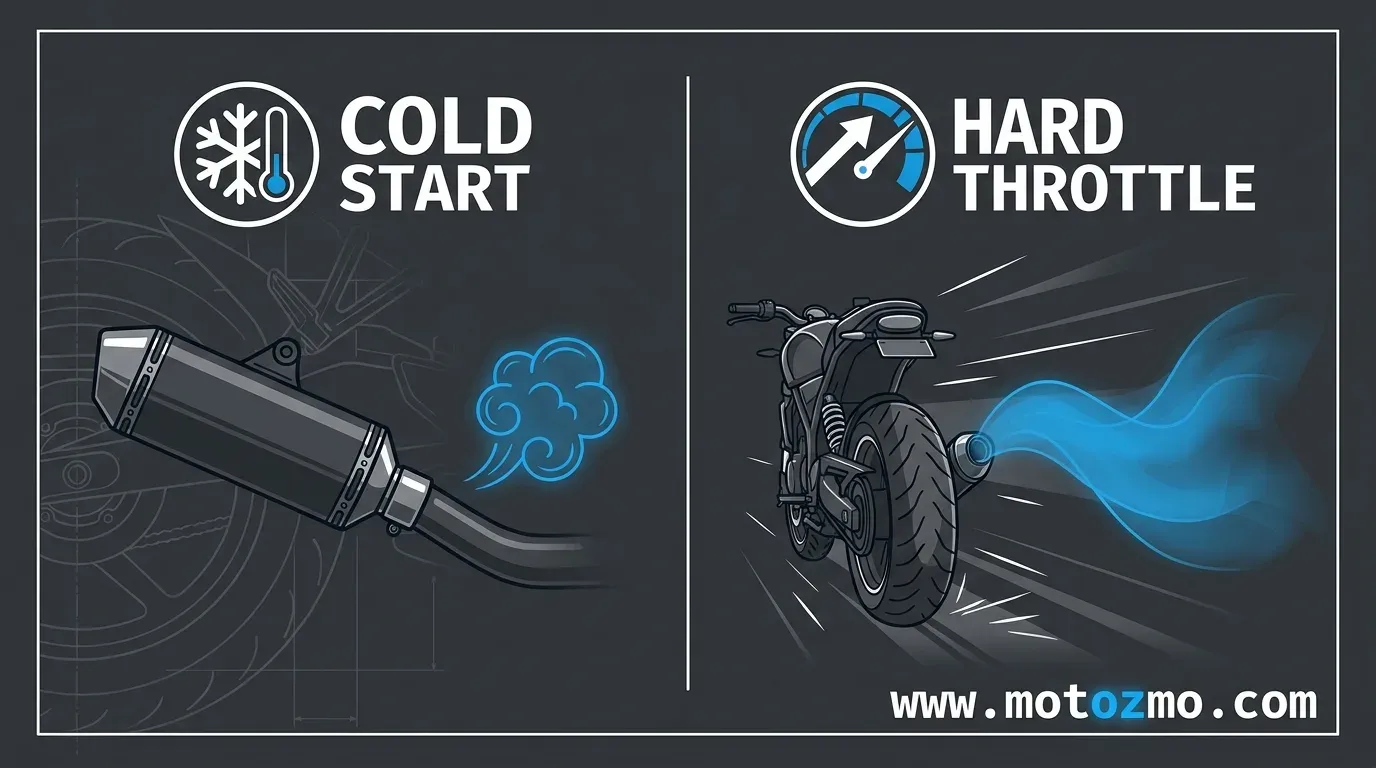
Smoke right at cold startup that clears within a few seconds points to worn valve seals. Smoke that shows up or gets worse under hard acceleration indicates worn piston rings. Both let oil into the combustion chamber, but for different mechanical reasons, and the two repairs are worlds apart in cost and how much of the engine has to come apart.
This article is part of our full guide to motorcycle leaking or burning oil, and it goes deeper into the comparison than a single timing rule, with an actual test you can run yourself before you commit to parts.
The One-Line Mechanical Difference
Valve seals sit around the valve stem and control oil at a specific moment, when the valve is closed and there’s vacuum pulling on the port. That’s mostly happening at idle, right after a cold start, and during deceleration, which is exactly why worn seals show up as a puff at startup rather than a constant haze.
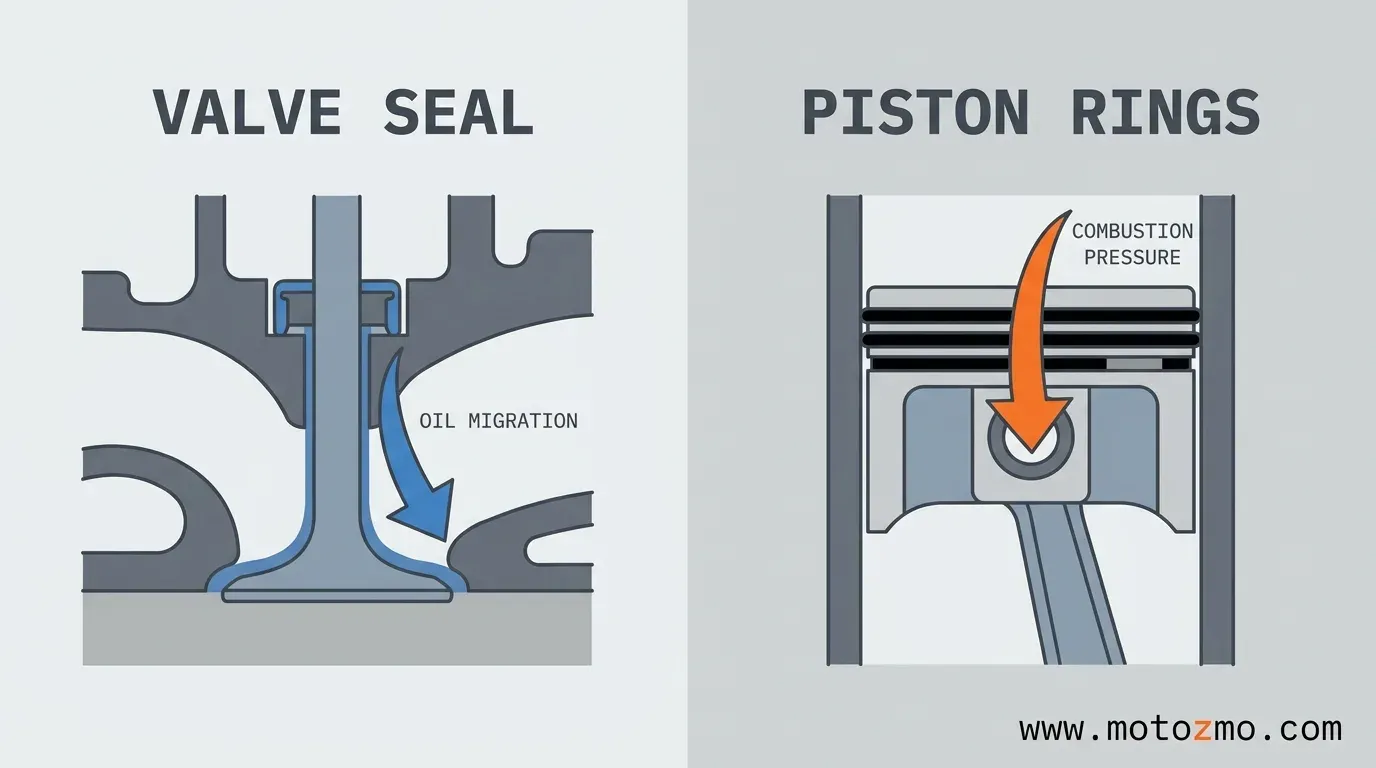
Piston rings work completely differently. They seal the gap between the piston and the cylinder wall against the pressure created during combustion. That pressure spikes hardest under acceleration, so worn rings let oil through exactly when you’re on the throttle, and the smoke tends to fade again once you settle into a steady cruise.
Compare Them Side by Side
| Sign | Valve seals | Piston rings |
|---|---|---|
| When the smoke happens | Puff at cold start, clears in seconds | Shows up or worsens under acceleration |
| Effect on power | Usually none, compression stays normal | Often noticeable, less pep, sometimes harder starting |
| Oil in the airbox or a catch can | Usually little to none | Often present, since worn rings pressurize the crankcase |
| Wet compression test result | Little to no change | Compression jumps noticeably |
| Repair scope | Top end only, sometimes without even removing the head | Cylinder and piston come out, occasionally the whole engine |
| Typical cost tier | Cheap parts, modest labor | More expensive, more labor, often machine work too |
The Test That Confirms It
A smoke-timing guess is a good starting point, but a compression test is what actually settles it, and it’s simpler on a single or twin-cylinder motorcycle engine than it is on a car with six cylinders to cross-check.
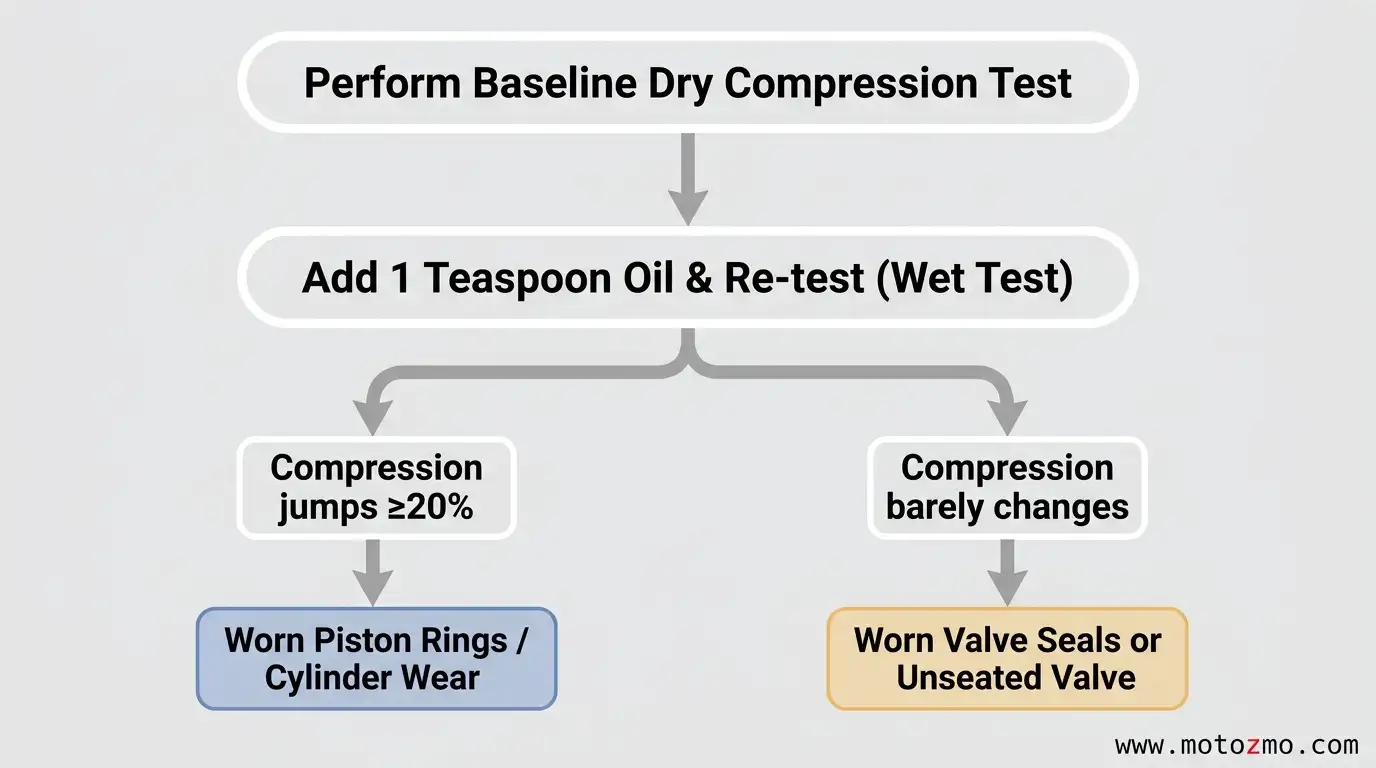
Start with a dry test. Pull the spark plug, thread in a compression gauge, and crank the engine over a few times to get a baseline reading. Then squirt about a teaspoon of engine oil into the cylinder through the spark plug hole and run the same test again, this is the wet test.
According to UnderhoodService, a trade publication for automotive technicians, the oil temporarily seals up any gaps around the piston rings, so if the rings are what’s leaking, the reading jumps. If the rings are fine and something else is the problem, the oil doesn’t change much because it never reaches the actual leak point.
Here’s how to read the result:
- Compression rises by a lot (some sources put the threshold around 20 percent or more, per EngineerFix) → piston rings or cylinder wall wear. The oil sealed a gap that shouldn’t have been there.
- Compression barely changes → valve seals, or possibly a valve that isn’t seating properly. The oil never reached the actual leak, since it’s happening at the valve, not the cylinder wall.
Don’t overdo the oil. More than a teaspoon can give you a falsely high reading that makes a healthy engine look like it has ring wear, which defeats the point of the test.
A Simpler At-Home Clue: Check for Oil in the Airbox
If you don’t have a compression gauge handy, there’s a rougher but genuinely useful check. Worn piston rings let combustion pressure blow past into the crankcase, and that pressure has to go somewhere, usually out through the crankcase breather and into the airbox. If you pull your air filter and find oil pooling in the airbox or on the filter itself, that leans toward rings. If it’s dry, that leans toward valve seals instead.
Our guide to burning oil and blue smoke covers what a clogged or overwhelmed breather looks like in more detail, since the same pathway is involved either way.
What Each Repair Involves
This is where the two problems really pull apart, and it’s worth knowing before you decide whether to tackle it yourself.
A valve seal job stays in the top end. Pull the valve cover, and on plenty of motorcycle engines you can even swap the seals without removing the cylinder head at all, holding the valve in place with compressed air through the spark plug hole while you work the spring compressor. Some mechanics prefer pulling the head anyway since it makes it easier to check the valve guides while you’re in there, but either way, the parts themselves are cheap and the job is realistic for a comfortable weekend mechanic.
A piston ring job is a different scale of work entirely. The cylinder has to come off, the piston gets inspected for wear and the bore gets measured for roundness, and depending on what you find, that means honing, boring, or new pistons on top of new rings. On some motorcycles, getting to any of this means pulling the engine out of the frame first. This is usually where it makes sense to hand things to a shop unless you’ve done engine work before.
Our guide to oil change costs, DIY or shop, gives a sense of how that DIY-versus-shop math tends to play out, and the gap only gets bigger for a job this size.
Which One Are You Probably Not Dealing with
If your bike still pulls the same as always, starts easily, and the smoke only ever shows up as a quick puff at startup, you’re probably not looking at a ring job. That’s a good thing, since it’s the cheaper fix.
If you’re noticing real power loss, a harder time starting, and smoke that never fully goes away, you’re probably past the point of a couple of cheap seals, and it’s worth budgeting for the bigger repair rather than hoping seals alone will fix it.
If a compression test comes back healthy and consistent across cylinders even before you run the wet test, neither one is likely your actual problem. At that point it’s worth checking whether you’re simply overfilled, our guide to how much engine oil is too much covers that, or whether consumption has just been creeping up gradually rather than pointing to a specific failure, which our guide to how much oil loss is normal can help you judge.