
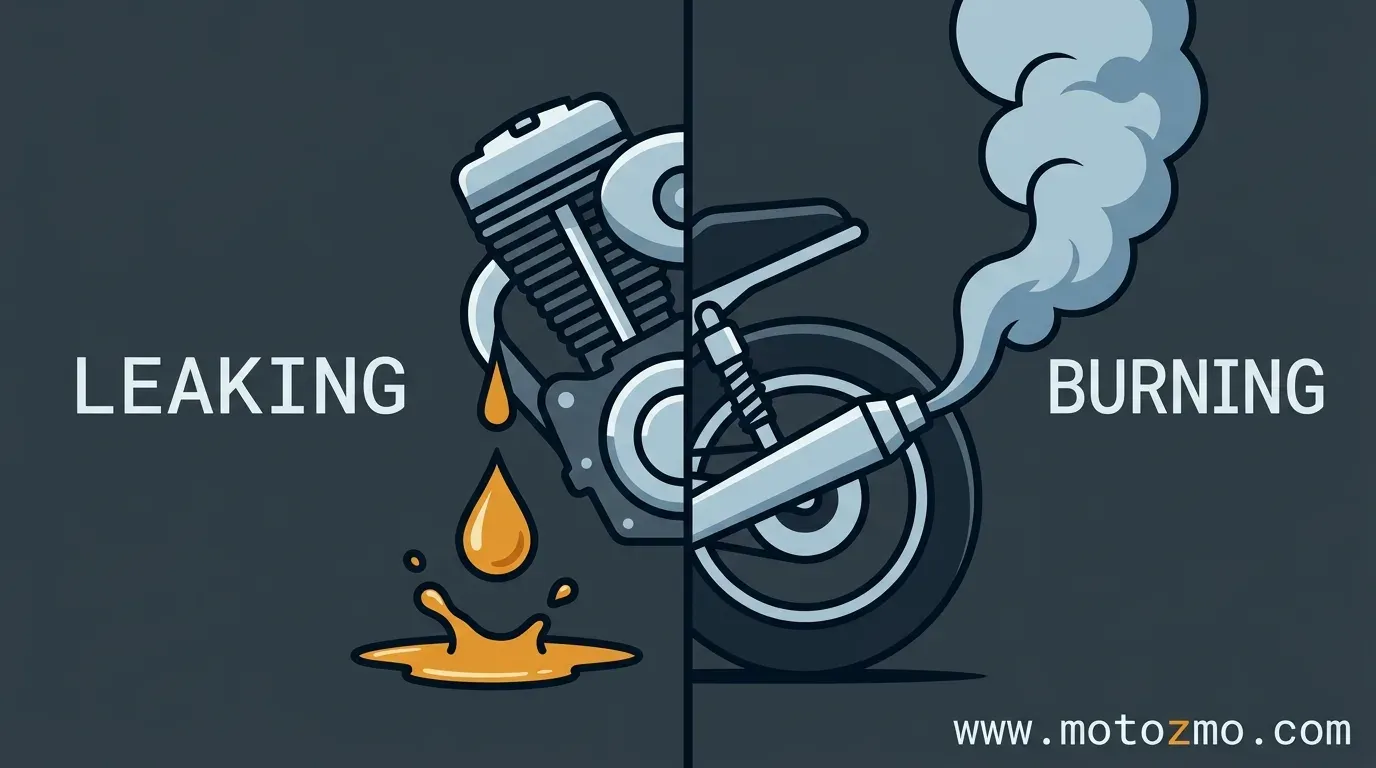
A puddle or wet patch under your bike almost always means a leak. Blue-gray smoke from the exhaust with no puddle usually means the engine is burning oil on the inside.
A leak is oil escaping past a gasket, seal, or plug on the outside of the engine. Burning oil means it’s getting past a seal or a ring and mixing with fuel inside the combustion chamber, which is a different problem and usually a bigger one. Left alone, a small leak just gets bigger and messier over time. Burning oil is the one that quietly wears the engine down while you keep topping off the tank without asking why.
This guide, part of our full motorcycle problems and fixes hub, walks through how to tell the two apart in under a minute, what each one usually points to, and when it’s still a Saturday afternoon job versus when it’s time to call a shop.
Leaking Oil or Burning Oil? Tell Them Apart in Under a Minute
Before you start pulling covers off the engine, figure out which problem you actually have. The two look similar from a distance, oil going somewhere it shouldn’t, but they come from different parts of the engine and get fixed in completely different ways.
| What you notice | What it usually means |
|---|---|
| Puddle or wet spot under the bike, no smoke | External leak |
| Blue-gray smoke at cold start that clears within a few seconds | Likely worn valve seals |
| Blue-gray smoke that gets worse under hard acceleration | Likely worn piston rings |
| Oil level keeps dropping, no puddle, no smoke | Small leak you haven’t spotted yet, or a slow internal burn |
| Warning light stays on with the engine running | Oil pressure problem, a separate and more urgent issue |
If that last row is your situation, stop and check the oil pressure section below before you do anything else. It isn’t the same problem as a leak or a smoky exhaust, and it can’t wait the way the other two can.
If Your Motorcycle Is Leaking Oil
Most external leaks trace back to one of a handful of spots: the valve cover gasket, the crankcase or clutch cover gasket, the drain plug washer, the oil filter, or the seal around the crankshaft near the sprocket. Gaskets dry out and turn brittle with age and heat, and once that happens they stop sealing properly.
Drain plug washers are meant to be used once and thrown away, so a leak that shows up right after a DIY oil change is often just a reused washer or a plug that wasn’t tightened to spec, not a sign of anything bigger. If you’re not sure how your bike’s drain plug should be torqued or which washer it takes, our guide to changing motorcycle oil covers both.
Athena, which makes OEM replacement gaskets and seals for motorcycles, points out that an overtightened oil filter causes almost as many leaks as an undertightened one. Cranking the filter down too hard can cut or push the rubber sealing ring out of its seat, and it ends up leaking while the bike is moving instead of sitting still, which makes it harder to spot until you’re already checking the driveway. (Athena)
For a full breakdown of every leak point on the engine, what each one looks like, and how to fix it yourself, see our full guide to motorcycle oil leaks. A dried-out washer or a loose bolt is usually a cheap part and twenty minutes with a socket wrench. A cracked case or a failed crankshaft seal is a bigger job and probably belongs at a shop.
If Your Motorcycle Is Burning Oil
Burning oil is a different problem. Oil is getting past a seal or a ring and ending up in the combustion chamber, where it burns along with your fuel. That’s what makes the blue-gray smoke, and it’s also eating into your oil level between changes even when nothing is dripping onto the garage floor.
Timing tells you almost everything you need to know before you open the engine up.
| When you see the smoke | Likely cause |
|---|---|
| A puff right at cold startup that clears within seconds | Worn valve seals |
| Smoke that shows up or worsens under hard acceleration | Worn piston rings or cylinder wear |
| Smoke all the time, at idle and under load | Could be both, or more serious wear |
When you park a bike, oil pools around the valve stems overnight. On startup, that pooled oil burns off in a couple of seconds before the smoke clears, which is the valve seal signature. Piston rings behave differently. Under hard acceleration, pressure inside the cylinder spikes and forces oil past worn rings into the combustion chamber, so that smoke shows up exactly when you’re on the throttle and tends to fade off again at a steady cruising speed.
A compression or leak-down test at a shop can confirm which one you’re dealing with before you commit to buying parts. For the full comparison, including which one is the cheaper fix, see our valve seals vs piston rings guide.
One thing worth ruling out first: an overfilled crankcase can push oil past the rings and cause smoke even when nothing is actually worn. Check your level cold, on level ground, before you assume the worst. Our guide on how much engine oil is too much covers exactly where that line sits and what it does to your bike.
How Much Oil Loss Is Normal
Every four-stroke engine burns a small amount of oil, even a healthy one. As a rough guide, a modern, well-maintained engine should use well under half a quart between oil changes. Older air-cooled engines, especially anything British or built before the 1990s, tend to run a bit thirstier than that by design, not necessarily because something is wrong.
What matters more than the exact number is the trend. If your level has stayed steady for years and suddenly starts dropping faster, something changed, and it’s worth figuring out what.
If you’ve never had to add oil between changes and now you’re topping up every few hundred miles, that’s worth chasing down rather than shrugging off. Our guide on how much oil loss counts as normal breaks this down by engine age and mileage.
Oil Pressure Light on? That’s a Different Problem, and It’s Urgent
A leak or a smoking exhaust usually gives you time to plan a fix. An oil pressure warning light does not. Oil pressure and oil level aren’t the same thing. You can have a full tank of oil and still lose pressure if the pump, a screen, or the sensor fails.
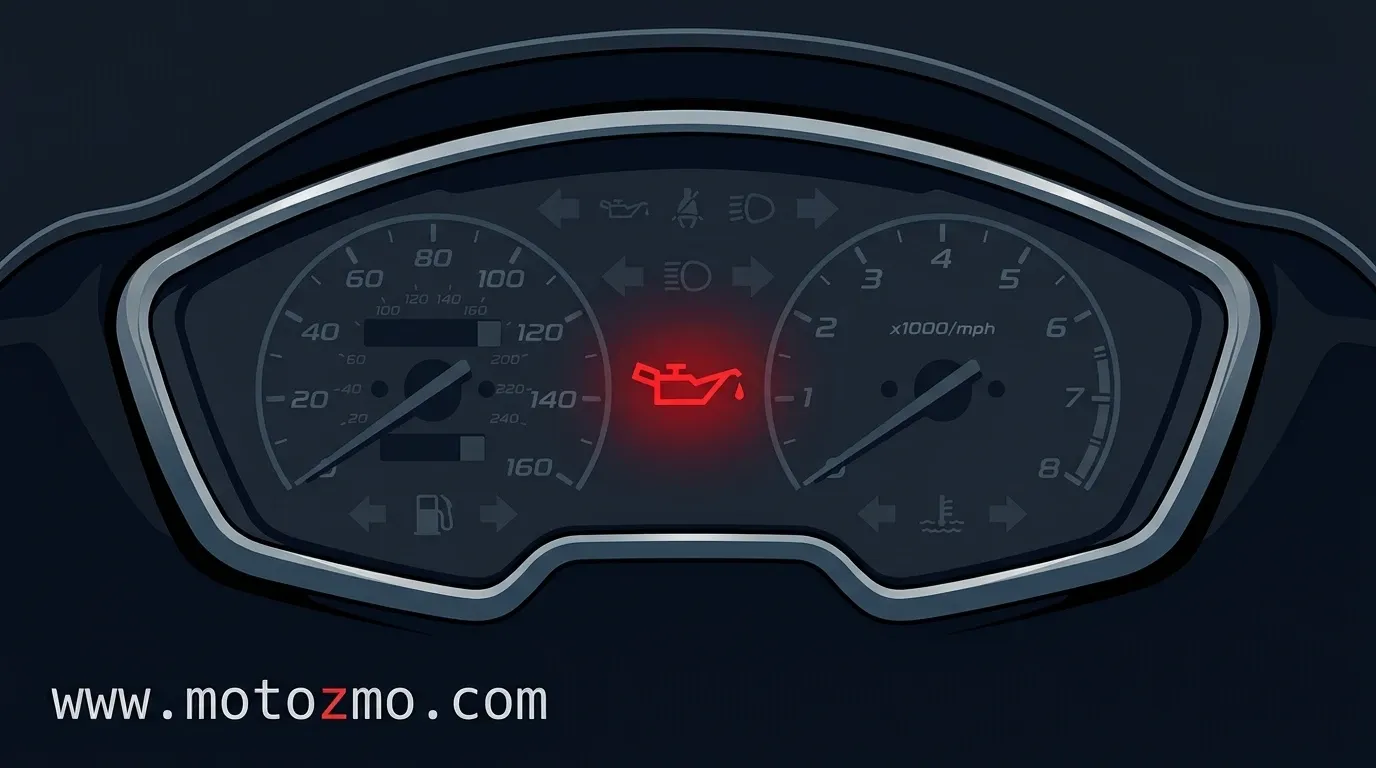
If that light comes on and stays on while the engine is running, pull over, shut the engine off, and check your level before doing anything else. If the level is fine and the light stays lit, don’t ride it home hoping it sorts itself out. Metal parts inside the engine can start grinding against each other within minutes without oil pressure protecting them, and that kind of damage isn’t a cheap gasket fix.
Our full guide to the oil pressure warning light walks through what triggers it, which causes are cheap, which ones aren’t, and what to check before you call a tow truck.
Should You Use an Oil Stop-Leak Additive?
Before you pour anything into your oil, know this: most stop-leak additives work by swelling old, brittle seals back toward their original shape, which can buy you time on a minor weep. They won’t fix a cracked case or a leak that’s actively getting worse, and on a motorcycle with a wet clutch, the wrong additive can trade a small leak for a bigger problem.
Most motorcycles run one oil system for the engine, gearbox, and clutch together, so the clutch plates sit soaked in the same oil that lubricates everything else. Motorcycle oils built for that setup carry a rating called JASO MA or MA2, set by the Japanese Automotive Standards Organization, and it exists specifically to keep the oil’s friction properties in a range that lets a wet clutch grip properly instead of slipping. A lot of stop-leak and oil-treatment products aren’t built with that in mind and adding one can leave your clutch slipping under load even though the leak itself looks better.
If you decide to try one anyway, check the label for wet-clutch compatibility first, and treat it as a stopgap rather than a permanent fix. For picks that are actually safe for a wet clutch, see our guide to oil stop-leak additives for motorcycles.
When It’s a DIY Fix and When It Isn’t
| What you’re dealing with | Urgency | DIY or shop |
|---|---|---|
| Small drip, dry within a day, no smoke | Low | DIY |
| Steady drip, level dropping between checks | Moderate | DIY if you’re comfortable with gaskets, shop if not |
| Smoke that’s getting worse over weeks | Moderate to high | Shop, needs a compression test |
| Oil pressure light staying on | High | Stop riding, tow or shop |
A gasket or a drain plug washer is cheap and forgiving if you get it wrong twice. A compression test and a set of rings are not, so it’s worth confirming which problem you actually have before you buy parts. If the oil is due for a change anyway while you’re investigating, our oil change cost guide breaks down what a shop charges versus doing it yourself.
FAQ
Is it safe to keep riding with a small oil leak?
For a short trip, yes, as long as your level stays in range and there’s no smoke or warning light. Check your level before every ride and get the leak fixed soon. It won’t heal on its own.
Does a leaking motorcycle always need an engine rebuild?
No. Most leaks trace back to a worn gasket, seal, or drain plug washer, all cheap parts. A rebuild only comes into play if you’re burning oil internally, not just leaking it externally.