
If your oil pressure light comes on and stays on while the engine is running, pull over, shut the engine off, and check your oil level before you do anything else. This light is not a maintenance reminder you can deal with next weekend. It means oil might not be reaching your engine’s moving parts right now, and metal grinding against metal without a protective film of oil can cause real damage within minutes.
This article is part of our full guide to motorcycle leaking or burning oil, and it covers exactly what triggers this specific light, how to tell a five-minute fix from a tow-truck situation, and what to do the moment it comes on.
Oil Pressure and Oil Level Are Not the Same Thing
This is the single most important thing to understand before you do anything else. Oil pressure measures how hard the pump is pushing oil through the engine’s passages. Oil level just measures how much oil is sitting in the pan. You can have a full tank of oil and still lose pressure if the pump, a screen, or the sensor itself fails. You can also be low on oil and still show fine pressure for a while, right up until the pickup tube starts sucking air.
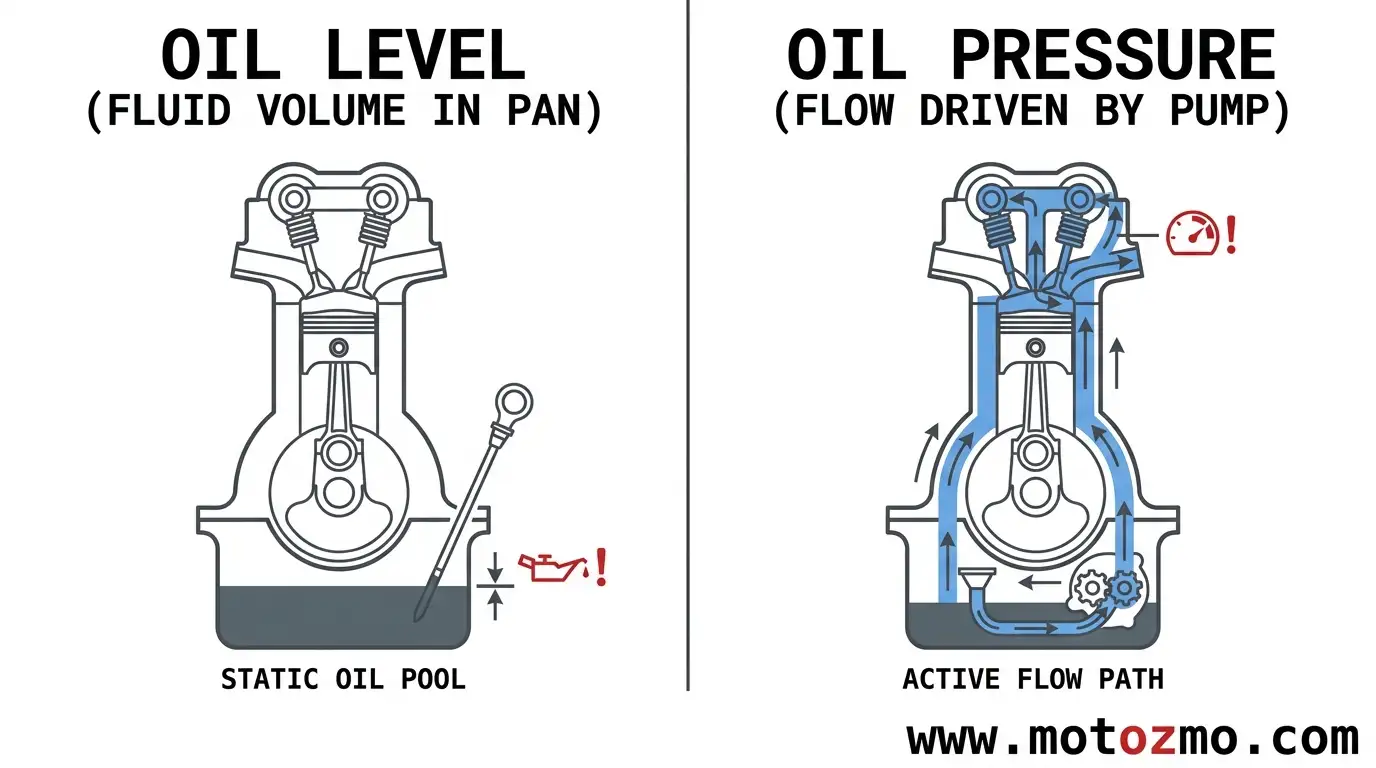
Cars sometimes split this into two separate lights, an amber one for low level and a red one for low pressure. Most motorcycles don’t bother with that distinction. You typically get one oil-can icon, and it’s tied to pressure, not level. That means the moment it lights up, treat it as a pressure problem first, even though checking your level is still the very first thing you do about it.
If what’s actually going on is oil escaping from a gasket or seal, or oil burning off inside the engine, either one can eventually starve the pump enough to trigger this light. Those are covered in more depth in our guides to motorcycle oil leaks and burning oil and blue smoke, but this article stays focused on the light itself and what it’s telling you in the moment.
What Causes the Light to Come on
Some of these are a five-minute fix. One of them isn’t.
| Cause | How common | Fix difficulty |
|---|---|---|
| Low oil level, from consumption, a leak, or a missed oil change | Very common | Cheap, top off and recheck |
| Clogged oil filter or pickup screen | Common, especially on bikes with skipped oil changes | Moderate, the filter itself is cheap, cleaning a screen takes more work |
| Oil that’s thin and hot after sustained highway riding, especially at idle | Common on hot days or higher-mileage engines | Not a repair, more of a wear characteristic worth watching |
| Failing oil pump | Less common, usually on neglected or very high-mileage engines | Expensive, a shop job |
| Faulty pressure switch or damaged wiring to it | Possible, and worth checking before assuming the worst | Cheap part, testable at home |
Skipped oil changes are the thread running through most of the common causes here. Old, dirty oil is thicker with contaminants and more likely to clog a filter or screen, which is exactly why our guide to how often to change motorcycle oil matters more than it might seem at first glance.
Why It Flickers at Idle and Clears When You Rev
If you’ve noticed the light flicker at a stoplight and go out the second you twist the throttle, that pattern is worth paying attention to rather than shrugging off. According to AAA, an intermittent light often happens because oil is shifting away from the pickup as the bike sits, accelerates, or leans, so the pump briefly loses its supply before catching up again.
The oil pump spins faster as engine speed increases, which is why revving the engine can build just enough pressure to clear the light again. That doesn’t mean the problem is gone, it means you caught it at the easy end of the scale, low level or oil that’s gotten too thin, rather than the expensive end.
If your bike takes a specific viscosity and you’ve been running whatever was on the shelf, thin, overheated oil at idle is a common enough cause that it’s worth checking your owner’s manual against what’s actually in the crankcase. Our guide to 4-stroke motorcycle engine oil covers picking the right grade for your bike and climate.
One thing worth knowing before you panic: motorcycles run at genuinely low oil pressure by design, especially smaller engines with plain or roller bearings, sometimes as low as 2 to 3 PSI at idle on certain models. A car’s oil pressure light is usually built around a 30 to 60 PSI normal range, so judging a bike by that same number is misleading.
If your idle speed happens to be sitting right at the bottom of spec, that alone can be enough to dip under the switch’s trigger point. Checking whether your idle matches what your manual calls for, and nudging it up slightly if it’s running low, is a cheap thing to try before you assume anything mechanical has failed.
Is it safe to ride a short distance home if the light only flickers at idle? It’s lower risk than a light that stays on solid, but it’s not risk-free. Check your level as soon as you can, and don’t make a habit of riding on a flickering light without ever looking into why.
What to Do the Moment It Comes on
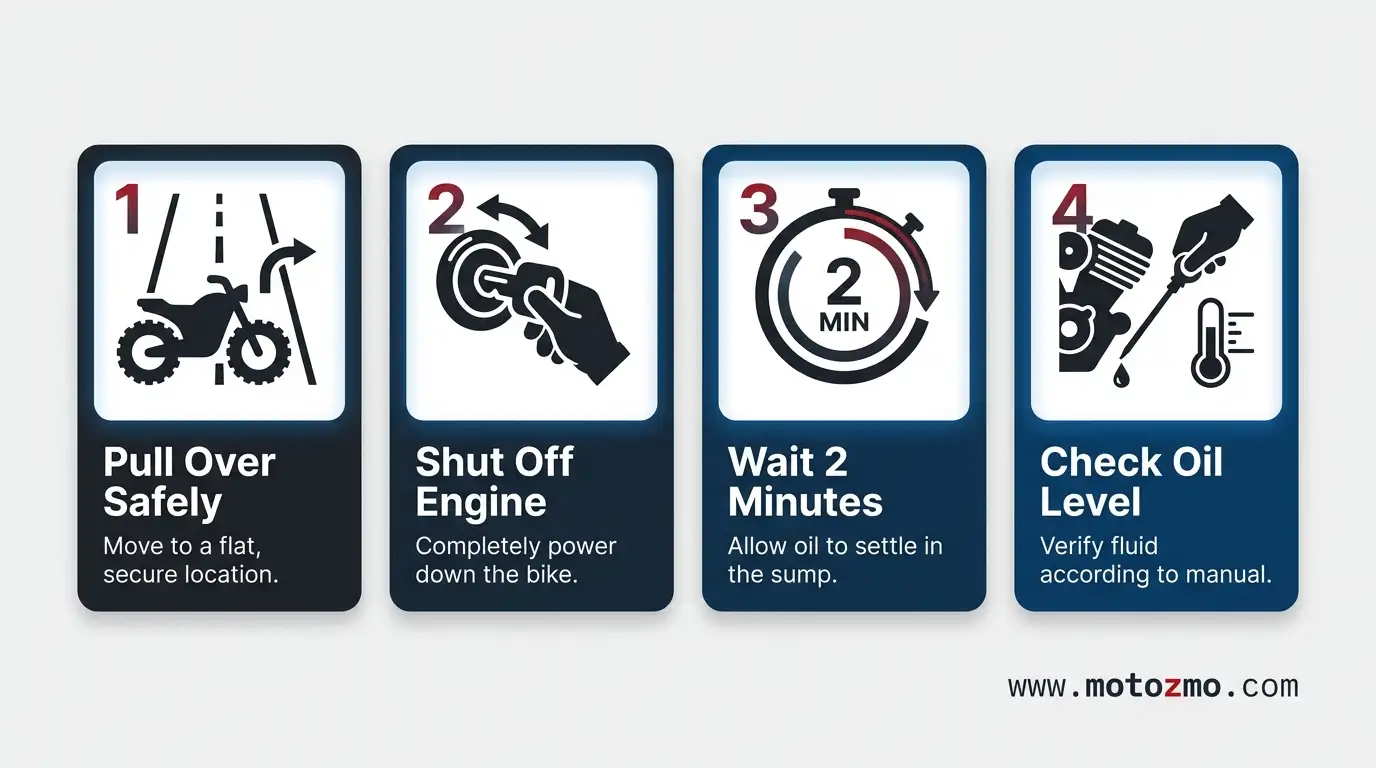
- Pull over somewhere safe as soon as you reasonably can. Don’t wait for the next gas station if you’re on the highway.
- Shut the engine off. Riding further while the light is on is the one thing that turns a cheap problem into an expensive one.
- Let it sit a minute or two before checking. Oil that was circulating through the top end takes a short while to drain back down into the pan or sight glass, so checking right after a ride can make your level look lower than it really is. Once it’s settled, check your oil level the way your manual describes, usually with the bike upright on level ground.
- If the level is low, top it off with the correct oil, then restart and watch the light. If it clears and stays off, you likely found your cause. Our guide to checking and changing motorcycle oil walks through doing this correctly.
- If the level was already fine, or the light comes right back on, don’t keep riding on the assumption it’ll sort itself out. Call for a tow or get it to a shop instead.
How Urgent Is It, Really?
Not every appearance of this light means the same thing, but the categories are pretty clear once you know what to look for.
| What the light is doing | Urgency | What to do |
|---|---|---|
| Flashes briefly at startup, then clears within a second or two | Low, this is normal on many engines as the pump primes | Note it, mention it at your next service if it happens every time |
| Flickers at idle, clears when you rev or ride | Moderate | Check your level and oil condition, don’t let it repeat for weeks without looking into it |
| Stays on solid while riding | High | Stop now, don’t try to make it home |
| Comes on along with a new knocking or ticking sound | Critical | Shut off immediately, don’t restart, arrange a tow |
Screaming Banshee Horns sums up the general rule for red dashboard lights well: a red warning means something is wrong right now, not something to fold into next weekend’s maintenance list. Motorcycle oil pressure lights are almost always red for exactly that reason.
Light Flashes for a Second After You Shut the Bike off? That’s a Different Situation
Some riders notice the light blink briefly right as the engine shuts down, not while it’s running. That’s not the scenario the rest of this article is warning you about.
Oil pressure drops to zero the instant the engine stops turning, so the switch is reading that correctly, and the light can flash for a moment while the ignition circuit is still live, especially if you killed the engine with the kill switch rather than the key. If the light stays off the whole time the engine is actually running, and only shows up during shutdown, you’re very likely fine.
The urgency in this guide is about the light coming on while you’re riding or idling with the engine running, not the split second after you’ve already turned it off.
When It Might Not be the Oil at All
Pressure switches and their wiring do fail on their own sometimes, and it’s a genuinely possible explanation, especially on an older bike with corroded connectors. The problem is you can’t tell that from the seat with any confidence.
A bad sensor and a failing oil pump look identical from the dashboard. The only way to rule out a sensor is to check with a mechanical oil pressure gauge, either your own or a shop’s, rather than betting your engine on a guess.
If your level and oil condition are both fine and the light still won’t clear, that’s exactly the situation worth a shop visit for, not because it’s definitely serious, but because guessing wrong here is expensive in a way that guessing wrong on a gasket leak isn’t.
Related Reading
If you’ve traced this back to oil consumption rather than a one-time low fill, our guide on how much oil loss is normal helps you figure out whether what you’re seeing is routine or a sign of a bigger problem forming.