
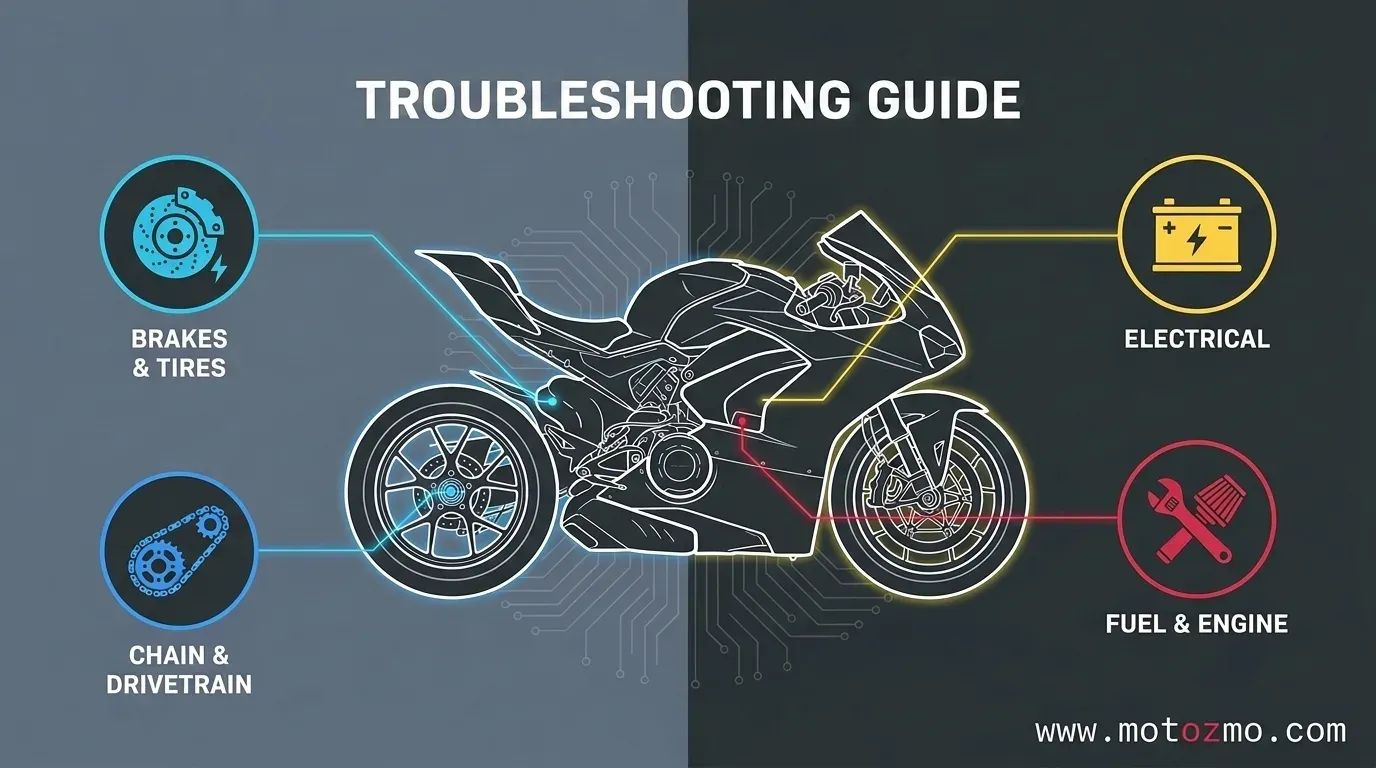
Most motorcycle problems trace back to five systems: starting, fuel delivery, electrical and charging, the drivetrain, and cooling, and each one tells you which it is before it strands you.
A rough idle sounds different from a dying battery. A clutch that slips feels nothing like one that drags. Learning to read those signals turns you from a stranded rider into someone who knows exactly which wire, hose, or plate to check first.
This guide is the map: a fast diagnostic framework for anything that goes wrong, answers to the questions that come up most, and a clear path to the deeper guide for whichever system is actually giving you trouble.
How to Diagnose Almost Anything on Two Wheels
Random part-swapping drains your wallet. A system does the opposite:
- Pin down the symptom. Cold start only? Under load? At idle? Constant or occasional? The pattern narrows the search fast.
- Check the obvious first. Fuel level, kill switch, kickstand safety switch, clutch lever engagement. These four eliminate more “problems” than any tool you own.
- Narrow it to a system: engine mechanical, fuel, electrical/ignition, transmission/clutch, or cooling.
- Test the cheapest explanation first, and keep testing until something confirms or rules itself out.
- Verify the fix with a real ride, not just a driveway idle.
Won’t Start, but It’s Cranking Fine
If the starter turns the engine over but it never fires, you’re not dealing with a dead battery, you’re dealing with fuel or spark not reaching the cylinder. Work through it in this order:
- Fuel: is there gas in the tank, and is the petcock or fuel pump actually delivering it? Disconnect the line at the carburetor (or listen for the fuel pump prime on injected bikes) and confirm flow.
- Choke: carbureted engines need a richer mixture cold. No choke, or a stuck choke cable, is a common culprit on a bike that starts fine once warm.
- Spark: pull a plug, ground it against the engine, and crank. A bright blue spark means ignition’s doing its job; a weak orange spark or nothing means the coil, cap, or plug itself needs attention.
- Flooding: if you’ve cranked it several times already, it may be drowning in fuel instead of starving. Full throttle, no choke, and a few 5-second bursts clears it.
If the bike won’t even crank, that’s a different problem: a dead battery, a bad starter relay, or a safety switch cutting power before the starter ever engages. Our guide to a motorcycle that won’t start but clicks covers that fork in detail.
Stalling While You’re Riding
An engine that dies mid-ride, then restarts fine after it cools for twenty minutes, is telling you something specific: heat is the trigger, not fuel starvation.
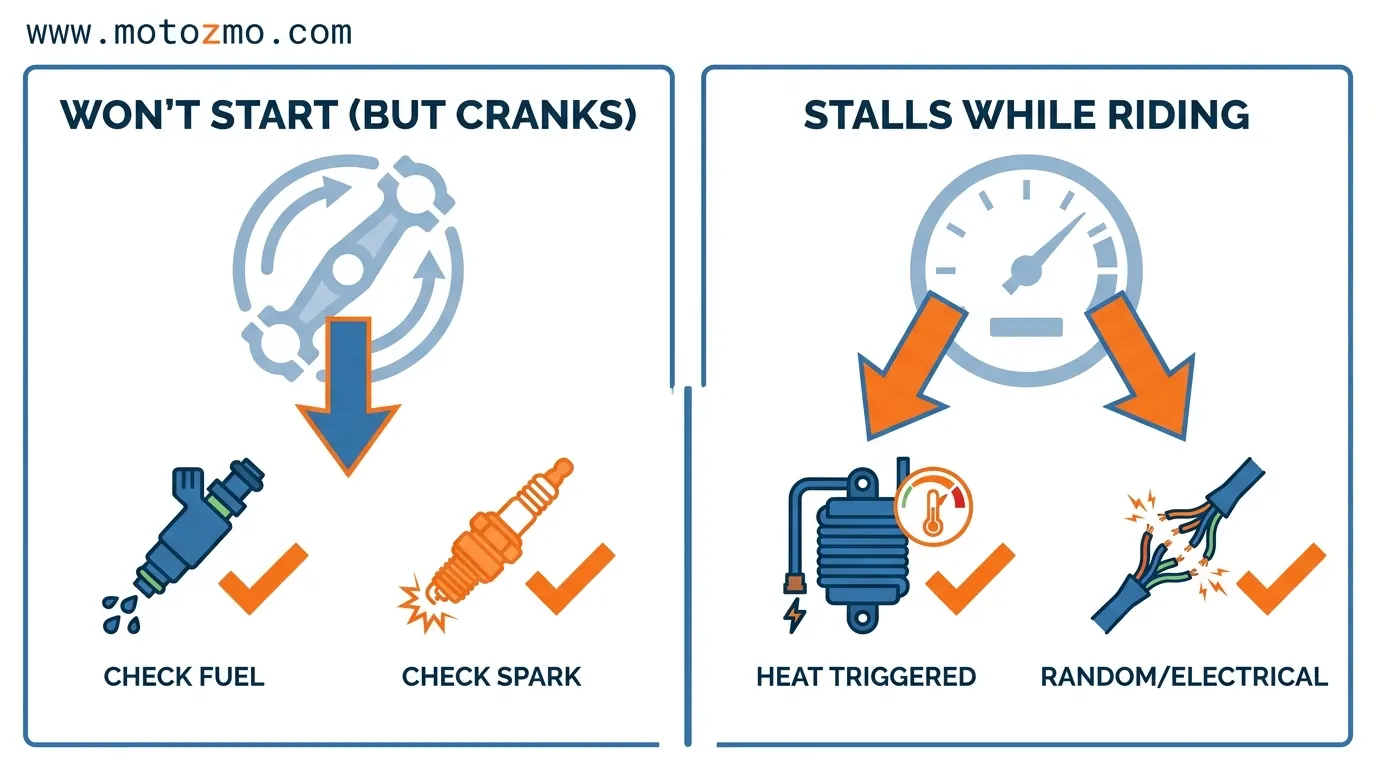
Ignition coils and CDI units develop internal faults as they warm up, then work again once they contract. If it stalls randomly with no pattern at all, suspect a loose electrical connection or a failing relay instead, and start there before you touch anything mechanical.
Getting home safely matters more than diagnosing it roadside. If it dies and won’t restart immediately, give it fifteen minutes to cool before trying again. If a wire’s visibly loose, wrap it and secure it with a zip tie rather than leaving it to vibrate free again. Neither of those fixes the actual fault, they just buy you the miles to get somewhere you can look properly.
Our guide to an engine that keeps cutting out walks through the fuel-delivery and electrical causes side by side.
Battery, Starter, and Charging: The Multimeter Checks
A multimeter answers this in about two minutes, and the numbers matter more than guesswork:
| Check | Reading | What it means |
|---|---|---|
| Battery, engine off | 12.6V or higher | Fully charged |
| Battery, engine off | Below 12.0V | Needs a charge |
| Cranking | Above 9.5V | Starter circuit is healthy |
| Cranking | Below 9.5V | Weak battery or high resistance somewhere in the circuit |
| Charging, at 2,000+ RPM | 13.5–14.5V | Charging system is doing its job |
| Charging, at 2,000+ RPM | Above 15V | Regulator/rectifier is failing, stop and check it |
A starter that clicks but doesn’t spin usually means a weak battery or a bad solenoid, not a dead starter motor. Bypass the solenoid by touching a screwdriver across its terminals; if the engine cranks, the solenoid’s the problem.
If your bike dies overnight even after a full charge, that’s a parasitic drain or a charging fault, not the battery itself; Yuasa’s own testing and maintenance guide covers the load-testing procedure in more depth. For chronic dying batteries specifically, our guide to a motorcycle battery that keeps dying is the deeper dive.
Carburetor or Fuel Injection: Which Is Cheaper to Live with
If you’re shopping and this is a factor, carburetors are simple and rebuildable but need more attention: jets clog with old fuel, mixture screws need periodic adjustment, and altitude changes affect them directly.
Fuel injection self-adjusts for altitude and temperature, starts more reliably cold, and needs less routine fiddling, but a failed sensor or injector is a job for a scan tool and often a shop, not a Saturday afternoon with carb cleaner. Neither is objectively better for a beginner; it’s a tradeoff between doing more maintenance yourself versus paying more when something electronic actually fails.
We’ve laid out the full comparison, including which specific symptoms point to which system, in our carburetor vs fuel injection breakdown.
Clutch Trouble: Slipping, Dragging, or Jerking
These three feel different, and the fix is different for each:
| Symptom | Likely cause | Fix |
|---|---|---|
| Revs climb but speed doesn’t follow, especially under load | Worn friction plates or oil contamination | Replace the plates; switch to a JASO MA/MA2-rated oil |
| Hard to find neutral, bike creeps forward in gear with the lever pulled in | Cable adjusted with too little free play | Reset free play, typically 10–20mm measured at the lever |
| Harsh lurch when releasing the lever, chatter during engagement | Grooved clutch basket or warped plates | Replace the basket, plates, or both |
Automotive oil is worth calling out on its own: it contains friction modifiers that make a wet clutch slip, so even a healthy clutch pack will act worn if you’ve been running the wrong oil.
If what you’re feeling is specifically a jerk or lurch when releasing the lever rather than a slip under load, our guide to a clutch that jerks when feathering goes deeper on that specific symptom.
Overheating: Liquid-Cooled vs Air-Cooled
The pattern of when it overheats usually tells you the cause:
| Pattern | Likely cause | Fix |
|---|---|---|
| Overheats in traffic, cools fine on the highway | Failed cooling fan or fan switch | Test the fan by bypassing the switch with a jumper; replace whichever part fails |
| Runs hot regardless of speed | Low coolant or a leak | Top off with a proper 50/50 mix, then pressure-test to find the leak |
| Climbs, then the engine starts running strangely | Thermostat stuck closed | Replace it; it’s a cheap part and an easy fix |
| Air-cooled, hot to the touch after sitting in traffic | Normal air-cooled behavior, worsened by zero airflow | Keep moving when you can, shut down during long stops |
Air-cooled engines run hotter by design, a cylinder head north of 300°F is normal, not a warning sign. What isn’t normal is a sudden loss of power, pinging, or a burning oil smell; that’s the point to stop and let it cool rather than push on.
Our guide to how hot a motorcycle engine actually gets covers the normal ranges in more detail.
Spark Test and Compression Test, Step by Step
Two tests answer most “it runs rough” or “it won’t start” questions definitively.
Spark test: pull a plug, reconnect the cap, and ground the plug’s threads against bare engine metal. Crank the engine and watch the gap. A bright blue spark means ignition’s fine; look elsewhere. Weak orange or nothing means the coil, cap, plug, or pickup coil needs testing individually. E3 Spark Plugs’ guide to reading a spark plug is a good next step once you’ve confirmed spark is present but something still feels off, since the plug’s color tells you whether the mixture’s rich, lean, or oil-fouled.
Compression test: warm the engine, pull all the plugs, thread in a compression tester, and crank through several revolutions with the throttle wide open. All cylinders should read within 10% of each other and meet your manual’s minimum spec. Low compression on one cylinder points to a valve or ring problem; low across the board suggests something more systemic, and both mean a top-end job is likely coming.
If the symptom is specifically popping or backfiring on deceleration rather than a flat misfire, that’s usually a lean mixture or an exhaust leak, not an ignition fault; our guide to motorcycle backfiring covers that separately. And if your bike throws electronic fault codes instead of needing this kind of manual check, our OBD2 scanner picks for motorcycles cover the modern alternative.
What to Carry for Roadside Diagnosis
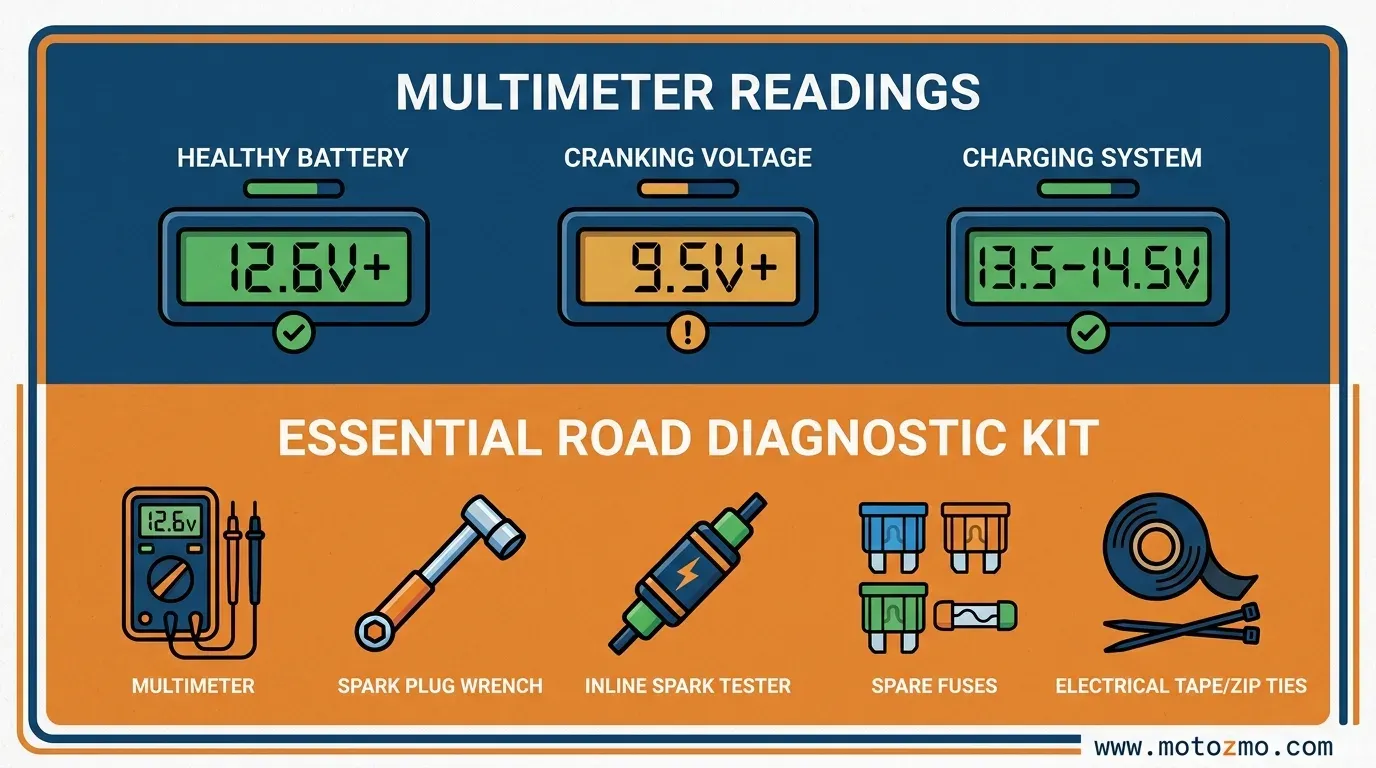
A compact kit turns a roadside mystery into a five-minute fix. At minimum: a multimeter or test light, a spark plug wrench, an inline spark tester, electrical tape and zip ties, spare fuses, and a spare plug.
Our full roundup of essential tools every rider should carry covers the broader kit, including what handles roadside repairs beyond diagnosis.
Two More Common Trouble Spots
A chain that’s developed slack, or skips under acceleration, isn’t a starting or electrical issue at all, it’s wear in the drivetrain, and it has its own diagnostic path. Our guide to a skipping or slack motorcycle chain walks through when it’s adjustment versus replacement.
A flat tire mid-ride isn’t a “problem” in the diagnostic sense so much as an emergency with its own procedure: stop safely, figure out tubeless versus tube-type, and decide whether it’s a roadside fix or a tow. Our step-by-step guide to a flat tire on the road covers that from the first ten seconds onward.
DIY or Professional, and What It Costs
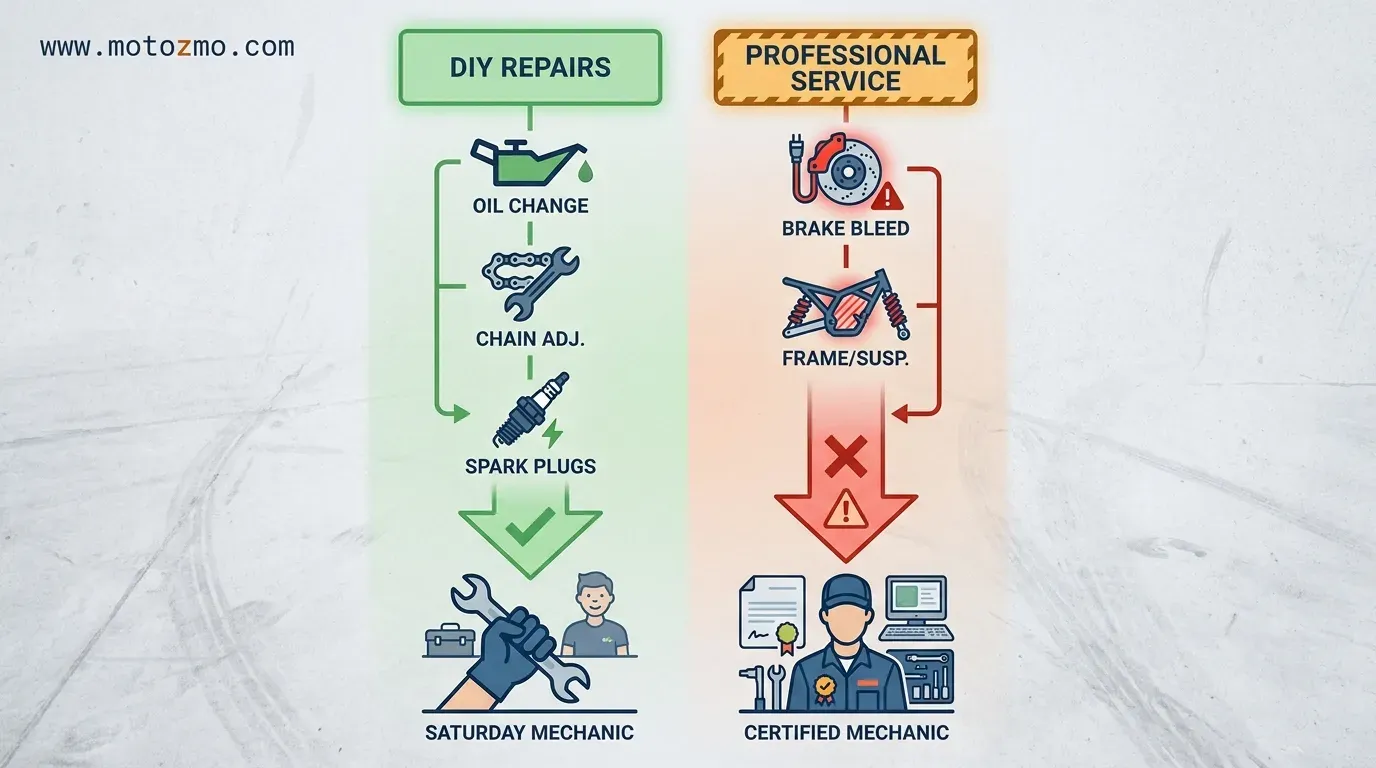
Some repairs punish a mistake with an inconvenience. Others punish it at speed.
| Repair | DIY-friendly? | Why |
|---|---|---|
| Oil changes, chain maintenance, spark plugs | Yes | Low risk, cheap tools, forgiving even if you’re not precise |
| Carburetor cleaning, cable adjustment | Yes, with patience | Fully reversible, well documented in service manuals |
| Clutch replacement | Depends on your tools and confidence | Needs specific tools; a bad install is expensive, not dangerous |
| Brake system work | Almost always professional | A bad bleed or seal fails at the worst possible moment |
| Frame, wheel-truing, suspension rebuilds | Always professional | Structural failure at speed, no margin for error |
On cost: a full clutch replacement at an independent shop commonly runs somewhere in the $300–$1,100 range for most street bikes, with cruisers and European models often landing higher. Brake work varies more by what’s actually needed, but a caliper rebuild plus a master cylinder kit and a fluid flush typically lands in the low hundreds per end, climbing fast if pads or rotors need replacing too.
Get a line-item quote before you commit either way; a shop that won’t separate parts from labor is a shop worth a second opinion. For the brake side specifically, our brake pad, fluid, and bleeding guide is the category’s own deep dive.
The Bottom Line
Most motorcycle problems announce themselves before they strand you: a sound that changes, a smell that shouldn’t be there, a gauge that creeps somewhere it shouldn’t. Work the symptom back to its system, check the cheap and obvious causes first, and know which repairs are worth your Saturday versus which ones belong at a shop. The specific guides linked above go deep on each system; this page is the map that gets you to the right one.