
Affiliate disclosure: This post may contain affiliate links. If you buy through a link on this page, MOTOZMO may earn a small commission at no extra cost to you. It helps keep our guides free. How we test and choose products.
Top Picks for You
ANCEL BA101
The fastest battery-or-charging answer for the least money — conductance-based health, cranking, and charging tests with readings within 5% of professional gear.
Check Price
KONNWEI KW600
Adds a live voltage waveform on a 2.4-inch color screen — catches intermittent charging faults that a single snapshot misses.
Check Price
TOPDON BT200
Stays readable in harsh sunlight with GOOD/CHARGE/BAD LEDs — the roadside diagnosis pick, if you accept the premium price.
Check Price
Klein MM400
A CAT III 600V multimeter for riders who read the reference table themselves — tests anything, decides nothing.
Check Price
I killed two good batteries before I learned the bike was never charging them in the first place.
When your bike dies every few weeks, the question is never just “is the battery good?” It is “is the battery dying, or is the charging system refusing to keep it alive?” Get that wrong and you buy a new battery, then watch it die too.
A basic voltmeter shows a number; the four testers below run battery, cranking, and charging tests and hand you a verdict in plain words. If you want to rule out slow drains first, read our piece on why your motorcycle battery keeps dying. Then pick a tester and get the answer in about two minutes.
Why Does a Healthy-Looking Battery Still Refuse to Start the Bike?
Because resting voltage lies. A tired battery can sit at 12.6 volts all day and collapse the moment the starter button draws current. Old hands on the forums have said this for years: a digital meter reads 12 volts, a bulb wired across the terminals goes dim, and only the loaded reading told the truth.
That is the gap in most ranking lists. They sell you a gadget that reads voltage, but they never teach you what the number means, and they skip the two tests that answer the real question: can the battery deliver under load, and does the bike recharge it while it runs?
Three tests matter. A battery health test measures internal resistance and cold-cranking ability through conductance, which works even on a partly discharged battery.
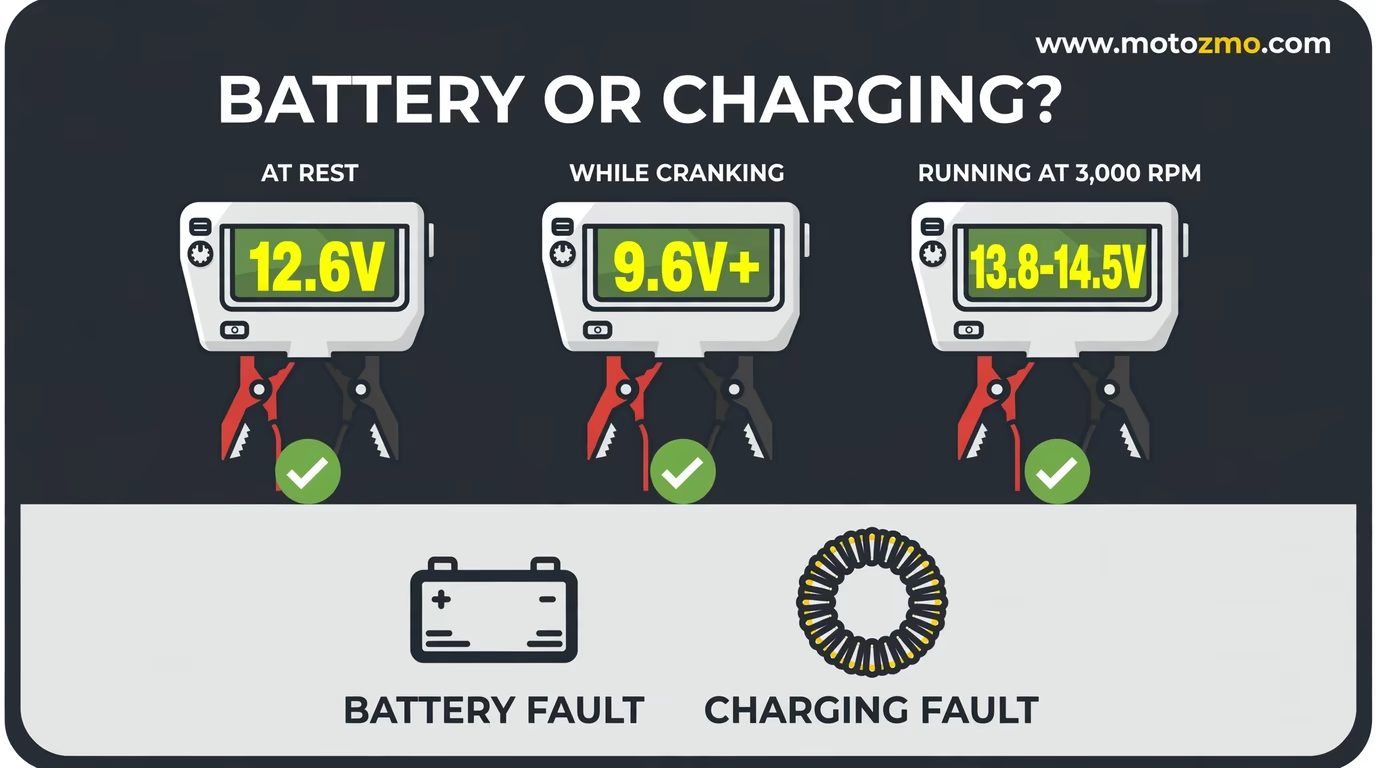
A cranking test watches voltage while the starter turns. A charging test watches voltage rise as the revs climb. Together they separate the three failure points: dead battery, weak starter circuit, or a stator and regulator that are not doing their job. Before any of them, clean and tighten the terminals first.
A corroded ground connection can fake every symptom on this page. A solid walkthrough of the same three tests on a bike lives at Bikernet’s charging-system test guide, which stresses testing with the battery fully charged and still wired into the bike.
What Your Voltage Readings Mean
| When you measure | Healthy reading | What it tells you |
|---|---|---|
| Battery at rest, bike off for at least an hour | 12.6V is full; 12.4V is about three-quarters; 12.2V is about half; under 12.0V, charge before testing further | How much charge the battery holds sitting still |
| While cranking | Stays above 9.6V, ideally above 10V | The battery can deliver power under load |
| While cranking, voltage collapses | Drops under 9.6V | The battery is done, or the starter is drawing too much current |
| Running at about 3,000 rpm | 13.8V to 14.5V, steady | The stator and regulator/rectifier are charging the battery |
| Running, climbing past 15V | Overcharging | The regulator/rectifier is suspect |
| Running, stuck at or below resting voltage | No rise with revs | The charging system is not feeding the battery; suspect the stator or regulator |
How Did We Pick These Four Testers?
Every pick runs all three tests: battery health, cranking, and charging. That is the non-negotiable line. Without those three, a tool only reads a number and leaves the diagnosis to you.
Each pick then serves a different kind of rider, from the roadside troubleshooter to the rider chasing a fault that only appears once a month. And each has at least one real tradeoff: no tool on this page is perfect.
| Tester | Battery test | Cranking test | Charging test | Display | Voltage range | Standout trait |
|---|---|---|---|---|---|---|
| ANCEL BA101 | Yes | Yes | Yes | Backlit mono LCD | 12V | Cheapest full diagnosis |
| KONNWEI KW600 | Yes | Yes | Yes | 2.4 in color TFT plus live waveform | 12V | Graphs charging output over time |
| TOPDON BT200 | Yes | Yes | Yes | 2.4 in color LCD plus GOOD/CHARGE/BAD LEDs | 12V battery; 12V/24V cranking and charging | Readable in harsh sun |
| Klein MM400 | Manual | Manual | Manual | Backlit LCD | Up to 600V AC/DC | Tests anything, decides nothing |
Most motorcycle electrical problems trace back to the battery or the charging system, so one of these four earns its shelf space fast.
What’s the Best All-Round Tester for Battery-vs-Charging Diagnosis?
Key Features
- Conductance-based health test across a 100–2000 CCA range
- Covers flooded, AGM flat/spiral, gel, and EFB batteries (30–220 Ah)
- Reverse-polarity protection on the clamps
- 12-volt lead-acid only — no 6V classics or lithium packs
The ANCEL BA101. It uses conductance to judge battery health (state of health, state of charge, internal resistance, and measured cold-cranking amps) in the 100 to 2000 CCA range, across regular flooded, AGM flat plate, AGM spiral, gel, and EFB batteries from 30 to 220 amp-hours.
Then it runs the other two tests that matter: a cranking test that records voltage drop and crank time while you hit the starter, and a charging test that checks alternator output under loaded and unloaded conditions. Reverse-polarity protection means a backwards clamp cannot fry it. It sits at the top of Amazon’s battery-tester category on sales.
The tradeoffs are real. The screen is a monochrome LCD, not color, and the plastic over it scratches if you toss the tester loose in a toolbox. It handles 12-volt lead-acid only, so it will not help with a 6-volt classic or a lithium pack.
But for a modern 12-volt bike it answers the core question faster than anything else near its price. If your symptom is a click instead of a crank, the cranking test pairs well with our notes on a motorcycle that won’t start but keeps clicking. Same sound, different causes.
Best for: riders who want the fastest battery-or-charging answer for the least money.
Which Tester Shows the Charging System as a Live Waveform?
Key Features
- 2.4-inch color TFT with live voltage waveform
- 12V, 100–2000 CCA battery, cranking, and charging tests
- Powered by the battery under test — no internal battery to charge
- Stores results for PC printout; lifetime firmware updates
The KONNWEI KW600. It covers the same ground as the BA101 (12 volts, 100 to 2000 CCA, battery, cranking, and charging tests) but adds a live voltage waveform on its 2.4-inch color screen.
You watch the line dip during cranking and ripple while the bike runs, which catches faults a single snapshot misses: a regulator that fades when hot, a connection that drops out over bumps.
It draws power from the battery under test, so there is no internal battery to keep charged, and it stores results you can print through a PC over USB. KONNWEI offers lifetime firmware updates, and the unit holds 4.5 stars across 835 Amazon ratings. The official user manual walks through the waveform menu if you want to see the screens before buying.
The tradeoffs: the color screen washes out in direct sun, which is exactly where roadside tests happen. The printed manual is thin, and the PC software feels like a different decade. But for intermittent electrical problems (the kind that never misbehave in the garage), a graph of what the charging system did over a minute beats a single number every time.
Best for: riders chasing an intermittent charging fault the garage never sees.
What’s the Easiest Tester to Read in Bright Sunlight?
Key Features
- 2.4-inch color LCD readable in harsh sunlight
- GOOD / CHARGE / BAD LEDs give the verdict at a glance
- 12V battery test; 12V/24V cranking and charging tests
- 2-year warranty; 4.6 stars from nearly 2,000 Amazon ratings
The TOPDON BT200. Its 2.4-inch color LCD stays readable in harsh light, and three LEDs on the face (GOOD, CHARGE, BAD) give you the verdict without squinting at digits.
It tests 12-volt battery health, and its cranking and charging tests cover both 12 and 24 volts, which suits riders who also keep a truck or a big adventure bike on 24-volt systems.
Conductance-based, reverse-polarity and spark-proof, with a two-year warranty and 4.6 stars from nearly two thousand Amazon ratings. TOPDON’s product page spells out the three-LED system and the loaded-versus-unloaded charging check.
The tradeoffs: it costs noticeably more than the BA101 for similar tests, and the battery-health test itself is 12-volt only; only cranking and charging extend to 24 volts.
Amazon stock comes and goes, so check availability before you plan a weekend around it. I would pay the premium only if you actually test bikes outdoors, where the screen and the LEDs earn their keep.
Best for: riders who diagnose bikes roadside or in bright shops.
What If You Want One Cheap Tool That Tests Everything, Slowly?
Key Features
- Auto-ranging: up to 600V AC/DC, 10A, resistance, continuity, capacitance
- Temperature probe included for diagnostics
- Survives a 3.3-foot drop; CAT III 600V rated
- 4.7 stars from 3,000+ Amazon reviews
The Klein MM400. It is an auto-ranging digital multimeter: up to 600 volts AC and DC, 10 amps, resistance, continuity, capacitance, frequency, and a temperature probe, built to survive a 3.3-foot drop and rated CAT III 600V. It will not judge your battery.
You read the resting voltage, hold the leads while someone cranks, read the charging voltage at revs, and compare against the table above yourself. For about the price of a tank of gas you get the most versatile electrical tool on this page, with 4.7 stars from over three thousand Amazon reviews.
The tradeoffs are the point of this pick. A dying battery can read a perfect 12.6 volts at rest and still fail the cranking test. The meter never tells you that; the table above does.
Some owners report a flaky continuity beeper and short battery life in the meter itself. It is slower than every tester above and demands that you know what the numbers mean, which is why we wrote the reference table.
But if you wrench on wiring, not just batteries, a meter does jobs no battery tester can, like tracing a dead circuit or checking a stator’s AC output. Our multimeter versus test light breakdown covers which jobs belong to which tool.
Best for: riders who already trust the reference table above and like doing the reading themselves.
Your Battery Failed the Test. Now What?
A failed battery test means shop for a replacement with confidence instead of hope. Our best AGM motorcycle battery picks cover the safe default, and the Kemimoto versus Antigravity lithium comparison covers the lightweight upgrade.
But if the charging test failed, stop: a new battery on a dead charging system is just an expensive way to repeat this article in three weeks. Fix the stator or regulator first, then buy the battery.
FAQ
Do you have to remove the battery from the bike to test it?
No. All four testers above work with the battery still wired in, which is the point, since the cranking and charging tests need the bike’s own circuits. Test after the bike has sat at least an hour with everything off, so surface charge does not flatter the reading, and scrape the terminals clean first. A dirty clamp can fail a perfectly good battery.