
Affiliate disclosure: This post may contain affiliate links. If you buy through a link on this page, MOTOZMO may earn a small commission at no extra cost to you. It helps keep our guides free. How we test and choose products.

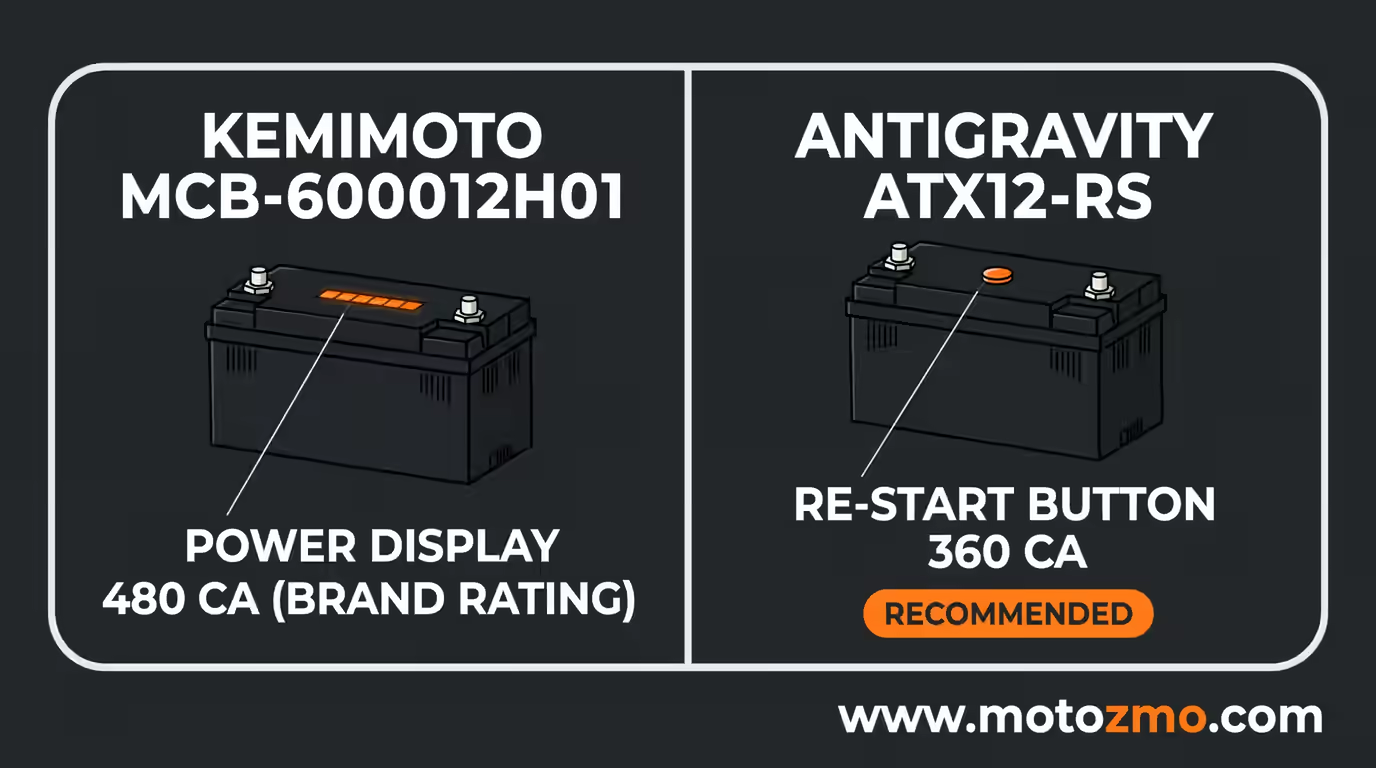
- 480 CA cranking (brand rating)
- 6 Ah capacity with a charge-level display
- Spacer kit fits YTX9-BS to YTX14-BS boxes
- About $100 street price

- 360 CA cranking
- 2.6 lbs in an OEM YTX12 case
- Full BMS with RE-START self-rescue button
- About $250 street price
Pick the Antigravity ATX12-RS if you want the battery that forgives mistakes. Pick the Kemimoto MCB-600012H01 if you want lithium power for a hundred dollars.
I have watched riders buy lithium for the weight savings alone, then get stranded on a cold morning. The weight loss is real, but so is the cold-start catch, and the two brands handle that catch in opposite ways.
The Kemimoto costs about $100 and prints a 480 cranking-amp rating on its label. The Antigravity costs about $250 and claims 360, with no shared test standard behind the numbers.
What the Antigravity buys you is a full battery management system and a self-rescue button. What the Kemimoto buys you is real lithium power, a charge display on top, and $150 left in your pocket.
If your battery keeps dying for reasons beyond brand choice, fix that first: no battery survives a parasitic drain for long.
What Do the Spec Sheets Say?
I pulled the numbers from both brands’ own pages, because forum posts mix up models and years. One gap jumps out at once. Antigravity publishes every figure a buyer needs.
Kemimoto prints its voltage, capacity, and cranking rating on the battery label, yet its product page never lists a weight or a case size. That silence matters later in this article.
| Spec | Kemimoto MCB-600012H01 | Antigravity ATX12-RS |
|---|---|---|
| Cranking | 480 CA (brand rating) | 360 CA |
| Capacity | 6 Ah actual (76.8 Wh) | 6.1 Ah actual (12 Ah lead-eq) |
| Weight | Not published | 2.6 lbs |
| Case | Compact case, 5 EVA spacers in the box | OEM YTX12 case (5.9 x 3.3 x 5.1 in) |
| Battery management | BMS with temperature cutout | Full BMS + RE-START button |
| Charge display | Yes, bars on the battery top | No built-in display |
| Street price | About $100 | About $250 |
| Warranty | Short seller warranty | 3-year prorated |
On capacity the two tie: 6 amp-hours against 6.1. On cranking claims the Kemimoto leads on paper, and that lead means little. Each brand rates its own battery its own way, with no shared test behind the numbers.
Treat the 480 as a claim, not a test result. Both batteries use LiFePO4 chemistry, so the fire stories you hear about phone batteries do not apply here.
How Much Weight Do You Save?
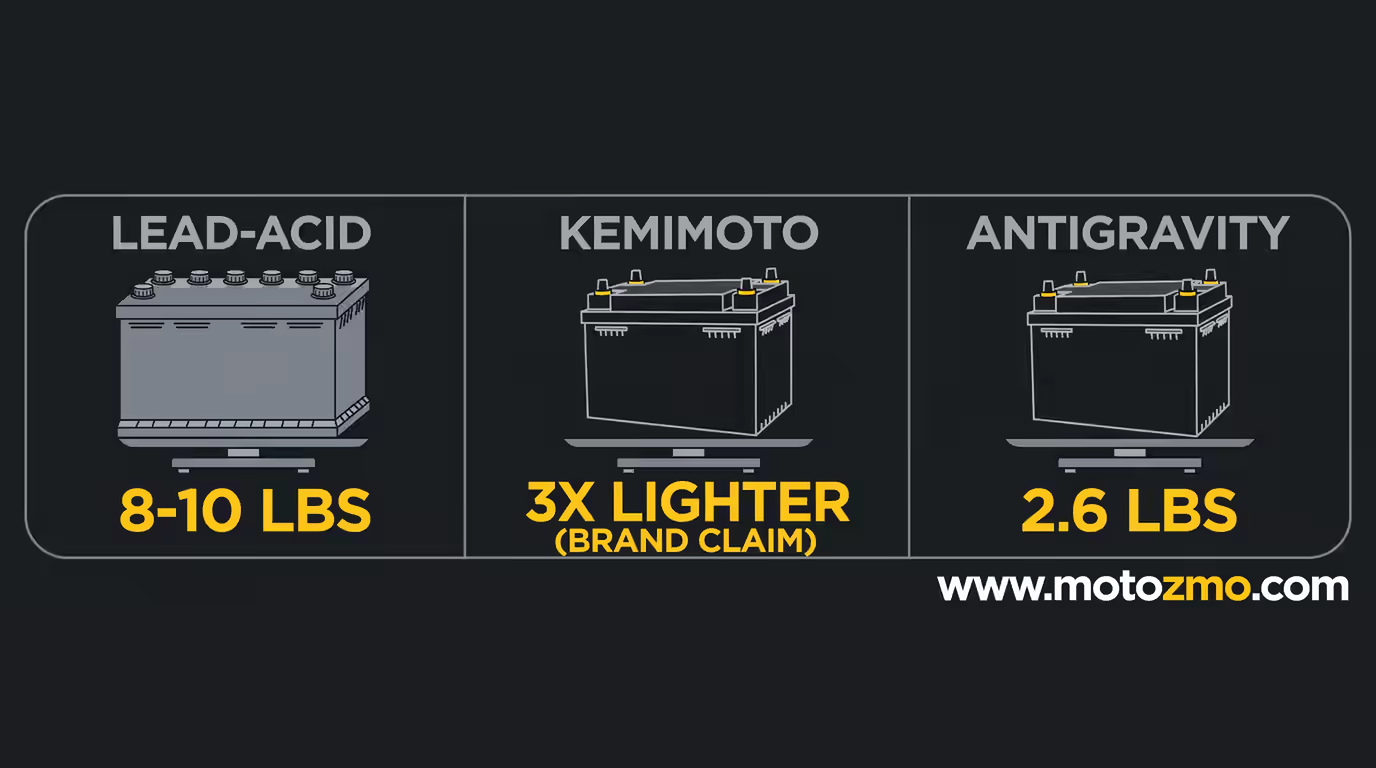
A stock lead-acid battery in a middleweight bike weighs 8 to 10 pounds. The Antigravity weighs 2.6 pounds, so the swap sheds about 6 to 7 pounds from high up on the bike.
Kemimoto publishes no weight at all. Run the brand’s own claim of about a third of the lead-acid it replaces, and you land near 3 pounds, with a saving in the same range.
On a 450-pound motorcycle with a 170-pound rider, 7 pounds is barely more than 1 percent of the total. You will not feel it pulling away from a stoplight. You feel it up high, where most batteries sit, when the bike flicks side to side.
Track-day riders notice it. Commuters do not. And since both batteries land in the same range, neither brand wins this round. That is the honest way to frame the weight round.
Why Does Cranking Sag in the Cold?
LiFePO4 chemistry gets sluggish in the cold. The internal resistance of the cells climbs as the temperature drops, so the voltage sags the moment the starter draws big current.
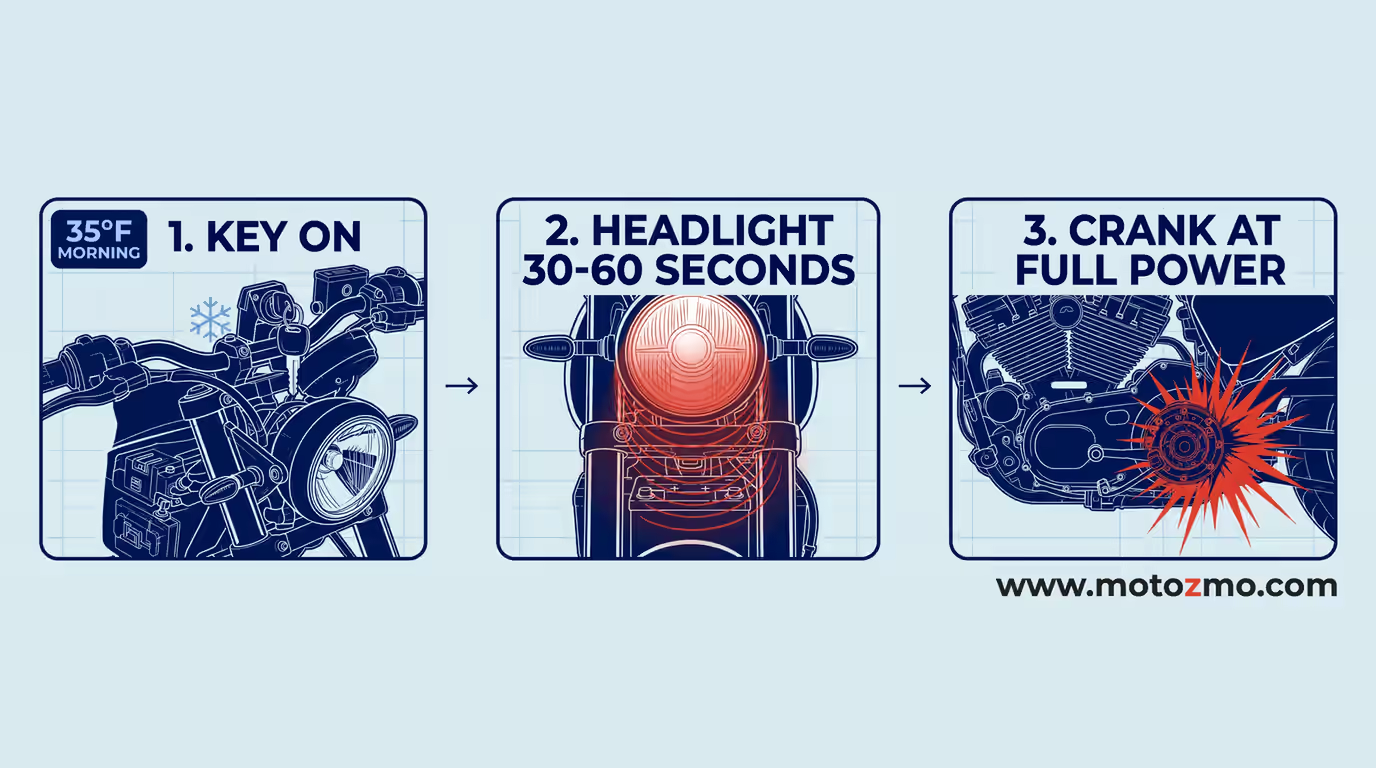
On a 35-degree morning, the first crank can feel weak and slow even on a full battery. Riders who start their bikes in warm states never see this. Riders in Minnesota see it every October.
The fix is a wake-up routine, and it takes a minute. Turn the key on and let the headlight burn for 30 to 60 seconds, or tap the starter in short bursts. That small draw warms the cells from the inside, the resistance drops, and the next crank comes through with full force.
Kemimoto adds one hard limit. Its battery management system cuts power if the battery sits below -2°F for hours, and again if it climbs above 172°F. That guard protects the cells, yet it means a bike parked outside on a deep-winter night may give you nothing until the battery warms up.
The Antigravity uses the same chemistry, so it sags in the cold too, but it publishes no such cutoff. If you ride through winter, read our guide to the best motorcycle battery for cold weather before you spend anything.
What Happens If You Drain One Flat?
This is where the two brands split hardest. Batteries die in dull ways: a key left on, an alarm sipping current for three weeks, a heated-grip controller that never sleeps.
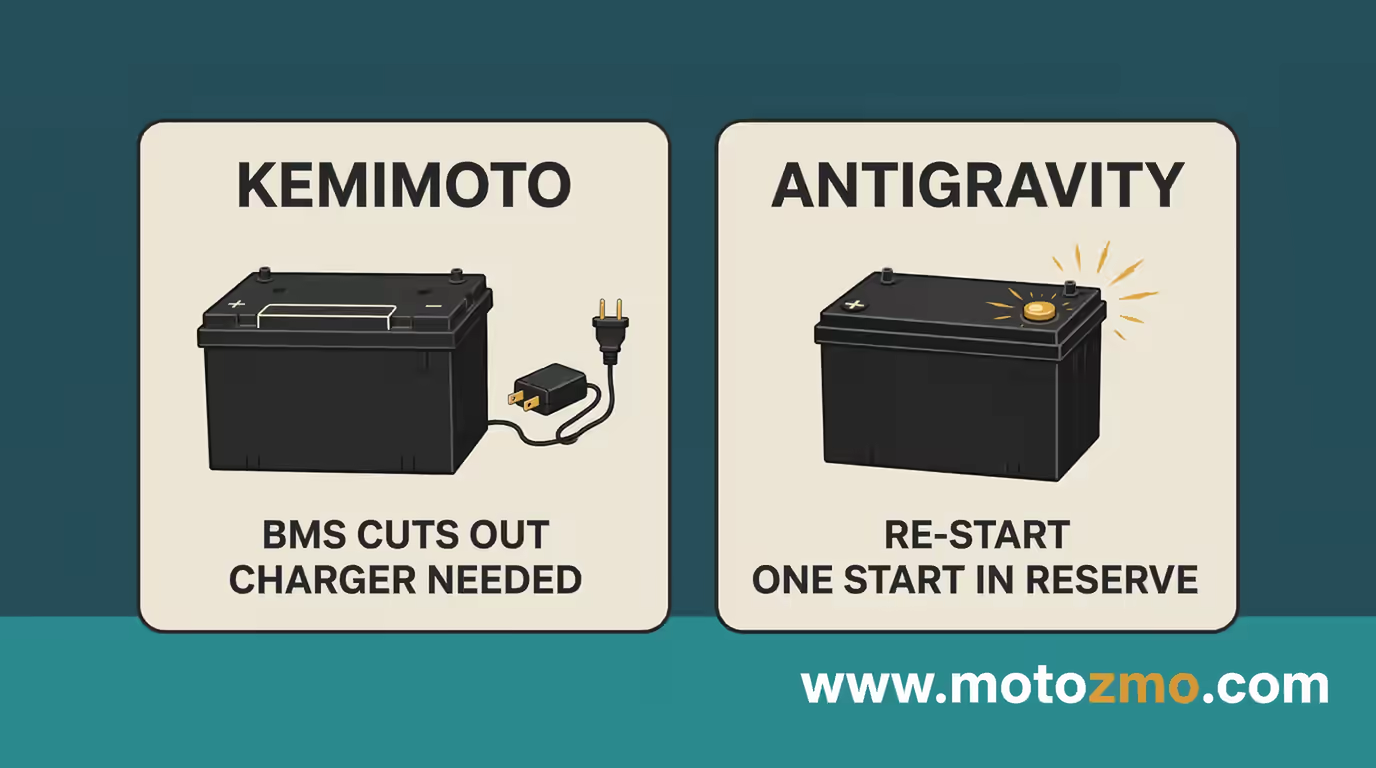
The Kemimoto’s management system guards its cells. It cuts output on over-discharge, over-charge, over-current, and short circuits. That saves the battery. It does not save your morning. Once the battery cuts out, you need a charger or a jump before the bike starts.
Antigravity goes one step further. Its RE-START system watches the voltage, and just before the battery would go flat, it puts itself to sleep with one start held in reserve.
Antigravity calls the ATX12-RS the first powersport battery with built-in jump starting, and the claim holds up in use. Press the button on top of the battery, thumb the starter, and ride away. No jump pack, no charger, no phone call.
Think about which failure you fear. A dead battery at home costs you an hour. A dead battery at a trailhead or a motel costs you the day.
Which Charger Can You Use?
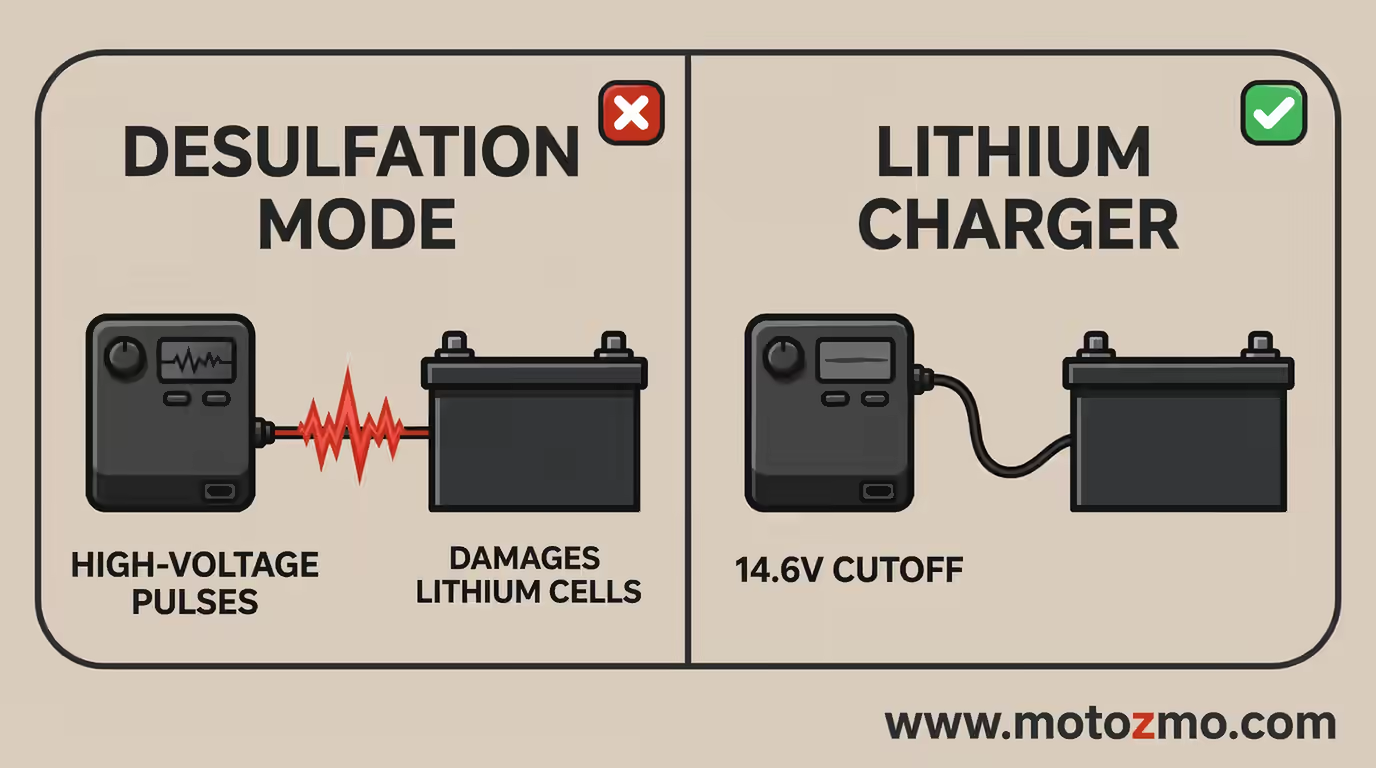
Get this wrong and you can hurt either battery. Kemimoto says its battery needs no special charger, with a charge cut-off of 14.6 volts.
Antigravity says the opposite: lithium-specific chargers only, no lead-acid chargers at all. My advice sits with Antigravity. A charger built for lithium costs little, keeps the cells balanced, and removes the guesswork.
One charger feature is poison to both brands: a desulfation mode. That routine fires high-voltage pulses into the battery to break up the sulfate crystals that choke lead-acid plates.
Lithium cells grow no sulfate, and the pulses can push them past safe voltage. If your charger has a desulfation mode, retire it.
Before you blame a battery, test your bike’s charging system. A tired regulator that spikes past 15 volts will cook a lithium battery, and neither brand’s warranty will save you.
A motorcycle voltage tester tells you the truth in five minutes. If you need a new charger, a lithium-capable smart charger covers both brands, and our Battery Tender vs NOCO Genius comparison picks the right one for your garage.
Who Should Not Buy the Kemimoto?
Do not buy the Kemimoto if your bike sips power while parked: an alarm, a hardwired GPS, a dash cam. The cutout protects the cells, but you still face a charger session before the bike starts. The Antigravity forgives that mistake once. The Kemimoto does not.
Do not buy it if your bike sleeps outside through a northern winter. A management system that cuts power below -2°F is a guard rail, and on the coldest mornings it turns into a wall.
Do not buy it if you want published numbers and a long warranty behind your battery. Kemimoto lists no weight, no case size, and no multi-year warranty. You save $150 up front, and you carry the risk yourself.
And if you hate rituals like the wake-up routine and the charger rules, price a quality AGM instead. It weighs more, but it cranks on the first push at 20 degrees, with no warm-up. Our best AGM motorcycle battery roundup covers the strong ones.
Who Should Not Buy the Antigravity?
Do not buy the Antigravity if the price stings. At about $250, it costs two and a half times the Kemimoto, and the Kemimoto starts the same bikes in fair weather.
Do not buy it if your battery tray is tiny. The ATX12-RS fills a full YTX12 footprint. Custom builds and vintage bikes with cramped trays often fit a compact case with spacers where an OEM-size case will not go.
Do not buy the RE-START version for a built V-twin. Antigravity itself steers modified motors over 103 cubic inches away from the RS line and toward its heavy-duty models. Big-twin owners should look at the ATX12-HD-RS instead.
Which One Wins for Which Rider?
| Rider | Pick | Why |
|---|---|---|
| Budget rider on a fair-weather bike | Kemimoto MCB-600012H01 | Lithium power and a charge display for about $100 |
| Daily rider, bike parked outside | Antigravity ATX12-RS | Full BMS and the RE-START rescue |
| Accessory-heavy touring bike | Antigravity ATX12-RS | The reserve start forgives parasitic draw |
| Vintage or custom build, tight tray | Kemimoto MCB-600012H01 | Compact case plus spacers fits odd trays |
| Cold-climate rider, no patience for rituals | Neither (consider AGM) | First-push starts below freezing |
Best for: the budget rider who wants lithium without the premium, the Kemimoto MCB-600012H01. Check the Kemimoto MCB-600012H01 on Amazon. You get a real 6 amp-hours of LiFePO4 capacity, a charge display on the battery top, and a spacer kit that fits most battery boxes, for about $100. Respect its limits: keep a lithium charger in the garage, do the cold-morning wake-up, and do not park it for weeks behind an alarm.
Best for: the rider who wants to stop thinking about the battery, the Antigravity ATX12-RS. Check the Antigravity ATX12-RS on Amazon. The full management system, the published specs, and the RE-START button make it the most forgiving lithium battery in this fight. You pay for that peace of mind, and for most daily riders the price is fair.
One last thing both brands share: lithium batteries barely self-discharge. Disconnect the negative terminal and either one will sit through winter storage holding its charge, no tender needed.
Our guide to storing a motorcycle for winter covers the rest of the routine. Pick the Kemimoto for your wallet, pick the Antigravity for the safety net, and you will not be disappointed by either.