
AGM batteries are the most reliable choice for cold-weather starting for most riders; lithium (LiFePO4) options work too, but only with built-in cold-weather charge protection.
The number that actually predicts whether your bike starts on a cold morning is CCA, Cold Cranking Amps, and it needs to match your engine size with real margin, not just meet the bare minimum. If your bike already struggled to turn over this week, diagnose that before you spend money on a replacement.
In this article, I have discussed how AGM and lithium compare in the cold, how to match CCA to your bike, and two specific picks depending on which chemistry you choose.
Not sure the battery is even the problem yet? Confirm the actual cause first. A weak battery, a bad charging system, and simple cold weather can all look identical from the saddle.
Why Cold Actually Kills Starting Power
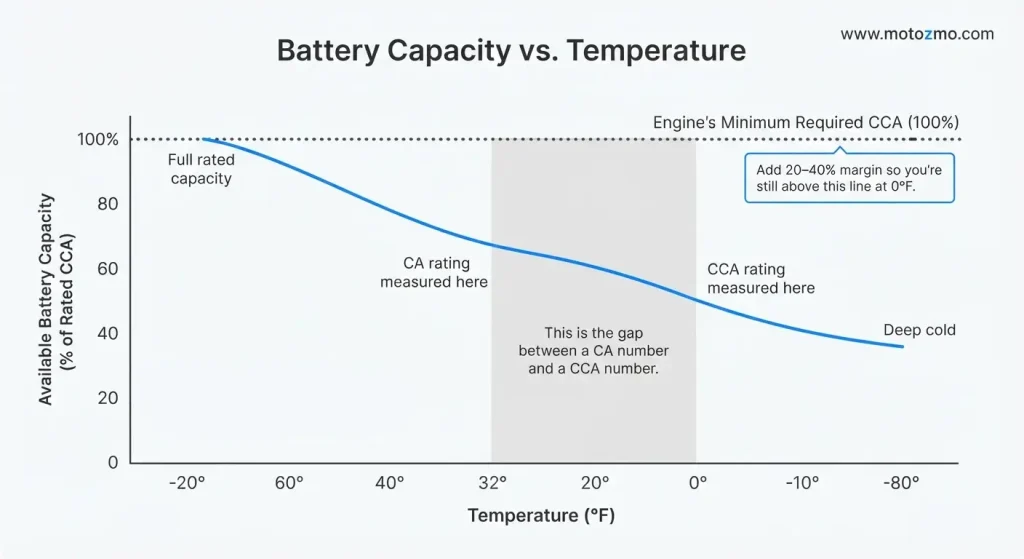
Every battery’s CCA rating is measured at exactly 0°F for a reason: that’s the temperature where the difference between a healthy battery and a marginal one shows up. Cold thickens engine oil and increases internal resistance, so your starter needs more current to turn the engine over right when your battery is least able to deliver it.
Lead-acid batteries lose the most capacity in the cold; AGM chemistry retains noticeably more; lithium (LiFePO4) holds voltage well, but its ability to accept a charge drops sharply below freezing, which is a completely different problem than starting power.
Battery capacity loss in cold isn’t small or linear, either. By 0°F, a battery is commonly delivering only around half its rated CCA, and it keeps dropping as temperatures fall further.
Which Battery Chemistry Actually Wins in Cold
AGM (The Reliable, Lower-Maintenance Default): AGM (Absorbent Glass Mat) batteries are the default recommendation for cold-weather starting for some simple reasons:
- Retaining capacity better than standard flooded lead-acid batteries
- Being sealed and maintenance-free
- Proven standard in this category for years.
If you just want a battery that starts reliably every winter morning without a second thought, AGM is where to start.
Lithium/LiFePO4 (Lighter and More Powerful, With a Real Caveat): Lithium batteries offer a clear upgrade in weight and often in cranking power for the same physical size, a real advantage on a bike where every pound matters.
The catch that most product pages don’t lead with: charging a LiFePO4 battery below freezing without proper protection can cause permanent internal damage, not just reduced performance.
A quality lithium motorcycle battery needs a Battery Management System (BMS) with a low-temperature charge cutoff built in, or you’re taking on real risk every time you plug in a charger on a cold morning.
Matching CCA to Your Engine Size
Use this as a starting baseline, then add margin for winter reliability specifically.
| Engine Size | Baseline CCA Range | Recommended Winter Margin |
|---|---|---|
| 250cc | 150–200 CCA | Add 20–40% |
| 500–750cc | 200–300 CCA | Add 20–40% |
| 750cc+ | 300–400 CCA | Add 20–40% |
That margin isn’t excessive. It’s compensating for exactly the capacity loss covered above. A battery that barely meets your bike’s minimum CCA at room temperature may fall short once real cold cuts that number roughly in half.
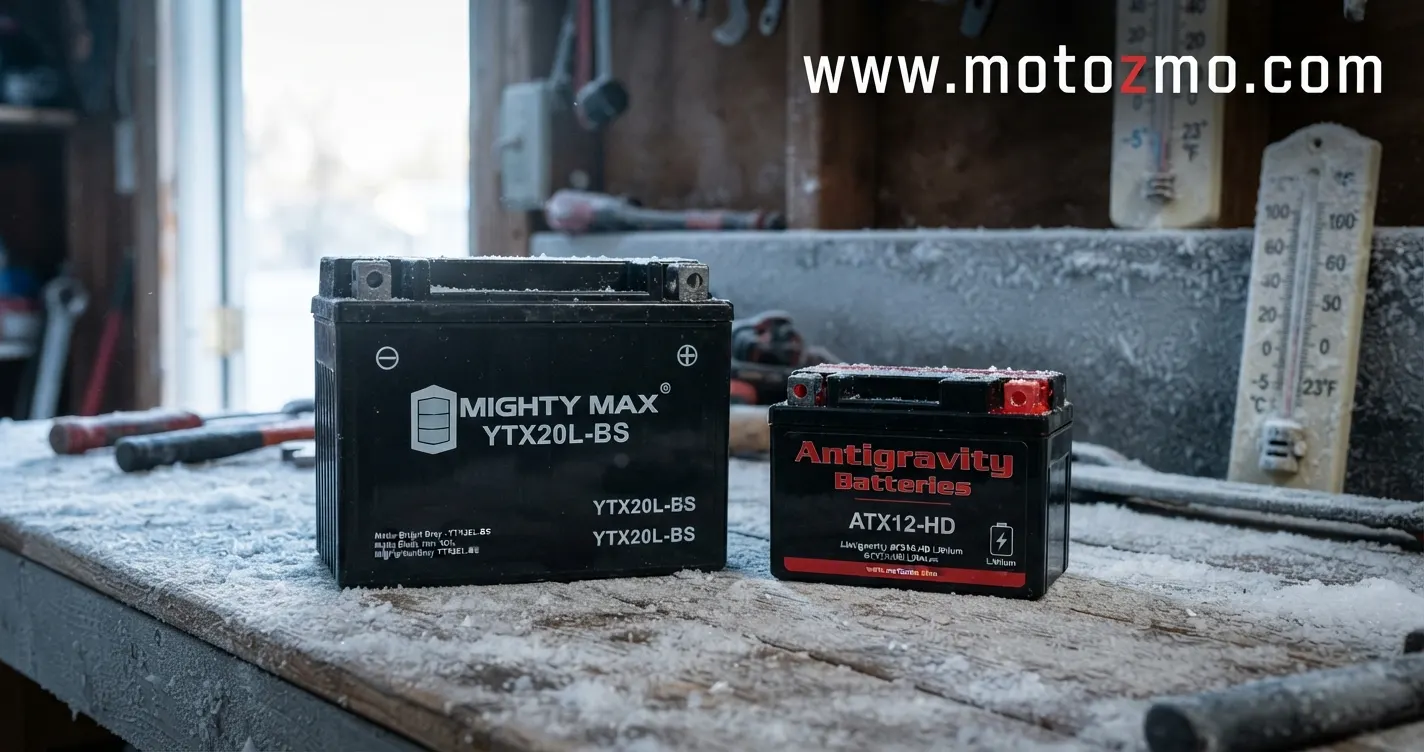
Best AGM Pick: Mighty Max Battery YTX20L-BS
270 CCA · 18Ah · Sealed, maintenance-free AGM

Key Features
- Sealed AGM construction with a fully maintenance-free design
- Can be mounted in any position and resists shock and vibration
- Backed by a full one-year manufacturer warranty
This is a straightforward, well-sized AGM pick for mid-to-larger displacement bikes, and it covers the fundamentals without complication: sealed lead-acid AGM construction that can be mounted in any position, resistance to shock and vibration, and a fully maintenance-free design, no topping off electrolyte, no fuss.
Riders who’ve installed this battery after a long-idle project bike report exactly the behavior you want from a cold-weather pick: it read close to a full 13V straight out of the box, and even during extended cranking on a bike with empty carburetors, it never dropped off or gave up before the engine finally caught. That kind of sustained cranking endurance, not just a single strong CCA number on paper, is the real-world test that matters most in cold conditions.
One practical note: this listing includes the battery and mounting screws only, no wiring harness, so confirm compatibility with your bike’s existing connections before you order.
Best Lithium Pick: Antigravity ATX12-HD
12.8V · 8Ah actual (16Ah lead-acid equivalent) · 480 CA · 3 lb · UL-listed LiFePO4 cells

Key Features
- Built-in RE-Start button lets you jump-start the battery directly from a dead state
- Full BMS with cell balancing and protection against over-charge, over-discharge, over-temperature, and short-circuit
- Rated for a 5–8 year service life, well beyond a typical AGM battery’s lifespan
If weight and a real safety net matter more to you than sticking with the proven AGM default, the ATX12-HD is a standout lithium pick, and its headline feature solves a real cold-weather problem directly.
Its built-in RE-Start function lets you jump-start the battery from a dead state by pressing a button on the case itself, no separate jump starter or clamps required, which reduces how often you’d need to carry a portable jump starter as a backup plan.
The full Battery Management System backs that up with cell balancing and protection against over-charge, over-discharge, over-temperature, and short-circuit. That layered protection is what makes trusting a button-press jump start reasonable in the first place.
Read this spec carefully: this battery is rated at 480 CA, not CCA. Cranking Amps (CA) is measured at 32°F, while Cold Cranking Amps (CCA) is measured at the much harsher 0°F standard, so 480 CA and the Mighty Max’s 270 CCA aren’t directly comparable on paper, even though 480 is the bigger number. In practice, the RE-Start function matters more for cold-weather confidence here than the CA rating alone does, since it gives you a real recovery option if a cold morning does leave the battery too weak to crank on its own.
At exactly 3 pounds and built on the common YTX12 OEM case size (also fitting YTX12-BS, YTX14, and similar sizes), it drops in as a straightforward replacement for a wide range of bikes while cutting significant weight versus a comparable stock lead-acid battery, real savings for anything off-road or low-speed, where unsprung and overall weight matters.
Two notable things are: it’s lighter than the number on the spec sheet suggests once it’s actually in hand, and it cranks confidently compared to the stock battery it replaced.
The quad-terminal design also means it fits either polarity orientation, which helps with fitment across different bikes. Antigravity rates it for a 5–8 year lifespan depending on use, well ahead of a typical AGM battery’s service life.
The caveat: like any lithium battery, this one should not be charged below freezing without built-in low-temperature protection. Charging a cold LiFePO4 cell incorrectly risks permanent, irreversible damage rather than just reduced performance. Bring it to a warmer space before connecting a charger on cold days, and don’t assume “it’s lithium” means the normal cold-weather charging rules don’t apply.
Protecting Whatever Battery You Choose
The battery you pick matters less than how you treat it once winter arrives.
- Keep it fully charged. A discharged battery freezes at a much higher temperature than a fully charged one. Letting charge drop during cold storage is one of the most common ways riders damage a perfectly good battery.
- Insulate it if it lives somewhere exposed. A battery blanket, or simply keeping the bike in an unheated but enclosed garage rather than fully outdoors, makes a real difference.
- Keep terminals clean. Corrosion adds resistance right when your starter needs every available amp.
- Pair it with a smart tender for winter storage. This is the single most useful habit for any battery sitting through cold weather. See our full battery tender roundup for picks that keep a battery properly maintained through the coldest months, including options with built-in temperature compensation.
If you’re dealing with this specifically after a winter of storage rather than active cold-weather riding, our seasonal battery guide covers that scenario in more depth.
The Bottom Line
For most riders, AGM remains the reliable, no-drama default for cold-weather starting. The Mighty Max YTX20L-BS is a solid, correctly sized example. Lithium options like the Antigravity ATX12-HD offer real weight and power advantages, plus a useful built-in jump-start feature, as long as you respect the cold-charging caveat. Whichever you choose, match the CCA to your engine size with real margin, and if you haven’t confirmed a full replacement is actually what you need, rule out the other causes first.
FAQs
What CCA do I need for winter riding?
Match your engine size to the baseline CCA range, then add a 20–40% margin specifically for cold weather. A battery that only meets the bare minimum at room temperature often falls short once real cold cuts capacity.
Is lithium or AGM better for cold weather?
AGM is the more forgiving, lower-maintenance default for most riders. Lithium can outperform it in weight and power, but only with proper low-temperature charge protection built in.
Can I charge a lithium motorcycle battery in freezing temps?
Not safely, unless it has a Battery Management System with a low-temperature charge cutoff. Charging a cold LiFePO4 cell without that protection risks permanent damage.
How much CCA does cold weather actually take away?
Roughly half of a battery’s rated CCA can be lost by 0°F, with further loss as temperatures drop beyond that.