Affiliate disclosure: This post may contain affiliate links. If you buy through a link on this page, MOTOZMO may earn a small commission at no extra cost to you. It helps keep our guides free. How we test and choose products.
Top Picks for You
Yuasa GYZ16H
The strongest, most consistent cold-start cranking in a stock-size case — 240 honest CCA, USA-built, with a track record of firing up engines that cheaper batteries just groan at.
Check Price
Deka ETX16
Maximum cranking muscle for big V-twins and high-compression engines — 325 CCA and 19 Ah from the same East Penn factory that builds Harley’s own batteries.
Check Price
Weize YTX14-BS
The budget AGM with solid real-world winter reports — 200 CCA and clean first-try starts on a 30°F morning for roughly half the Yuasa price.
Check Price
Mighty Max YTX14-BS
The cheapest reliable AGM for commuters and second bikes — often around $40 with a 1-year warranty, if you plan to replace it on schedule.
Check Price
The Yuasa GYZ16H is the best AGM motorcycle battery for cold starts in most bikes: 240 cold cranking amps in a stock-size case, real American build quality, and a track record of firing up engines that cheaper batteries just groan at.
I went looking for the battery that turns a cold engine over on a 35-degree morning, not the one with the prettiest spec sheet. Four AGM batteries made the cut, each one built for a different kind of rider and a different kind of cold morning.
If your motorcycle battery keeps dying between rides, read that first: a new battery won’t fix a drain problem. But if the battery is simply done, this guide answers the question most roundups dodge: which of these batteries actually cranks when it is cold.
Which AGM Battery Starts Best in the Cold?
Key Features
- Factory-activated: arrives filled, sealed, and fully charged
- Heavy-duty terminals with brass nuts baked in
- Made in the USA — Yuasa’s top-tier GYZ AGM line
- 1-year warranty; roughly twice the price of budget AGMs
The Yuasa GYZ16H. Its 240 CCA rating looks modest next to some bigger bricks in this list, but Yuasa rates its batteries the honest way and builds them with taller plates that hold cranking muscle deeper into a cold snap. I have seen forum riders report GYZ batteries cranking with the same authority after years of service as some batteries manage brand new.
Specs: 12V, 240 CCA at 0°F, 16 Ah, 12.4 lbs, factory activated so it arrives filled, sealed, and charged. Yuasa also builds the case around heavy-duty terminals with brass nuts baked in, which matters when you torque the cables down and ride through vibration season after season.
The GYZ line is Yuasa’s high-performance AGM family, made in the USA, and the 16H size drops straight into the stock box on a huge range of bikes.
The tradeoff is the price and the warranty. You will pay roughly twice what a budget AGM costs, and Yuasa only backs it for one year, short for a premium battery. It is also heavier than the standard YTX batteries it replaces, so weight-shavers should look at lithium instead.
Best for: riders who want the strongest, most consistent cold starts from a stock-size battery and are fine paying for it.
What About a Big V-Twin That Drinks Current?
Key Features
- 325 CCA and 19 Ah — the biggest cranking punch in this roundup
- Built by East Penn in Pennsylvania, Harley’s OEM battery maker
- 16-B group size at 17 lbs — measure your tray before ordering
- 1-year warranty; sold mainly through specialty battery shops
The Deka ETX16. Harley riders and big-twin owners live in a different world: larger displacement, higher compression, and more electrical load from accessories. The ETX16 answers with 325 CCA and 19 Ah, the biggest cranking punch in this roundup, and it is built by East Penn in Pennsylvania, the same company that makes Harley’s own branded batteries.
Plenty of forum riders treat Deka as the “buy the OEM battery without the logo tax” move, and five-to-seven-year service life on a tender is a common report.
Specs: 12V, 325 CCA, 19 Ah, 17 lbs, factory activated, 1-year warranty. One honest warning from a dealer tech I found in research: if you see an ETX16 advertised at 275 CCA, it is not a real Deka; the genuine battery is rated 325, and Deka publishes the full ETX range specs in its own datasheet.
The tradeoff is size and weight. Seventeen pounds is a lot of battery, and the 16-B group size does not fit every bike, so measure your tray before you order. It is also harder to buy: Deka mostly moves through specialty battery shops rather than Amazon, so plan for shipping or a local dealer.
Best for: big V-twin and touring riders who need maximum cranking muscle for high-compression engines.
Is There a Decent Budget AGM for Winter?
Key Features
- 200 CCA and 12 Ah at roughly half the Yuasa price
- YTX14-BS size, about 9.5 lbs
- Tested clean first-try starts on a 30°F morning
- Weize suggests replacement every two years
The Weize YTX14-BS. If the Yuasa costs too much, the Weize is the budget AGM that keeps showing up with solid real-world reports. It is rated 200 CCA and 12 Ah, weighs about 9.5 lbs, and usually sells for roughly half the price of a Yuasa.
One independent reviewer tested it through a 30°F morning and reported clean, first-try starts with barely any voltage drop, exactly what you want from a cold-start battery at this price.
The tradeoff is longevity and consistency. Weize’s own listing suggests replacing the battery every two years, which tells you what the company expects from it. Budget AGM quality control varies more than the premium brands, and 200 CCA is enough for middleweight bikes but thin for big twins in real winter.
Best for: riders on a budget who want a solid winter starter for a standard or mid-size bike without paying the premium-brand price.
What If I Just Need a Cheap Battery That Works?
Key Features
- 200 CCA and 12 Ah, often listed around $40
- 4.3-star average across 2,300+ Amazon reviews
- Full 1-year warranty, sealed and maintenance-free
- Realistic lifespan of 2 to 3 years per owner reports
The Mighty Max YTX14-BS. This is the value play for commuters and second bikes: 200 CCA, 12 Ah, about 10 lbs, often listed around $40 on Amazon, with a 4.3-star average across more than 2,300 reviews and a full 1-year warranty. Mighty Max publishes its specs and keeps the design simple: sealed, maintenance-free, ready to install.
The honest tradeoff is lifespan. Forum riders consistently report 2 to 3 years from budget brands like this versus 5 to 8 from a Yuasa. Do the math before you buy: if you keep bikes for a long time, two Mighty Max batteries can cost you more than one Yuasa and leave you stranded once in between.
Best for: commuters and multi-bike owners who want the cheapest reliable AGM and plan to replace it on schedule.
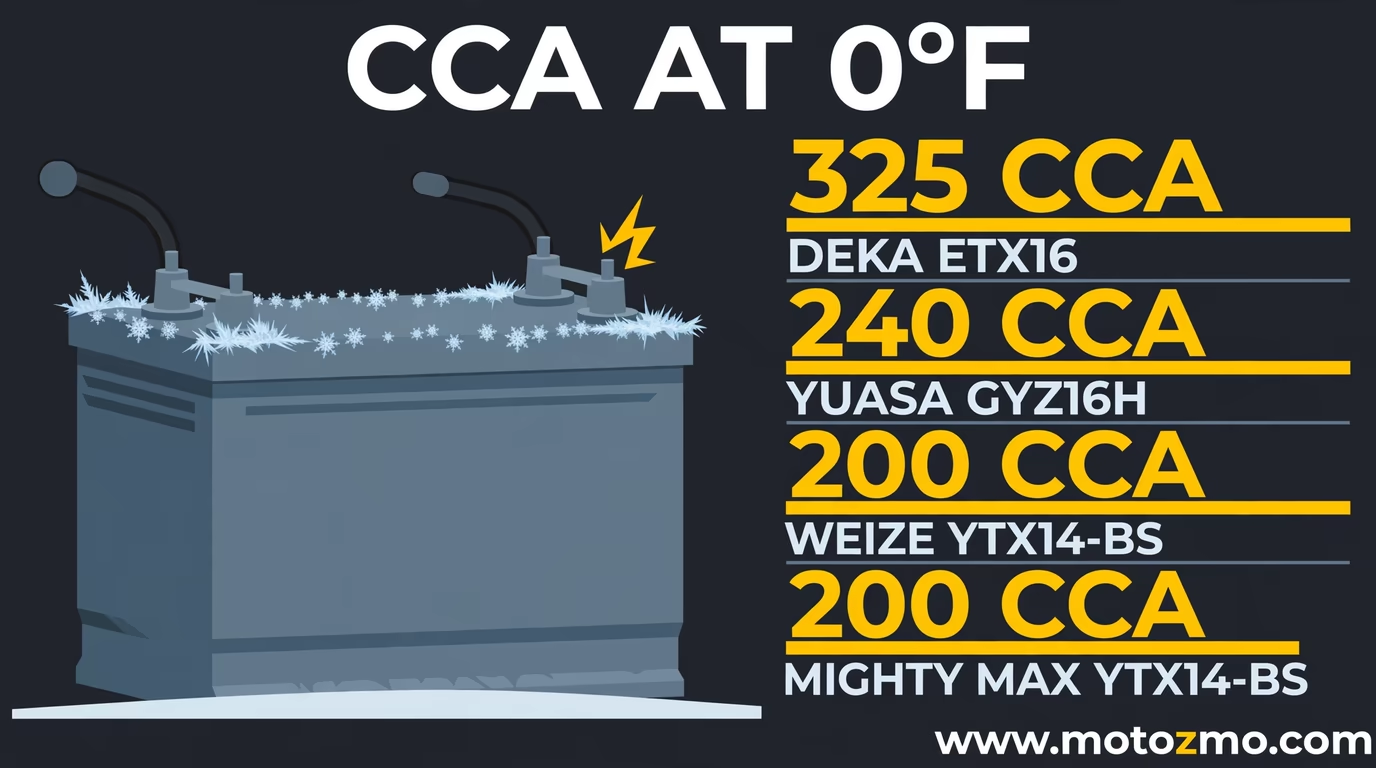
How Do the Four Compare on Cold-Start Muscle?
| Battery | CCA (0°F) | Capacity | Weight | Warranty |
|---|---|---|---|---|
| Yuasa GYZ16H | 240 | 16 Ah | 12.4 lbs | 1 year |
| Deka ETX16L | 325 | 19 Ah | 17 lbs | 1 year |
| Weize YTX14-BS | 200 | 12 Ah | ~9.5 lbs | 1 year |
| Mighty Max YTX14-BS | 200 | 12 Ah | ~10 lbs | 1 year |
CCA is the number that matters on a cold morning: it measures how many amps the battery can push at 0°F. But don’t shop by CCA alone.
A bigger number in a battery that doesn’t fit your tray is useless, and every battery on this list fades fast if you let it sit half-charged through winter.
If you want the full picture on picking batteries for freezing weather, my guide to motorcycle batteries for cold weather goes deeper on the chemistry.
How Do I Make Any AGM Survive Winter?
Buy a tender. Cold slows the chemistry inside every lead-acid battery, and a battery that sits at 80% charge through December will not give you its rated CCA in January.
I keep every bike on a maintainer when parked; the riders reporting 5 to 7 years from Deka and Yuasa batteries almost always mention one. My battery tender roundup covers which maintainers are worth the money, and the NOCO vs Battery Tender comparison settles the two most popular brands.
Clean terminals matter too. Corrosion adds resistance, and resistance steals cranking amps exactly when you can least afford it. A wire brush and five minutes in the fall beats a jump start in February.
What If the Bike Still Won’t Start?
First, check the voltage. A healthy AGM reads about 12.8V at rest; under 12.4V and you are starting on borrowed time. A cheap motorcycle voltage tester tells you in seconds whether the battery or the charging system is the problem.
If you hear rapid clicking but no crank, the battery has voltage but no muscle. Classic end-of-life behavior, and exactly what this article’s picks are meant to prevent. My guide to a motorcycle that won’t start but clicks walks through the diagnosis step by step.
And if cold starts keep beating every AGM you try, lithium is the next step up: lighter, stronger cranking, but fussier about chargers. I compared the two big lithium brands in Kemimoto vs Antigravity.
Which One Should I Buy?
Match the battery to the morning you dread:
| Your situation | Buy this |
|---|---|
| You want the best cold starts, period | Yuasa GYZ16H |
| Big V-twin or high-compression engine | Deka ETX16 |
| Tight budget, standard-size bike | Weize YTX14-BS |
| Commuter or second bike, replace on schedule | Mighty Max YTX14-BS |
My own pick for most riders is the Yuasa GYZ16H. The 240 CCA rating undersells what it does on a cold morning, and a battery you trust for six years beats a battery you replace every two.
But if your engine is big and thirsty, the Deka’s 325 CCA is the honest answer to the question this whole article asks.
FAQ
Can a Battery with Higher CCA Than Stock Hurt My Bike?
No. The starter only draws the current it needs; extra CCA is headroom, not force. What matters is matching voltage (12V), physical size, and terminal position so the battery fits your tray and cables. Going up in CCA within the same group size is safe and is exactly how riders fix weak cold starts.