
Top Picks For You
Fly Racing unisex-adult Racing Vest
The most adjustable rider vest I found. Side and waist straps dial the fit over any jacket, and it folds into its own pouch when you reach your stop.
Check Price
cortech Hi-Viz Motorcycle Vest
The snuggest fit of the bunch. A stretch chassis hugs your jacket so nothing flaps at speed, and the price undercuts every other rider-specific vest here.
Check Price
Klim Vantage Hi-Vis Vest
The minimalist pick for tourers. Almost no bulk, packs tiny, and disappears into a pannier until traffic or low light calls for it.
Check Price
REV’IT! Athos 3 Air High-Visibility Vest
Made for REV’IT! jacket owners. It clips to compatible jackets so it cannot shift or flap, and the vented mesh keeps air moving through.
Check Price
XPCARE 2-Pack Reflective Safety Vest
The honest budget option. Two vests for the price of lunch, bright enough for around-town rides, with real tradeoffs at highway speed.
Check Price
A motorcycle-specific hi-viz vest beats a construction vest every time. The Fly Racing vest is my top pick because it adjusts to fit over armored jackets, packs into its own pocket, and uses real 3M reflective panels instead of the shiny tape that peels off cheap vests.
I have worn the $10 hardware-store kind and the $80 rider kind, and the difference shows up the first time you hit 65 mph. Cheap vests balloon, ride up, and buzz against your helmet. Rider vests stay put.
This guide covers five vests made for motorcyclists, what to check before you buy, and how to wear one over the gear you already own. For the full picture on staying visible, start with my motorcycle visibility products guide.
Why a Construction Vest Fails on a Bike
Most “best hi-viz vest” lists online are just construction vests with the word motorcycle pasted into the title. Those vests were designed for a person standing still next to a road crew truck. Put one on a bike and three things go wrong fast.
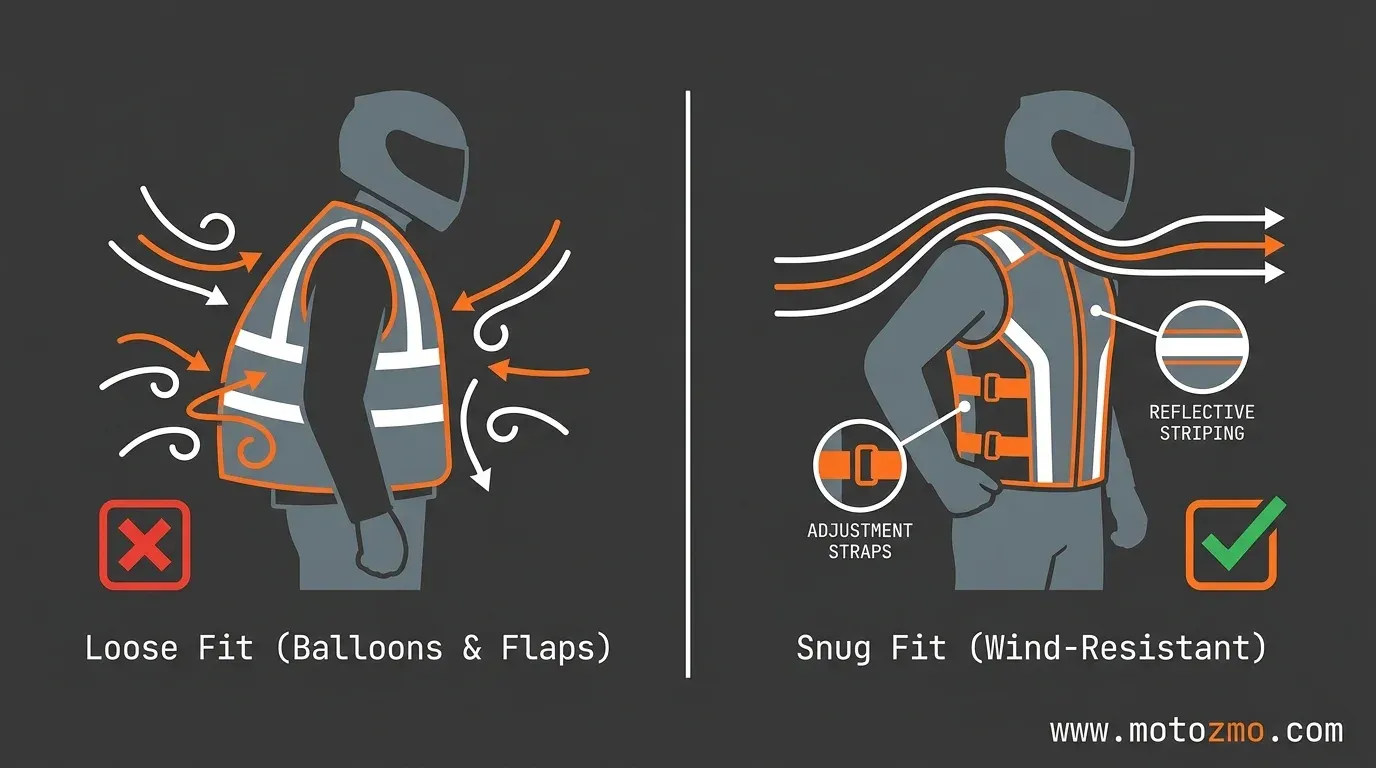
First, they flap. A boxy vest with no side adjustment turns into a sail at 60 mph. It tugs at your neck, buzzes against your helmet, and distracts you, which defeats the whole point of safety gear. Riders in forums name this as the number one complaint, ahead of price and looks.
Second, they fight your jacket. A vest sized for a t-shirt will not close over a textile jacket with armor, and one sized for a winter parka swims on you in summer. Motorcycle vests solve this with side straps, stretch panels, or a cut made to sit over riding gear.
Third, they cook you. Solid polyester blocks the vents you paid good money for in your jacket. Rider vests use open mesh that lets air through to the jacket vents underneath.
What to Check before You Buy
Run every vest through this checklist and you will dodge the duds.
- Fit over your actual jacket. Measure your chest wearing your bulkiest riding jacket, then check the vest size chart against that number, not your t-shirt size.
- Side adjustment. Straps, elastic, or stretch fabric at the sides is what stops flapping. No side adjustment means no highway use.
- Closure quality. A zipper beats velcro at speed. Cheap velcro peels open in the wind, and riders report this constantly with bargain vests.
- Mesh, not solid fabric. Open mesh keeps your jacket vents working. Solid fabric turns your vented summer jacket into a sauna.
- Reflective layout, day and night. Fluorescent yellow or orange does the work in daylight. Silver reflective tape or panels do the work after dark. You need both, front and back, because a rear-end hit at a stoplight is the crash riders fear most.
- ANSI rating, explained. ANSI/ISEA 107 is the US standard for work-zone apparel. Almost no motorcycle-specific vest carries it, and that is fine. It is a workplace rule, not a riding rule. What matters on a bike is fluorescent coverage by day and reflective coverage by night, not a printed class number.
The 5 Vests at a Glance
| Vest | Best for | Standout trait |
|---|---|---|
| Fly Racing Vest | Most riders | Straps everywhere, packs into itself |
| cortech Hi-Viz Motorcycle Vest | No-flap fit | Stretch chassis hugs your jacket |
| Klim Vantage | Touring and ADV | Minimal bulk, tiny pack size |
| REV’IT! Athos 3 Air HV | REV’IT! jacket owners | Clips to the jacket, zero shift |
| XPCARE 2-pack | Tight budgets | Two vests, honest tradeoffs |
Fly Racing unisex-adult Racing Vest
- Best for: commuters and tourers who want one vest that fits every jacket they own.
Key Features
- Rugged rip-stop nylon shell with ballistic airflow mesh panels
- Folds into its own front pocket for tank-bag storage
- Clear vinyl ID chest pocket doubles as toll-pass holder
- Microfiber-lined collar prevents neck chafing on long rides
This is the vest other rider vests get measured against. Fly Racing has been making motorcycle-specific hi-viz gear for years, and this vest refines the formula: rip-stop nylon shell, big ballistic mesh panels for airflow, and 3M Scotchlite reflective panels that actually throw light back at night instead of just looking shiny.
The killer feature is adjustability. Straps at the sides and waist let you cinch it over a summer mesh jacket or loosen it over winter layers, so one vest covers the whole year. It also folds into its own front pocket, which means it lives in a tank bag or under the seat instead of getting lost in the garage.
Tradeoffs: it is bulkier than the stretch-fit Icon, and it only comes in yellow. Riders who want orange are out of luck.
Skip it if you only ever wear one jacket and want the tightest possible fit. That is the Icon’s game.
cortech Hi-Viz Motorcycle Vest
- Best for: riders who hate flapping and want the tidiest fit.
Key Features
- 4-way stretch polyester chassis moves with your riding position
- Premium YKK front zipper resists wind peel at speed
- Retro-reflective heat transfers on sides and back
- Sublimated graphics will not crack or peel with washing
Instead of straps and buckles, this vest uses a 4-way stretch polyester chassis that hugs your jacket like a second skin. Nothing balloons, nothing buzzes, and the vest works with your jacket vents instead of sealing them shut.
A YKK front zipper gives easy on-off without the wind-peel problem of cheap velcro, and retro-reflective side and back panels handle the night shift. The tonal bolt graphics divide opinion, but from more than a few feet away all anyone sees is hi-viz.
Tradeoffs: the stretch fit means less airflow than open-mesh vests on brutal summer days, and sizing runs snug, so check the chart against your jacket-on chest measurement.
Skip it if you switch between bulky winter gear and summer mesh often. Stretch only goes so far, and the Olympia’s straps handle that job better.
Klim Vantage Hi-Vis Vest
- Best for: touring and adventure riders who pack light.
Key Features
- Wind-permeable mesh keeps jacket vents fully functional
- Folds into its own pocket for pannier-friendly packing
- Quick-adjust fasteners at hem lock the fit in seconds
- Hi-vis color matched to current Klim outerwear colors
Klim built this for riders who want visibility on demand without wearing a billboard all day. It is deliberately minimal: wind-permeable mesh, 3M Scotchlite reflective material, a front zip, and quick-adjust fasteners at the hem. It folds into its own pocket and vanishes into a pannier until traffic, rain, or dusk calls for it.
The hi-vis color matches Klim’s current outerwear line, so it looks intentional over a Klim jacket rather than slapped on. Airflow is excellent because there is almost nothing to it.
Tradeoffs: minimalism cuts both ways. Coverage is narrower than the Olympia, there are no storage pockets, and at around $90-130 it is the priciest vest here. You are paying for the Klim name and the packability.
Skip it if you want pockets or maximum adjustability. This is a visibility layer, not a utility vest.
REV’IT! Athos 3 Air High-Visibility Vest
- Best for: REV’IT! jacket owners who want the vest locked in place.
Key Features
- PWR shell mesh meets EN471 visibility fabric standard
- Connector loops attach to compatible REV’IT! jackets
- Transport bag included for pannier storage
- Adjustable waist belt with tour fit cut
This one solves flapping differently from everyone else: it attaches to the jacket. Velcro loops connect the vest to a long list of REV’IT! jackets, so it cannot ride up, twist, or balloon no matter how hard the wind hits. You put your jacket on and off as normal, and the vest just comes along.
Even without a compatible jacket it works as a standalone vest. The vented mesh construction keeps air moving, an adjustable waist belt dials the fit, and 3M Scotchlite reflective material at the shoulders and back covers the night side. A transport bag comes in the box.
Tradeoffs: the headline feature only pays off if you own a compatible REV’IT! jacket, so check their list before buying. Pocket count is zero, and you are paying for the connector system more than raw coverage.
Skip it if you do not ride in REV’IT! gear.
XPCARE 2-Pack Reflective Safety Vest
- Best for: tight budgets and trying the vest habit before spending real money.
Key Features
- Two vests in the pack, one for you and one for a passenger
- 2-inch reflective tape on shoulders, chest, waist, and back
- Five front pockets with velcro closures
- Machine washable polyester, lightweight for summer
Two vests for around $10-15. The reflective tape is genuinely bright, the fluorescent yellow reads well in daylight, and five front pockets swallow a phone and wallet. For around-town rides under 45 mph, this does the core job: drivers see you.
Now the honest part. The fit runs small, so order up, and the boxy cut flaps at highway speed exactly like the forum complaints describe. The zipper is a coin flip. I would not trust this on a long interstate run, but as a first vest or a spare for passengers, the price is hard to beat.
Tradeoffs: no mesh airflow to speak of, no adjustability, and durability is a season or two at best. But it costs less than a tank of gas, and a cheap vest you actually wear beats an $80 vest sitting in a drawer.
Skip it if most of your miles are highway. Save for the Icon or Olympia instead.
How to Wear It over Your Gear
Size the vest to the jacket, not to you. Put on your bulkiest riding jacket, measure your chest, and buy to that number. A vest that fits your t-shirt will not close in November.
Layer it over rain gear too. A good rain suit keeps you dry but most are black, which is the worst color for a grey rainy day. Pulling a hi-viz vest over the top fixes that in ten seconds.
Rain is also when fluorescent fabric earns its keep, since overcast light kills contrast; my rain riding guide covers the rest of the wet-weather setup.
Pair the vest with a bright helmet and you cover both ends of the visibility equation. Research on rider conspicuity found fluorescent clothing cut crash risk by about 37%, and a white helmet cut it by 24% versus black in the well-known BMJ case-control study.
My hi-viz helmet roundup scores five lids on day and night visibility if you want to complete the setup.
Mistakes That Waste Your Money
Buying too big. The classic error. A loose vest flaps, rides up, and ends up stuffed in a saddlebag. When in doubt between sizes, the snugger one wins for riding, as long as the zipper closes over your jacket.
Expecting the vest to do all the work. A vest helps drivers detect you, but it does not fix bad positioning. If you sit in a car’s blind spot, no amount of neon saves you. Learn to stay out of blind spots and the vest becomes a backup instead of your only plan.
Ignoring the night side. Fluorescent fabric goes quiet after dark. If you ride home late, check that your vest has real reflective panels, not just bright cloth. The Icon’s own product page shows how their retro-reflective paneling is placed for low-light detection, which is the detail to look for on any vest.
Frequently Asked Questions
How long does a hi-viz vest stay effective?
Reflective tape degrades with washing and sun. Expect a season or two of full brightness from a cheap vest and several years from a quality one. When the silver strips look dull grey in headlights, replace it.
Is a black vest with reflective stripes as good as a fluorescent one?
No. Reflective stripes only work after dark when headlights hit them. Fluorescent fabric works in daylight by converting UV light. For all-day riding you want both, which is why every vest here pairs neon fabric with reflective panels.
Can I wear a vest for my motorcycle safety course?
Yes, and instructors like it. No US state requires a vest for the riding test, but being easy to spot helps the instructor track you, and it builds the habit for street riding afterward.