Affiliate disclosure: This post may contain affiliate links. If you buy through a link on this page, MOTOZMO may earn a small commission at no extra cost to you. It helps keep our guides free. How we test and choose products.
Buy fluorescent clothing first, add auxiliary lights second, and add reflective tape third. That order matches what the research says prevents crashes.
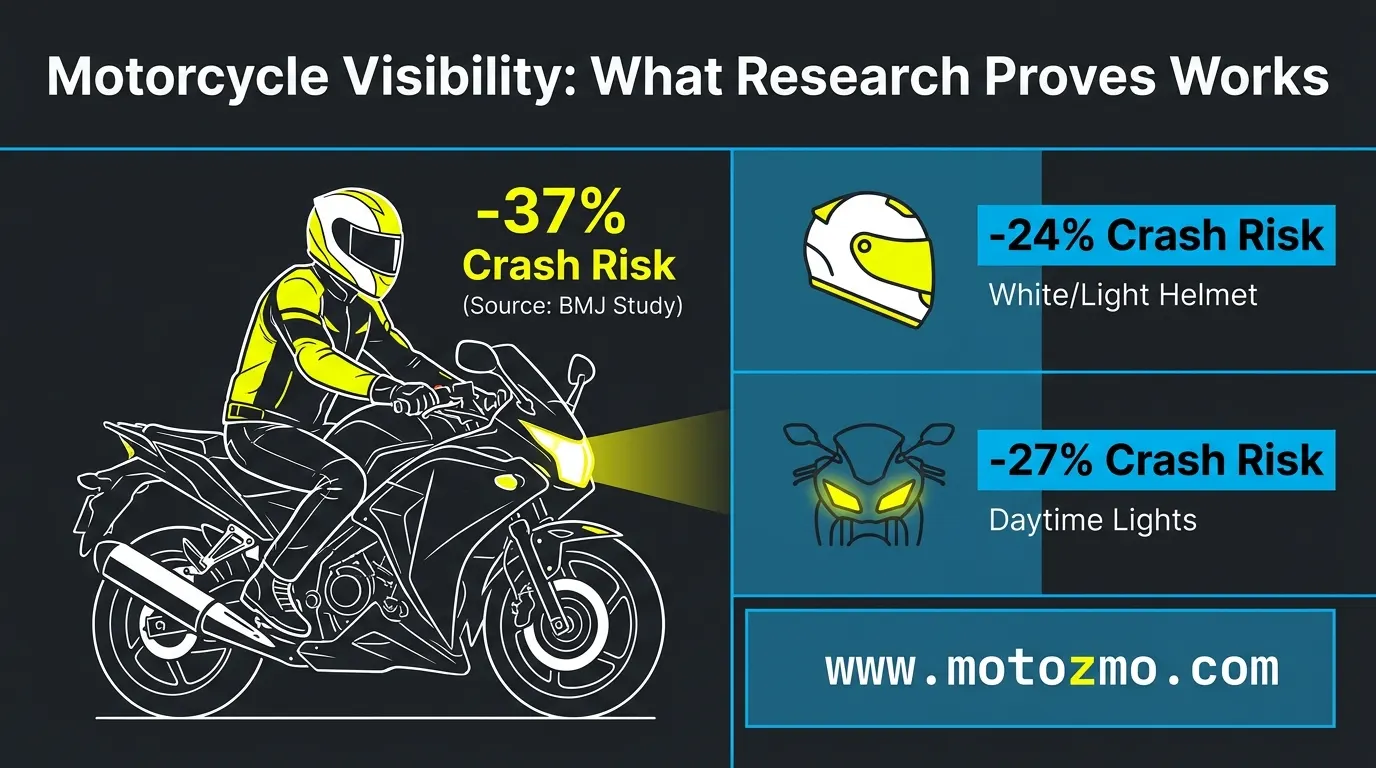
I read the studies behind motorcycle visibility gear because most guides list products without telling you what matters most. The best-documented finding: riders wearing reflective or fluorescent clothing had a 37% lower crash risk in a large case-control study. No other visibility product comes close to that number.
Helmet color counts too. A white helmet beat a black one by 24%, and I break down the best helmets for visibility in a separate guide. But a helmet is only one layer. Below is the buying order I recommend based on how you actually ride, plus the science of why drivers fail to see bikes at all.
What Visibility Gear Should You Buy First?
If you can only afford one upgrade, make it something fluorescent you wear on your torso, like a vest over your jacket or a hi-viz jacket itself. Nothing else in the research comes close to the 37% figure, so this is where your money does the most work.
| How you ride | Buy first | Buy next | Add later |
|---|---|---|---|
| Daytime commuting | Fluorescent vest or jacket | Confirm your headlight runs in daylight (free) | Reflective tape |
| Night riding | Auxiliary LED pods | Reflective tape on bike and gear | Fluorescent jacket |
| Mixed commuting | Fluorescent jacket | Auxiliary lights | Reflective tape |
| Rain and fog | Fluorescent rain gear | Amber auxiliary lights | Reflective tape |
The logic is simple. Clothing has the strongest evidence behind it. Lights are the only layer that works the same in daylight and dark.
Reflective tape does nothing until headlights hit it, so it sits last. If most of your miles happen after dark, move it up to second place.
Why Do Drivers Look at You and Still Pull out?
Every rider knows the phrase: “Sorry mate, I didn’t see you.” Researchers split that failure into two distinct perception errors, and each one points at a different piece of gear. Which layer you need depends on when you ride.
Detection failure. A motorcycle is small and easy to lose in visual clutter. Simulator studies found that car daytime running lights make this worse. Your single headlight drowns in a sea of car LEDs.
Fluorescent clothing fixes detection in daylight because it contrasts hard against road and surroundings. At night, only reflected light or your own lights break through the clutter.
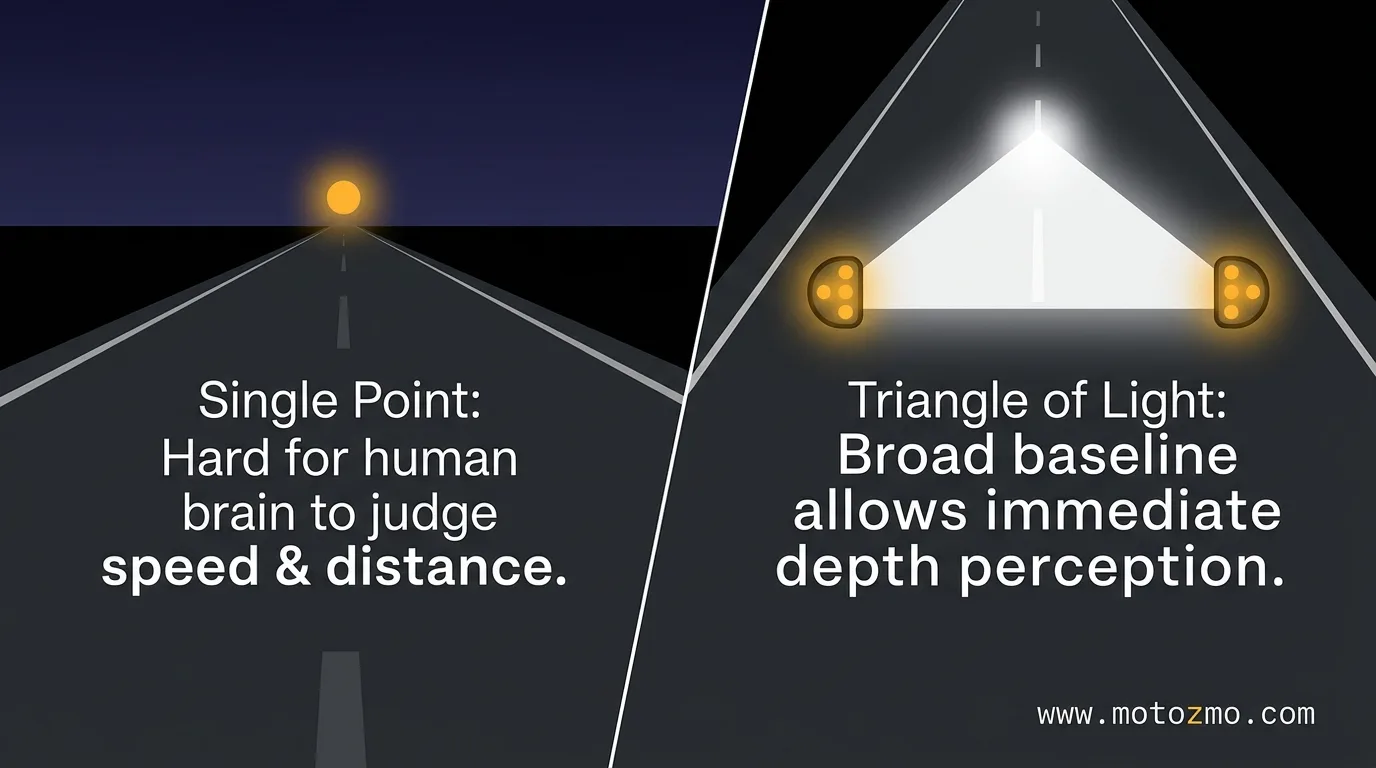
Motion-perception error. One headlight gives an oncoming driver no size reference. The brain reads a single point of light as a distant car rather than a close bike, so drivers misjudge your speed and distance and turn across your path.
Two extra light points break the illusion. That is the entire idea behind the “triangle of light” setup covered in the lighting section below.
Rain and fog make both errors worse, which is why fluorescent rain gear tops the wet-weather column above. If you ride in those conditions often, check whether riding in rain is safe for you before spending on gear.
What Does the Research Say?
The numbers in this guide lean on one study more than any other: Wells et al., a 2004 population case-control study published in the BMJ, which compared 463 crash-involved riders against 1,233 roadside controls in Auckland, New Zealand.
| Factor | Effect on crash risk |
|---|---|
| Reflective or fluorescent clothing | 37% lower |
| White helmet vs black helmet | 24% lower |
| Light-colored vs dark helmet | 19% lower |
| Daytime headlight on | 27% lower |
The study also calculated population attributable risk (roughly, how much of the total crash burden ties to each factor). By that measure, 33% of crashes were attributable to wearing no reflective or fluorescent clothing, versus 18% for a non-white helmet and 7% for no daytime headlight. In plain terms: clothing matters more than helmet color, which flips what most visibility guides emphasize.
One caveat: this is a single study from 2004, and daytime-headlight research shows a wide range across studies, about 10% to 27%. Treat every number here as a solid estimate, not a guarantee.
Which Clothing Makes You Visible?
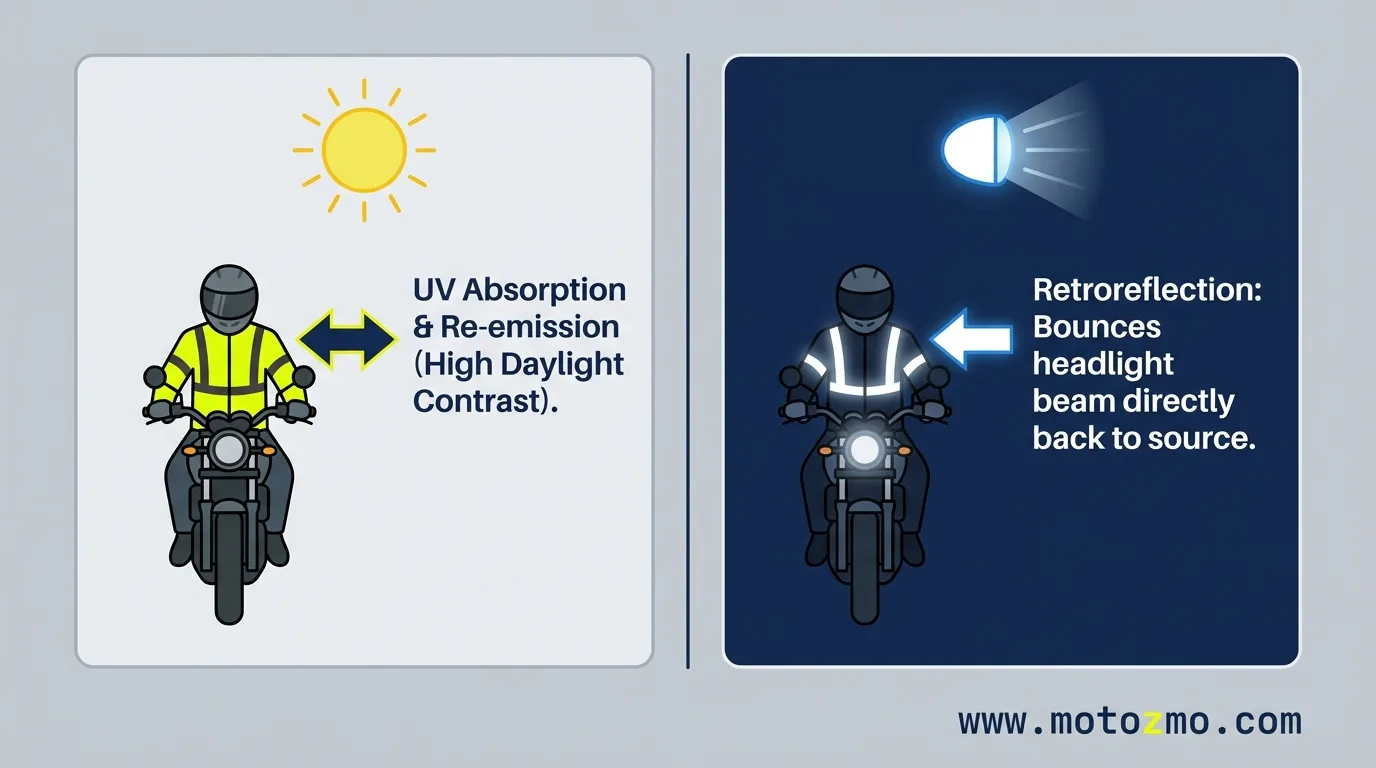
Fluorescent and reflective are not the same thing, and mixing them up is the most common mistake in this whole category. Fluorescent colors absorb UV light and re-emit it, which makes them pop in daylight and at dusk. They do almost nothing at night.
Reflective material does the opposite: almost invisible by day, it fires headlights straight back at the driver after dark.
Because clothing carries the largest share of preventable risk in the research, a hi-viz jacket is the highest-impact purchase most riders underrate.
Scorpion Yosemite Hi-Viz Jacket is a well-regarded touring jacket in the hi-viz space, built with heavier denier nylon reinforced at impact-prone areas, with the fluorescent panels integrated into the shell rather than added as an afterthought. It is a real step up from a basic reflective overlayer if you log serious miles and want armor and weatherproofing built in rather than layered on top.
Scorpion Optima is the budget alternative in the same lineup, running about half the price while keeping the core hi-viz visibility and sensible armor placement. If you commute short distances and do not need touring-grade weatherproofing, this is the more sensible buy.
Tradeoff: a dedicated hi-viz jacket costs more than a vest or tape over gear you own. Skip the dedicated jacket if you already own good armored gear. A hi-viz vest worn over it gets you most of the benefit for less money.
Do Auxiliary Lights Work in the Daytime Too?
Yes. Lighting is the one layer that works the same at noon and at midnight, and NHTSA’s conspicuity guidance backs the idea that extra frontal lighting helps other drivers judge a motorcycle’s position and distance.
A single headlight reads to an oncoming driver as something far away, the way a car’s two headlights look from a distance. Adding a second and third light point breaks that illusion and helps drivers judge how close you actually are.
Denali D4 auxiliary LED pods are a well-established, purpose-built option in the powersports lighting space, regarded as a durable, quality choice among riders who have compared several brands, with weatherproofing built for motorcycle-specific vibration and exposure rather than repurposed automotive lighting.
Nilight LED pods are the easy-to-find budget option, often recommended in rider forums as a reliable choice for the price, though without the same refinement or long-term track record as a dedicated motorcycle lighting brand like Denali.
Tradeoff: auxiliary lights need wiring into your bike’s electrical system, which is a more involved install than clothing or tape, and cheaper kits vary more in build quality and weatherproofing than established brands.
One install tip worth the extra five minutes: put dielectric grease on the connectors before you button everything up. Road salt and rain corrode bare terminals fast, and I cover which product to use in my anti-corrosion spray guide.
Legal note: skip red and blue. Most states reserve those colors for emergency vehicles, so white and amber are the safe picks.
When Is Reflective Tape Worth Buying?
At night, when your fluorescent gear goes quiet. Reflective tape bounces headlights back at the driver, which is when color stops helping. If you ride home after dark often, this is the cheapest meaningful upgrade on this page.
SWRT DOT-C2 reflective tape is the reflective material industry standard, the same material integrated into serious hi-viz jackets and worksite gear, sold as standalone tape and decals for a helmet, jacket, or bike panels you already own.
Application tips that matter:
- Clean the surface with isopropyl alcohol first and let it dry. Dust or oil under the tape shortens how long the adhesive holds.
- Apply in straight runs rather than stretching hard around curves. Overstretched tape can crack its reflective coating even though the adhesive still holds.
- A brief pass with a hair dryer on low heat after application helps the adhesive bond in cold weather.
Tradeoff: tape does nothing for daytime visibility. If you only ride in daylight, spend the money on fluorescent gear instead.
What Mistakes Waste Money on Visibility Gear?
Treating one layer as the whole fix. A fluorescent jacket with your headlight off and no reflective elements uses one of three available layers. The research shows the layers work on their own, not as substitutes for each other.
Buying red or blue aux lights. Those colors are reserved for emergency vehicles in most states. Stick to white or amber unless you have confirmed your state’s rules.
Letting tape age past its usefulness. Reflective tape fades, peels, or gets covered in road grime within one to two riding seasons. A quick glance each month for peeling edges takes seconds and tells you when it is due for replacement.
Thinking gear replaces positioning. No vest fixes riding in a blind spot. Lane position still decides whether a driver can see you at all. Here is how to stay out of blind spots.
When Should You Replace Each Layer?
Fluorescent materials fade under UV exposure and lose meaningful brightness within one to two riding seasons of sun. When the color looks washed out next to a new piece, it is done.
Reflective tape and decals run on a similar timeline before peeling or dulling cuts their effectiveness. A check each month for lifting edges beats any fixed replacement schedule.
LED auxiliary lights outlast both, with failure more often tied to connector corrosion or a cracked lens than the LED itself burning out, which is another reason to protect the connections at install time.
Wipe reflective surfaces with a damp microfiber cloth rather than harsh cleaners, which can degrade the adhesive or coating. And one last thing: visibility gear cannot compensate for worn rubber. If your tires are due, replacing them comes before any of this.
Bottom Line
Buy in order: fluorescent clothing, auxiliary lights, reflective tape, matched to when you ride. No single product does the whole job, and clothing deserves more of your budget than helmet color gets credit for.