Affiliate disclosure: This post may contain affiliate links. If you buy through a link on this page, MOTOZMO may earn a small commission at no extra cost to you. It helps keep our guides free. How we test and choose products.
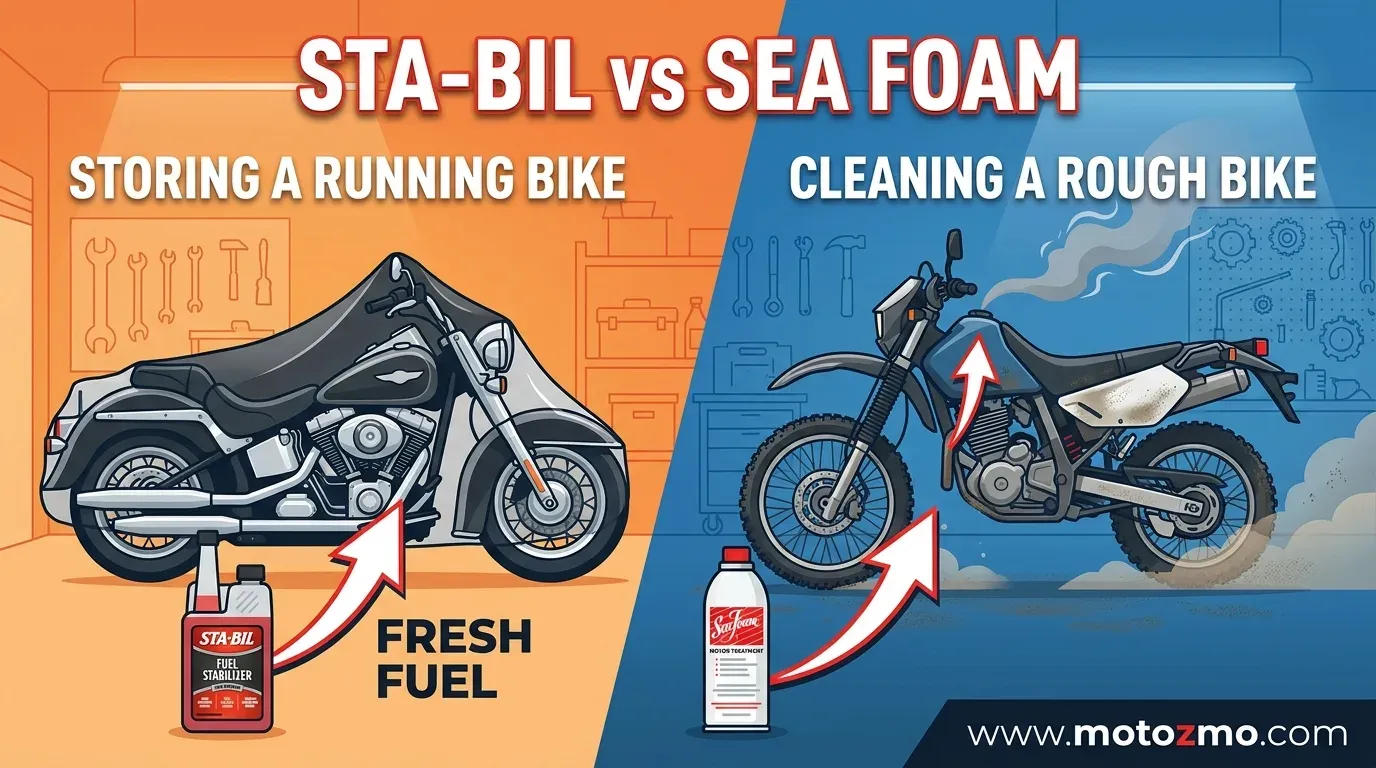
Buy STA-BIL if your bike is about to sit; buy Sea Foam if your bike sat too long already.
That one line settles most of the forum arguments. STA-BIL is a fuel stabilizer, full stop. It keeps fresh gas fresh while the bike sleeps through winter. Sea Foam is a cleaner that also stabilizes. It dissolves the gum and varnish that old gas leaves behind in carbs and injectors.
I keep both on my garage shelf and reach for them for different jobs. The confusion starts when riders treat them as rivals. They solve different problems.
Below is the straight comparison: what each one is, when to use which, whether you can use both, and the dosing math for a 3-to-5-gallon bike tank. If winter layup is your main job, read this alongside our fuel stabilizer picks for winter.
What Each Product Actually Is
STA-BIL Storage does one job. Gasoline starts breaking down the day it leaves the pump. Oxygen attacks it, and the light parts evaporate first. What remains turns into the sticky varnish that plugs pilot jets.
The product slows that oxidation. Pour it into fresh gas, and the fuel stays usable for up to 24 months. It does not clean anything. If your carbs are already gummed, STA-BIL will preserve the gum right along with the gas.
Sea Foam does two jobs. It is a petroleum blend that works as a solvent. It dissolves the deposits that old fuel leaves in carb passages, on injector tips, and around intake valves.
It also stabilizes fuel for up to 24 months, so it can cover storage duty too. The tradeoff is dose and cost. You need more of it per gallon, which makes pure storage the expensive way to use it.
Think of it this way. STA-BIL is a lock on a clean garage. Sea Foam is a cleaning crew that also locks up after. You would not hire the crew just to lock the door.

- Pure stabilizer that keeps gas fresh up to 24 months
- 1 oz treats 2.5 gallons, so a small bottle lasts several winters
- Pour-and-park routine with no warm-up run needed
- Will not clean carbs that are already gummed up

- Dissolves gum and varnish while stabilizing up to 24 months
- 1 oz per gallon to stabilize, up to 2 oz per gallon to clean
- Petroleum-based formula safe for carbs and injectors
- Costs more per treatment than a pure stabilizer
When to Use Which
Match the product to the bike in front of you, not the one in the ad.
| Your situation | Reach for | Why |
|---|---|---|
| Bike runs fine, parking it for winter | STA-BIL | Pure storage is its whole job, at the lowest dose |
| Bike sat for months and now runs rough | Sea Foam | Cleaning is what it does best |
| Used bike with unknown fuel history | Sea Foam first, then STA-BIL | Clean first, then protect the fresh gas |
| You ride year-round and want upkeep | Sea Foam every few tanks | Light cleaning between rides |
| Storage past a year in a damp garage | STA-BIL | Set-and-forget stability with no guesswork |
The used-bike row deserves a note. A bike that sat in a shed for two years has varnish in places no additive fully reaches.
Sea Foam earns its keep as the first try before you pull the carbs. If it does not clear the idle circuit, no bottle will. That is a carburetor maintenance job, not a chemistry problem.
The Dosing Math for Small Bike Tanks
Both labels were written for cars and boats. A motorcycle tank changes the math.
- STA-BIL Storage: 1 oz per 2.5 gallons. A 4-gallon tank needs about 1.6 oz, roughly one shot glass. A 4 oz bottle covers two full winters.
- Sea Foam to stabilize: 1 oz per gallon. That same 4-gallon tank needs 4 oz, a quarter of a 16 oz can.
- Sea Foam to clean: up to 2 oz per gallon. That is 8 oz in a 4-gallon tank, half the can, and you should ride the bike to work it through.
Do not eyeball it and do not double it “for luck.” Overdosing a stabilizer can leave residue, and overdosing a cleaner wastes money without cleaning faster. Measure with the bottle cap or a cheap kitchen syringe.
Gold Eagle, the company behind STA-BIL, keeps its official stabilizer guidance short: fresh fuel, correct dose, full tank, run the engine so treated gas reaches the carbs or injectors.
Can You Use Both Together
Yes, and plenty of riders do, just not at the same moment. The common pattern from the forums: run Sea Foam through the system during the last month of the riding season, then fill up, add STA-BIL, and park the bike.
The Sea Foam cleans on the way out. The STA-BIL guards while it sits. Neither manufacturer blesses mixing both in one tank at once, so keep them sequential. Clean first, protect second.
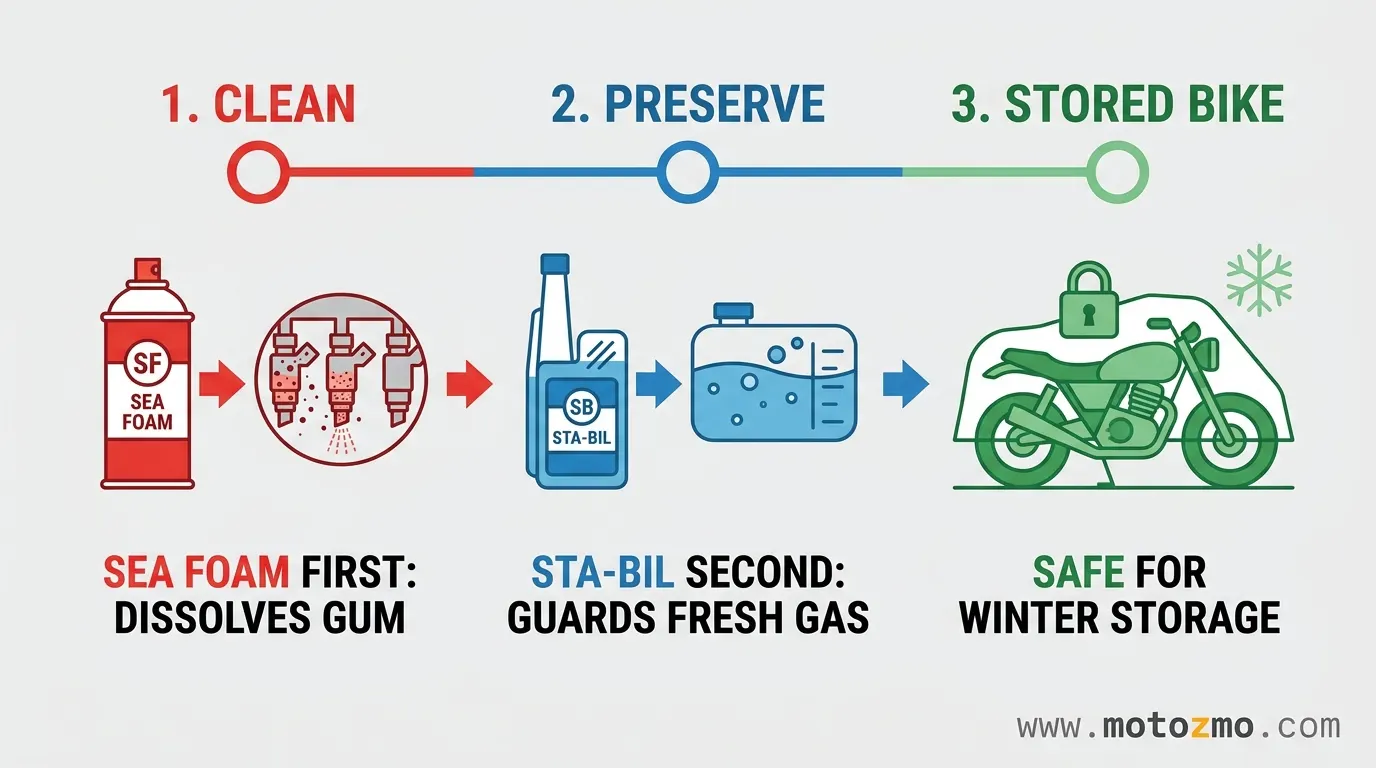
This is also the answer to the “which one for winter” argument. If the bike ran well all season, STA-BIL alone is enough, and our winter storage walkthrough covers the rest of the layup.
If the bike coughed and stumbled on the last few rides, give it the Sea Foam treatment first. Putting a pure stabilizer on top of dirty carbs just preserves the dirt.
Who Should Not Buy Each
Skip STA-BIL if the damage is done. A stabilizer cannot dissolve varnish, free a stuck float, or clear a plugged pilot jet. Buying it for a bike that already runs rough is buying a lock for a burned-down garage.
Skip Sea Foam as your only winter plan if cost bothers you. It stabilizes fine, but at 1 oz per gallon you will burn through a can over a few seasons where a small bottle of STA-BIL would have done the same job for less. Sea Foam’s motorcycle winter storage page is honest about this: it works for storage, and it shines brightest as a cleaner.
Bottom Line
For a motorcycle going into winter storage, STA-BIL is the pick. It is the cheaper, simpler, purpose-built answer, which is why it wears the Recommended badge above. Sea Foam is the pick for the bike that already sat too long, the used bike with a mystery past, or year-round light maintenance. Own both if you want. Just remember the order: Sea Foam cleans, STA-BIL preserves, and neither one fixes a carburetor that needs hands and tools.
FAQs
Can I put Sea Foam in my motorcycle’s engine oil?
Yes. Sea Foam’s label covers crankcase use at 1 ounce per quart of oil. Add it, ride gently, and change the oil soon after. STA-BIL never goes in oil.
Does Sea Foam go bad on the shelf like STA-BIL does?
An opened bottle of STA-BIL lasts about 2 years; Sea Foam’s petroleum blend keeps far longer. See the STA-BIL shelf life guide for the date code.