
Affiliate disclosure: This post may contain affiliate links. If you buy through a link on this page, MOTOZMO may earn a small commission at no extra cost to you. It helps keep our guides free. How we test and choose products.
No, don’t put car oil in your motorcycle, unless your bike has a dry clutch. I nearly made this mistake in my own garage, jug of 10W-40 car oil in hand, thinking viscosity was the whole story. It isn’t.
Most bikes run a wet clutch that bathes in the same oil feeding the engine and gearbox, and car oil carries friction modifiers that make that clutch slip. Same grade on the bottle, wrong chemistry inside. The rule has real exceptions, though: some bikes run dry clutches, and one careful top-up won’t destroy a wet clutch either.
Below I’ll show you how to read any oil label in 30 seconds, when car oil actually works, and how to recover if you already poured it in. For the rest of the basics, my guide on how often to change motorcycle oil covers the full schedule.
Why a Wet Clutch Hates Car Oil
One oil does three jobs in most motorcycles: it feeds the engine, the gearbox, and the clutch. Car engines keep these jobs apart: engine oil handles the engine, transmission fluid handles the gearbox. Bike oil has to do all three at once, and that changes what goes into the bottle.
The clutch is the dealbreaker. A wet clutch is a stack of plates soaked in oil, and car oil includes friction modifiers (molybdenum compounds) that cut internal drag so a car burns less fuel.
Inside a car engine, that’s a win. Between clutch plates, that same slipperiness stops the plates from gripping. The symptom shows up first under hard throttle: the revs climb, but the bike doesn’t pull.
Heat and shear finish the job. Bike engines spin faster, run hotter, and mash oil between gear teeth far harder than anything inside a car. Car oil loses thickness faster under that beating, and modern car oils carry less zinc anti-wear additive than they used to (cut back to protect catalytic converters), and that zinc is exactly what hard-loaded gears and cams need.
A detailed comparison of car and motorcycle oil walks through the shear and heat problem if you want the full engineering picture.
Read the Bottle in 30 Seconds
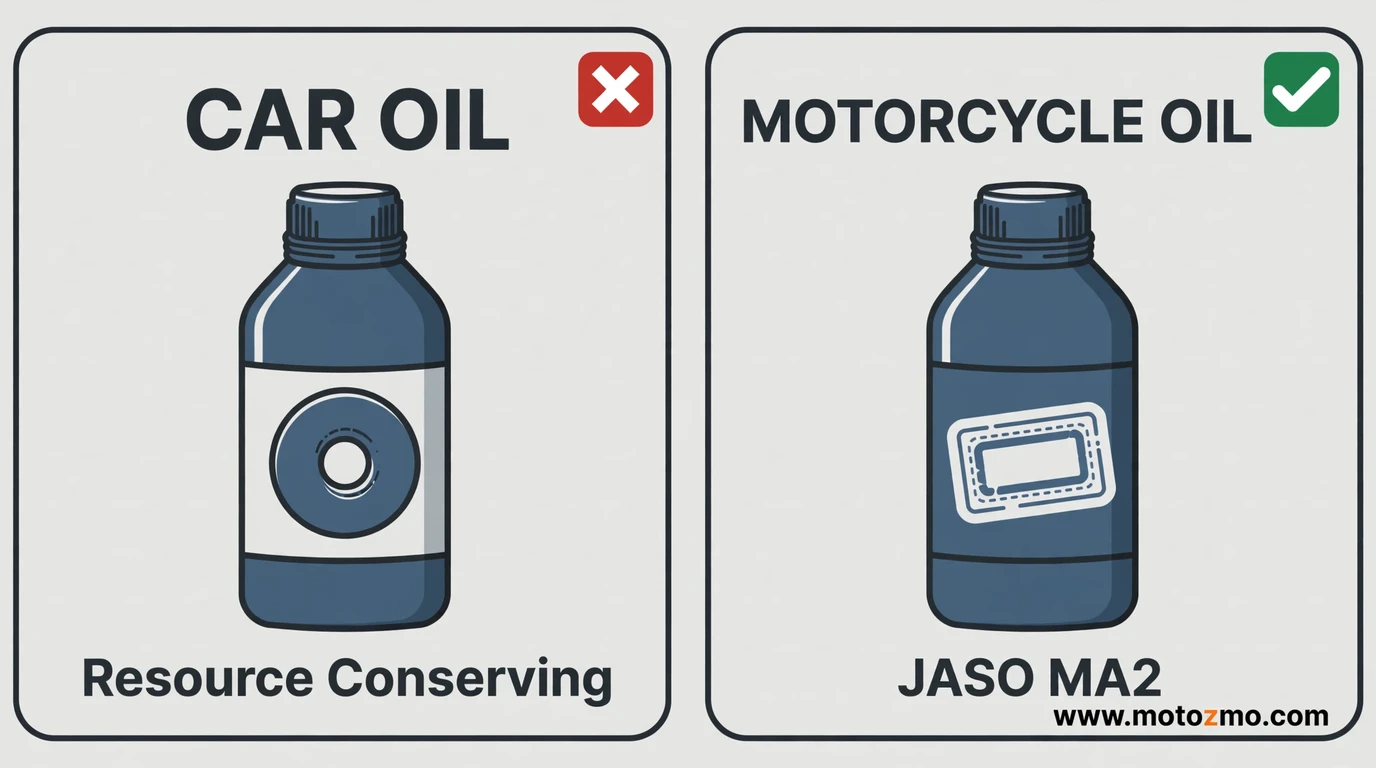
You don’t need a chemistry degree. You need to read two labels.
| What the label says | What it means for your bike |
|---|---|
| JASO MA or MA2 | Tested safe for wet clutches. This is the stamp you want. |
| JASO MB | Made for scooters and automatics. It will make a wet clutch slip. Skip it. |
| “Resource Conserving” or “Energy Conserving” in the API donut | Contains friction modifiers. Do not use in a wet-clutch bike. |
| No JASO stamp at all | You are gambling on the additive package. Don’t. |
JASO is the Japanese standard that tests whether an oil grips or slips in a wet clutch, and RockOil’s guide to the JASO specifications explains what MA, MA1, MA2, and MB each certify. MA2 is the tighter, newer friction band most modern bikes call for.
Then comes the viscosity trap: 10W-40 car oil is not 10W-40 motorcycle oil. The grade only describes thickness at two temperatures. It says nothing about friction modifiers, shear resistance, or clutch safety. Two bottles can share a grade and be completely different oils.
When Car Oil Works
The flat “never” answer is wrong for some bikes. Dry-clutch bikes never let oil touch the clutch: BMW’s oilhead boxers, Ducati’s dry-clutch models, and dry-clutch Moto Guzzis among them.
Friction modifiers have nothing to slip there, so the clutch argument disappears. Shear protection still matters, but the risk drops a lot. Check your manual: if it doesn’t call for JASO MA, car oil of the right grade is a far smaller gamble.
The other exception is the emergency top-up. You’re low on oil, the only shop nearby stocks car oil, and you need to get home. Half a quart of plain, non-energy-conserving conventional oil will get you there.
Oil in the sump beats no oil. Then change it at the next chance. One top-up is a rescue; a full interval on car oil is a habit that will cost you a clutch.
Already Poured It in? How to Recover
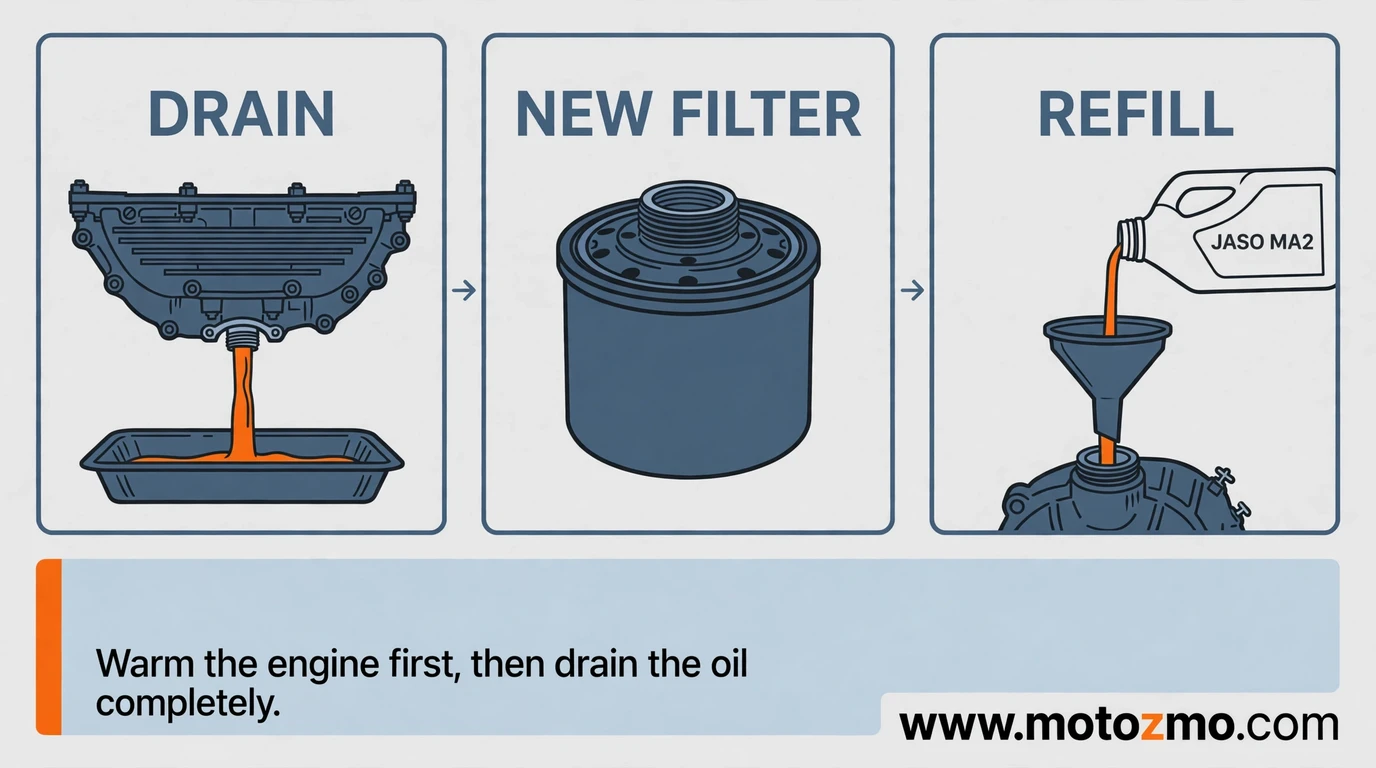
Don’t panic. One fill of car oil won’t seize an engine. Damage from this mistake arrives in order, and the clutch warns you first.
- First: the clutch slips under load. Revs rise, speed doesn’t, the lever feels vague and mushy.
- Later: faster gear and bearing wear, over thousands of miles, from oil that shears down too fast.
The fix is simple. Ride gently (no hard launches) until the engine is warm, then drain the oil completely, fit a fresh filter, and refill with JASO MA/MA2 oil in the grade your manual calls for.
My guide to changing motorcycle oil walks through the full drain-and-fill. Clutch slip from one bad fill almost always clears once clean oil is in. If slip survives two fresh changes, the plates may be glazed, and then you’re looking at a clutch job.
What to Buy Instead
Standing in the aisle, reach for a bottle stamped JASO MA or MA2 in the grade your manual specifies. That’s the whole decision.
My roundup of the best 4-stroke motorcycle oils lists bottles that carry the right certifications, so you can grab one and ride without thinking about chemistry again.
FAQ
Can I mix car oil and motorcycle oil?
For a one-time emergency top-up, half a quart of plain conventional car oil will not hurt a wet clutch. Don’t make it a habit, and change the oil soon after, because the mix still carries friction modifiers.
Is synthetic car oil safer than conventional car oil in a bike?
No. Synthetic describes the base oil, not the additive package. A synthetic car oil labeled “Resource Conserving” carries the same clutch-slipping friction modifiers as the conventional version. Check the certifications, not the base oil type.