
Affiliate disclosure: This post may contain affiliate links. If you buy through a link on this page, MOTOZMO may earn a small commission at no extra cost to you. It helps keep our guides free. How we test and choose products.

- Uniform molecules resist gearbox shear far longer
- Holds viscosity in heat, flows faster on cold starts
- Stretches change intervals to 5,000-6,000 miles
- Costs more per bottle; wasted on garage queens

- Refined from crude; cheapest bottle on the shelf
- Fine for low-stress, air-cooled older engines
- Needs changing every 3,000-4,000 miles
- Breaks down faster under heat and hard riding
Buy full synthetic if your bike is modern and you ride hard; buy conventional if your bike is old and your rides are easy. For most riders, synthetic is the better deal. That surprises people, because the bottle costs about twice as much. But your bike’s gearbox shares oil with the engine, and those gears chop oil molecules apart.
Synthetic resists that beating far longer, so you change it half as often. I ran conventional in my old air-cooled twin for years and it was fine. Then I did the math on my newer bike and the per-mile cost came out about even. One rule matters more than either choice: match the oil’s JASO rating to your clutch first.
Below is the full decision, including when conventional is honestly the smarter buy. If you want the interval side of this, how often to change motorcycle oil covers the two-clock rule.
What Separates the Two?

Conventional oil is refined straight from crude. Its molecules come in all sizes, which means it thins out unevenly as heat and mechanical stress chew on it. Synthetic oil is built molecule by molecule instead, so every molecule is close to the same size and shape. That uniformity is the whole story.
On a car this matters a little. On a bike it matters a lot, because your transmission gears bathe in the same oil as the engine. Gears shear oil. They snip long molecules into short ones, and short molecules mean thin oil.
Lab tests run for AAA put full synthetics about 47 percent ahead of conventional oil on shear stability, deposit control, cold flow, and oxidation resistance. That is not marketing math; it is the uniform molecules surviving the gearbox.
The practical result is the interval gap: conventional holds up for roughly 3,000 to 4,000 miles, while a good synthetic stretches to 5,000 or 6,000. If you ride a modern liquid-cooled bike the way it was designed to be ridden, that gap is the entire decision.
Your Clutch Cares More about JASO Than “Synthetic”

Here is the part most comparison articles skip. Your wet clutch does not read the word “synthetic” on the bottle. It feels friction, and friction is governed by the JASO rating, not the base oil.
A conventional oil with a JASO MA2 rating protects your clutch better than a synthetic oil without one. The JASO T903 standard is the actual test that sorts oils into MA, MA1, MA2, and MB by how they behave against clutch plates.
That is also why “synthetic car oil” is a trap. Car synthetics carry friction modifiers for fuel economy, and those modifiers make a wet clutch slip.
A motorcycle-specific synthetic like Mobil 1 Racing 4T pairs its synthetic base with a JASO MA2 rating, which is the combination that matters. Base oil first, certification always.
Which Riders Should Buy Synthetic?
Stop asking which oil is “better” and ask which rider you are. This table is the whole article in one place.
| Rider | Verdict | Why |
|---|---|---|
| Sportbike or track day rider | Synthetic | High RPM and heat shear conventional oil fast |
| Tourer piling on miles | Synthetic | Longer intervals mean fewer changes on the road |
| Hot climate or air-cooled big twin | Synthetic | Heat is what kills conventional first |
| Daily commuter, modern bike | Synthetic | Cold starts add up; synthetic flows sooner |
| Vintage 70s-80s bike, gentle rides | Conventional is fine | Low stress, loose tolerances, short intervals anyway |
| Bike sits most of the year | Conventional is fine | Time, not miles, ends the oil; change it yearly |
If you want specific bottles rather than categories, our 4-stroke oil picks break down the best options by bike brand and riding style, synthetic and otherwise.
When Conventional Is the Smarter Buy
Synthetic is not a universal upgrade. Three riders should save their money.
- You own a very old bike with original seals. Synthetic detergents clean aggressively, and that cleaning can wash away deposits that were plugging small leaks. The oil did not create the leak; it exposed one. If your seals date to the Carter administration, expect weeping.
- You change oil every 2,000 to 3,000 miles regardless. Some riders do, out of habit or love. If you do, you throw away synthetic’s main advantage before it pays you back.
- Your budget is tight and your bike is low-stress. A JASO MA2 conventional changed on time protects a gentle commuter better than a synthetic interval you stretch too far because the bottle was expensive.
The Cost-Per-Mile Math
The sticker shock is real, so run the numbers instead of feeling them. Using example prices for a 3-quart sump over 6,000 miles:
| Conventional | Full synthetic | |
|---|---|---|
| Example cost per change | 3 qt at $9 + $10 filter = $37 | 3 qt at $15 + $10 filter = $55 |
| Changes per 6,000 miles | 2 | 1 |
| Total per 6,000 miles | $74 | $55 |
Synthetic can cost less per mile, not more. Actual prices move around, and the premium has shrunk a lot over the years, but the structure holds: you pay more per bottle and buy fewer bottles. If you do your own changes, the DIY-vs-shop cost breakdown shows where the real savings live.
Switching: What to Watch
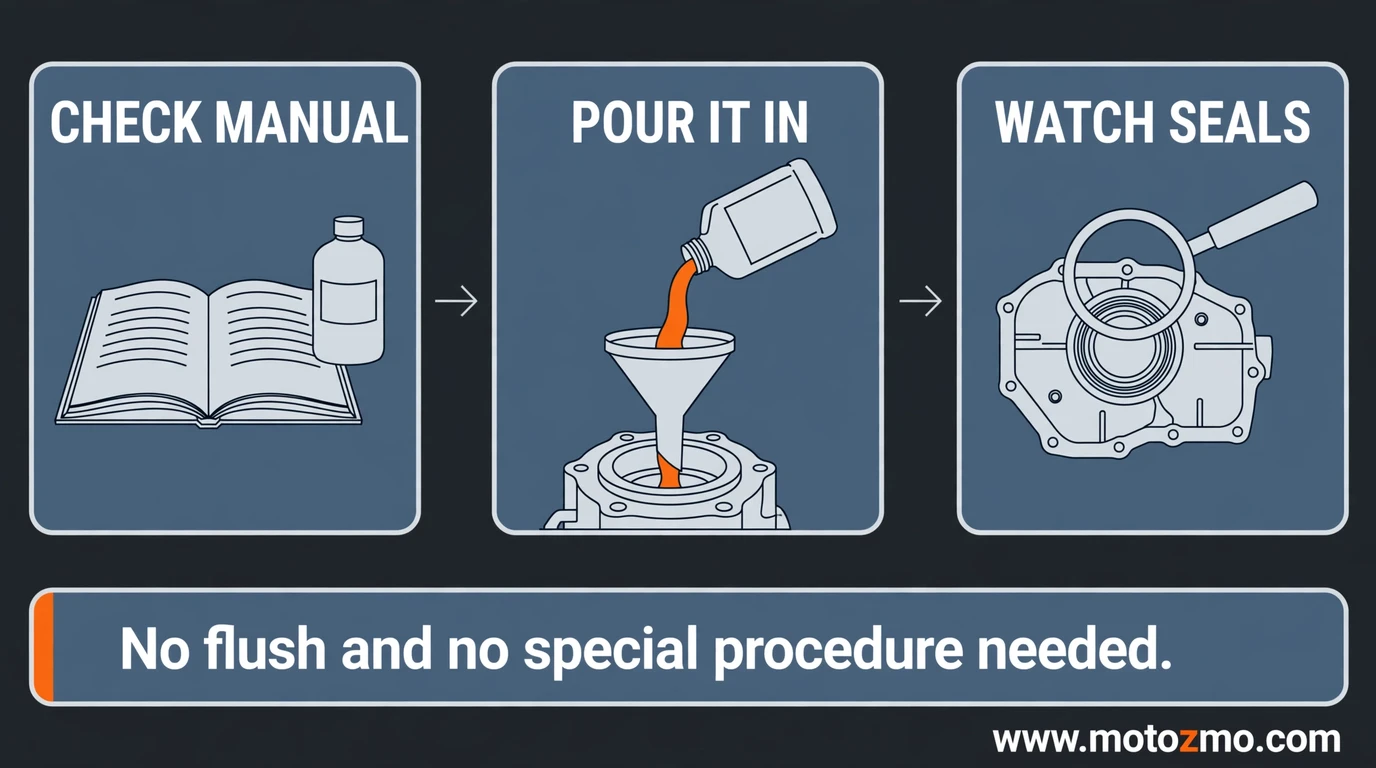
You can switch from conventional to synthetic and back without a flush or any special procedure. Check your manual first, then pour. Two cautions: on an old bike, watch the seals for the first few hundred miles, as described above.
And while topping off with the other type in a pinch will not hurt anything, do not run a deliberate 50/50 mix as a strategy. If you are doing the swap yourself, here is the full oil change walkthrough.
The Bottom Line
For most modern bikes, full synthetic earns the Recommended badge: it survives the shared gearbox, holds up in heat, and the longer interval makes the per-mile cost equal or better. But the JASO rating on the label outranks the word “synthetic” every time, and a conventional oil changed on schedule is a perfectly honorable choice for an older, easy-ridden bike. Match the oil to the rider you actually are.
FAQ
Will synthetic oil make my old motorcycle leak?
It will not create a leak, but its detergents can wash away sludge that was plugging a worn seal. If your bike is decades old, check for weeping after the switch and budget for new seals.
Can I mix synthetic and conventional motorcycle oil?
Topping off with the other type in a pinch is fine. Do not blend them on purpose. Keep the viscosity and JASO rating the same and you will be fine.