
Affiliate disclosure: This post may contain affiliate links. If you buy through a link on this page, MOTOZMO may earn a small commission at no extra cost to you. It helps keep our guides free. How we test and choose products.
Top Picks for You
Oxford AnchorForce
Sold Secure Diamond and Secured by Design with expansion bolts, ball bearings, and plugs in the box — the budget pick for solid concrete slabs.
Check Price
Kryptonite Stronghold
A 19cm domed body only 4.2cm tall with a 16mm folding shackle you can drive over — now Diamond rated, but the dearest anchor here.
Check Price
Abus WBA 100
A 16mm hardened shackle that survived a 42-inch bolt cropper test, for floors or walls — but the 16mm masonry bit is not in the box.
Check Price
If your garage has a solid concrete slab, buy the Oxford AnchorForce and bolt it down with the supplied expansion bolts.
I have watched riders spend real money on a Diamond-rated anchor and then fix it to a crumbling screed, like fitting good tires on bent rims. The anchor is the easy part. The floor is the security. A Diamond rating describes an attack in a test rig, not your garage.
This guide works from the floor up: your mounting surface, the fixings it needs, what the install really takes, and which of five anchors suits your spot. Pair it with the rest of your setup in our motorcycle theft prevention guide.
Why Does Your Floor Matter More Than the Anchor?
Every “best ground anchor” list ranks products by their Sold Secure rating. That rating is real and useful: Diamond is the top grade, and it means the anchor survived cutting, grinding, and lever attacks in a lab.
But Sold Secure tests the product, not your garage. As one security retailer puts it, the rating covers the tested product, and the real-world result also depends on your chain, your padlock, and how the whole thing is installed. You can read the grading definitions on Sold Secure’s site.
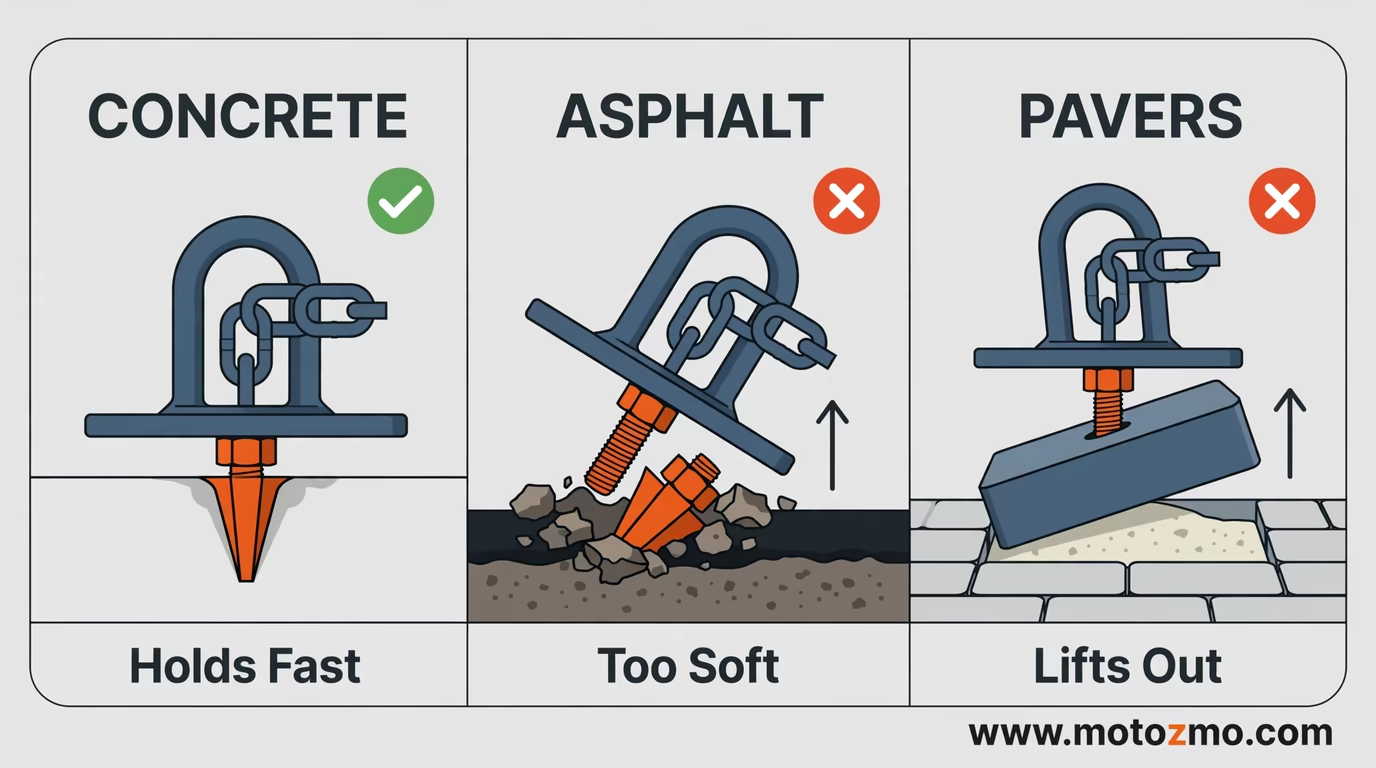
Oxford says it plainly on the AnchorForce page: the strength of the installation depends on the quality of the floor or wall material. Expansion bolts wedge themselves into the hole as you torque them down.
In solid concrete they hold fast. In weak, thin, or crumbling concrete they tear out, and no rating on the box changes that. This is the piece the ranking articles skip, and it is the piece that decides whether your anchor works.
What Surface Are You Bolting To?
Before you pick an anchor, work out what you are actually fixing it to. The anchor family follows the surface, not the other way around.
| Surface | What works | What fails |
|---|---|---|
| Solid concrete slab (garage floor, 100mm or more) | Bolt-down anchor with expansion bolts or resin fixings | Nothing, this is the easy case |
| Block paving or pavers laid on sand | Concrete-in anchor, or cut out pavers and pour a concrete pad | Bolt-down anchors, pavers lift straight out |
| Tarmac or asphalt | Concrete-in anchor set in a poured pad | Bolt-down anchors, asphalt is too soft |
| Bare earth or gravel | Concrete-in anchor in a dug hole with poured concrete | Bolt-down anchors, nothing solid to grip |
| Wooden shed floor | Shed-specific shackle through the wall uprights, or cut a hole in the floor and concrete-in | Any anchor bolted to floorboards |
| Rented garage | Bolt-down, but only with the landlord’s written OK | Drilling first and asking later |
Bolt-down anchors get all the attention, but they are useless on block paving, slabs, and tarmac. If your bike lives on the driveway, the concrete-in route means digging a hole and pouring concrete, which is a bigger job but the only one that holds.
And if your anchor lives outside in the weather, a good outdoor cover earns its keep: it hides the anchor and the chain from casual eyes and keeps rain off the fixings.
Expanding Bolts or Resin: Which Fixings for Your Floor?
Most bolt-down anchors ship with expanding bolts, and they are the fast option. You drill a hole to an exact diameter and depth, vacuum out the dust, drop the bolt in, and torque it down.
The bolt’s sleeve wedges against the hole walls as it tightens. They demand solid, crack-free concrete and precise holes. The Abus WBA 100 is a good example of the ritual: four holes, 90mm deep, drilled with a 16mm masonry bit, torqued to 25Nm.
Resin or chemical anchors work differently. You drill the hole, inject resin or drop in a resin capsule, and set the stud into it. The resin bonds the stud to the concrete.
They are more forgiving on older or weaker concrete because they grip the whole hole instead of wedging at one point. The price is patience: resin needs curing time, often a full day before you load it, and the job is messier.
Both types usually come with anti-tamper extras in the box. Steel ball bearings get hammered into the bolt heads so a thief cannot get a tool on them, and steel plugs or plastic covers hide the fixings. Use them. An anchor with its bolt heads exposed is an anchor that unscrews.
One more tip that costs nothing: mount the anchor close to a wall if you can. A chain lying loose on the ground gives a thief something to stamp bolt croppers against. A chain held up off the ground, threaded through the bike frame, is much harder to cut.
What Does the Install Job Really Take?
The version from riders who have done it:
A bolt-down anchor on good concrete is about an hour’s work, most of it drilling. The tool that matters is a hammer drill, ideally an SDS rotary drill, with the right masonry bit (usually 16mm). A normal DIY drill will struggle in a proper slab. If you do not own one, this is the hire-shop item, not the anchor, that decides your weekend.
You also want a vacuum cleaner for the dust, because a dusty hole halves the grip of an expanding bolt. Mark the holes through the base plate, drill, clean, set the bolts, torque them, hammer in the ball bearings, fit the cover. Done.
Checkatrade’s step-by-step install guide covers the same sequence if you want a second opinion before you start.
A concrete-in anchor is half a day plus curing. You dig a hole roughly 450mm by 300mm and 450mm deep, put a gravel bed at the bottom for drainage, set the anchor, and pour around 120kg of concrete around it. Then you wait.
Concrete needs a day or two to cure before you trust it with your bike, longer in cold weather. Plan the job for a weekend when the bike can live somewhere else.
Renters get the shortest paragraph and the hardest truth. Expanding bolts do not come back out. One forum rider reported that even with the bolt heads intact, his old anchor could not be pulled from the concrete when he moved. If you rent, get permission in writing before you drill, and accept that you are probably leaving the anchor behind.
Which Anchor for Which Parking Spot?
Here are three anchors, each one the answer to a different parking situation. Every one is marketed for motorcycles by its maker, and every one carries a real tradeoff.
Best for: solid concrete garage floors on a tight budget, the Oxford AnchorForce.
Key Features
- Sold Secure Powered Cycle Diamond rating plus police Secured by Design accreditation
- Four high-security expansion bolts, four anti-tamper ball bearings, and four steel plugs included
- Mounts to concrete floors or brick walls
- Shackle accepts chains and cables up to 16mm link diameter
The Oxford AnchorForce carries the top Sold Secure Powered Cycle Diamond rating and the police Secured by Design stamp, and the box includes four high-security expansion bolts, four anti-tamper ball bearings, and four steel plugs. It mounts to concrete floors or brick walls, and Oxford’s fitting notes are refreshingly honest about the floor doing half the work.
The tradeoff is the 16mm chain ceiling: the shackle takes chains and cables up to 16mm link diameter, so if you already own a 19mm or 22mm monster chain, look at the Torc instead. Full specs are on Oxford’s AnchorForce page.
Best for: driveways and shared garages where cars pass over it, the Kryptonite Stronghold.
Key Features
- Domed body 19cm across and 4.2cm tall — walk or drive straight over it
- 16mm hardened steel shackle folds flat into the body
- Two masonry bits (pilot and final) included in the box
- 5/8-inch cement bolts fix straight into the slab
The domed body is 19cm across and only 4.2cm tall, and the 16mm hardened steel shackle folds flat into it, so you can walk or drive straight over it.
Kryptonite includes two masonry bits (pilot and final) in the box, which almost nobody else does, and the 5/8-inch cement bolts go straight into the slab.
It now holds a Sold Secure Diamond rating. The tradeoff is money and footprint: it is the dearest anchor in this roundup, and that wide dome needs a clear patch of floor.
Best for: wall mounting and tight single garages, the Abus WBA 100.
Key Features
- Four Fischer-branded expansion bolts supplied
- 16mm hardened shackle survived a 42-inch bolt-cropper attack in independent testing
- Bolts to a concrete floor or a solid brick wall; shackle folds down
- Plastic cover fits over the top so you can drive over it
Abus ships it with four Fischer-branded expansion bolts, and the 16mm hardened shackle survived a 42-inch bolt cropper attack in independent testing.
It bolts to a concrete floor or a solid brick wall, the shackle folds down, and a plastic cover sits over the whole thing so you can drive over it.
The tradeoff is a small design quirk: the shackle only lies flat on one side, so if you leave it flipped up in a tight garage, a car tire can catch it. Also note the 16mm masonry bit is not supplied, so budget for one.
| Anchor | Rating | Shackle | Best surface | Install kit in box |
|---|---|---|---|---|
| Oxford AnchorForce | Diamond | 16mm chain max | Solid concrete slab | Expansion bolts, ball bearings, plugs |
| Kryptonite Stronghold | Diamond | 16mm, folds flat | Driveway, shared garage | Cement bolts, 2 masonry bits |
| Abus WBA 100 | 16mm hardened, cropper-tested | Wall or tight garage | Fischer bolts, ball bearings (bit not incl.) |
Should the Anchor or the Chain Come First?
Buy them as a pair, because a Diamond anchor with a thin cable lock is theater. The chain is the part a thief actually attacks, so match it to the anchor’s shackle: 16mm max on the AnchorForce, up to 22mm on the Torc Maxi.
Thread the chain through the anchor and the bike’s frame, keep it off the ground, and mount the anchor near a wall when you can. If you are still deciding between chain types, our disc lock vs chain lock comparison breaks down when each one makes sense.
And remember what the anchor cannot do. It stops the lift-and-vanish, the most common way bikes disappear from home. It does nothing against a thief with an angle grinder and time. Layers still win: a ground anchor plus a GPS tracker means the thief who defeats the anchor still has to find the tracker.
Frequently Asked Questions
Can I Remove a Bolt-Down Anchor When I Move Out?
Practically, no. Expanding bolts wedge into the concrete and do not reverse out, and resin anchors are even more permanent. The usual end of life is an angle grinder cutting the bolts flush with the floor, then filling the holes. If you rent, this is the conversation to have with your landlord before you buy the anchor, not after.