
Top Picks For You
ROX Speed FX Pivoting Risers
Ideal for riders needing adjustable ergonomic tuning. These American-made 6061-T6 aluminum risers permit post-install angle adjustments mid-trip to eliminate back and wrist pain on adventure and cruiser bikes.
Check Price
ROX Speed FX Anti-Vibration Risers
Designed specifically to stop hand numbness by using integrated rubber isolators to filter out engine chatter, making long-distance journeys comfortable on rougher single and parallel-twin motorcycles.
Check Price
HeliBars Tour Performance Risers
Tailored for sport-touring and ADV riders who want premium ergonomic relief without the hassle of extending factory control cables, brake hoses, or electrical harnesses.
Check Price
Krator Pullback Risers
An economical choice for cruiser riders aiming to achieve a relaxed, pulled-back riding posture and classic aesthetic without undertaking an expensive complete handlebar replacement.
Check Price
KEMIMOTO Universal Risers
A cost-effective CNC-machined aluminum upgrade tailored for dirt bikes and dual-sports, delivering a raised, upright riding posture for budget-conscious riders.
Check Price
For most riders, ROX Speed FX pivoting risers are the best motorcycle handlebar risers, because you can fine-tune the angle after they’re bolted on instead of committing to one fixed position.
That said, the right pick changes with the problem you’re solving. Reach and back strain call for a different fix than hands that go numb on a buzzy single-cylinder bike, and a cruiser owner chasing a certain look has different needs than someone on a budget dual-sport.
Below, I match five riser sets to five specific problems, and I cover the one thing most listings skip: whether your cables and brake lines can even handle the change.
Match the Risers to Your Problem First
Handlebar risers solve three different problems, and they’re not interchangeable.
- Reach and back strain: your bars sit too far forward or too low, so you lean and stretch on every ride. A taller or pulled-back riser brings the grips closer to a natural arm position.
- Hand and arm numbness: your bars are positioned fine, but engine buzz travels straight into your palms on long rides. This calls for a riser built to absorb vibration, something a plain reach adjustment won’t fix.
- No room to swap handlebars: some bikes have cable routing or a fairing that makes a full handlebar swap a hassle. Risers change your position without touching the bars themselves.
Once you know which problem you have, check your handlebar diameter. Most risers are sold for 7/8-inch or 1-1/8-inch bars, and cruisers use 1-inch bars, so a riser that fits one won’t clamp onto another.
If you’re not sure what you’re working with, our handlebar diameter guide walks you through measuring it in a few minutes.
Here’s how that maps to the picks below.
| Your problem | Best pick |
|---|---|
| Want to dial in the exact angle after install | ROX Speed FX Pivoting Risers |
| Hands go numb on long rides | ROX Speed FX Anti-Vibration Risers |
| Sport-touring or ADV bike, don’t want new cables | HeliBars Tour Performance (bike-specific) |
| Harley or metric cruiser, want the pulled-back look | Krator Pullback Risers |
| Dirt bike or dual-sport, tight budget | KEMIMOTO Universal Risers |
The Problem Most Listings Don’t Mention: Cable and Brake Line Length
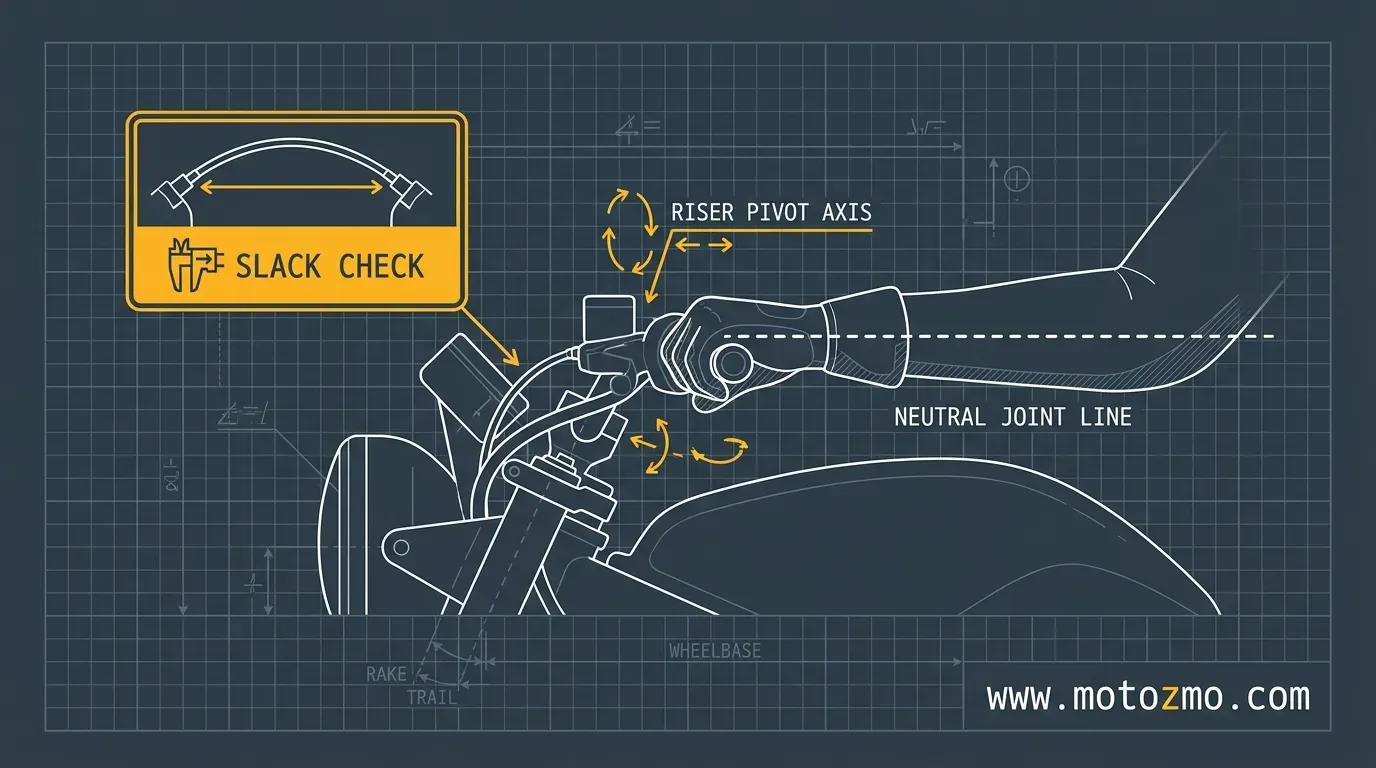
Raising or pulling back your bars stretches every cable, hose, and wire that runs from the handlebar to the rest of the bike: the throttle cable, the clutch cable, the front brake line, and the wiring harness for your switches.
Go too far and one of two things happens. Either the cable runs out of slack and binds, which can hang your throttle open or drag your clutch, or a line pulls tight enough at full steering lock to crack a fitting.
This isn’t a rare complaint. One rider installing budget risers on an ATV found the stock throttle cable had so little slack that even the shortest riser in the kit wouldn’t work, and he came close to losing control backing out of his garage.
A reviewer fitting ROX risers to a BMW GS ran into the same limit: the bike’s stock cables capped how much rise he could use before he’d need to buy longer ones. Federal rules for motorcycle controls, covered under 49 CFR 571.123, exist because control operation isn’t just a comfort question.
Before you order any riser, pull your brake lever and twist the throttle at full steering lock in both directions and look for slack. If there’s barely any, plan on budgeting for longer cables, or choose a bike-specific kit built to avoid the issue.
Faired bikes add a second wrinkle. Taller risers can bring the bar close enough to the fairing or windscreen that full steering lock isn’t possible anymore, so check your fairing clearance too, alongside your cables.
Why Raising Your Bars Actually Helps
A wrist bent up, down, or to the side under load works harder than one held straight, and that strain adds up over a long ride.
OSHA’s ergonomics guidance describes the same neutral-wrist principle that applies here: keeping the joint in line with the forearm, not forced into an angle, cuts down on strain.
A riser that brings the bar up and back moves your wrist and shoulder closer to that neutral line, which is why a small change, sometimes under two inches, can make a noticeable difference on a long ride.
The 5 Best Motorcycle Handlebar Risers
Each of these solves a different version of the problems above. If nothing here jumps out, go back to the table and match your problem.
ROX Speed FX Pivoting Risers: Best for Dialing in Your Position After Install
- Adjustable after install? Yes
- Keeps stock cables? Depends on your bike’s cable slack
Key Features
- Post-installation pivoting angle adjustment
- USA-machined 6061-T6 billet aluminum
- Versatile fitment for ADV/cruiser bars
- Requires two-bolt locking mechanism
The pivoting design is what sets ROX apart from a fixed riser. Instead of picking one angle and living with it, you loosen two bolts, rotate the riser to a new position, and lock it back down. Riders who tour long distances use this to adjust their setup mid-trip instead of carrying tools to swap parts.
They’re machined from 6061-T6 aluminum in the USA, and owners on adventure bikes and cruisers report real relief for back and wrist pain after installing them.
The trade-off is cost and install time, and the pivoting mechanism doesn’t help if your cables are already at their limit; a rider on a BMW F800 GS found the stock control lines capped how much rise he could use, even with the riser’s full range available.
Pros:
- Pivoting design lets you re-adjust the angle without removing the riser
- Machined aluminum construction, built in the USA
- Fits most adventure bikes and many cruisers and customs
Cons:
- Costs more than a fixed riser, and takes longer to install
- Your final range depends on how much slack your stock cables have, no matter how the riser itself is built
- No vibration damping in the standard version
ROX Speed FX Anti-Vibration Risers: best if your hands go numb on long rides
- Adjustable after install? Yes
- Keeps stock cables? Depends on your bike’s cable slack
Key Features
- Integrated rubber vibration isolators
- Independent left/right mounting adaptation
- Full pivoting positioning capability
- Specialized for high-vibration engines
This is the same pivoting design with a rubber isolator built into the riser body, meant to filter out engine buzz before it reaches your hands. Riders on big singles and parallel twins, the bikes that vibrate the most through the bars, are the ones who report the biggest difference.
Results are mixed, and it’s worth being upfront about that. One owner running a big single called the difference significant and said it was worth the extra cost. Another rider on a smooth-running boxer twin said he felt no real change and suspected the anti-vibe effect matters more on rougher-running engines.
If your bike already runs smooth, the standard pivoting riser probably makes more sense. For a deeper look at cutting vibration across the whole bike, see our motorcycle vibration dampener roundup.
Pros:
- Same pivoting adjustability as the standard ROX riser
- Cuts noticeable buzz on rough-running singles and twins, according to multiple owners
- Independent left and right risers adapt to different clamp widths
Cons:
- Costs well more than the standard pivoting riser
- Riders on smoother engines report little to no difference
- Limited color and finish options compared to the standard line
HeliBars Tour Performance Risers: Best for Keeping Your Stock Cables and Lines
- Adjustable after install? No
- Keeps stock cables? Yes, by design
Key Features
- Model-specific custom engineering
- Guarantees stock cable compatibility
- Includes detailed video installation guides
- Direct targeted joint strain relief
HeliBars builds a separate kit for each motorcycle model instead of selling one universal design, and that’s the entire point. Because the riser is engineered around your specific bike’s cable and hose routing, most kits retain the factory cables, brake line, and wiring harness, sidestepping the cable-length problem that trips up universal risers.
Owners on Gold Wings, Pan Americas, and BMW GS models report real relief in the wrists, forearms, and shoulders after a few hundred miles, and installation videos walk through the process step by step.
The catch is price. A bike-specific kit costs more than a universal riser, and one owner noted the new bar position blocked part of a dashboard readout on their model, so check reviews for your specific bike before you buy.
Pros:
- Engineered per model, so most kits keep your factory cables and brake line
- Owners report real, lasting relief for wrist, shoulder, and back strain
- Detailed installation instructions and video walkthroughs from the manufacturer
Cons:
- Costs more than universal risers, often $150 or more depending on the model
- You need the exact kit for your bike and year; a universal riser won’t do the same job
- A repositioned bar can block part of a dashboard or gauge on some models
Krator Pullback Risers: Best for Harley and Metric Cruisers on a Budget
- Adjustable after install? No
- Keeps stock cables? Depends on your bike’s cable slack
Key Features
- Classic cruiser pullback orientation
- Multiple height/finish options available
- Budget-friendly direct clamp alternative
- Standard basic tool installation
Krator’s pullback risers give a cruiser that classic pulled-back stance without the cost of a full handlebar swap. They come in multiple heights and finishes to match Sportsters, Softails, Dynas, and a long list of metric cruisers.
Reviews are mixed on quality control, and that’s the honest picture. Some owners report a clean fit and a solid look for the price. Others have received units with flaking paint or threads that stripped when the bolts were overtightened.
A recurring note across reviews: bolts often aren’t included, so budget for a trip to the hardware store, and use the shortest bolt that still engages the threads, rather than cranking down on one that’s too long.
Pros:
- Wide range of heights and finishes for Harley and metric cruisers
- Priced well below bike-specific kits
- Straightforward install for anyone comfortable with basic hand tools
Cons:
- Quality control is inconsistent; some owners report flaking paint or stripped threads
- Mounting bolts often aren’t included in the box
- No vibration damping and no adjustability once installed
KEMIMOTO Universal Risers: Best Budget Pick for Dirt Bikes and Dual-Sports
- Adjustable after install? No
- Keeps stock cables? Depends on your bike’s cable slack
Key Features
- CNC-machined aluminum construction
- Weather and rust-resistant hardware
- Universal fit for 7/8-inch handlebars
- Low-cost basic height elevation
KEMIMOTO’s 7/8-inch risers are built for the dirt bike and dual-sport crowd, where the market is full of overpriced options for a part that’s little more than a block of aluminum with two clamps. They fit a wide range of small-to-midsize bikes and ATVs, and most riders report a comfortable, more upright position after install.
The catch is the same universal-fit issue that runs through this whole category: nothing about these risers is engineered around your specific bike’s cable length.
One owner installing a similar universal riser on an ATV found the stock throttle cable had almost no spare slack, and the riser couldn’t be used safely until the cable was replaced. Check your cable slack at full steering lock before you install these, not after.
Pros:
- Low price compared to name-brand pivoting or bike-specific risers
- CNC aluminum construction with rust-resistant hardware
- Fits a wide range of dirt bikes, dual-sports, and small-cc cruisers
Cons:
- No pivoting adjustability once bolted down
- Universal fit means no guarantee your factory cables will reach
- Basic finish compared to premium brands
Which One Should You Buy
If you ride a bike with tight, model-specific cable routing, a sport-tourer or an ADV bike you plan to keep for years, pay for the HeliBars kit and skip the cable-length gamble.
If you want the freedom to adjust your position as your riding changes, get the ROX pivoting riser, and step up to the anti-vibration version if your engine is a buzzy single or twin.
Cruiser owners chasing a specific look can get there with Krator for a fraction of a custom builder’s price, and dirt bike or dual-sport riders on a budget will get a real comfort upgrade from KEMIMOTO without overspending on a part that doesn’t need to be fancy.
Whatever you choose, check your cable and brake line slack at full steering lock before you install anything. A five-minute check now beats a stuck throttle later.