
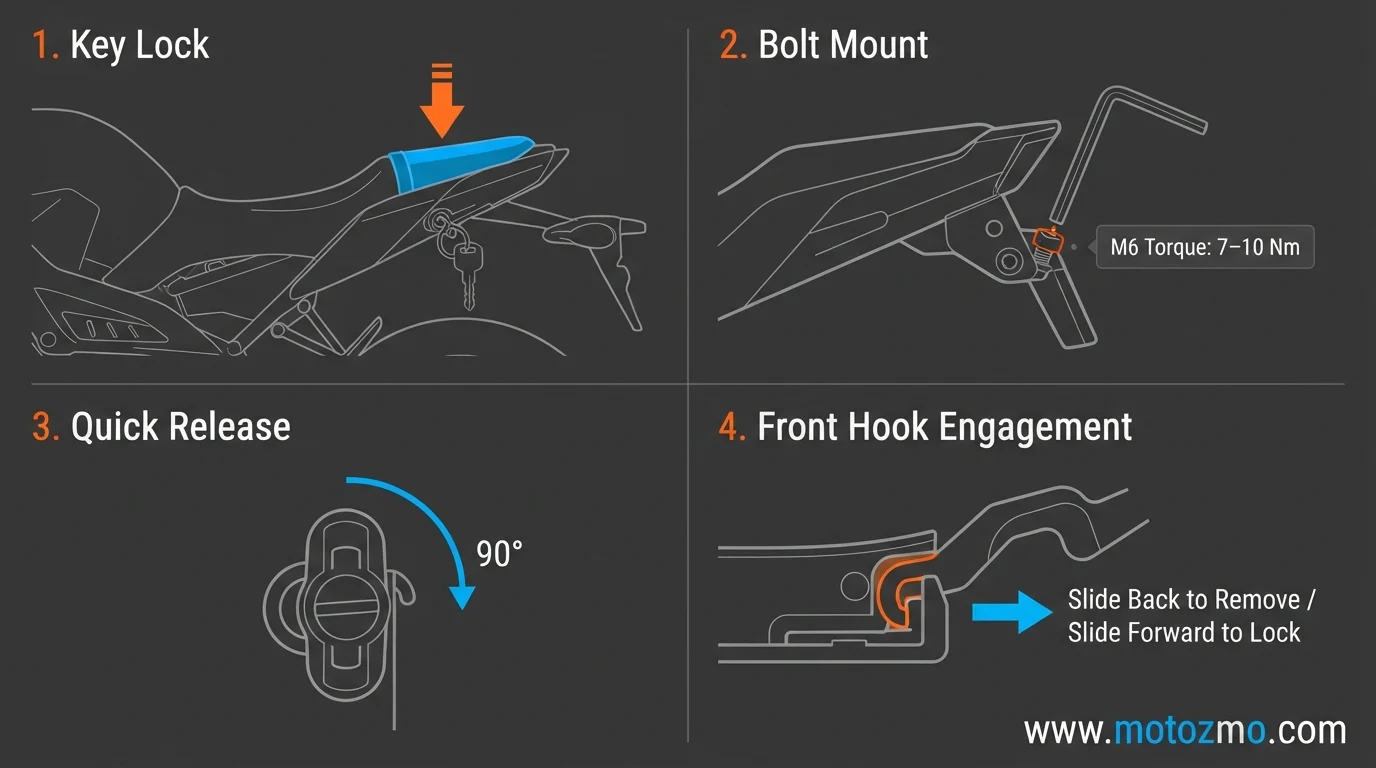
Most motorcycle seats come off one of three ways — a key-operated latch, a couple of bolts, or a quick-release tab — and the part that trips people up isn’t finding the release, it’s not realizing the seat needs gentle pressure while you release it.
The mechanism itself is rarely the problem. Knowing which of the three types you’re dealing with, and the one trick that applies to almost all of them, is what actually saves you the guesswork.
Key Takeaways
- The #1 Seat Removal Trick: Relieve mechanical tension by pressing down or pushing forward on the seat while turning the key or releasing the latch.
- Identify Your Mechanism First: Seats release via key lock, external bolts/screws, quick-release tabs, or quarter-turn Dzus fasteners.
- Pre-Work Safety Check: Disconnect the battery if you have seat heaters/wiring under the seat, and be aware of underseat fuel fillers (e.g., Honda NC700, Yamaha Virago).
- Use Real Penetrating Oil: Rust-bound bolts need dedicated penetrants like PB Blaster or Kroil with 10–15 minutes of dwell time, not standard WD-40.
- Avoid Key Breakage: Never force a stuck seat lock key with high torque; follow the systematic troubleshooting flow instead.
What You’ll Need
- Screwdriver (Phillips and flat)
- Socket wrench or Allen keys, sized to your bike’s fasteners
- Pliers, for latches or stubborn clips
- A real penetrating oil for any bolt that looks rusted (more on why below)
- Flashlight
- Gloves
- A small container or magnetic tray for loose bolts
- Your phone, to photograph wiring or routing before you disconnect anything
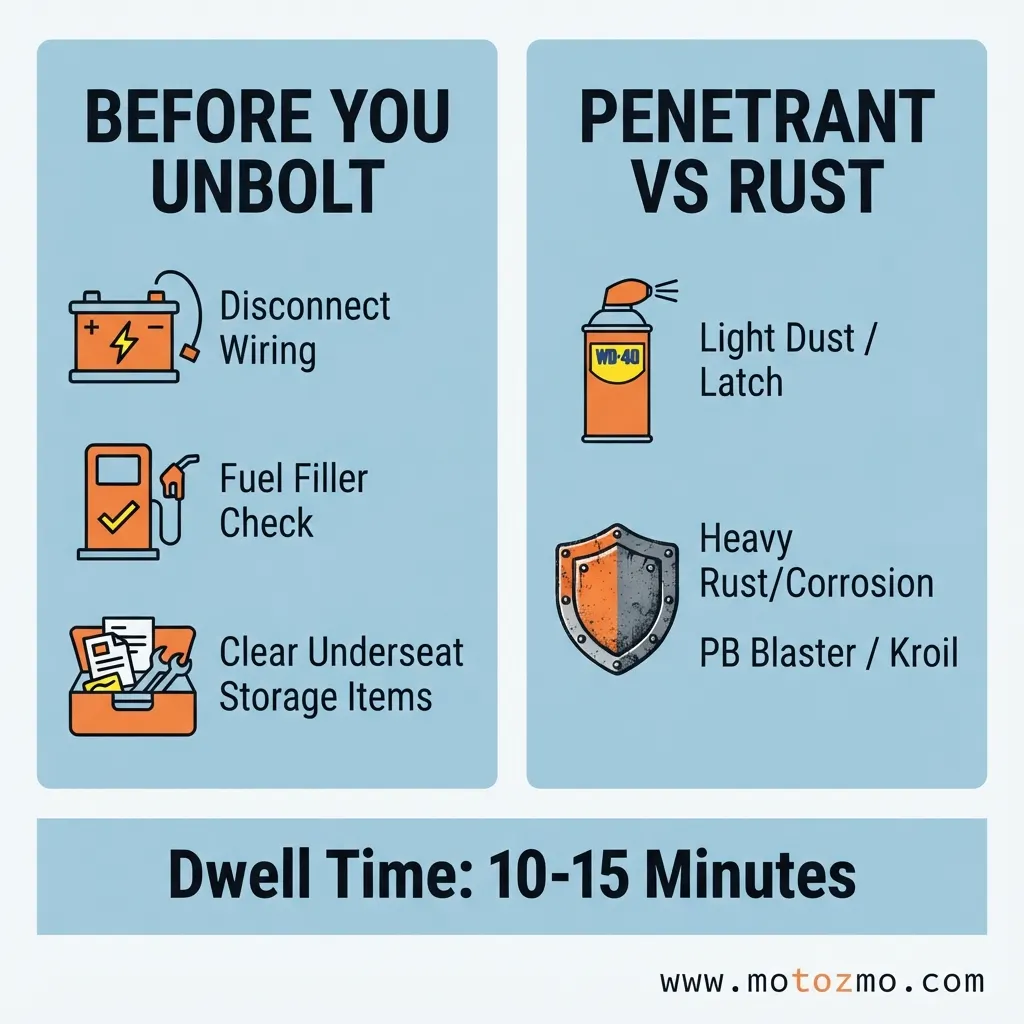
On the penetrating oil: WD-40 is fine for freeing a lightly stuck latch or a dusty bolt, but independent testing has repeatedly found dedicated penetrants like PB Blaster and Kroil loosen genuinely rusted fasteners faster and more reliably than WD-40 does.
If a bolt has been sitting under a seat rusting for years, reach for a real penetrant, spray it, and give it 10–15 minutes before you try again.
Before You Touch a Bolt: A 60-Second Check
A few things are worth confirming before you start, because they change how carefully you need to work:
- Does your seat have any wiring underneath it? Heated seats, seat sensors for helmet locks, USB ports, and alarm systems all route wiring under the seat. If yours does, disconnect the battery first. A metal tool bridging a live terminal while you’re working blind under a seat is how wiring harnesses get shorted.
- Is your fuel filler under the seat? Most bikes have a top-mounted gas cap, but a handful of models, including older Yamaha Viragos, the Honda NC700 series, and some smaller BMWs among them, route the fuel filler under the seat instead. If that’s your bike, treat the area like you would any fuel system: no sparks, no open flame, and don’t leave the cap off longer than you need to.
- What’s stored under there? Registration, tool kits, tire repair kits, and owner’s manuals commonly live in underseat storage. Pull them out before you start so nothing gets lost or crushed, and it’s worth knowing where to actually keep your registration if you’re rethinking where that paperwork lives.
Which Seat Mechanism Do You Have?
Skip the temptation to look up “how to remove a [brand] seat.” Mechanisms vary enormously even within one manufacturer’s own lineup, sometimes year to year on the same model. What’s consistent is the mechanism type, so identify that first.
| Mechanism | How to spot it | Typically found on |
|---|---|---|
| Key-operated latch | A keyhole on the side or rear of the seat, separate from the ignition | Most modern street bikes, cruisers, adventure bikes |
| Bolt or screw fasteners | Visible fasteners at the rear of the seat or under a side panel | Older bikes, budget models, many dirt and dual-sport bikes |
| Quick-release tab/clip | No visible hardware; seat pulls free after a lever or button release | Higher-end and newer models, some sport bikes |
| Quarter-turn (Dzus) fastener | A small slotted or flush-mount fastener that turns 90° to release | Track-oriented seats, race fairings, some aftermarket seats |
Removing a Key-Locked Seat
Insert the key into the seat lock and turn it. Direction genuinely varies by manufacturer, like some turn clockwise and some counterclockwise. So, if it doesn’t move, try the other way before assuming anything’s broken.
The trick that applies almost universally: apply gentle downward or forward pressure on the seat while you turn the key. The internal hook is spring-loaded and sits under a small amount of tension from the seat’s own weight resting on it; that pressure is what’s binding the mechanism, and relieving it with your free hand is usually what lets the key turn freely.
Once you feel or hear the latch release, lift the rear of the seat first, then slide it backward to clear the front mounting tab.
Common mistake: forcing the key with real torque when it won’t turn. This is how keys snap off in seat locks. If gentle pressure and trying both directions doesn’t free it, stop and move to the troubleshooting section below rather than muscling it.
Removing a Bolt-Fastened Seat
Locate the fasteners, usually at the rear of the seat or hidden under a side cover and remove them with the correctly sized socket or Allen key.
Support the seat with one hand as you remove the last bolt. It’s not always spring-loaded, but plenty of seats are held at an angle that lets them slide forward into the tank the instant the last fastener comes free.
Store the bolts in a small container as you go. Seat mounting bolts are generally small (M5–M6) and don’t need to be torqued down hard. As a rough reference, M6 fasteners are typically in the 7–10 Nm (60–90 in-lb) range, but your owner’s manual has the number for your specific bike, and overtightening into plastic or a stressed bracket is an easy way to crack a mount that was never a stress point to begin with.
Removing a Quick-Release or Quarter-Turn Seat
Look for a small lever, tab, or button, often under the edge of the seat or integrated with a side panel, rather than a visible bolt or keyhole.
Quarter-turn fasteners need a flat-blade screwdriver or a dedicated Dzus key turned a firm quarter-turn; they’re designed to need real, deliberate pressure to release, so a fastener that won’t budge with a normal turn usually means it’s just gritted with dirt rather than actually stuck.
Seat Won’t Come off? Work Through This in Order
Start with the fastest checks and only move down the list if the faster ones don’t solve it.
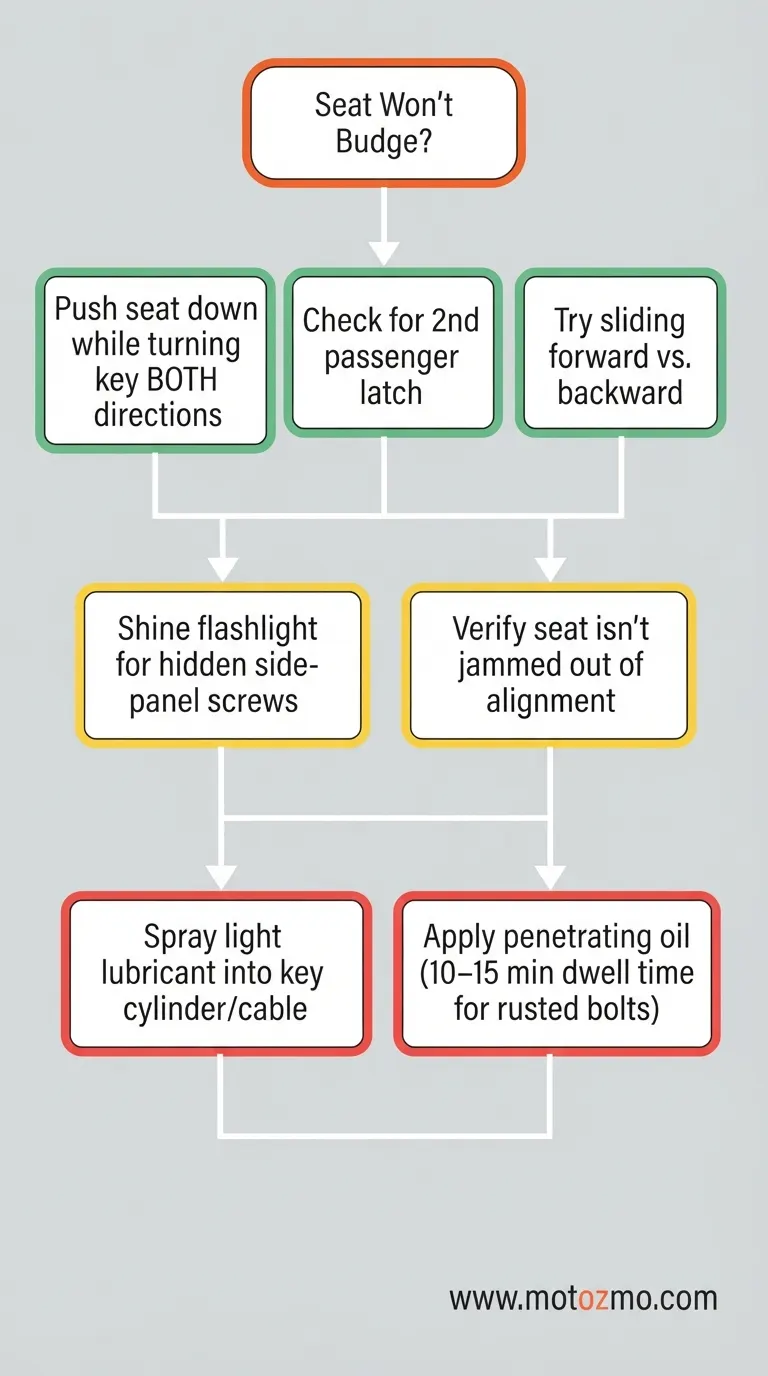
Quick checks (2 minutes):
- Apply pressure to the seat while turning the key, in both directions, if you haven’t already
- Check for a second latch: some seats, especially two-piece rider/passenger setups, have more than one release point
- Confirm you’re pulling in the right direction (backward vs. forward varies by bike)
Medium checks (10–15 minutes):
- Inspect with a flashlight for hidden screws or clips under side panels or fairings
- Check whether the seat was actually seated and locked correctly the last time it went on; a seat that didn’t click fully into place can bind at an angle that makes the latch feel stuck even though it’s release-ready
- If it’s a bolt-on seat, confirm you haven’t missed a fastener hidden under a rubber grommet or trim piece
Advanced checks (30+ minutes):
- A latch that turns but doesn’t release anything is often a cable or lock cylinder gummed up with old grease or dirt. Spraying a light lubricant into the mechanism and working the key back and forth several times often frees it.
- Genuinely rusted bolts need a proper penetrating oil, 10–15 minutes of dwell time, and possibly a second application (see the note on penetrants above)
When it’s a locksmith or dealer job: If the key is lost entirely, most dealers can cut a new key from the bike’s VIN, though it may take a special order. A mobile locksmith can sometimes pick a seat lock on-site for less than a dealer visit. Drilling the lock or accessing the release cable directly through a panel is a genuine last resort. It works, but it usually means replacing the lock afterward, so treat it as the final option, not the first one.
Reinstalling the Seat
Line up the front tab or hook into its receiving slot first, then press down at the rear until you hear or feel the latch click, or thread the bolts back in by hand before tightening any of them fully. This avoids cross-threading and lets the seat settle into its correct position before you lock it down.
Once it’s on, push down and try to wiggle it to confirm it’s actually secure before you ride off; a seat that isn’t fully seated can shift or pop loose over a bump.
Keeping It Easy to Remove Next Time
A latch or cable that’s dry seizes up faster than one that’s had a little attention. Once a year, work a light lubricant into the key mechanism and the release cable if you can access it, and wipe down the mounting points to keep dirt from working its way into the latch.
If you’re removing the seat anyway to work on something underneath, it’s also a good time to check the seat itself, comparing seat cover types if the stock cover is worn, or looking at how to install a new seat cover yourself, since the seat’s already off and most of the work is already done. Cracked or dried leather seats are a different repair; here’s how to restore a leather motorcycle seat if that’s what you’re looking at instead.
If the reason you’re pulling the seat is to get at the battery, as it usually is, remember that a battery that’s given you trouble once tends to do it again, worth a look at why motorcycle batteries die over winter if this isn’t the first time you’ve been under here for exactly this reason.
Bottom Line
Figure out which of the three mechanisms you’ve got, apply a little pressure while you release it, and most seats come off in under five minutes. The times it actually fights back are almost always one of two things: a latch that needs lubrication, or a bolt that needs a real penetrant instead of another spray of WD-40.
FAQs
Which direction do I turn the key to unlock a motorcycle seat?
It varies by manufacturer; there’s no universal direction. If it doesn’t turn one way, try the other, and apply gentle downward pressure on the seat at the same time to relieve tension on the internal hook.
Will WD-40 loosen a rusted seat bolt?
It can help with light corrosion, but dedicated penetrants like PB Blaster or Kroil consistently outperform it on genuinely rusted fasteners. Save WD-40 for dust and light grime, not bolts that have been rusting for years.
What if I lost my seat key?
Most dealers can cut a new key from your bike’s VIN. A mobile locksmith can often pick the lock on-site for less. Drilling the lock is a last resort that usually means replacing it afterward.
Do I need to disconnect the battery before removing my seat?
Only if your seat has wiring under it — heated elements, alarm sensors, or USB ports. A metal tool contacting a live terminal while you work blind underneath is the real risk, so disconnect first if in doubt.
Why does my seat feel stuck even though the key turns fine?
The latch is likely gummed up internally, or the seat wasn’t seated correctly last time it went on. Try applying pressure while working the key, and if that fails, a light lubricant in the mechanism usually frees it.
Will removing my seat void my warranty?
Routine removal for maintenance typically doesn’t. Damaging the latch, cable, or mounting points while forcing a stuck seat is what can create a warranty issue. Check your documentation if you’re unsure.