
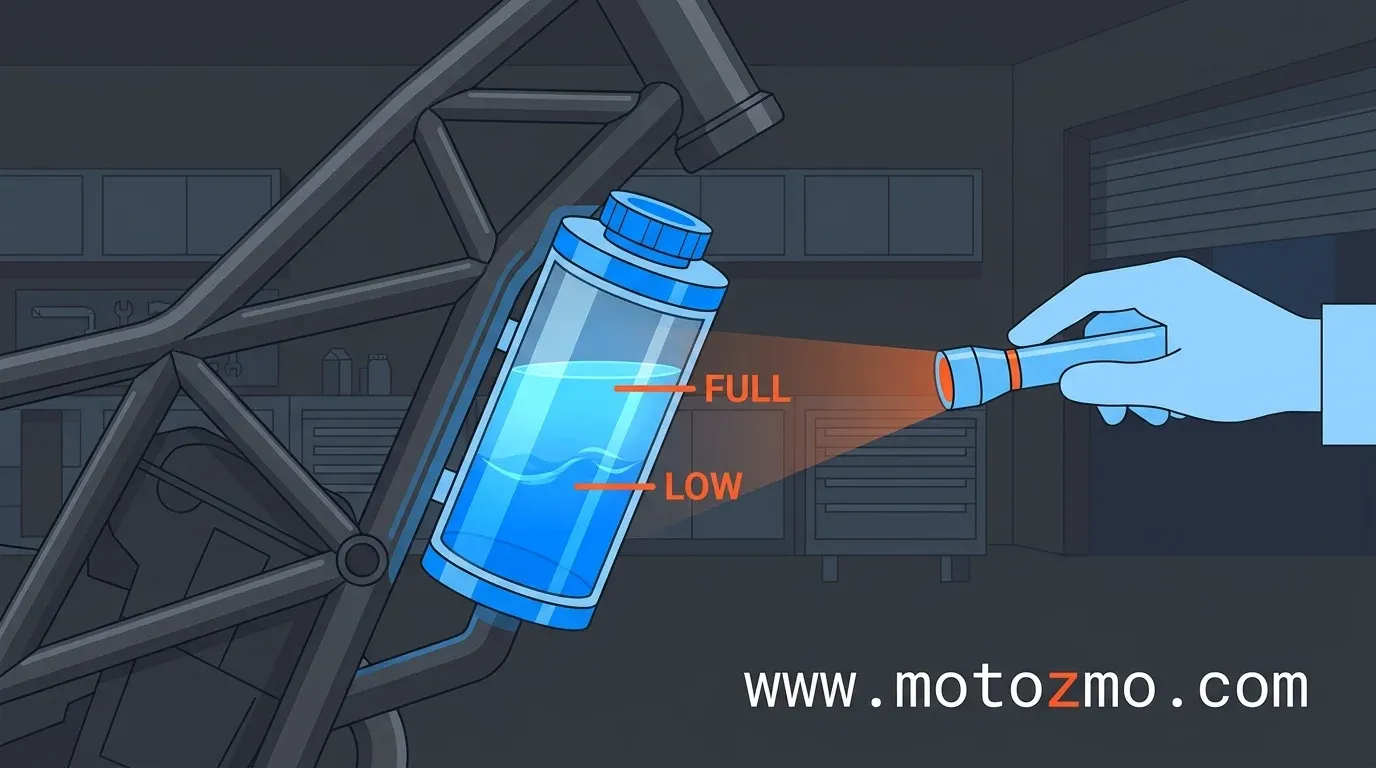
Check your motorcycle’s coolant with the engine cold and the bike upright on level ground: the fluid in the reservoir’s sight glass should sit between the low and full marks. If it’s low, top it up with the exact coolant your manual calls for and check again in a week. If it looks brown, rusty, or milky, don’t top it up. Flush it instead.
Coolant loses its ability to fight corrosion over time, even on a bike you barely ride, and a motorcycle engine’s tight aluminum passages, already running hotter than most riders expect, make that breakdown a bigger problem than the same drop would be in a car. The check itself takes five minutes. Knowing when a low reading means “add fluid” and when it means “get this looked at” takes a bit more. Here’s how to check it right, read the warning signs, and know when a top-up isn’t enough.
Checking Your Coolant Level in Five Minutes
Check the level with the engine cold. This is best done before your first ride of the day, or at least an hour after your last one. A hot cooling system is pressurized, and it needs time to settle before a reading means anything.
Stand the bike straight up on level ground. Don’t check it on the side stand. That tilt shifts the fluid to one side of the reservoir and gives you a reading that’s off in either direction. Use a paddock stand, or have someone hold the bike upright while you look.
Find the reservoir. On most bikes it’s a small, semi-clear tank near the radiator, under a side panel, or tucked beside the frame, with LOW and FULL (or MIN and MAX) marks molded into the plastic. Look through the sight glass and check that the fluid sits between those two marks. Honda’s own service guidance for checking the level through the reservoir’s inspection window follows this exact method.
One mistake to avoid: don’t open the radiator cap to check the level. That’s the pressurized cap, and it can stay hot enough to burn you well after the engine’s stopped. Only open the reservoir cap, and only when the bike is cold. If the reservoir is bone dry, don’t top it and ride off. Get the system checked for a leak first.
What a Low Reading Is Telling You
A low reading by itself doesn’t tell you much. What matters is the pattern.
| What you see | Likely cause |
|---|---|
| Low once, stays topped up after a refill | Normal. Minor loss from evaporation and heat cycling over months |
| Empties again within a few weeks | An external leak. Check hose clamps, the radiator, and the water pump weep hole for residue |
| Sweet smell near the engine, no visible puddle | A small leak burning off on hot parts. Still worth tracking down |
| Level is fine, but the fluid looks milky or foamy | Possible head gasket problem. Stop riding it and get it checked |
| Temperature gauge or warning light climbs with a normal level | Not a coolant level problem. Check the thermostat, fan, or water pump instead |
If the level keeps dropping and you can’t find a wet spot anywhere, it might be leaking inside the engine, burning off with the exhaust instead of pooling on the ground. That’s a job for a mechanic, not a top-up.
Why the Color Matters, But Isn’t Proof on Its Own
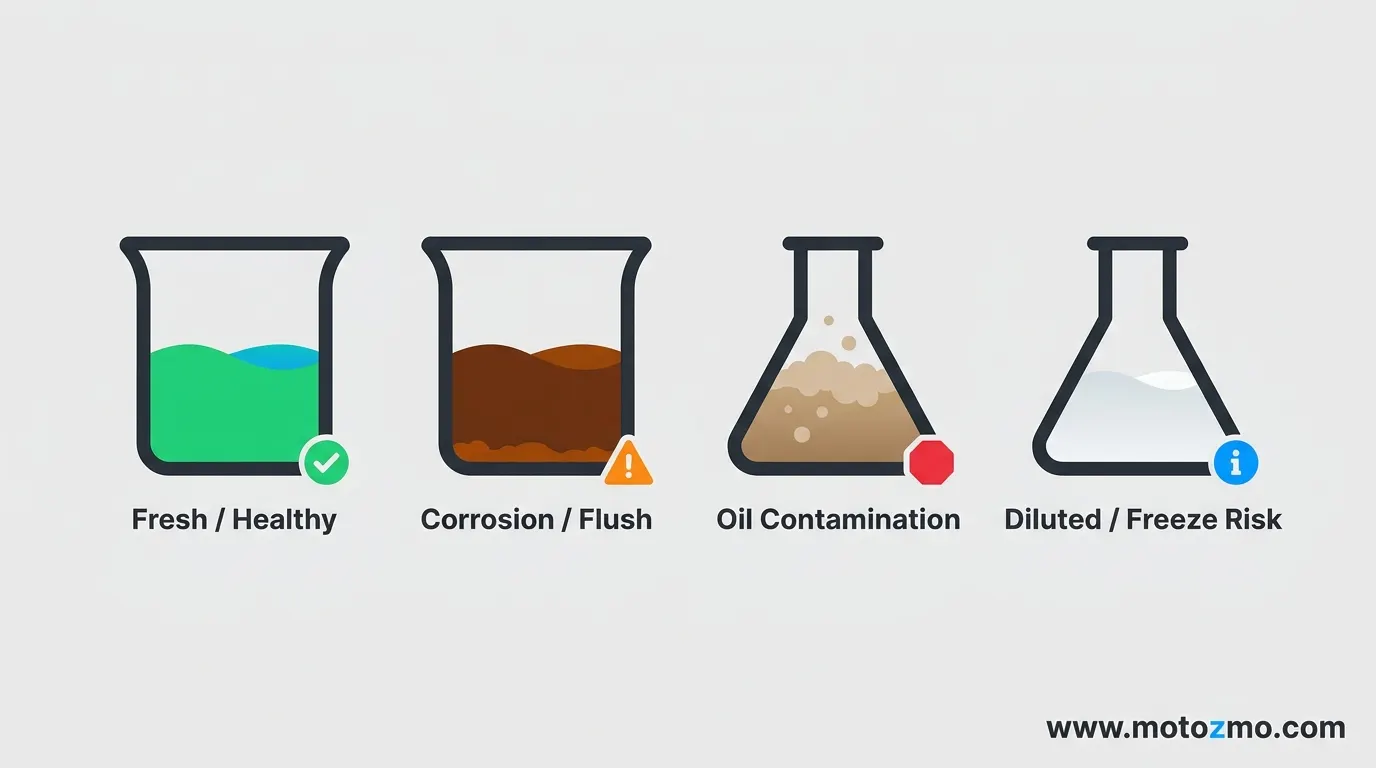
Fresh coolant is bright: green, blue, pink, or orange, depending on the formula. That color alone doesn’t confirm you’ve got the right spec. Different makers dye compatible and incompatible formulas the same shade. What the color does tell you is whether your coolant has changed since the last time you looked at it.
Brown, rust-colored, or cloudy fluid means corrosion is building inside the system. A milky or frothy look, closer to chocolate milk than juice, points to oil mixing in, a sign of a failing head gasket, and a reason to stop riding rather than top up and hope for the best. If you can’t remember the last time it was changed and it doesn’t look bright anymore, treat that as your answer.
When to Flush Your Motorcycle’s Coolant
As a general rule, plan on a flush about every 2 years, or every 20,000 to 24,000 km (12,000 to 15,000 miles), whichever comes first. Check your owner’s manual, since some long-life formulas stretch further.
Time matters as much as mileage. A bike that sits most of the season still needs this, since the additives break down through heat cycling and time, not only distance. If your bike spends winter under a cover, that’s part of why a proper winter storage routine matters even for a bike you barely start.
Flush it regardless of the calendar if you spot any of the warning signs above, if the bike has overheated even once, or if a coolant warning light keeps coming back after a top-up.
Don’t Reach for Car Antifreeze
This is where motorcycle coolant and car coolant split, and it’s worth knowing why. Older car coolants use a corrosion-fighting chemistry called IAT, built around silicates. Silicates work by scrubbing rust off cast iron parts, which suits an old cast-iron car engine. Most motorcycles don’t have that problem to solve: modern bike engines, radiators, and water pumps are aluminum, and the same silicates that protect cast iron abrade aluminum instead, wearing down water pump seals rather than protecting them.
Motorcycle-specific coolant runs on OAT or HOAT chemistry instead: organic acids that guard aluminum without the abrasive grit. Bike engines also spin faster than car engines and hold far less coolant, so the wrong chemistry has less fluid to dilute into and shows up as a problem sooner.
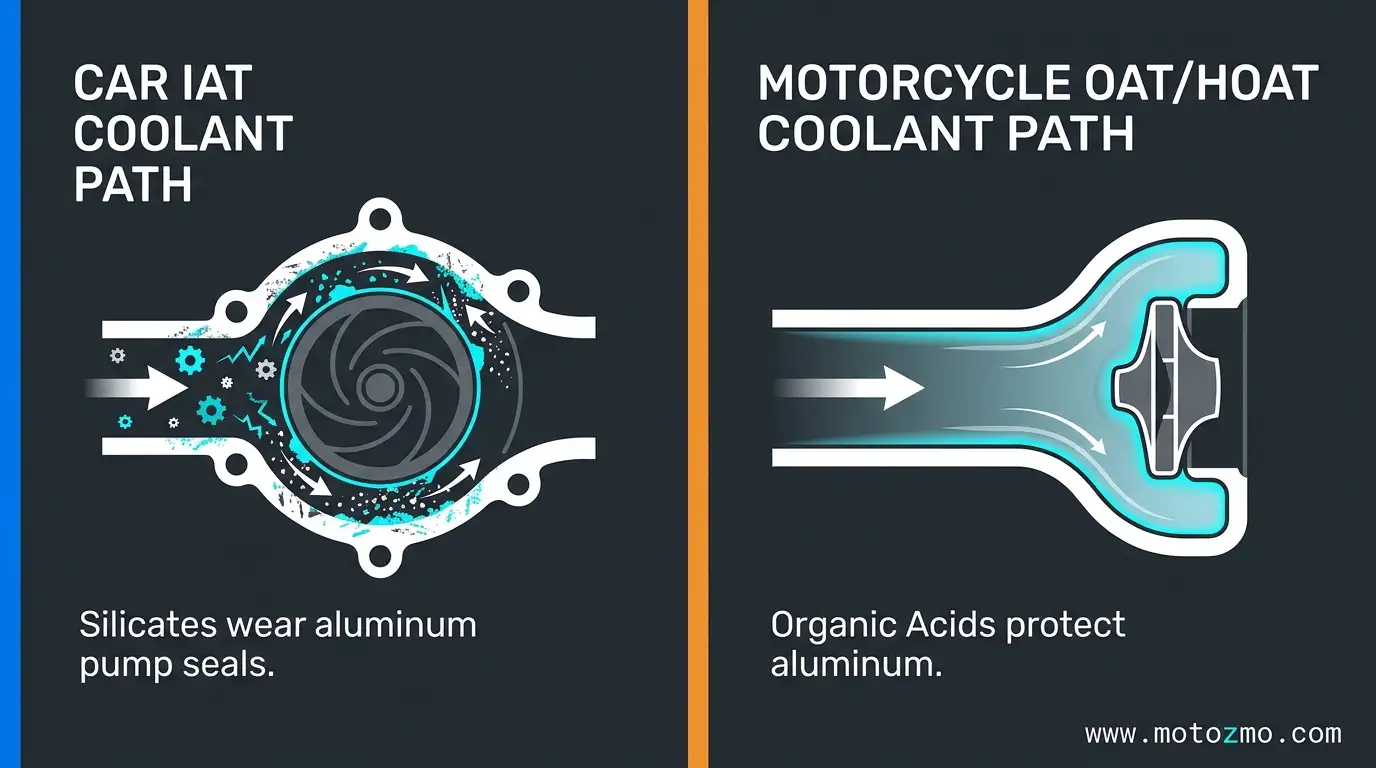
| Factor | Typical car coolant (IAT) | Motorcycle coolant (OAT/HOAT) |
|---|---|---|
| Corrosion fighter | Silicates | Organic acids |
| Built for | Cast iron and mixed-metal engines | Aluminum engines and water pumps |
| Risk if used in an aluminum bike engine | Can wear down water pump seals over time | Built for the job |
| Typical color | Often green | Green, blue, orange, or pink, depending on the brand |
Bottom line: buy coolant labeled for motorcycle use, or confirm the label states silicate-free and rated for aluminum systems before it goes in. When you’re not sure, go with what your owner’s manual specifies.
Flushing and Refilling It Yourself
Let the engine cool all the way, then park the bike level. Open the radiator cap and find the drain bolt. On most bikes, it sits near the water pump. Drain the old coolant into a pan and take it to a recycling or hazardous-waste site; it’s toxic to pets and wildlife, so don’t pour it down a drain.
Flush the system with distilled water: fill it, run the engine to operating temperature, let it cool, and drain again. Repeat until the water runs clear. Refill with the coolant your manual specifies, mixed with distilled water if it isn’t premixed. Skip tap water. Its minerals cause the same scale you just flushed out.
Run the engine with the cap off to bleed trapped air, topping up as the level drops, following your manual’s bleed steps. Recheck the level once everything’s cooled and after a short ride. Set aside about an hour for the whole job. If that’s more than you want to take on, a shop can handle it for the cost of the coolant plus an hour or so of labor.
What to Pair with This Check
Picking the right bottle matters as much as the schedule. Our guide to the best motorcycle coolant covers options for different climates and engine types.
While you’ve got the panels off, it’s worth five more minutes to check your air filter too. We break down paper versus reusable filters if you’re due for a look there.
Pairing this check with your oil change schedule means one less maintenance date to remember on its own.
FAQs
Can I top off with plain water if I’m low and don’t have coolant on hand?
Yes, for a short ride home. Plain or distilled water in a pinch won’t hurt, but it dilutes your coolant’s freeze and corrosion protection. Drain and refill with the correct mix as soon as you can, and don’t make it a habit.
Is it safe to keep riding with a coolant warning light on?
No. Pull over as soon as it’s safe and let the engine cool before you check anything. Riding on with an overheating engine risks a warped head or a blown gasket, repairs that cost a lot more than the time you’d lose stopping.