
Top Picks For You
Engine Ice High-Performance Coolant
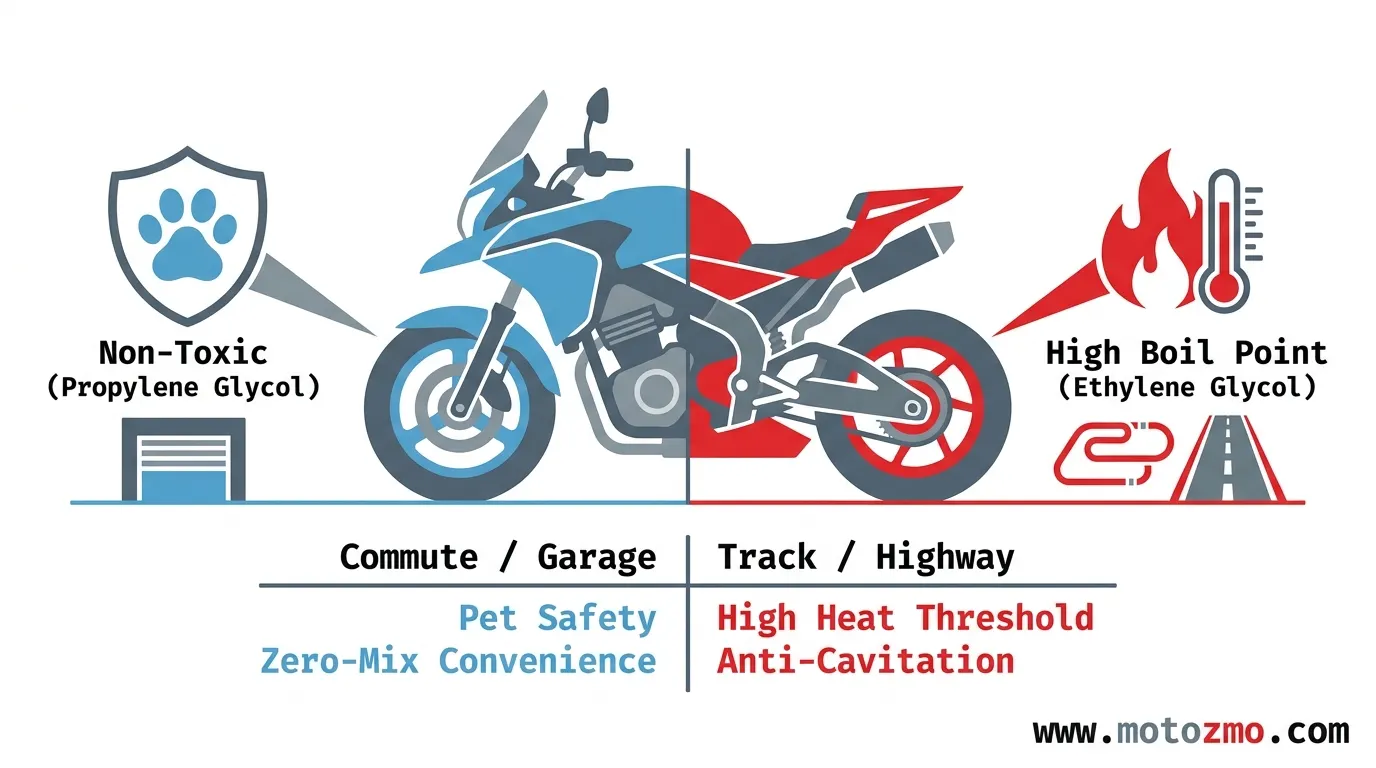
A pet-safe, ready-to-pour propylene glycol formula ideal for street riders prioritizing safety and hassle-free garage maintenance without worrying about toxic chemical spills.
Check Price
Pro Honda HP Coolant
Factory-engineered coolant providing total peace of mind for Honda owners needing guaranteed OEM specification compliance to protect aluminum engine components and warranty coverage.
Check Price
Motul Motocool Expert
High-boiling hybrid organic formula engineered for track-day enthusiasts pushing high-RPM sport bikes through sustained extreme heat conditions.
Check Price
Maxima Coolanol
Highway-focused coolant crafted with anti-foam agents to maximize thermal transfer across aluminum and magnesium engines during continuous high-speed riding.
Check Price
Bel-Ray Moto Chill Racing Coolant
Environmentally conscious, highly portable track-side coolant designed for quick emergency top-offs and off-road trailheads where toxic spills must be avoided.
Check Price
If you just want one answer: Engine Ice High-Performance Coolant is the safest all-around pick for most street bikes, and Pro Honda HP Coolant is the better call if your bike’s still under warranty and you want an exact factory match.
Neither one is right for every rider, though. A track day pushes coolant harder than a daily commute ever will. An off-road bike deals with mud and heat soak a highway cruiser never sees. And a coolant that works great on an Arizona highway might not be the one you want sitting in a garage in a Michigan winter.
Below are five motorcycle-specific coolants, what real riders say went right and wrong with each, and who should skip which one.
Quick Picks by Riding Style
| Your situation | Pick | Why |
|---|---|---|
| Daily commuter, want zero worry | Engine Ice | Non-toxic, pre-mixed, works with most engines |
| Bike still under warranty, especially a Honda | Pro Honda HP Coolant | Exact factory spec, no guesswork |
| Track days or a hard-ridden sport bike | Motul Motocool Expert | Built for sustained high heat |
| Hot climate, mostly highway miles | Maxima Coolanol | Strong cooling with steady airflow |
| Track-day bag or a quick top-up | Bel-Ray Moto Chill | Small, light, non-toxic bottle |
Now let’s get into what separates these once you’ve owned a bottle for a season.
1. Engine Ice High-Performance Motorcycle Coolant and Antifreeze
- Base chemistry: Propylene glycol
- Freeze protection: -24°F
- Boil protection: 253°F
- Toxicity: Non-toxic
- Bootle size: 0.5 gal
Key Features
- Propylene glycol non-toxic base
- Pre-mixed formula requires no water
Engine Ice runs on propylene glycol instead of the ethylene glycol most coolants use. That’s the whole reason it earns a spot at the top of this list: propylene glycol is far less dangerous if it spills in your garage or a curious dog gets to it. The bottle comes pre-mixed, so there’s no math and no distilled water to add.
What riders like about it: the non-toxic formula tops the list for anyone with pets or kids around the workbench. It’s also a repeat pick in reader polls run by off-road racing magazines, which is more a popularity signal than a lab result, but it says something about how many riders keep buying it.
What riders don’t like about it: it costs more than a jug of plain automotive antifreeze, and the half-gallon bottle covers most single bikes for a top-up, but a full flush on a larger-capacity touring bike may need a second bottle.
Best for: daily riders and anyone who wants one less thing to worry about with a spill.
Skip it if: your owner’s manual calls for a specific OEM formula and you’d rather match that spec.
2. Pro Honda HP Coolant
- Base chemistry: Ethylene glycol, organic inhibitors
- Freeze protection: -34°F
- Boil protection: 265°F
- Toxicity: Toxic if swallowed
- Bootle size: 32 oz
Key Features
- Organic corrosion inhibitor formula
- Silicate-free water pump protection
This is Honda’s own factory formula, built by Honda’s R&D team for aluminum motorcycle engines. It uses organic corrosion inhibitors instead of silicates, so it won’t chew on your water pump seals the way an old-style automotive coolant can.
What riders like about it: it removes the guesswork. If your manual names this product, buying it means you’re never in a position to argue with a dealer over what coolant caused a warranty claim.
One long-time owner reviewing it on a retailer site pointed out that it runs on propylene glycol rather than the more common ethylene glycol, and warned other buyers not to confuse the two when topping up.
What riders don’t like about it: it costs more per quart than a jug of general automotive coolant, and some forum posters argue an equivalent silicate-free automotive coolant does the same job for less. That argument holds up on the chemistry, but going off the manual’s exact recommendation is the choice that costs you nothing if a dealer ever questions a repair.
Best for: Honda owners, and anyone who’d rather buy the one bottle the manual already names than research alternatives.
Skip it if: you don’t ride a Honda and don’t want to pay a small premium for a formula built around Honda’s own spec, even though Honda’s page says the formula suits aluminum cooling systems across its lineup.
3. Motul Motocool Expert
- Base chemistry: Propylene glycol
- Freeze protection: -35°F
- Boil protection: 275°F
- Toxicity: Toxic if swallowed
- Bootle size: 1 L
Key Features
- Hybrid organic acid technology (AOT)
- Full rubber and seal compatibility
Motul built this one for motorcycle and powersport cooling systems, not for cars, using a hybrid organic acid formula and a high boiling point that suits engines running hot and hard.
What riders like about it: sport bike and track-day riders reach for it because it’s rated for real heat, and it’s compatible with seals, rubber hoses, and plastic parts without complaint.
What riders don’t like about it: Motul doesn’t spell out “silicate-free” on the label the way Honda and Maxima do, and that gap shows up in owner forums, where riders debate whether it’s safe for every aluminum water pump.
One rider mentioned a water pump seal failure after switching to it, though nothing tied the failure to the coolant itself. Treat that as an open question worth asking your dealer about, not a confirmed flaw.
Best for: sport bike and track riders whose engines spend real time at high RPM.
Skip it if: you want a brand to state “silicate-free” in plain words before you trust it. Honda and Maxima both do.
4. Maxima Coolanol
- Base chemistry: Ethylene glycol
- Freeze protection: -34°F
- Boil protection: 265°F
- Toxicity: Toxic if swallowed
- Bootle size: Varies
Key Features
- Anti-cavitation anti-foam technology
- Formulated for aluminum and magnesium
- Added bittering agent for safety
Coolanol is an ethylene-glycol premix built for aluminum and magnesium motorcycle engines, with anti-foam agents that fight water pump cavitation at high RPM.
What riders like about it: riders report it keeps engines running cooler in hot weather and cuts down how often the radiator fan kicks on, which matters if you ride somewhere that stays hot most of the year. It pours straight from the bottle with no mixing.
What riders don’t like about it: it’s ethylene glycol, which means it’s toxic if a pet or kid gets into it. Maxima adds a bittering agent to discourage tasting, and it ships as a hazardous material because of that toxicity.
A few riders on off-road and ATV forums also report it doesn’t dissipate heat as well in stop-and-go traffic or slow, low-airflow riding, since it leans on steady airflow over the radiator to do its job.
Best for: riders in hot climates who log steady highway miles, and racers who spend most of their time at speed.
Skip it if: most of your riding happens in heavy traffic, or pets and kids are anywhere near your garage. Engine Ice or Bel-Ray are the safer choice there.
5. Bel-Ray Moto Chill Racing Coolant
- Base chemistry: Propylene glycol
- Freeze protection: -29°F
- Boil protection: 262°F
- Toxicity: Non-toxic
- Bootle size: 1 L
Key Features
- Eco-friendly and non-toxic formula
- Safe for wash bays and trailheads
Bel-Ray’s take on the non-toxic propylene glycol formula, sold in a smaller 1-liter bottle built with racing conditions in mind.
What riders like about it: it’s non-toxic like Engine Ice, but the compact bottle is easy to toss in a track bag or under a seat for a mid-day top-up. It’s harmless to fish and wildlife if any spills near a wash bay or a trailhead.
What riders don’t like about it: the 1-liter size runs short for a full flush on most street bikes, so a complete coolant change often needs a second bottle, which cuts into the price advantage over a half-gallon jug.
Best for: track-day riders and anyone who wants a light bottle for topping up on the road rather than a full flush at home.
Skip it if: you’re doing a full flush on a bike with a larger coolant capacity. Engine Ice’s half-gallon bottle covers that job in one bottle instead of two.
Which One Should You Buy?
Match the pick to how you ride, not to whatever’s cheapest at the moment. A commuter and a track-day racer are solving different problems, even though both bottles say “motorcycle coolant” on the label.
If you’re still unsure, the owner’s manual for your specific bike settles the argument faster than any forum thread.
Pair This with
Already picked a bottle? Our guide to checking your coolant level and knowing when to flush it covers the maintenance side, including how the color of your current coolant tells you whether it’s time for a change.
It’s also worth a look at paper versus reusable air filters while you’ve got the bike up on a stand, since both are five-minute checks that pay off over the life of the engine. Round out the same maintenance session with a tire pressure check, another five-minute job that’s easy to put off.
FAQs
Can I mix two different brands of motorcycle coolant?
Avoid it if you can help it. Different corrosion inhibitor packages don’t always mix well, and combining an organic acid formula with an older silicate one can cut protection or create sludge. Drain the old coolant instead of topping it off with a different brand.
Does motorcycle-specific coolant matter, or is that just marketing?
It matters most for aluminum engines, which cover nearly every modern motorcycle, since ordinary automotive coolant isn’t always built with that metal in mind. Sticking with something labeled for motorcycle or powersport use, or a car coolant your manufacturer approves by name, is the safer default.