
Top Picks For You
JACO ElitePro Digital Tire Pressure Gauge
Designed for riders demanding exact precision, this digital gauge features dual-calibrated sensors, rugged brass fittings, a real-time bleed valve, and a clear backlit display for low-light checks.
Check Price
Counteract MKPG-D Analog Tire Air Pressure Gauge
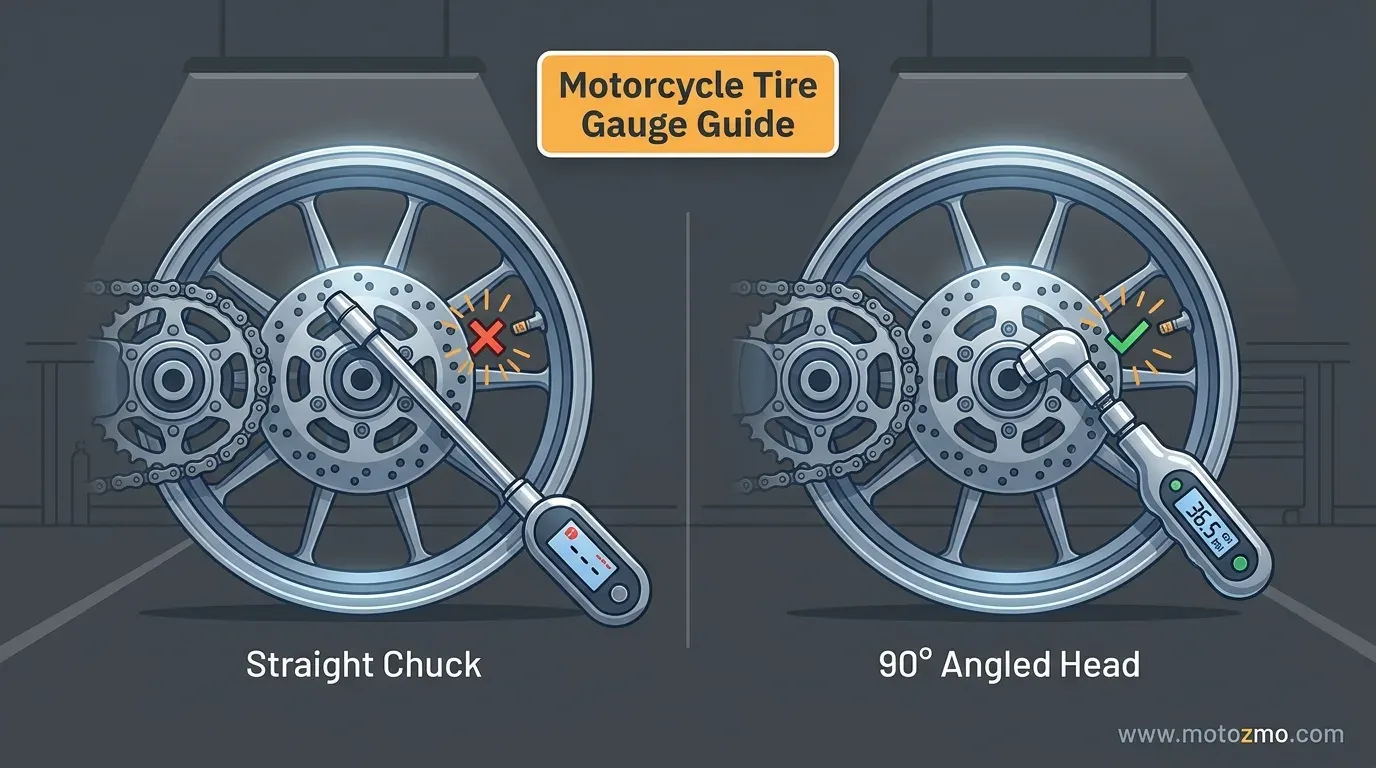
Built specifically for bikes with tight wheel clearances, this battery-free mechanical gauge reaches obscured valve stems effortlessly without fighting brake discs or sprockets.
Check Price
Motion Pro Digital Tire Pressure Gauge
Ideal for performance-focused riders, this professional powersports tool features continuous live readings during air bleeding to rapidly fine-tune tire pressures between track sessions.
Check Price
BikeMaster Digital Tire Gauge (DT-105)
An ultra-affordable, lightweight digital reader that provides hassle-free, single-button pressure checks, making it an ideal entry-level option for casual commuters on a budget.
Check Price
If you just want one answer: the JACO ElitePro Digital Tire Pressure Gauge is the most accurate all-around pick for most street bikes, and the Counteract MKPG-D is the better call if your valve stem hides behind a brake disc or sprocket that a straight-on gauge can’t reach.
A gauge from your car’s glovebox rarely solves either problem well. It’s built for a wider pressure range than a motorcycle tire uses, so the 28 to 42 psi most bikes run gets squeezed into a tiny sliver of the dial, and its straight chuck often won’t fit into the tight wheel clearances a motorcycle has.
Below are four gauges built or labeled for motorcycle use, what riders say went right and wrong with each, and which one fits your bike.
Quick Picks by Situation
| Your situation | Pick | Why |
|---|---|---|
| Want the most accurate reading and don’t mind paying for it | JACO ElitePro Digital | 0.1 psi resolution, dual sensors |
| Cruiser or adventure bike with a valve tucked behind a disc or sprocket | Counteract MKPG-D | 90-degree head reaches around tight spots |
| Track days, off-road, or dialing in suspension setup | Motion Pro Digital | Keeps reading while you bleed air out |
| Want something cheap and simple | BikeMaster Digital | Lowest price, one-button use |
One thing worth knowing before you shop: on a mechanical dial gauge, a narrower range like Counteract’s 5-50 psi spreads your bike’s actual working pressure across more of the dial face, so it’s easier to read than a 0-200 psi dial built for truck tires.
On a digital gauge, that doesn’t matter nearly as much, since the sensor’s resolution (0.1 psi vs whole psi) is what decides how fine the reading gets, not the number printed as the max range.
1. JACO ElitePro Digital Tire Pressure Gauge
- Type: Digital
- Range: 0-100 psi
- Power: 2x AAA (included)
- Resolution: 0.1 psi
Key Features
- Dual-sensor ANSI 2A precision accuracy
- Real-time air bleed valve
- Backlit screen for low-light readings
- Protective rubber drop boot
This is the gauge mechanics reach for when accuracy has to be right. It runs dual pressure sensors, calibrated to ANSI 2A standards, and reads down to 0.1 psi. The chuck and fittings are solid brass, wrapped in a rubber boot that shrugs off a drop onto the garage floor.
What riders like about it: the readings hold steady and match between units, which matters if you’re comparing front and rear pressure or checking your gauge against a second one. The bleed valve lets you release air in real time without resetting the display, and the backlit screen makes early-morning or evening checks easy.
What riders don’t like about it: it doesn’t ship with a case, and more than one motorcycle owner has said they’d pay extra for a form-fitted pouch to carry it in a saddlebag instead of rigging up something themselves. The auto shut-off also kicks in at 150 seconds, which can catch you mid-check if you get distracted.
Worth a separate note: JACO’s older analog ElitePro line has drawn a handful of complaints about the needle sticking or reading low after a drop, so if you’re tempted by the cheaper mechanical version instead of this digital one, handle it with care.
Best for: riders who want shop-level accuracy and don’t mind paying a bit more for it.
Skip it if: you’d rather have a tool that needs no batteries at all. Go with the Counteract instead.
2. Counteract MKPG-D Analog Tire Air Pressure Gauge
- Type: Mechanical
- Range: 5-50 psi
- Power: None needed
- Resolution: About 1 psi per mark
Key Features
- 90-degree angled chuck head
- All-metal mechanical construction
- Battery-free operation
Counteract built this one for motorcycle and ATV tires, not for cars, and it shows in the one feature that sets it apart: a 90-degree head that swings in behind a brake disc or sprocket to reach valve stems a straight gauge can’t touch. The body is solid metal, and it needs no battery.
What riders like about it: the angled head solves the tight-clearance problem that cruisers, spoked wheels, and adventure bikes create. One rider described getting a valve stem behind a sprocket and brake disc as no longer a fight. Because it’s mechanical, there’s no battery to die on you mid-trip.
What riders don’t like about it: there’s no backlight or glow-in-the-dark dial, so reading it at dusk or in a dim garage takes a flashlight. Like any mechanical gauge, it can drift over time, so check it against a second gauge once in a while rather than assuming it stays accurate for years.
Best for: cruisers, adventure bikes, and anything with a valve stem in an awkward spot.
Skip it if: you check pressure at night a lot and want a lit display without reaching for a flashlight. The JACO or Motion Pro handle that better.
3. Motion Pro Digital Tire Pressure Gauge
- Type: Digital
- Range: 0-60 psi
- Power: 2x AAA (included)
- Resolution: 0.1 psi
Key Features
- Live-reading air bleed mechanism
- Premium billet aluminum body
- Dual-swivel chuck hose assembly
- Powersports-dedicated ergonomic design
Motion Pro builds tools for motorcycles, ATVs, snowmobiles, and personal watercraft, full stop, and this gauge is aimed at riders who tune pressure as part of dialing in how a bike handles, not just topping it off. The billet aluminum body and dual-swivel chuck come from a company that only builds for powersports.
What riders like about it: the display keeps reading while you bleed air out through the built-in valve, so you can dial in an exact number without disconnecting and reconnecting to check your progress. That’s a real time-saver on race day when you’re adjusting pressure between sessions based on track feedback.
What riders don’t like about it: it’s a specialty tool, priced like one, and owner reviews on it have been mixed, not glowing across the board. If all you want is a quick pressure check before a commute, this is more tool than you need.
Best for: track days, off-road riders, and anyone adjusting pressure to change how the bike feels, not just to hit a number.
Skip it if: you just want a simple pre-ride check. The JACO or BikeMaster cost less and do that job just as well.
4. BikeMaster Digital Tire Gauge (DT-105)
- Type: Digital
- Range: 0-100 psi
- Power: 1 battery (included)
- Resolution: Whole psi
Key Features
- Simple one-button digital operation
- Automatic battery-saving shutoff
- Compact, lightweight plastic body
- Whole-PSI clear digital readout
BikeMaster makes parts and tools for motorcycles only, and this is its budget digital gauge: one button, a 0-100 psi range, and an automatic shut-off to save the battery.
What riders like about it: it’s inexpensive, easy to read, and does the basic job of telling you your pressure without any learning curve. Several long-term owners report buying a second or third one and still using them a year or more later.
What riders don’t like about it: one specific complaint keeps showing up, and it’s a real motorcycle-only problem: tossed loose into a soft tank bag or saddlebag, the button can take repeated hits during a ride and drain the battery dry before you reach your destination. Keep it in a hard case or a pocket in your gear instead of a soft bag, and build quality overall gets called mediocre, even by owners who keep buying it.
Best for: riders who want the cheapest gauge that still gets the job done.
Skip it if: you’re going to toss it loose into soft luggage. Store it somewhere it can’t get bumped on, or pick the JACO instead.
Which One Should You Buy?
Match the gauge to the problem you have. If your valve stem is easy to reach and you just want a trustworthy number, the JACO or BikeMaster both do that well at different price points.
If reaching the valve is the fight, the Counteract’s angled head solves that specific problem better than any straight gauge can. If you’re tuning pressure for performance, the Motion Pro pays for itself in time saved at the track.
Pair This with
A gauge only helps if you use it alongside the rest of your tire routine. Our guide to checking your motorcycle tires covers what else to look at in the same five minutes, and knowing when to replace them rounds out the picture once tread wear becomes the bigger concern.
If you also carry a portable 12V tire inflator, you can check and correct pressure roadside instead of just diagnosing the problem.
This wraps up the pre-ride check series for this part of the site. If you haven’t already, it’s worth running through checking your coolant level and knowing when to flush it, picking a motorcycle-specific coolant, and comparing paper versus reusable air filters. Tires, coolant, and the air filter cover most of what a five-minute pre-ride check should include.
FAQs
Do motorcycle tires need a different gauge than car tires?
Not strictly, since air pressure is air pressure. But a car gauge often can’t physically reach a valve stem tucked behind a brake disc, sprocket, or spoked wheel, and its scale is usually stretched across 0-200 psi or more, which buries the 28 to 42 psi range most motorcycles use in a small sliver of the dial. A gauge built or labeled for motorcycles fixes both problems.
How often should I check my motorcycle’s tire pressure?
Check it cold, before you ride, at least once a week if you ride often, and always before a long trip. Tires lose a little pressure on their own over time, and that loss speeds up in cold weather.