
Top Picks For You
AstroAI L7
A compact cordless inflator that doubles as a real emergency tool, with fast, high-frequency pressure sensing and dual-purpose USB power.
Check Price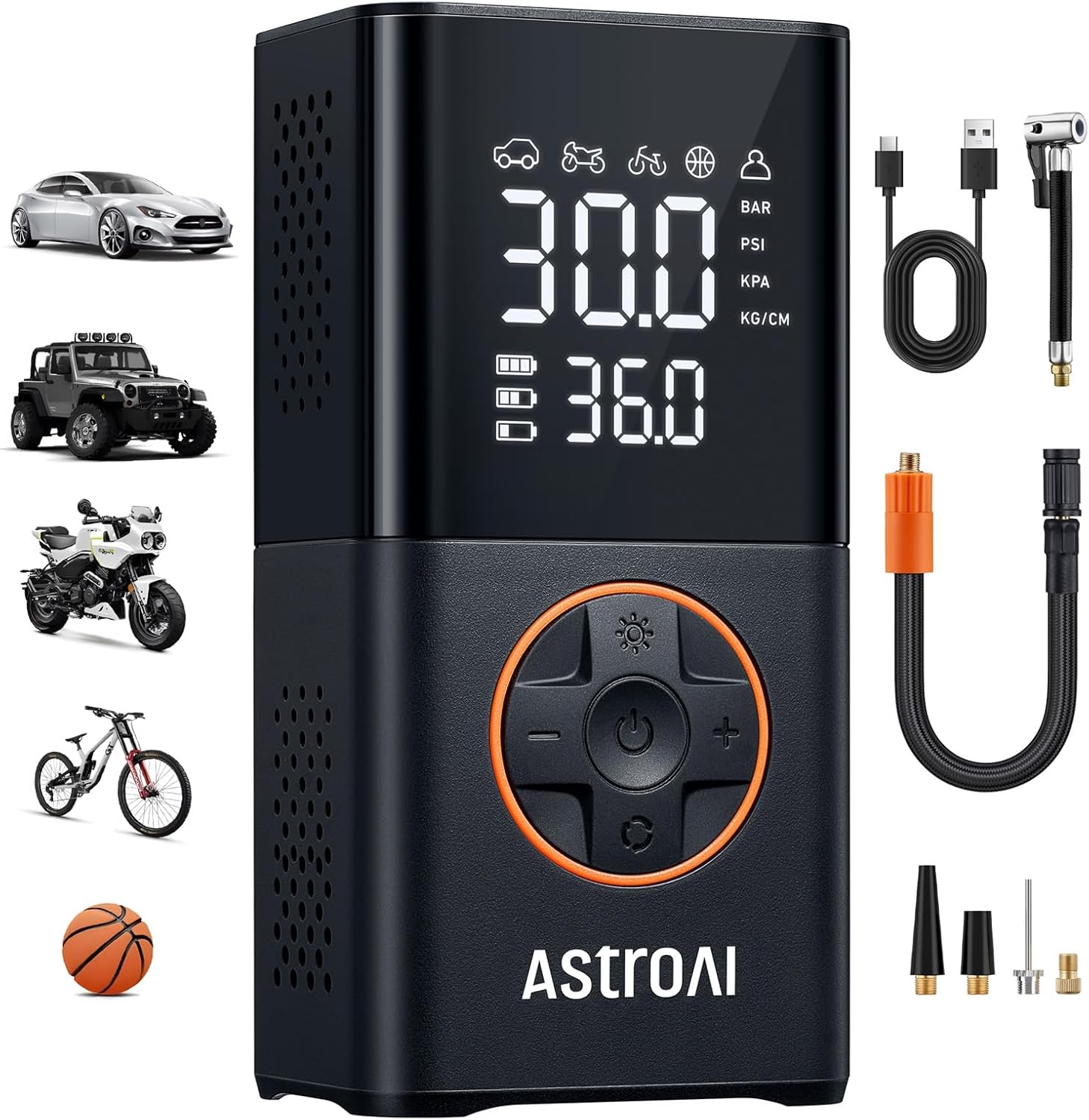
OlarHike
A dual-power inflator that never leaves you stuck. Run it cordless on the road or plugged in for unlimited continuous use.
Check Price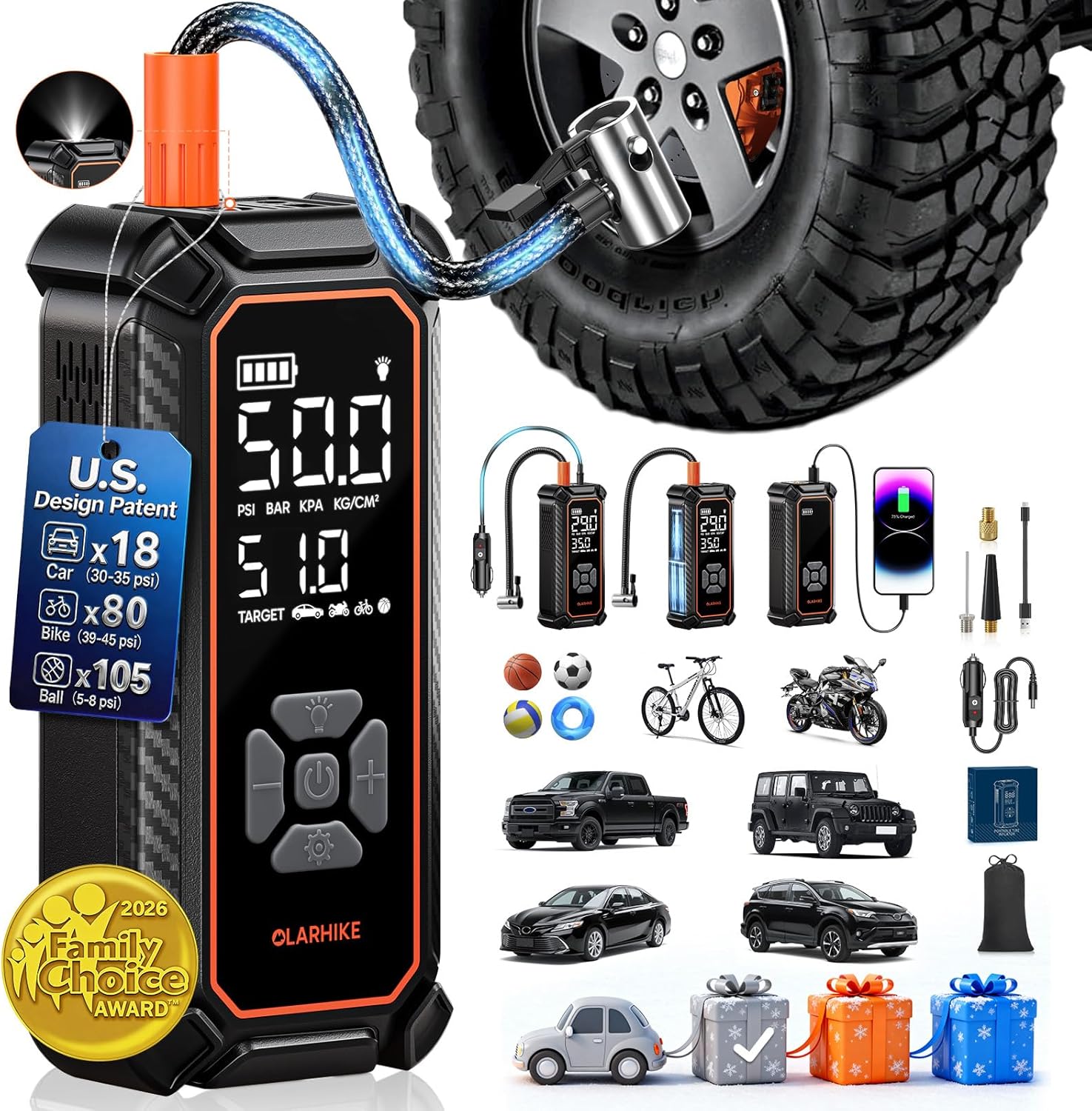
Fanttik X9 SE
A corded inflator built around precision, not portability. The pick for accuracy if your bike already has a wired accessory outlet.
Check Price
ETENWOLF S1
A long-runtime cordless inflator with unusually tight valve sealing, built to lose the least air possible every time you disconnect it.
Check Price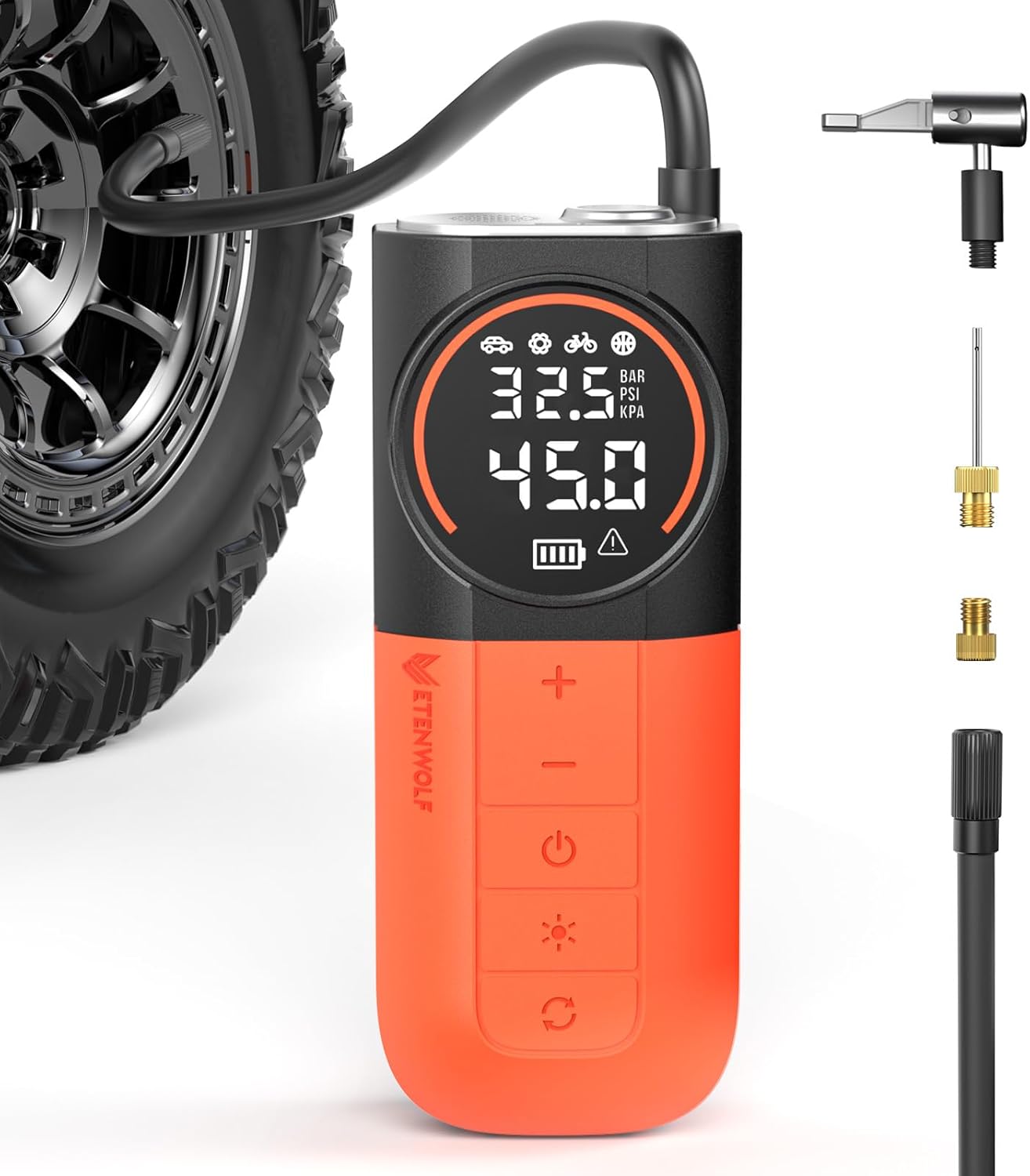
The AstroAI L7 is the best overall pick for most riders. It’s a cordless, battery-powered inflator small enough to live in a saddlebag, with enough extras (an SOS flashlight, USB phone charging) to work as a real emergency tool, not just a pump.
That’s the right default if you want one compact device that works whether or not your bike is running. But the right pick depends on how you’ll actually use it, so here’s how four different inflators compare.
What Actually Matters When You’re Choosing One for a Motorcycle
Cordless vs. Corded, This Matters More on a Bike Than a Car
Most inflator reviews never mention this, because they’re written with cars in mind. Your car has a cigarette lighter socket ready to go, and your motorcycle almost certainly doesn’t.
A corded 12V inflator like the Fanttik only works if you have a live 12V accessory outlet to plug it into. That means either your bike came with a wired SAE-to-DC accessory socket (common on touring and adventure bikes built for heated gear), or you’re not using it at all.
If you don’t already have that kind of outlet, a cordless, battery-powered unit isn’t a nice-to-have. It’s your only realistic option.
PSI Headroom You Don’t Actually Need
Every unit here is rated well above what a motorcycle tire requires. Motorcycle tire pressure typically runs somewhere in the 28–42 PSI range, depending on your bike and whether you’re riding solo or two-up.
The exact number always comes from your bike’s placard or owner’s manual, not the tire’s sidewall. A 150–160 PSI max rating is headroom built for car and truck tires, not a number you’ll ever approach on a motorcycle.
Don’t let a bigger max-PSI number sway your decision. Every inflator on this list has more than enough for your bike.
Gauge Accuracy Matters More on a Motorcycle
A motorcycle’s contact patch is small, often not much bigger than a credit card. That means small pressure deviations affect your handling, braking distance, and grip more noticeably than the same few PSI would on a car.
An inflator with a gauge that’s off by a couple of pounds matters more here than it would filling a truck tire. If you want to check your own gauge, compare it against a separate trusted gauge once, so you know what you’re working with.
Size for Saddlebag Storage
Every unit reviewed here weighs under a pound and a half, which is the realistic bar for something you’ll actually carry rather than leave at home.
Beyond raw size, look at how the hose and accessories store. A unit with a built-in hose wrap or accessory slots stays organized in a saddlebag. Loose parts rattling around tend to go missing.
Best Overall: AstroAI L7
150 PSI · 4,000mAh battery · USB-C power bank · SOS flashlight
Key Features
- Refills up to 8 tires per full charge before needing a recharge
- 4+N smart mode presets, plus a fully custom 3–150 PSI setting
- Snap-on quick-release air chuck avoids the air-loss hiss of screw-on fittings
- Weighs under 1 pound; genuinely disappears into a saddlebag
This is the pick that earns its spot by doing more than one job well. Beyond fast, accurate inflation (the L7’s sensor samples pressure 200 times per second, which gives you a responsive digital readout rather than a laggy one), you get a real emergency toolkit built into the same compact housing.
The flashlight isn’t a gimmick. It runs in a dedicated SOS strobe mode, which is exactly what you want if you’re stopped on a dark shoulder and need to be visible. The USB-C port works both ways too, so if your phone is dying at the same time your tire is low, this handles both.
You keep this in your saddlebag as your one answer to “my tire is low and I’m not near an outlet.” At under a pound, it’s an easy addition to a saddlebag you’re already packing. The auto-shutoff means you set your target PSI, walk away, and come back to a correctly inflated tire rather than babysitting a gauge the whole time.
One caveat: the listing notes it’s not built for heavy-duty tires. That won’t affect you on a motorcycle, but it matters if you’re hoping to share it with a truck in the same household.
Best Dual-Power Flexibility: OlarHike
Cordless (6,000mAh) or 12V DC plug-in · Up to 51 PSI · Includes storage bag
Key Features
- Switches between battery power and a 12V DC plug-in cable, no compromise required
- Includes a French valve adapter for non-standard valve types
- Comes with a dedicated storage bag to keep the hose and accessories together
The OlarHike solves the cordless-vs-corded tradeoff by giving you both. Use the internal battery when you’re away from any power source, or plug directly into a 12V outlet (your car, a wired bike accessory socket, or a garage adapter) when you want continuous runtime without touching the battery.
Pick this one if you’re managing tire pressure across more than one vehicle, not just the bike. The 6,000mAh battery is rated for a high number of top-offs before it needs a recharge. You can top off the motorcycle, then a car, then still have plenty left for a bicycle or two without reaching for the charging cable.
One practical note: the hose fitting can get noticeably hot after continuous use, so give it a second before you grab that end of the unit right after a fill.
Best for Accuracy: Fanttik X9 SE
Corded 12V DC only · 9.8 ft cord · 1.5 PSI accuracy · No internal battery
Key Features
- 9.8-foot cord reaches front and rear tires without repositioning the unit
- Advanced cooling system supports up to 15 minutes of continuous operation
- Compact 1.38 lb housing despite having no internal battery to carry
- One-touch unit switching between PSI, kPa, and BAR
If you have a wired accessory outlet on your bike (many touring and adventure models do, originally meant for heated gear), the Fanttik is worth serious consideration purely on accuracy. Independent gauge comparisons back this up. Readings from the X9 SE have been checked against separate high-quality gauges and matched precisely, which is exactly the confidence you want when a couple of PSI changes how your bike handles.
This lives in a fixed spot, either your garage or plugged into your bike’s accessory socket during a stop, rather than as your go-anywhere emergency backup. It has no internal battery and won’t function without a live 12V source.
The extended cooling system is a real advantage if you’re topping off more than one tire in a row, letting it run continuously without the thermal shutoffs some corded units suffer from.
The tradeoff is in the power source: no battery means no cordless use, so this isn’t the pick if your bike has no accessory outlet at all.
Best Battery Life: ETENWOLF S1
160 PSI · 5,200mAh battery · Minimal air loss on disconnect
Key Features
- Rated for dozens of motorcycle-tire top-offs on a single 5,200mAh charge
- Rear-mounted hose wrap and accessory slots keep the unit tangle-free in storage
- Auto-stop cuts off precisely at target PSI, without coasting past it
- Built-in memory recalls your last-used pressure setting automatically
The ETENWOLF’s headline number is staying power. A single charge is rated for dozens of motorcycle-tire top-offs before it needs to be plugged back in, which matters if you’re the type to forget to recharge gear between trips.
Beyond raw capacity, one design detail stands out for motorcycle use: the screw-on nozzle fitting loses noticeably less air when you disconnect it than competing designs do. That matters more on a bike than it sounds like it should. A motorcycle tire holds far less total air volume than a car tire, so every bit of air that escapes during disconnection is a proportionally bigger loss.
Get this if you check pressure monthly, like you should, and want a unit that isn’t fussy about hose fittings leaking air every time. Small losses add up if you’re checking pressure regularly rather than only in emergencies.
The auto-shutoff is also precise, stopping right at your target pressure rather than coasting a few extra seconds past it the way some cheaper units do.
Round Out Your Roadside Kit
An inflator solves half the roadside puncture problem. It gets air back into a tire, but it doesn’t seal the hole that let the air out in the first place.
Pair whichever inflator you choose with a real tire repair kit built for a motorcycle. If you’re not sure whether a plug-only fix is enough for your situation, here’s the real difference between a plug and a patch.
And since a dead battery is the other classic reason riders end up stranded, keep a portable jump starter in the same saddlebag as whichever inflator you pick.
The Bottom Line
For most riders, a cordless inflator is the realistic choice, since most motorcycles don’t have a 12V outlet to plug a corded unit into. The AstroAI L7 earns the top spot by pairing solid, accurate inflation with emergency-tool extras you’ll actually use. If you already have a wired accessory socket, the Fanttik’s accuracy is hard to beat. If you’re managing multiple vehicles, the OlarHike’s dual power mode is the more flexible buy. And if forgetting to recharge gear is a real pattern for you, the ETENWOLF’s battery life covers you longer between charges. Whichever you pick, it’s only the first half of the roadside puncture problem, so pair it with a real tire repair kit and cover both halves.
FAQs
What PSI should I actually inflate my motorcycle tires to?
Check your bike’s placard (usually on the swingarm, chain guard, or frame near the steering head) or your owner’s manual. Most street motorcycles fall somewhere between 28–42 PSI front and rear, but the correct number depends on your specific bike, tires, and whether you’re riding solo or two-up.
Can I use a car tire inflator on my motorcycle?
Yes. Every inflator in this roundup handles motorcycle tires easily, since their max PSI ratings are well above anything a motorcycle needs. The real question is power source, not pressure capability. A corded car-style inflator only works if your bike has somewhere to plug it in.
Does my motorcycle have a place to plug in a corded inflator?
Only if it has a wired 12V accessory socket, commonly found on touring and adventure bikes for powering heated gear. If your bike doesn’t have one, stick with a cordless, battery-powered inflator.
How accurate do these gauges actually need to be?
More accurate than you might assume. Because a motorcycle’s contact patch is small, even a few PSI of error affects handling and braking distance more noticeably than the same error would on a car tire.