
Affiliate disclosure: This post may contain affiliate links. If you buy through a link on this page, MOTOZMO may earn a small commission at no extra cost to you. It helps keep our guides free. How we test and choose products.

- 0.6 mm iridium fine-wire center electrode
- Tapered-cut nickel ground electrode
- Heat-range scale 2 (hot) to 11 (cold)
- Factory gap 0.8–1.1 mm, laser-controlled

- 0.4 mm iridium fine-wire center electrode
- 0.7 mm platinum needle ground, 360° laser weld
- Heat-range scale 16 (hot) to 31 (cold)
- Rated past 100,000 miles
I have run both brands in my own bikes and the brand matters less than getting the heat range and gap right for your engine. Pick a plug whose heat range matches what the manufacturer printed in your manual, check the gap with a feeler gauge before you install it, and you will be fine with either badge on the box.
Most online comparisons spend 2,000 words arguing iridium versus iridium while skipping the one choice that can foul your plugs or pit your pistons: the heat-range number hidden in the part code.
Before you blame the plugs themselves, rule out the rest of the starting system, starting with the battery, this guide on why a motorcycle battery keeps dying walks through that check. A weak battery will make even a perfect plug look dead.
Why the Heat Range Matters More Than the Brand
Both companies make excellent iridium plugs. In honest back-to-back riding I could not tell you which one was in the bike by feel alone. The difference you can feel is a plug that runs at the wrong temperature.
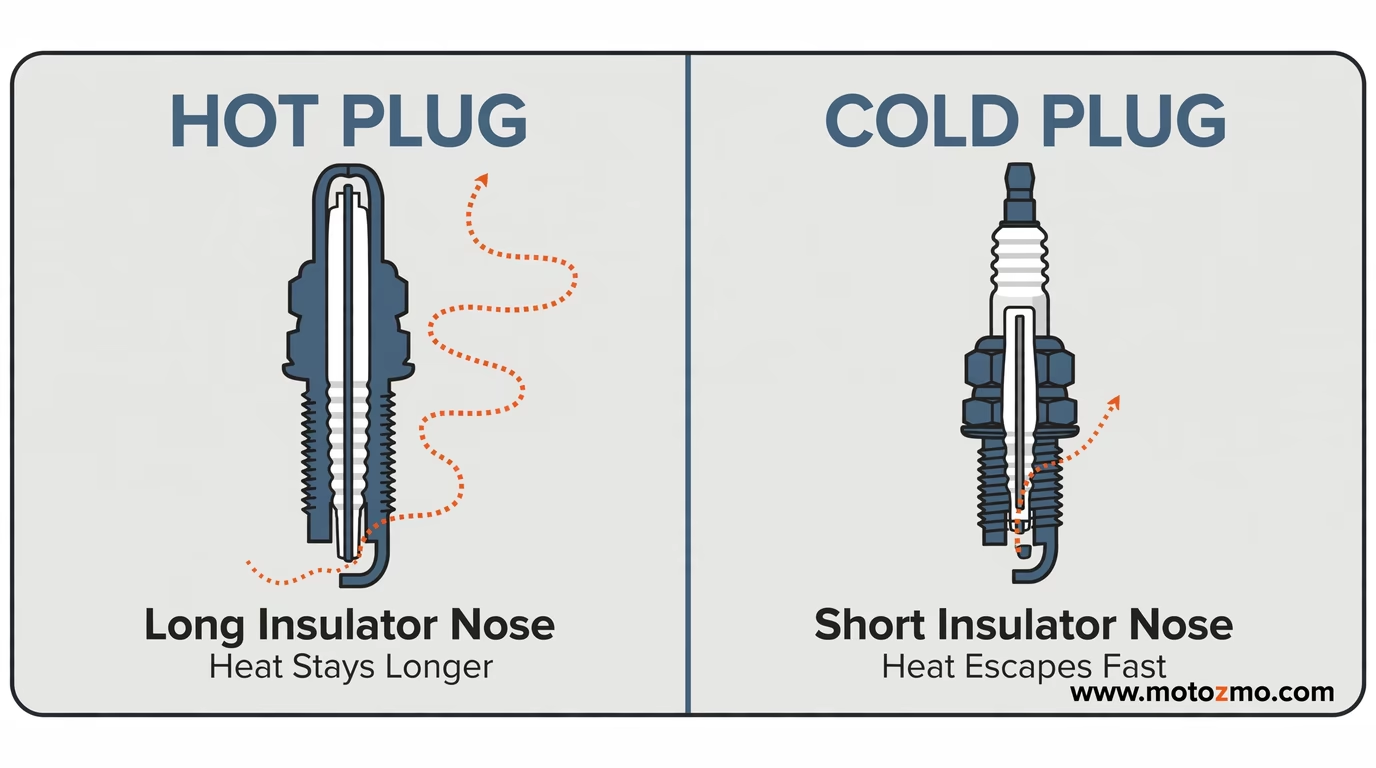
The firing tip has to stay between roughly 500 and 800 degrees Celsius: hot enough to burn off carbon, cool enough that it never glows and lights the fuel early.
A plug that is too cold for your engine fouls with black carbon and starts misfiring. A plug that is too hot holds so much heat that it can cause pre-ignition, and pre-ignition can eat a piston crown.
That is why this article is built around selection instead of a brand cheer. NGK and Denso each publish their own heat-range charts, and the numbers do not work the same way, which is where riders get tripped up when they cross over from one brand to the other.
How Do I Read the Heat Range on My Current Plugs?
For NGK, the heat range sits in the middle of the part number. Take CR8EHIX-9: the 8 is the heat range. On NGK’s scale a smaller number means a hotter plug: 2 is the hottest, 12 the coldest. So a CR7E is one step hotter than a CR8E, and a CR9E is one step colder. The number after the dash is the factory gap in tenths of a millimeter: -9 means 0.9 mm.
Denso uses the same direction but a different scale. On a Denso plug like IU24, the 24 is the heat range and lower is still hotter. The range runs roughly 16 to 31 on modern plugs, so there is no digit-for-digit match with NGK.
Denso says the numbers are not interchangeable, and they are right: NGK’s conversion chart lines them up, with NGK 6 matching Denso 20, NGK 7 matching Denso 22, and NGK 8 matching Denso 24.
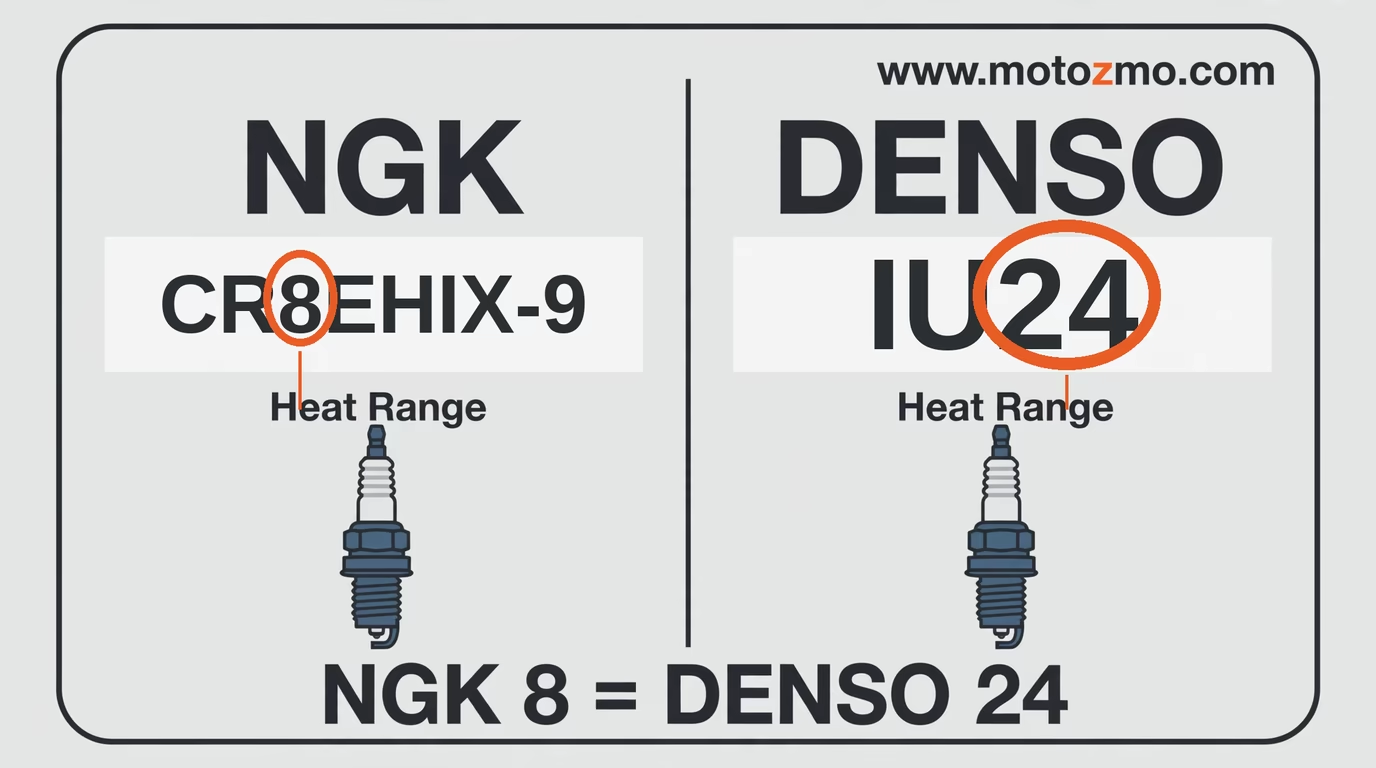
Start with the exact heat range your manual calls for. If your bike calls for a CR8E and you want a Denso, you buy the Denso that crosses to heat range 8, not the one whose number looks like an 8. Riders who tune for more compression, or who ride a big twin hard in hot weather, sometimes go one step colder; riders who foul plugs on short winter commutes sometimes go one step hotter.
Either move is a one-step experiment, never a guess across three grades. If your engine starts cutting out under load, a fouled plug from the wrong heat range is one of the first suspects.
| What you want to know | NGK | Denso |
|---|---|---|
| Where the heat range lives in the part number | Middle digits (CR8E) | Middle digits (IU24) |
| Smaller number means… | Hotter (2 hottest, 12 coldest) | Hotter (16 hot, 31 cold) |
| Cross-reference example | NGK 8 | Denso 24 |
| Gap marking | After the dash (-9 = 0.9 mm) | Pre-gapped; spec on the box |
| Fine-wire warning | Do not re-gap unless you must | Do not re-gap fine-wire tips |
What Is Different Between the NGK and Denso Designs?
The center electrode is where the two brands part ways. NGK Iridium IX uses a 0.6 mm fine-wire iridium center tip paired with a tapered-cut nickel ground electrode, and the taper gives the flame room to grow on the ground side.
NGK Laser Iridium keeps the same 0.6 mm iridium center but upgrades the ground to platinum, which is the long-life OE line rather than the performance line.
Denso went a different route with the Iridium TT. It has a 0.4 mm iridium center electrode, the smallest diameter any plug maker runs, plus a second fine tip: a 0.7 mm platinum needle on the ground electrode, attached with a 360-degree laser weld. That twin-tip shape is meant to shrink the quenching effect, where big flat electrodes steal heat from the flame kernel as it forms.
You can read Denso’s full breakdown of the Iridium TT twin-tip design on their own site. The practical result both brands claim is the same: the spark needs less voltage to jump, so starts are easier and the fire is more complete.
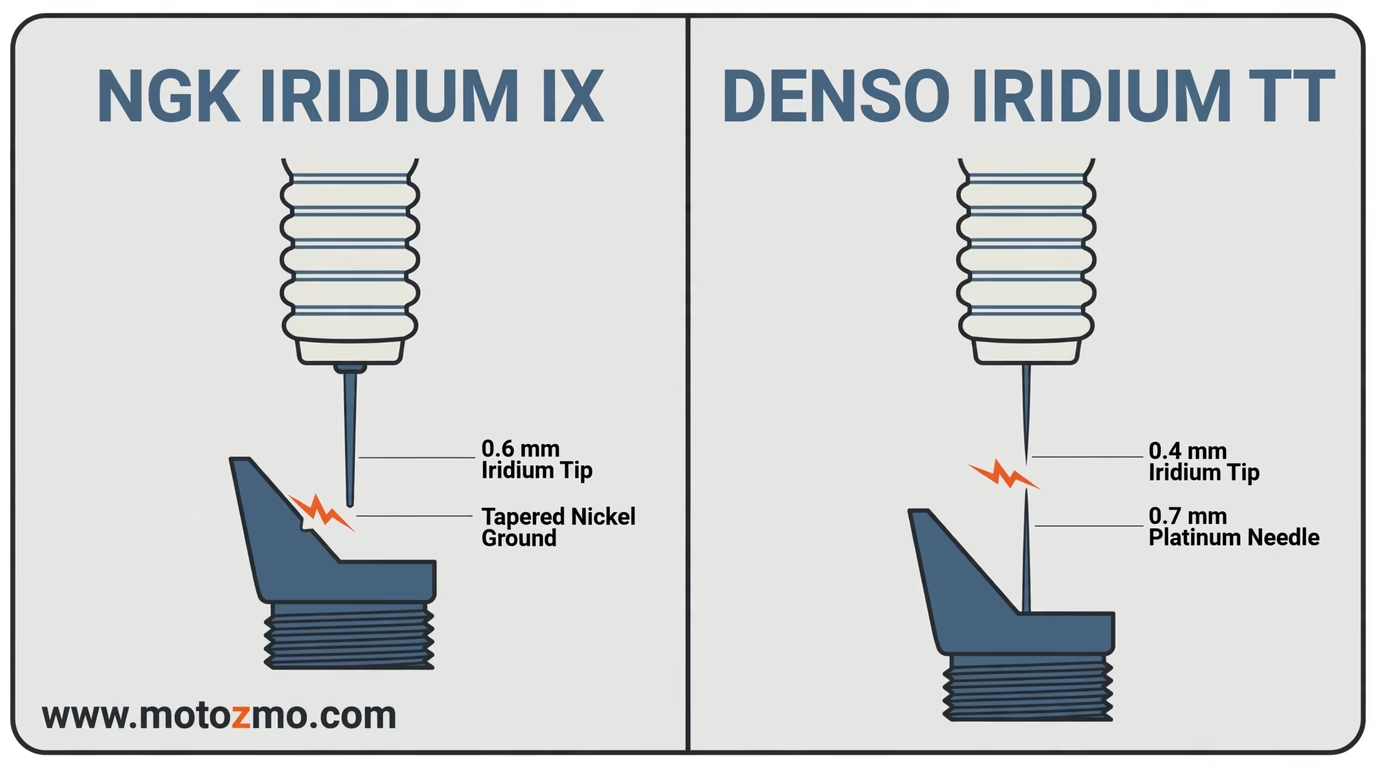
On heat range, Denso’s scale is wider (16 to 31 versus NGK’s 2 to 11), which gives tuners a few half-step options NGK does not offer in the same family.
On price, single plugs from both brands sit in roughly the same band on Amazon, a few dollars apart either way. And on OEM coverage, NGK is the factory fill on most Hondas while Denso is the factory fill on most Toyotas and a share of European bikes.
If your Japanese bike rolled out of the factory with one brand, that is usually the plug the ignition map was tested with. If you want the broader context of plug materials before choosing, my breakdown of iridium versus standard spark plugs for motorcycles covers where the upgrade actually pays off.
| Spec | NGK Iridium IX | Denso Iridium TT |
|---|---|---|
| Center electrode | 0.6 mm iridium fine wire | 0.4 mm iridium fine wire |
| Ground electrode | Tapered-cut nickel | 0.7 mm platinum needle, laser welded |
| Heat-range scale | 2 (hot) to 11 (cold) | 16 (hot) to 31 (cold) |
| Typical gap | 0.8-1.1 mm, factory set | 1.0 mm, factory set |
| Claimed endurance | Performance line (Laser Iridium is the long-life line) | Over 100,000 miles |
| Thread coating | Trivalent plating, no anti-seize needed | Machine-rolled threads |
How Do I Check and Set the Gap Without Wrecking the Plug?
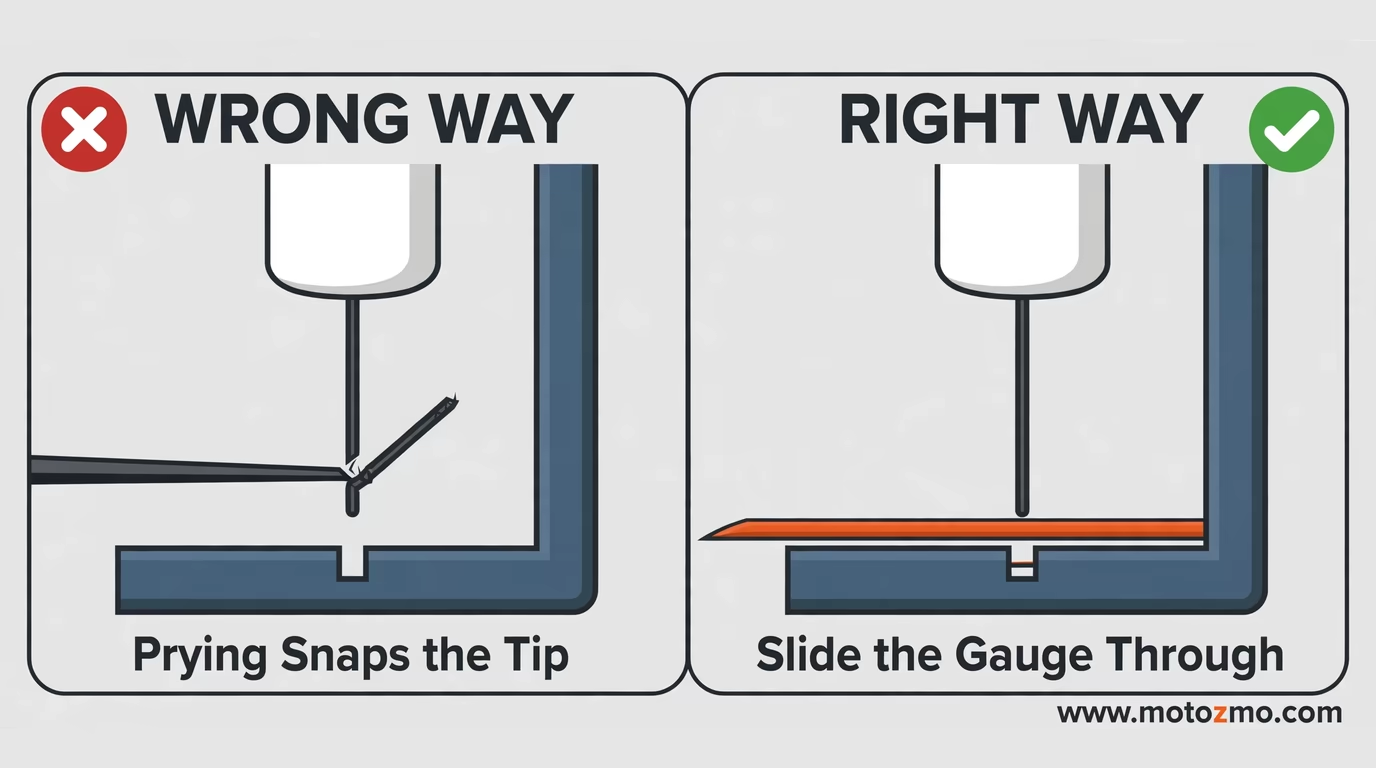
Here is the part almost nobody does, and it is where fine-wire iridium plugs get ruined. Both brands ship their iridium plugs pre-gapped, and both tell you to leave the gap alone unless you have a real reason to change it.
NGK’s guidance is that the gaps are laser-controlled at the factory, and the thin 0.6 mm iridium tip can snap if you lever a coin-style gauge against it. Denso says the same about its 0.4 mm tip.
That said, plugs do get dropped in shipping, and a dropped plug can close up. So check every plug with a wire or blade feeler gauge before it goes in. Never pry against the center electrode, and use the ground strap side if you must nudge anything.
NGK allows an adjustment of no more than about 0.008 inch from the factory preset; more than that and the electrodes stop lining up, which hurts the spark more than a slightly wide gap ever would.
Match the gap to your engine, not to the plug brand. Your owner’s manual lists a gap range. Many middleweight bikes call for 0.8 to 0.9 mm, and the number after the dash on an NGK part number tells you what the plug was gapped for at the factory.
If your manual says 0.8 mm and the plug comes at 0.9, that small difference is fine to run; if it comes at 1.1, you picked the wrong part number and should exchange it rather than bend it.
How Long Do They Last, and When Should I Replace Them?
Fine-wire iridium holds its gap far longer than old copper plugs because iridium resists the erosion that opens the gap up. Denso rates the Iridium TT past 100,000 miles in car use, though motorcycle engines spin faster and run hotter, so I treat that number as a ceiling, not a target.
NGK splits its lineup on purpose: Iridium IX is the performance plug you change sooner, and Laser Iridium is the OE long-life plug with the platinum ground that goes the distance.
On a bike, I pull plugs once a season and look at them. If the gap has opened more than a tenth of a millimeter past spec, or the ground electrode edge has gone round, the plug is done no matter what brand is on it.
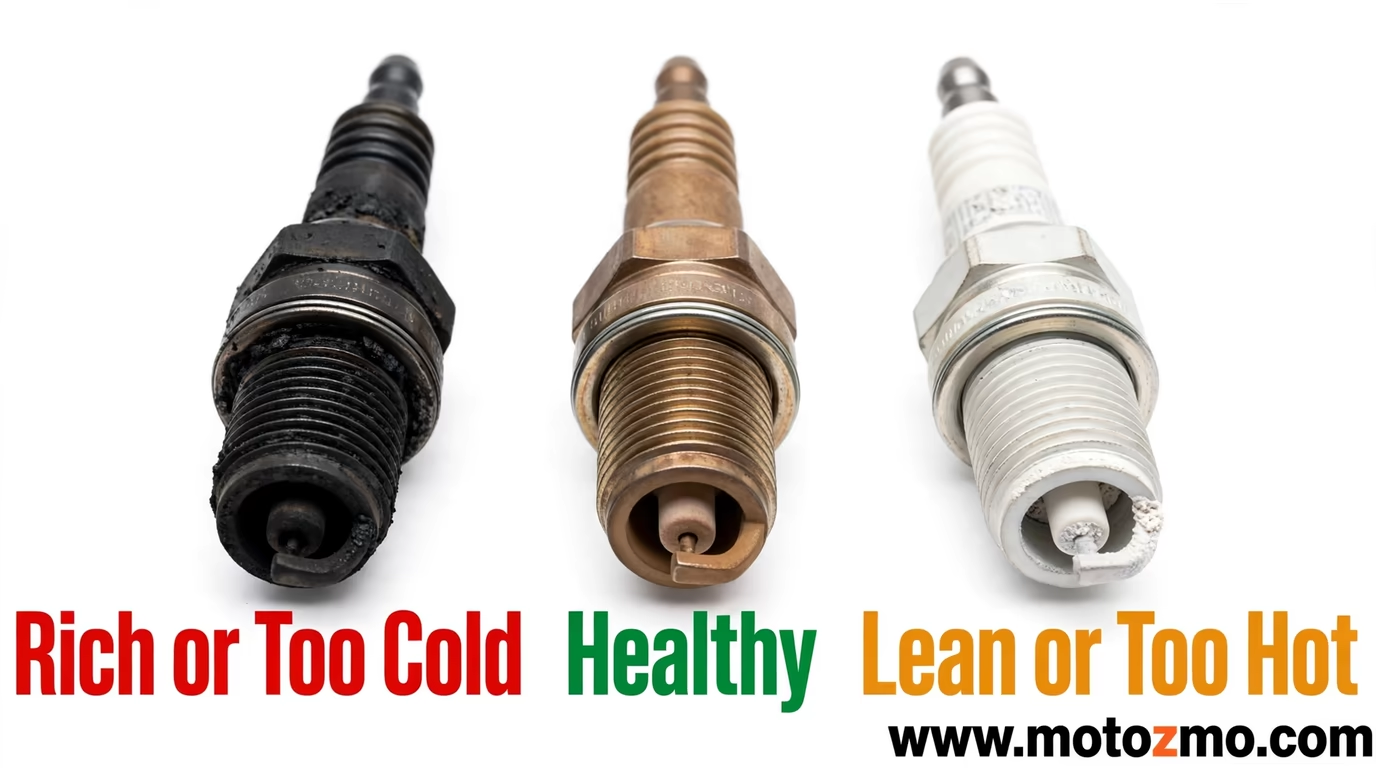
Color tells you more than mileage: a tan, light-brown insulator nose is a healthy engine, black dry soot means rich or a too-cold heat range, and white blistered ceramic means lean or a too-hot plug. Read the plug after a normal ride, not after idling in the driveway, or you will fool yourself.
What Are Misfires and Fouling Telling Me?
A plug that fouls in a week is not a bad plug; it is a plug telling you something. Carbon-fouled plugs with black soot point at too rich a mixture, a dirty air filter, or a heat range too cold for how you ride.
Short trips in cold weather are the classic case. White, blistered tips with tiny black specks point the other way: lean mixture or a heat range too hot. And if one cylinder fouls while the others look fine, suspect that cylinder’s coil or injector, not the brand of plug in it.
Before you throw plugs at a misfire, make sure the charging system is healthy, because a weak spark looks exactly like a bad plug. A quick check with a motorcycle voltage tester across the battery at idle and at revs will tell you in two minutes whether the coil is getting what it needs.
Loud pops on deceleration are a separate story. That is usually lean fueling or an exhaust leak, and I covered the causes in the motorcycle backfiring guide rather than here.
Who Should Not Buy Each Brand?
Neither brand is wrong, but each has a rider it fits poorly.
Skip the NGK Iridium IX if you ride a stock commuter and just want the longest interval between changes. The IX is the performance line with a nickel ground electrode; the Laser Iridium line with the platinum ground is the one built for long life, and it usually costs about the same.
Also skip NGK if your manual’s factory plug is a Denso with a specific projected tip. Swapping in an NGK of the “same” heat range does not copy the projection length, and projection changes where the spark sits in the chamber.
Skip the Denso Iridium TT if your bike’s charging system is marginal or your coils are old. The TT’s big selling point is a lower required firing voltage, which sounds like it would help a weak system, but in practice a worn coil with a fine-wire plug can produce a thin, weak spark that still misfires under load.
Fix the coil first. Also skip it if you cannot find the exact heat range for your bike. Denso’s motorcycle coverage is thinner than NGK’s in some markets, and a TT plug in the wrong heat range is worse than a standard plug in the right one.
My Verdict
After running both, I buy on heat range and availability, not on the badge. My daily commuter gets NGK Laser Iridium in the factory heat range because I want the longest change interval and NGK’s coverage means I can find it anywhere.
The bike I ride hard in summer heat gets a Denso Iridium TT one heat step colder than stock, because the twin-tip design holds up well at sustained high rpm and Denso’s wider scale makes that half-step move easy.
Best for: NGK Iridium IX CR8EHIX-9 if you want a proven motorcycle iridium plug at a fair price. Check the NGK Iridium IX CR8EHIX-9 on Amazon.
Best for: Denso Iridium TT IK20TT if you want the twin-tip design and longest rated life. Check the Denso Iridium TT IK20TT on Amazon.
Whichever you pick, cross-check the heat range against your manual using NGK’s guide to finding a colder or hotter plug, confirm the gap before installation, and buy from a seller you trust.
NGK’s market share has made it the most counterfeited plug on the internet. For a wider look at the whole shelf before you decide, the best spark plugs for motorcycles roundup covers the rest of the field.
Frequently Asked Question
My New Iridium Plugs Are Gapped at 0.044 Inch but My Manual Says 0.040. Should I Adjust Them?
Leave them alone. Four thousandths of an inch is inside the error of most feeler gauges, and both brands warn against re-gapping fine-wire iridium tips, since the electrodes are fragile and levering them can crack the tip. Forum mechanics I trust run the factory gap in that situation with no trouble. Only re-gap if the plug arrived visibly damaged from shipping, and even then stay within about 0.008 inch of the factory setting.