
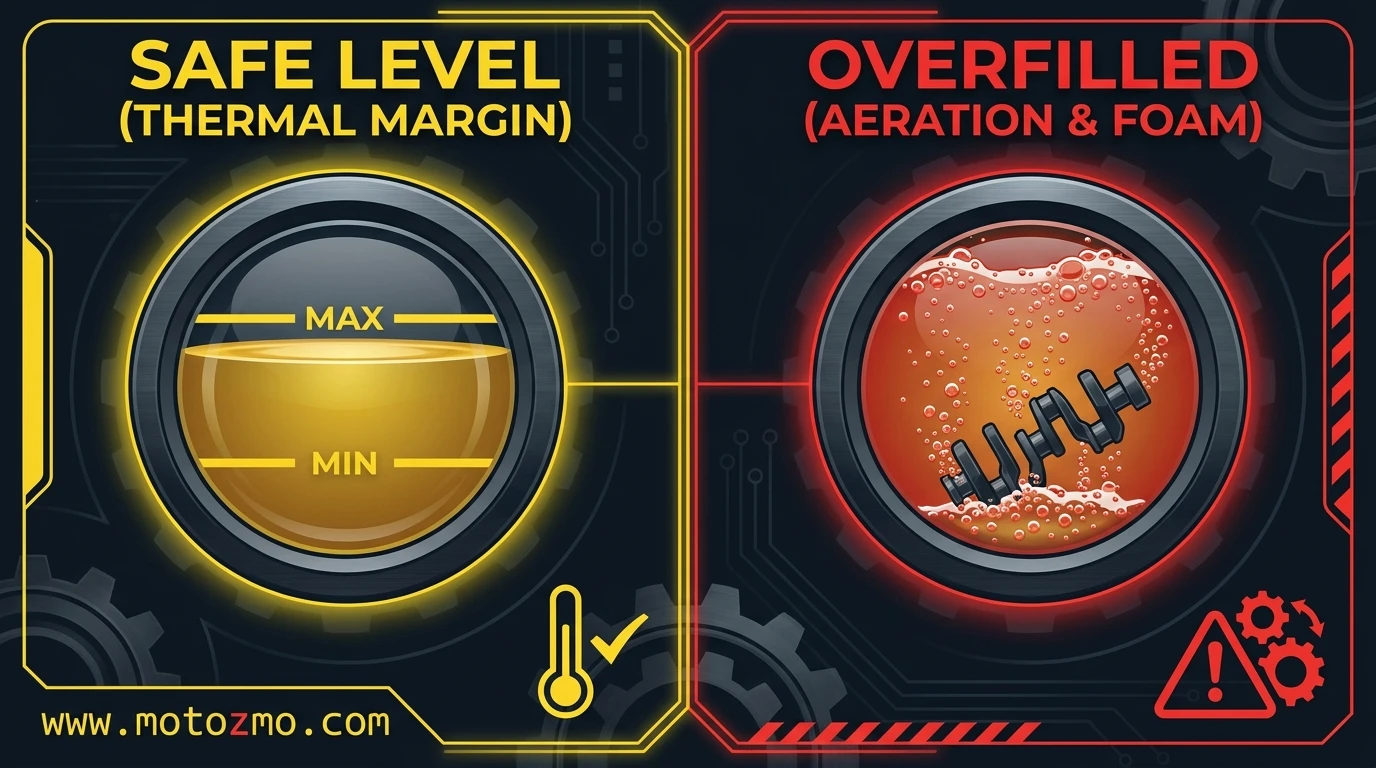
A few millimeters above the max mark on your dipstick or sight glass is normal and accounts for thermal expansion, but once you’re roughly a quarter to a third of a quart over that line, it’s worth draining the excess rather than waiting to see what happens.
Overfilled oil gets whipped into foam by the spinning crankshaft, and foam doesn’t lubricate the way liquid oil does. That raises pressure inside the crankcase, which pushes oil past seals and gaskets and up through the breather into the intake, where it gets burned or fouls a plug. On bikes with a wet clutch, which is most of them, foamy oil can also make the clutch slip, something that doesn’t have a real equivalent on the car side of this topic.
None of this happens instantly from a slight overfill, but it’s not something to shrug off either. Here’s how much oil your bike actually needs, what overfilling really does to it, and how to fix it if you’ve gone over.
For the full maintenance picture beyond just oil level, our motorcycle engine maintenance guide covers the rest of what keeps an engine running well.
Key Takeaways
- Safety Margin: A few millimeters above the “Max” mark (or full sight glass) is normal to account for thermal expansion.
- Danger Zone: Exceeding the max line by 1/4 to 1/3 quart (200–300 mL) introduces real risk of mechanical damage.
- The Mechanism: Excess oil gets whipped into foam by the crankshaft, reducing lubrication, raising crankcase pressure, blowing out seals, and causing wet-clutch slippage.
- Key Symptoms: Blue/white exhaust smoke, oil weeping from seals, grabby/slipping clutch, or fouled spark plugs.
- How to Fix: Level the bike on a stand, let the oil settle, then extract the excess through the fill tube with a syringe/pump or briefly loosen the drain plug.
How Much Oil Does Your Bike Need?
There’s no single number that applies across all motorcycles; capacity scales with engine size and design, and it varies more than most “3-4 quarts for every bike” advice suggests.
| Bike type | Typical oil capacity |
|---|---|
| Small commuter (100-150cc) | Roughly 0.8-1.3 quarts |
| Mid-size (250-600cc) | Roughly 1.5-3.5 quarts |
| Cruiser | Roughly 3-4 quarts |
| Large sport or touring (1000cc+) | Roughly 4-6 quarts |
Your owner’s manual has the exact figure for your specific bike, and it’s worth using that number over any general estimate, including the table above. A few motorcycles complicate this further: Harley-Davidsons, for instance, run three separate oil reservoirs, the engine, the transmission, and the primary chaincase, each with its own capacity and its own consequences for overfilling.
Overfilling the primary specifically is a well-documented cause of clutch slippage on these bikes, separate from anything happening in the engine itself.
What Happens When You Overfill
The oil pan or sump is only supposed to be partially full so the crankshaft spins through open air, not oil. Add too much, and the crankshaft starts dragging through the oil itself, whipping air into it and turning part of the reservoir into foam. Foam compresses instead of maintaining steady pressure, so it lubricates less effectively than the liquid oil it displaced.
That foaming also raises pressure inside the crankcase. The system has to vent that pressure somewhere, and it typically does so through the crankcase breather, which routes into the intake or airbox. Oil pushed through there gets pulled into the combustion chamber and burned, which shows up as smoke from the exhaust, or it settles on a spark plug and fouls it.
Sustained high pressure also finds the weakest seals and gaskets in the system and pushes past them, which is where an overfill turns into an actual oil leak rather than just a performance problem.
On a wet-clutch motorcycle, where the clutch shares oil with the engine and transmission, foamed oil doesn’t grip the clutch plates as well as it should. That shows up as a clutch that slips or feels grabby even with normal lever pressure, a symptom that’s specific to how most motorcycles are built and doesn’t come up in overfill advice written for cars.
None of this happens the instant you overfill by a small amount; a bike can run for a while on oil that’s a bit too full before symptoms show up clearly. That’s different from saying it’s fine, though. The damage compounds with time and mileage, not all at once.
Symptoms of Overfilled Oil
| Symptom | Why it happens |
|---|---|
| Blue or white smoke from the exhaust | Oil pushed through the breather into the intake is being burned in the combustion chamber |
| Oil weeping from gaskets or seals | Crankcase pressure is forcing oil past the weakest seal points |
| Burning oil smell | Oil reaching hot exhaust components or burning in the chamber |
| Rougher or unstable idle | Foamed oil isn’t lubricating consistently, or oil has fouled a spark plug |
| Clutch that slips or feels grabby (wet-clutch bikes) | Foamed oil reduces friction between the clutch plates |
| Oil stains under the bike after parking | A seal has already started leaking from sustained pressure |
If you’re seeing more than one of these at once, especially smoke plus a leak, that’s a stronger signal than any single symptom alone.
How Much Over Is a Problem?
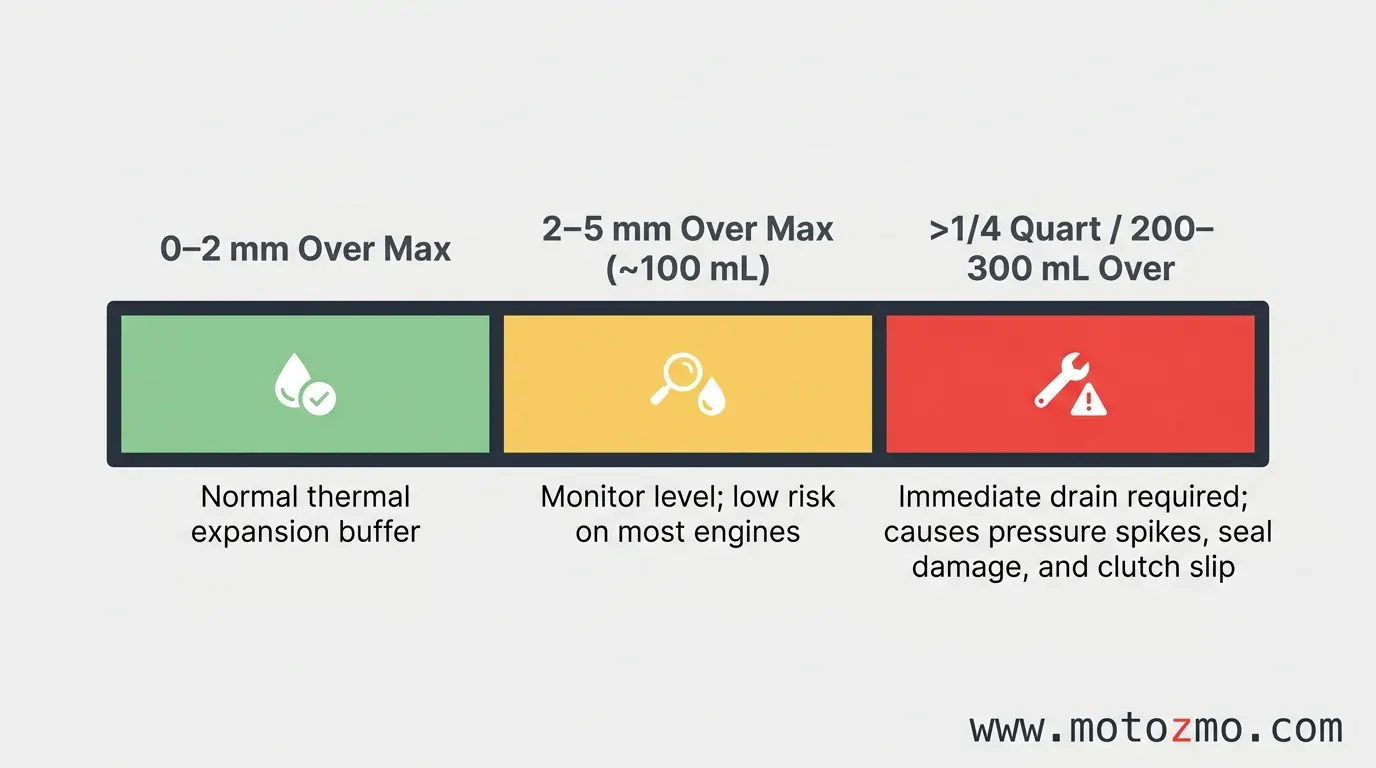
A small margin above the “full” mark is intentional, not a mistake. Oil expands as it heats up, and manufacturers build in a bit of headroom in the dipstick or sight glass range specifically to handle that expansion without pushing oil out through the breather during normal riding. A few millimeters above the top line, or filling to the very top of a sight glass window, is usually within that margin.
Where it becomes an actual problem is somewhere around a quarter to a third of a quart over the max line, roughly 200-300ml if your bike’s spec is in metric.
Past that point, you’re not looking at expansion headroom anymore, you’re looking at excess volume that has nowhere to go but foam, pressure, and eventually a seal.
How to Fix It
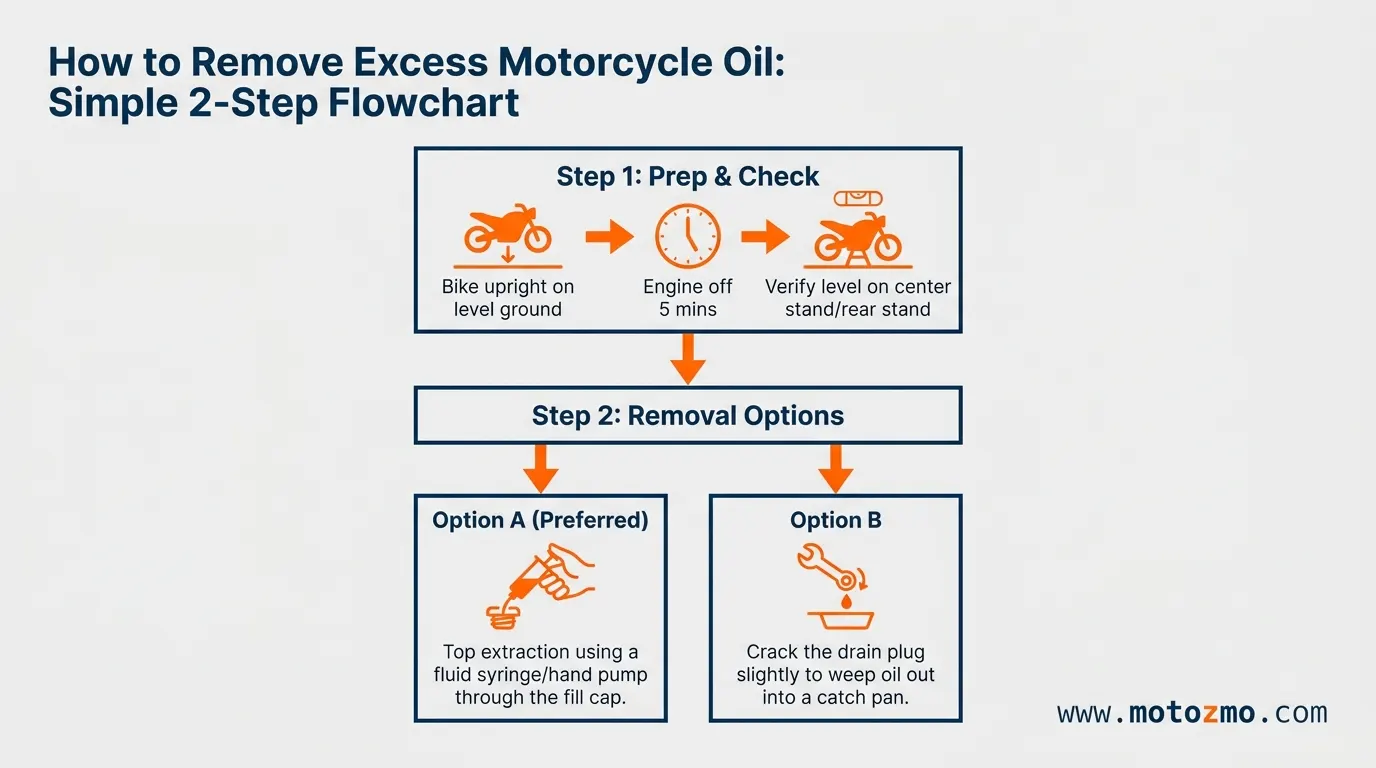
- Let the bike sit level for a few minutes so oil settles fully into the sump before you check or drain anything; a reading taken right after riding, or with the bike leaning on its side stand, isn’t reliable.
- Drain a measured amount through the drain plug. This is the cleanest method: place a container underneath, remove the plug, let out roughly the amount you estimate you’re over by, and reinstall with a fresh crush washer if your bike uses one.
- Or pull oil out through the fill hole with a hand pump or large syringe if you’d rather not drain and refill from scratch. This works well for small corrections and avoids losing more oil than necessary.
- Avoid tipping the bike to drain oil back out the fill tube. It’s imprecise, messy, and easy to overcorrect into an underfill.
- Recheck the level with the bike upright and level, engine off, after letting it settle again.
- Start the engine and idle it for a minute or two, then shut it off, wait, and check the level one more time before considering it done.
Preventing It Next Time
Measure before you pour rather than eyeballing it from the bottle. Add oil in stages, especially the last portion, checking the dipstick or sight glass between additions instead of dumping in the full amount at once. Factor in whether you’re also replacing the filter; leaving the old filter in place typically needs a bit less oil than installing a new one; the exact difference varies by bike and filter size, so check your manual rather than assuming a fixed amount.
If you’re doing a full oil change rather than just correcting a level, our guides to how often to change motorcycle oil, changing it yourself, and DIY vs shop oil change costs cover the rest of it. If you’re choosing oil for hot climates or a specific engine type, best motorcycle engine oil for hot weather and best 4-stroke motorcycle engine oil are worth a look too.
FAQs
What are the effects of overfilling motorcycle oil?
Overfilled oil foams as the crankshaft whips through it, which weakens lubrication, raises crankcase pressure, and pushes oil past seals and gaskets. On wet-clutch bikes, it can also make the clutch slip since foamy oil grips less effectively.
Can you ride a motorcycle with too much oil?
Not safely for long. A slight overfill of a few millimeters usually just vents out through the breather over a short ride. A significant overfill risks seal damage, fouled plugs, and clutch slippage the longer you keep riding on it.
How do you fix too much oil in a motorcycle?
Remove the drain plug and let a measured amount out into a container, or pull oil out through the fill hole with a syringe or hand pump, then recheck the level. Avoid tipping the bike to drain from the fill tube; it’s messier and less precise.
What are symptoms of too much oil in a motorcycle?
Blue or white smoke from the exhaust, oil weeping from gaskets or seals, a burning oil smell, a rougher idle, and on wet-clutch bikes, a clutch that slips or feels grabby even with normal lever pressure.
How much oil is actually too much?
A few millimeters above the max mark is normal thermal expansion room. Once you’re roughly a quarter to a third of a quart over that line, drain the excess rather than waiting to see what happens.
Does the oil filter change how much oil I need?
Yes. Leaving the old filter in place needs slightly less oil than installing a new one, typically a few tenths of a quart less, since a fresh filter has to fill with oil too. Check your manual for the exact difference on your bike.