
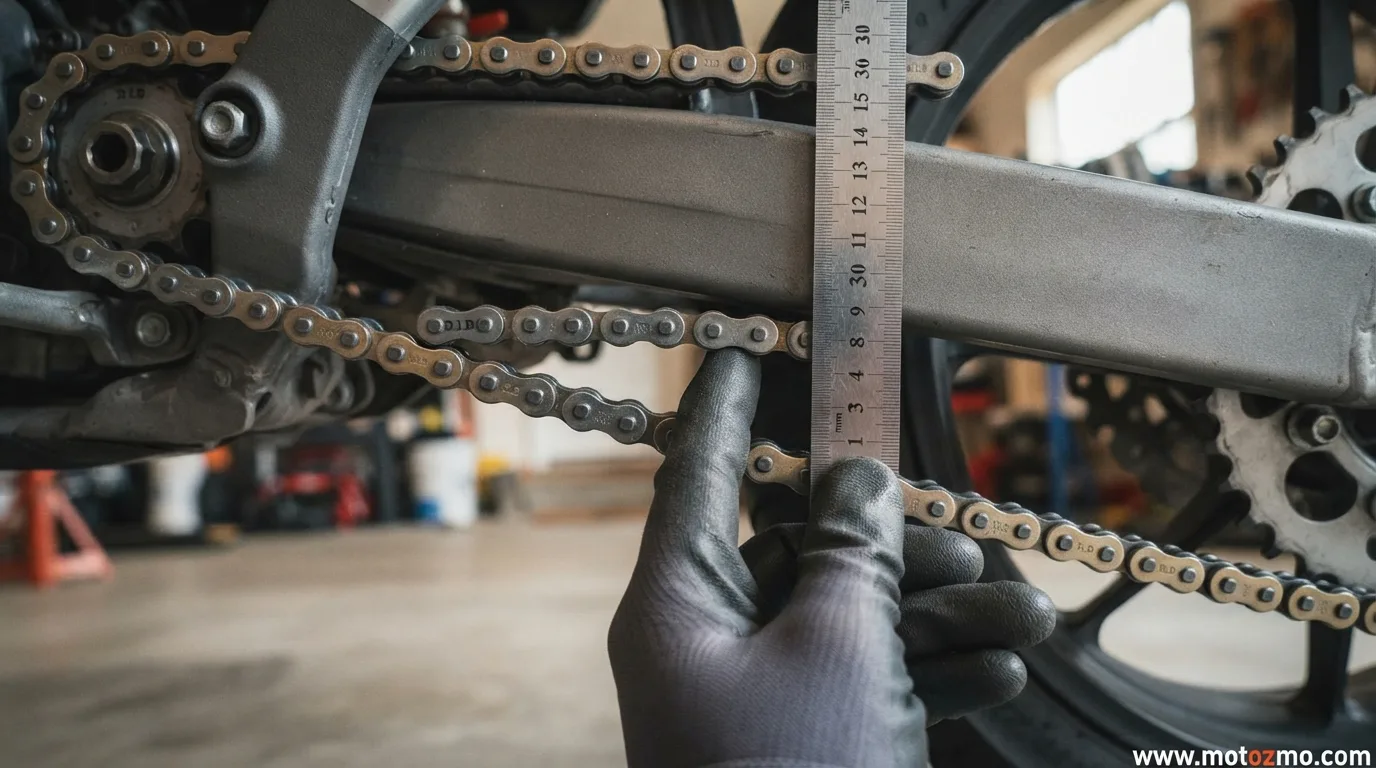
A skipping or consistently slack chain almost always means one of three things. The chain has stretched past its usable life. The sprockets have worn into a shape that no longer grips cleanly. Or the two no longer match each other. Once that’s true, cleaning and adjusting won’t fix it. Only replacement will.
That’s not the case with every bit of slack, though. Telling the two apart before you spend money is what this guide is built to do. Here’s how to separate a simple maintenance gap from a real wear signal, and when to commit to replacement.
Key Takeaways
- A chain that holds spec after a clean, lube, and adjustment is a maintenance gap, not a failure. No replacement needed yet.
- Slack that returns within days, or a chain with a visibly tighter section, is real wear. Cleaning and adjusting won’t fix it.
- Normal chain slack is typically 1–1.2 inches (25–30mm) at the tightest point. Always confirm against your owner’s manual.
- Replace signs include slack returning fast, no room left on the adjuster, rust or stiff links, and hooked, shark-fin sprocket teeth.
- A skipping or broken chain can lock the rear wheel or whip loose and damage the swingarm. It’s a real safety risk, not just an inconvenience.
- When it’s time to replace, do the chain and sprockets together because a new chain on worn sprockets wears out fast.
Is This Actually a Cleaning/Tension Problem, or Real Wear?
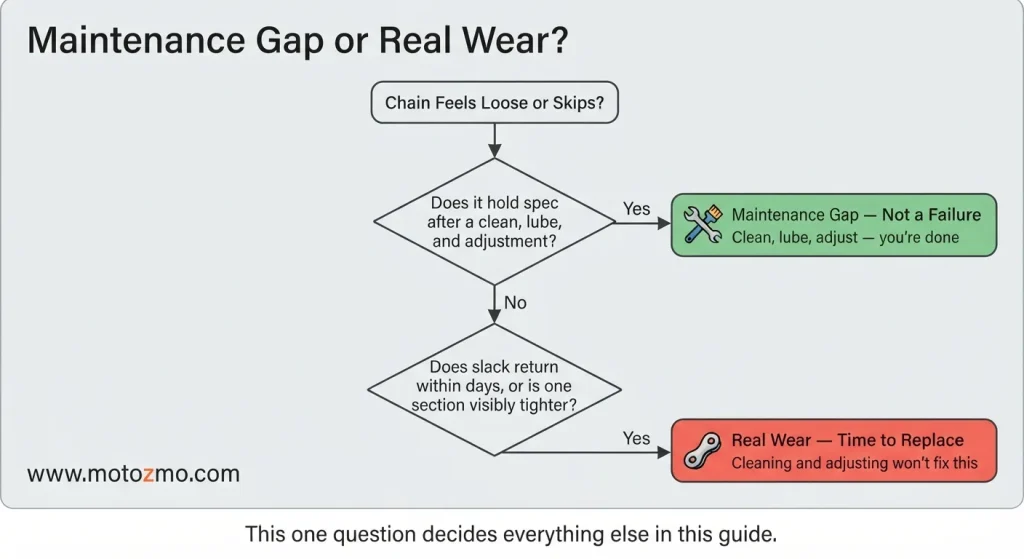
This one question decides everything that follows. Slack that responds normally to a standard tension adjustment, and that stays put after a proper clean and lube, is routine maintenance. It’s not a failure of anything. Every chain-driven motorcycle needs this periodically. It doesn’t mean something is wrong.
The real warning signs look different. Slack that returns within days of an adjustment you just made. A chain with one section that’s visibly tighter than the rest as you rotate the rear wheel by hand, commonly called a “tight spot.” Those aren’t maintenance gaps. They’re wear signals, and no amount of cleaning or adjusting will make them go away.
If what you’re dealing with is just buildup, grime, or an overdue adjustment, here’s how to properly clean and adjust it before you assume the worst. The rest of this guide is for the chains that don’t respond to that.
Why Chains Actually Skip: The Real Causes
Chain Stretch
Chains don’t stretch in the rubber-band sense. What happens is internal wear at the pins and bushings, which gradually elongates the chain’s effective pitch (the distance between each link).
Once that pitch grows enough, the chain no longer meshes cleanly with the sprocket teeth. It starts to skip or jump under load instead of gripping.
Worn or “Hooked” Sprocket Teeth
Sprocket teeth wear unevenly over time. They take on a shark-fin, hooked profile instead of their original straight shape. A hooked tooth doesn’t hold the chain the way a healthy one does. It lets the chain climb and jump instead.
Worse, a hooked sprocket will chew through a brand-new chain quickly if you replace the chain alone and leave the old sprockets in place.
Mismatched Chain and Sprockets
Putting a new chain on old, worn sprockets, or the reverse, throws off the pitch match between the two parts. That mismatch speeds up wear on both components at once. It turns what should have been a straightforward chain replacement into a much shorter-lived fix.
How Much Slack Is Actually Normal
There’s no single universal number here. Any guide that gives you one flat figure without a caveat is oversimplifying. Typical street bike chain slack falls in roughly a 1 to 1.2-inch (25–30mm) range at the tightest point. Dirt bikes with longer suspension travel commonly run looser. Your specific bike’s owner’s manual, not a general rule, is always the final word.
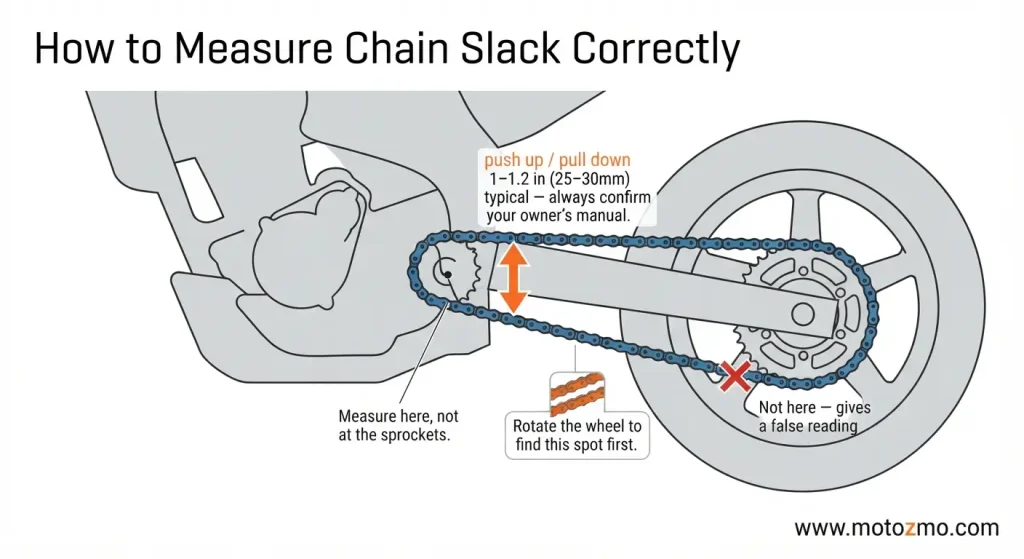
To measure correctly, rotate the rear wheel until you find the tightest section of chain. Then measure the vertical play at the midpoint of the lower chain run, between the front and rear sprockets.
Measuring at any other point, or at the loosest section instead of the tightest, will give you a false reading and risks over-tightening the rest of the chain.
Warning Signs That Mean Replace, Not Adjust
A handful of specific signs mean you’ve moved past maintenance:
- Slack that returns within days of adjustment. A properly adjusted chain shouldn’t need attention again almost immediately.
- A chain that won’t pull back to spec even at the tightest adjuster position. There’s no more room left to compensate for the wear.
- Visible rust, or a stiff/frozen link that doesn’t loosen when you flex it by hand.
- Hooked sprocket teeth, visible on a direct inspection of the front or rear sprocket.
Any one of these on its own is a real signal, not a coincidence.
Why You Shouldn’t Ignore This
This isn’t just an inconvenience. Take it seriously. A chain that skips or breaks under load can jam between the sprocket and swingarm, instantly locking the rear wheel. That’s a sudden, uncontrolled skid, especially dangerous mid-corner or at highway speed.
Even short of a full lockup, a chain that whips loose after breaking can strike the swingarm, engine cases, or wiring hard enough to cause real damage beyond the chain itself.
This isn’t a hypothetical worst case, either. Transport Canada’s own recall documentation for a drive chain defect on certain motorcycles states plainly that a snapped chain trapped between the wheel and frame can lock the rear wheel and lead to a loss of control and a crash. A skipping or badly worn chain is a genuine safety issue, not something to get around to eventually.
Replace the Chain and Sprockets Together
Nearly every credible source agrees on this. A new chain paired with worn sprockets, or the reverse, causes rapid, mismatched wear on whichever part you didn’t replace.
Replacing the chain and both sprockets together, at matching pitch, is the standard, cost-effective approach. It avoids paying for a new chain twice within a short window. The chain and sprocket kits we’d trust covers what to buy once you’ve confirmed replacement is necessary.
Choosing a Replacement Chain: O-Ring, X-Ring, or Standard
Once you’re buying a new chain, the seal type matters more than almost any other spec. It’s the difference between a chain that holds its factory lubrication for thousands of miles and one that needs constant attention. Standard, non-sealed chains are lighter and cheaper but wear faster.
O-ring and X-ring designs trap lubricant inside the chain using small rubber seals at each pin, which greatly extends service life at the cost of a bit more weight and friction. Which chain type actually fits your bike breaks down the real tradeoffs in depth rather than repeating them here.
Keeping the New One From Wearing Out Early
A new chain and sprocket set is only as good as how you maintain it afterward. Regular cleaning matters. Don’t skip it just because everything’s new.
Pair that with the right lubricant for your actual riding conditions, and you keep a fresh chain from repeating the exact wear pattern that got you here. The lube that keeps it lasting covers what to use and how often.
The Bottom Line
The split that matters is simple. If your chain responds normally to a clean, lube, and adjustment, you likely don’t need to spend a dollar yet. If the slack keeps coming back, a section feels noticeably tighter than the rest, or you can see hooked sprocket teeth, that’s real wear. Only replacement fixes it. When you get there, the chain and sprocket kits we’d trust, and which chain type actually fits your bike are the two next steps worth reading.
FAQs
How much slack should a motorcycle chain have?
Typically 1 to 1.2 inches (25–30mm) at the tightest point for most street bikes, though this varies by model. Always confirm against your owner’s manual rather than assuming a universal number.
How many miles does a motorcycle chain typically last?
It varies a lot based on riding conditions, chain type, and maintenance habits. A well-maintained O-ring or X-ring chain can last much longer than a neglected one, but there’s no single reliable mileage figure that applies across all bikes and riding styles.
Can I replace just the chain and not the sprockets?
Technically yes, but it’s not recommended. Pairing a new chain with worn sprockets speeds up wear on the new chain, often forcing a second replacement much sooner than expected.
Is a skipping chain dangerous to keep riding on?
Yes. A chain that skips or fails under load can lock the rear wheel or whip loose and strike the swingarm, engine cases, or wiring. That’s a genuine safety risk, not just a mechanical inconvenience.
Why does my chain keep needing adjustment?
If it needs re-adjusting again within days of a proper adjustment, that’s usually a sign of real wear, either chain stretch or worn sprockets, rather than a normal maintenance interval.