
Both O-ring and X-ring chains are sealed chains. They trap factory-packed grease inside the pins and bushings. The only real difference is the shape of that internal seal, and that shape changes how much friction and sealing surface you get, and how long the chain lasts.
An O-ring uses a simple round seal. An X-ring uses a seal shaped like an X. It twists instead of flattening under load. That is why X-ring chains usually run smoother and last much longer than O-rings. You pay more for that, though. On a smaller commuter bike, you may never need it. Below, you’ll see what’s different, how each one feels on your bike, and which type fits your riding. Not just the one with the fancier name.
Key Takeaways
- O-ring and X-ring chains are both sealed chains. The only real difference is the shape of the internal seal.
- X-ring seals twist under load instead of flattening, which cuts friction and roughly doubles service life versus O-ring.
- O-ring chains are simpler, cheaper, and genuinely sufficient for commuters and smaller-displacement bikes (125–300cc).
- X-ring chains cost more ($150–$250+) but pay off on high-mileage, high-displacement, touring, and ADV/mud-and-water riding.
- Sealed chains still need external cleaning and lube. The seal only protects the internal pins and bushings, not the outside.
- Always replace the sprockets alongside a new chain so the pitch stays matched.
O-Ring vs. X-Ring at a Glance
| O-Ring | X-Ring | |
|---|---|---|
| Seal shape | Circular | X-shaped |
| Friction | Standard | Lower |
| Typical service life | Baseline | Up to ~2x longer |
| Price | Lower | Higher |
| Best for | Commuters, smaller-displacement bikes, budget-conscious riders | Higher-displacement bikes, touring, ADV/mud & water crossings, high mileage |
How Sealed Chains Work (and Why They Beat a Standard Chain)
Almost every chain sold today is a sealed chain, apart from those on small commuter bikes. A small rubber ring sits between the inner and outer plates at every pin joint. It locks in the grease packed in at the factory. It also keeps road grit and water out of the pins and bushings, the one place your chain can’t handle contamination.
That’s very different from an old-style unsealed roller chain. That kind depends on you keeping it clean and freshly lubed. Skip it and metal-on-metal wear stretches the chain within a few thousand miles.
Sealing doesn’t mean you can ignore your chain, though. It just changes what needs your attention. The seal protects the internals. But the outside of the chain, the rollers, and the sprockets still pick up dust and grime.
So regular cleaning and lubing is still part of the job. And if slack keeps coming back no matter how often you adjust it, that’s usually not a sealing problem. Check how to tell if it’s time to replace before you spend money on either chain below.
O-Ring Chains: The Original Sealed Design
An O-ring chain uses a round rubber ring squeezed between the link plates. It’s simple and proven. According to D.I.D’s technical breakdown, from one of the makers that pioneered sealed-chain technology, it’s still a solid choice for durability and low maintenance. Not just a budget compromise.
The tradeoff is shape. Because the ring is round, it flattens between the plates instead of keeping its natural cross-section. That creates one wide contact band and a bit more internal friction than the X-ring below. In practice, you won’t feel that on a 300cc commuter or a weekend cruiser. The loads and speeds are too low to punish that extra friction.
A liter-bike or a high-mileage tourer would be a different story. If you ride to work in the rain a few days a week and want a chain that just works without a big price tag, a quality O-ring does the job.
X-Ring Chains: What the “X” Shape Buys You
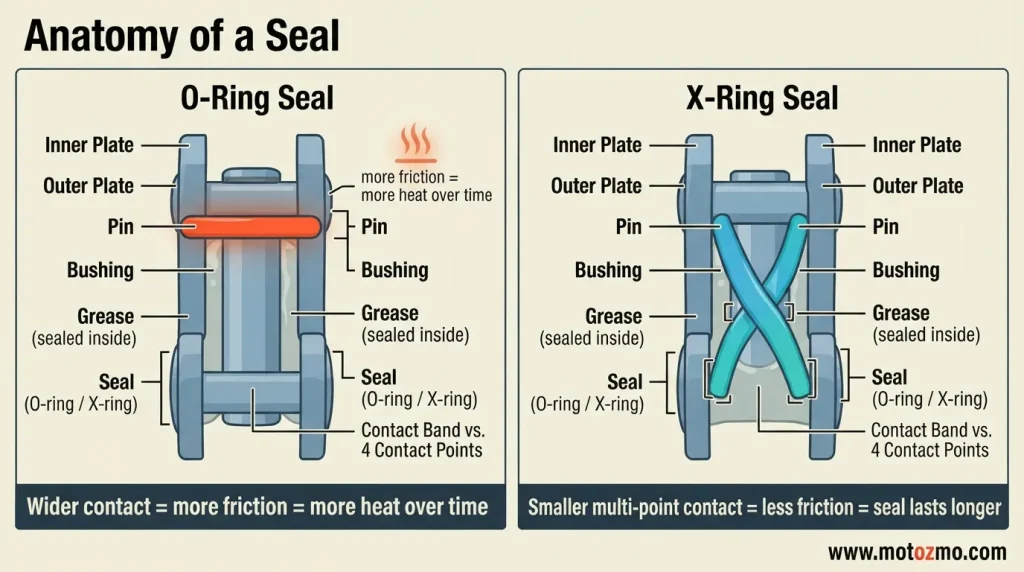
An X-ring chain uses the same core idea, a rubber seal at every pin joint, but shaped like an X instead of a circle. Under the same compression, that shape twists rather than flattens. It creates several small contact points instead of one wide band.
Less material dragging against the plates means less friction. That lower friction at the seal is where an X-ring’s extra life comes from. It isn’t marketing. It’s a direct result of the shape.
You’ll feel this on the bike, not just read about it on a spec sheet. Less internal drag shows up as smoother, more direct throttle response. You get less of the snatch and lash you feel rolling on and off the gas hard through a canyon or in stop-and-go traffic.
And because the seal holds up longer under load, an X-ring is the one to have if you rack up miles fast. Think a sport-touring bike on the interstate, or an adventure bike through water crossings and gravel, where a worn seal would let grit in fast.
Is “Lasts Twice as Long” Real, or Just Marketing?
It’s a real claim, grounded in the mechanics. Less friction at the seal means less heat there over the life of the chain. Heat is what breaks down grease and hardens rubber seals over time. Slow that breakdown, and the chain keeps its factory grease and its flexibility for longer.
Manufacturer testing often cites about double the service life of an X-ring over a comparable O-ring. That matches what independent chain shops and repeat buyers report too.
Price and Weight: What You’re Paying Extra For
That extra service life isn’t free. X-ring chains usually cost more than a comparable O-ring. They can weigh a touch more too, thanks to the more complex seal and heavier-duty build. RevZilla’s buying guide puts premium X-ring and similar advanced-seal chains in the range of about $150 to $250-plus. That’s well above a basic O-ring chain.
Whether it’s worth it comes down to simple math. If you only put a few thousand easy miles a year on a small bike, you may replace an O-ring before the price gap ever matters.
If you rack up serious mileage, ride hard, or run the chain through mud and water often, the X-ring’s longer life and lower wear on your sprockets can pay for itself.
Which One Fits Your Bike and Your Riding
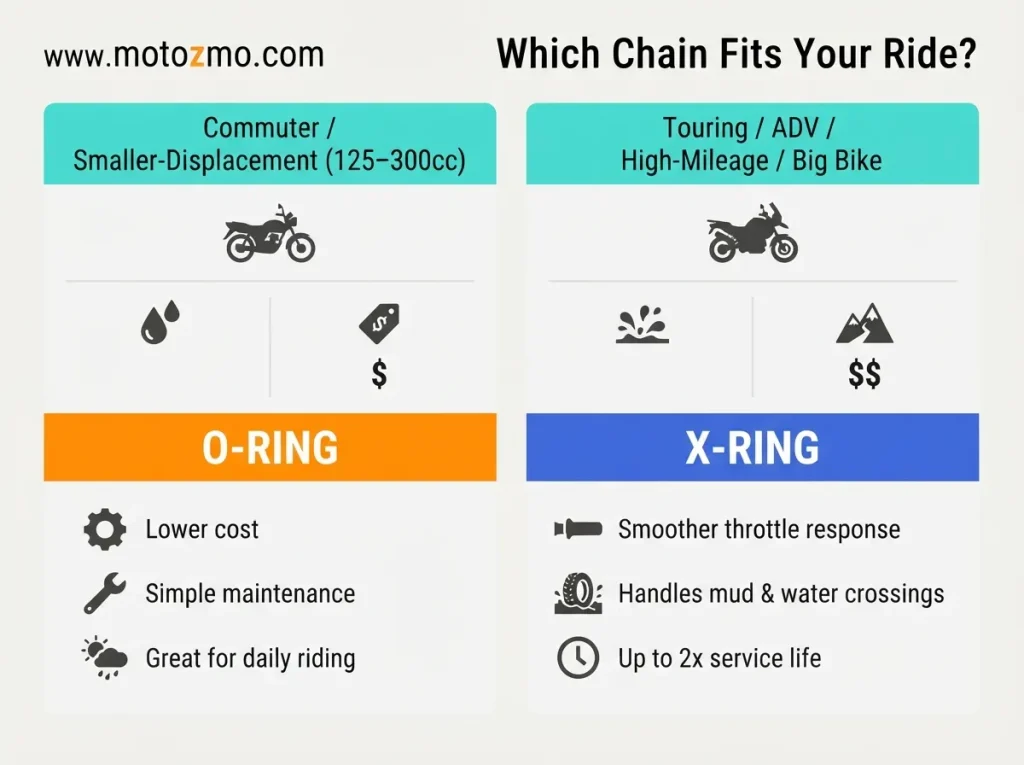
If you ride a commuter or smaller bike (roughly 125–300cc): the loads and heat on your chain are modest. A quality O-ring chain from a good brand is enough. You lose little performance or lifespan by skipping the X-ring premium.
If you ride something bigger, tour long distances, or take an adventure bike through mud and water crossings: the X-ring’s better sealing and longer life are worth the money. It’s also the type most bigger bikes ship with from the factory, for this reason.
Whichever type fits you, plan to replace the sprockets at the same time, at a matching pitch. See the full kits built around each type rather than pairing a new chain with worn sprockets. Once it’s installed, the right lube for either type protects the outside of the chain without breaking down the seal underneath.
Bottom Line
The real question isn’t which chain is better. It’s which one matches what you ride. An O-ring chain is a smart, low-cost pick for a commuter or lighter bike. An X-ring earns its higher price on bigger bikes, longer mileage, and rougher conditions. Match the chain to your riding, and either sealed option will treat you well.
FAQs
Do I still need to lube a sealed chain?
Yes. The seal protects the pins and bushings inside. But the outer rollers and plates are still exposed to grit and grime. External cleaning and lubing still matter for a long service life.
Can I put an X-ring chain on a bike that came with an O-ring chain?
Usually yes, as long as the pitch, length, and tensile rating match your bike’s specs. Check your owner’s manual or a parts fitment chart before you buy.
Which one holds up better in wet weather?
Both are sealed and handle rain well. The X-ring’s better seal gives it a slight edge in water crossings and long wet rides. But neither type is a poor choice in the rain.
Is X-ring worth it for a small commuter bike?
Not usually. The lower loads and mileage on most commuter chains rarely justify the extra cost. A quality O-ring chain will easily outlast your riding needs.