
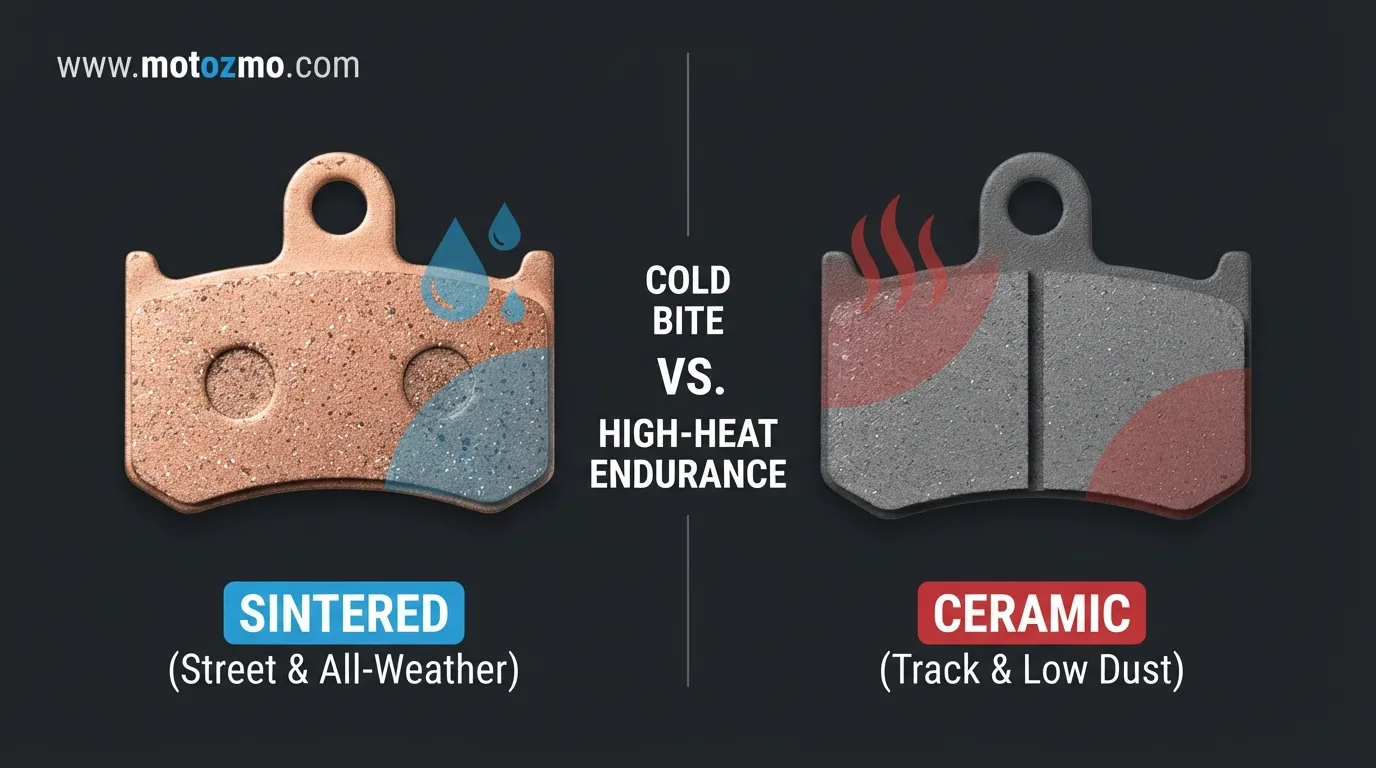
Sintered brake pads are the right default for the overwhelming majority of street and all-weather riders. Ceramic isn’t a straightforward upgrade over sintered; it’s a different tool built mainly for track and racing use, where sustained heat and minimal dust matter more than fast, cold bite.
If you’ve seen ceramic marketed as the “premium” option and assumed it’s simply better, that’s the exact assumption worth correcting before you spend the extra money.
Below, you’ll see how each one actually works, why sintered wins for most riding you’ll actually do, and the specific conditions where ceramic genuinely earns its keep.
Key Takeaways
- Sintered is the Ideal Street Default: Fused copper-alloy particles deliver immediate, high cold friction (0.4-0.6) and strong initial bite, essential for stop-and-go commuting and wet weather.
- Ceramic Requires Heat to Shine: Ceramic compounds need repeated heat cycling to perform at their peak; cold street performance feels modest and offers no braking advantage over sintered.
- Rotor Myths Cleared Up: Modern motorcycle brake rotors are stainless steel (unlike traditional cast-iron car rotors) and engineered specifically to handle sintered pad wear.
- Where Ceramic Earns Its Keep: Ceramic pads are best suited for track days, aggressive high-heat circuit riding, or riders prioritizing low dust and quiet operation over cold bite.
How Sintered and Ceramic Brake Pads Work
Sintered pads are made from metal particles, commonly a copper alloy, fused together under intense heat and pressure. That process gives them a strong 0.4 to 0.6 friction coefficient and excellent heat tolerance, which is why they’re the OEM default on the vast majority of modern motorcycles.
Ceramic pads combine ceramic fibers and copper fibers, also bonded under high heat and pressure, but the result runs a more moderate friction coefficient with noticeably less dust. The tradeoff for that cleaner, quieter operation is a pad that needs more heat cycling to reach its best performance than sintered does.
Why Sintered Wins for Most Street Riders
Street riding means braking constantly from cold, at a stoplight, into a corner, in traffic, long before any pad has had a real chance to heat-cycle.
Sintered’s fast, consistent bite from a cold start, combined with reliable performance in wet or muddy conditions, is exactly what everyday and all-weather riding demands. It’s the same reason matching your tire tread to the conditions you actually ride in matters as much as picking the right pad, the parts that touch the road need to match how and where you ride, not a spec sheet.
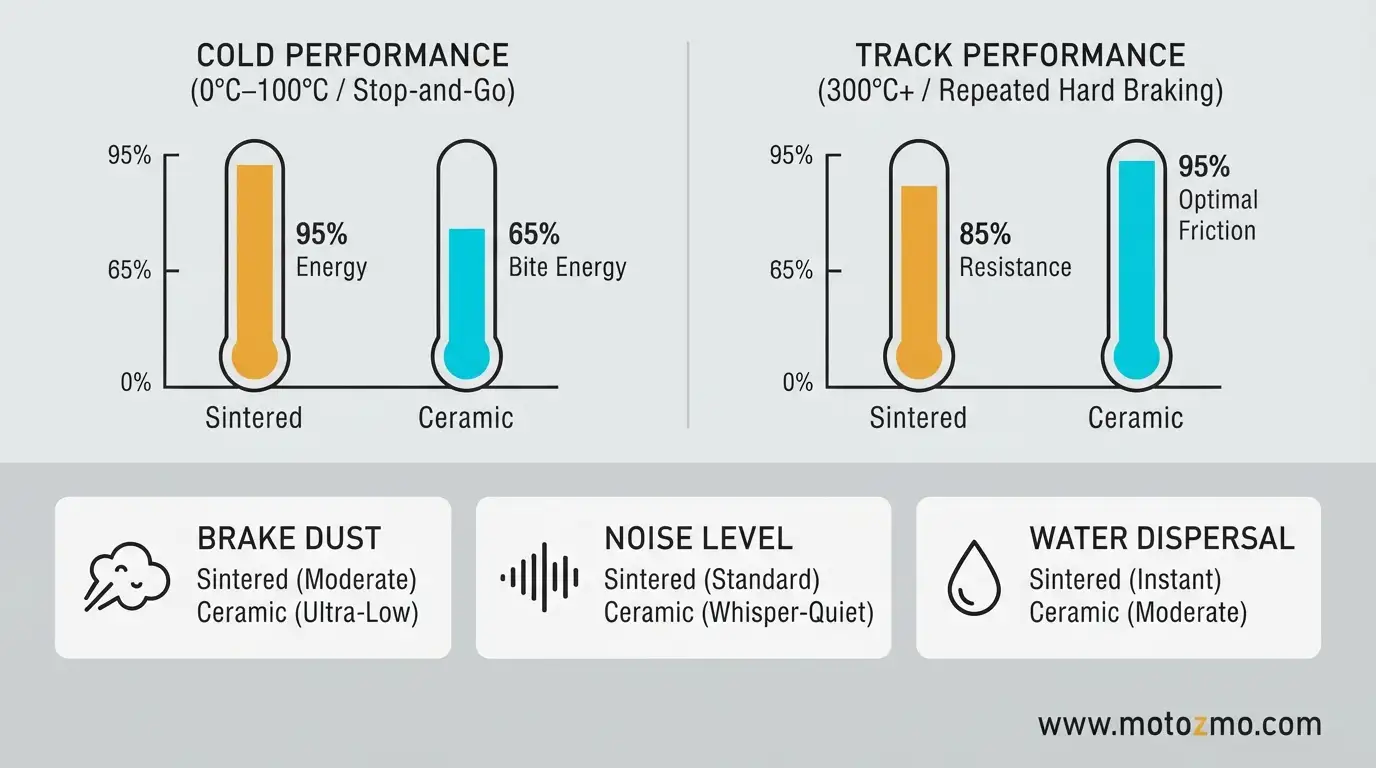
GBrakes’ own breakdown of sintered performance confirms this directly for motorcycles specifically: sintered compounds disperse water quickly from the metallic surface and resist heat-related fade, which is exactly why they’re the default for spirited street riding, long descents, and wet-weather commuting alike.
Why Ceramic Isn’t Simply “The Premium Option”
This is the assumption worth correcting. Ceramic costing more doesn’t automatically make it the better pad for you; it makes it a different pad, tuned for a different job.
Ceramic needs noticeably more heat cycling to reach its best, most consistent performance than sintered does, which is a real drawback for street riding, where you’re braking hard from cold constantly rather than through a sustained series of laps.
Motorcycle.com’s own hands-on test of a comparable ceramic pad found exactly this in practice: swapping in ceramic pads produced only a modest improvement over stock street performance, and both the stock and ceramic pads showed real fade under hard braking from higher speeds. That’s not a knock-on ceramic; it’s a sign the pad was never built to solve the problem most street riders actually have.
Where Ceramic Earns Its Keep
Ceramic makes real sense in a narrower set of conditions: sustained track and racing use, where consistent heat cycling plays to its strengths instead of working against it; riders who genuinely prioritize minimal brake dust and quieter operation over outright cold bite; and anyone chasing a cleaner, quieter daily ride over maximum stopping power.
Price, Noise, and Rotor Wear
Ceramic costs more upfront, runs quieter, and visibly produces less dust on your wheels. Sintered can be a little noisier, especially in wet conditions, and its harder composition does wear rotors somewhat faster over time, the tradeoff for its all-weather consistency.
One correction worth making here: car-ceramic marketing leans hard on “gentler on your rotors,” and that comparison was built around cast-iron car rotors.
Most motorcycle rotors are already stainless steel, specifically engineered to pair well with sintered pads in the first place, so the rotor-protection argument that sells ceramic pads on a car doesn’t carry over to a bike with anywhere near the same weight.
If rotor wear is genuinely your deciding factor, know that the baseline you’re comparing against is already a harder, more wear-resistant material than what ceramic car pads were designed to go easy on.
Which One Fits Your Riding
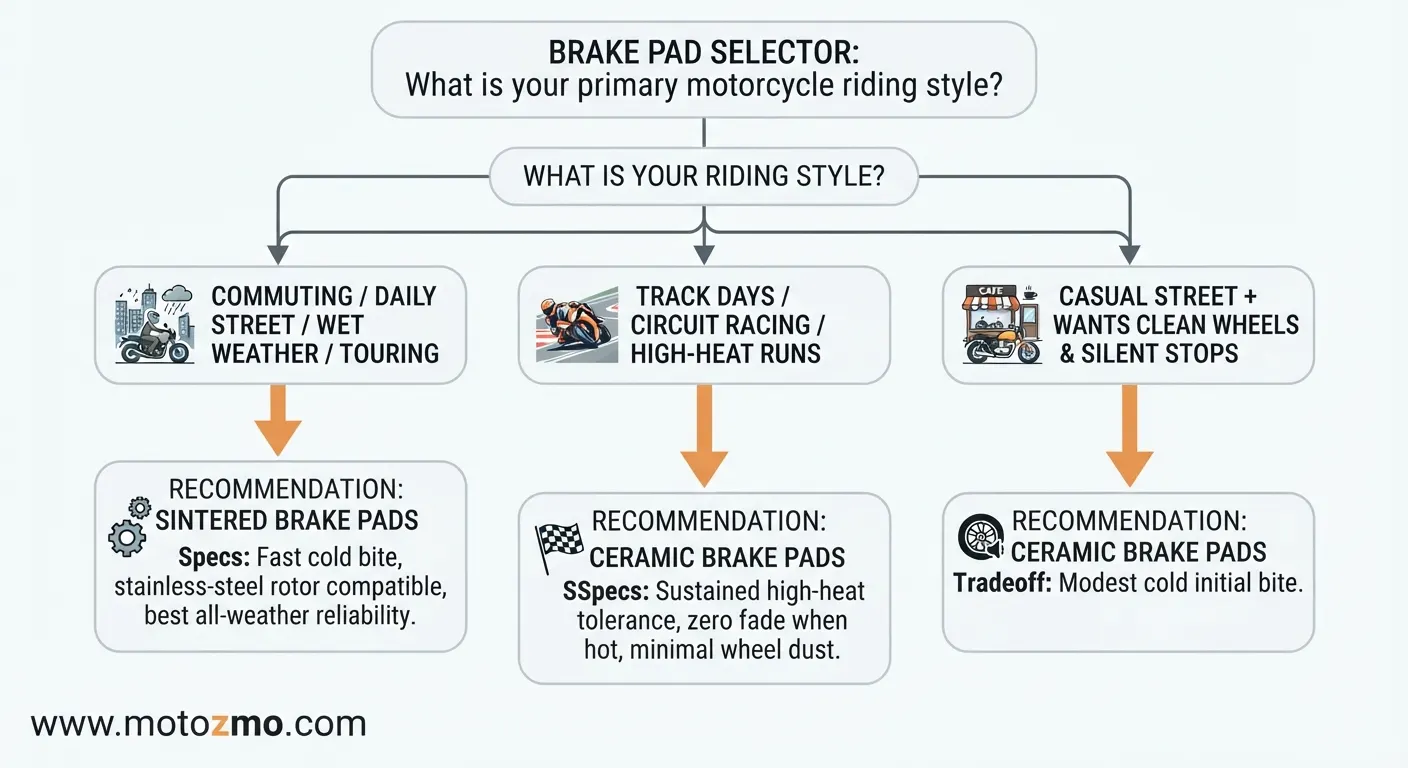
Daily street riding, commuting, touring, mixed weather: sintered is the right default, and it’s what most bikes ship with for good reason.
Dedicated track use, or a genuine priority on quiet, low-dust operation over outright cold bite: ceramic is worth considering.
Whichever direction you land on, see the full sintered and ceramic picks for specific pads worth buying in each category.
Bottom Line
Sintered remains the right call for nearly all street and all-weather riding, fast, consistent bite matters more day to day than the cleaner wheels and quieter stops ceramic offers. Ceramic earns its place only in a narrower set of conditions: sustained track use, or a genuine priority on dust and noise over cold bite. If you’re still not sure your pads even need replacing yet, start here before you buy either one.
FAQs
Is ceramic really better than sintered for a motorcycle?
Not automatically. It’s better suited to sustained track use and dust-sensitive riders. Sintered remains the better all-around choice for street and all-weather riding.
Do ceramic brake pads wear rotors faster than sintered?
Generally the opposite. Ceramic tends to be gentler on rotors than sintered, though that gap matters less on motorcycles, which already run harder stainless rotors than cars do.
Why do ceramic pads take longer to work well?
They rely more on sustained heat cycling to reach consistent performance, which suits track laps better than the constant cold braking of everyday street riding.
Can I mix sintered pads front and ceramic pads rear?
It’s not recommended. Match front and rear pad material so your braking balance and lever feel stay consistent and predictable.