
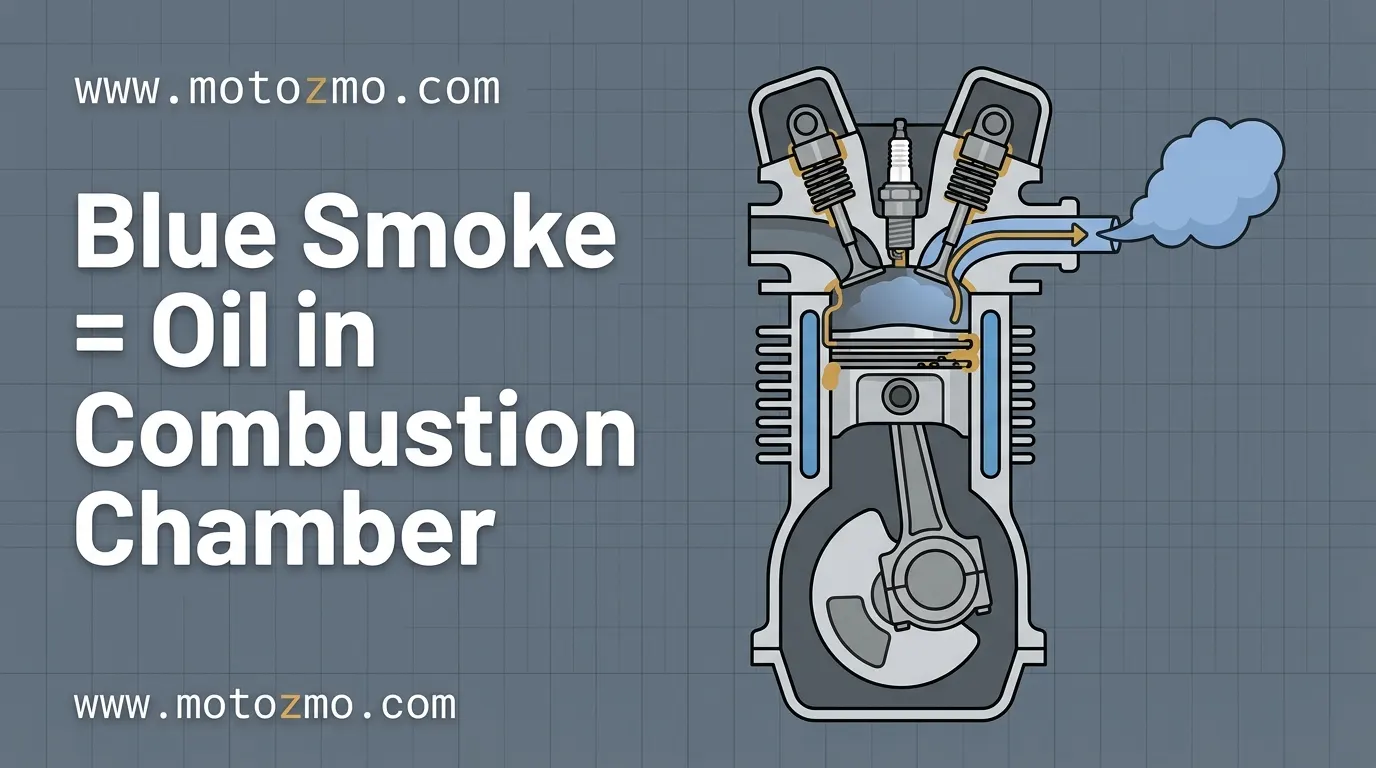
Blue-gray smoke from the exhaust almost always means oil is getting into the combustion chamber and burning off with the fuel, because of worn valve seals or worn piston rings. Black smoke is a different problem entirely, a rich fuel mixture, not oil. Thick white smoke that smells sweet usually means coolant, not oil either.
If you’ve already ruled out a puddle under the bike, which would point to a leak instead (our guide to motorcycle oil leaks covers that side of it), and you’re just seeing smoke with no drips, you’re in the right place. This article is part of our full breakdown on motorcycle leaking or burning oil, and it goes deeper into why oil ends up in the combustion chamber, how to narrow down which part is letting it in, and what’s routine wear versus something worth fixing soon.
First, Confirm It’s Blue Smoke
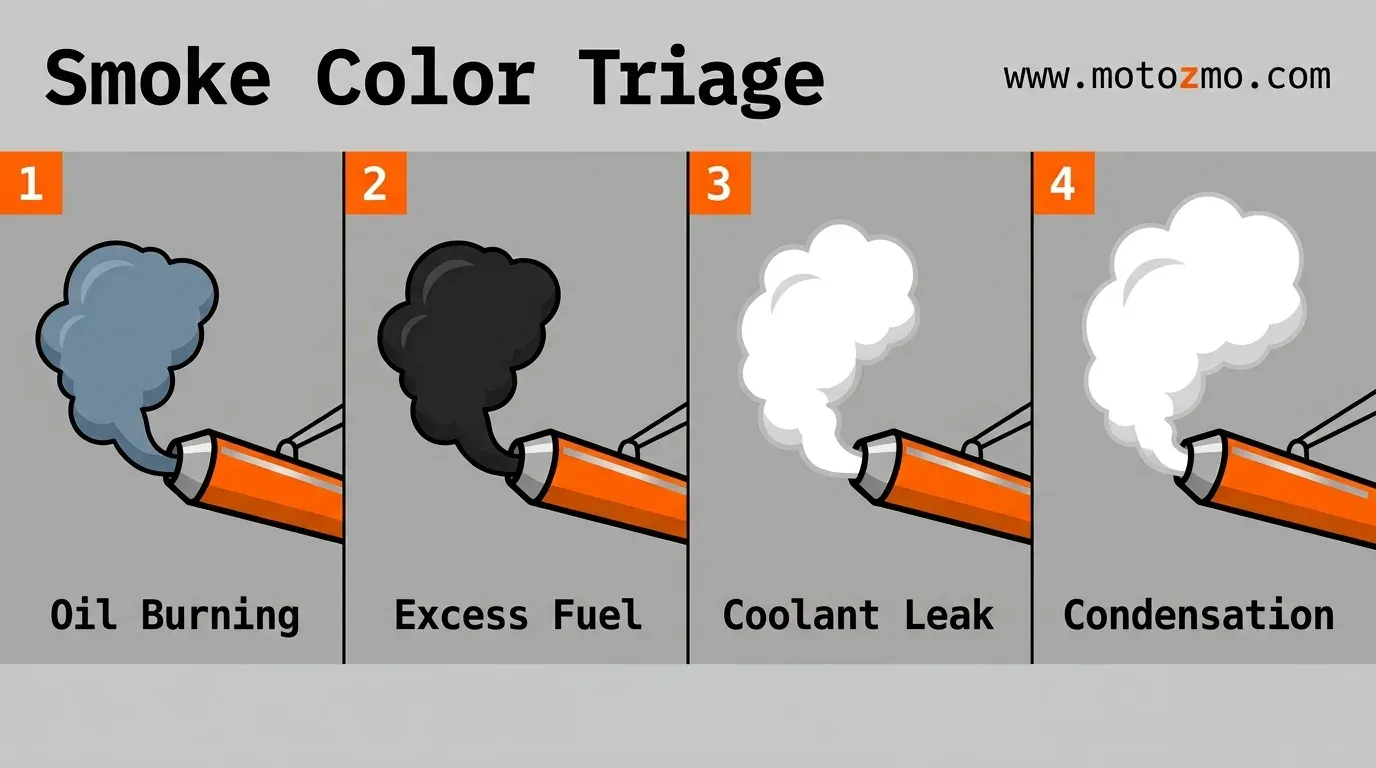
Smoke color is one of the fastest diagnostic tools you have, and it’s easy to get wrong from a quick glance, especially in bright sunlight where blue smoke can look almost white.
| Smoke color | What’s burning | What it usually points to |
|---|---|---|
| Blue or blue-gray | Oil | Worn valve seals, worn piston rings, or too much oil in the crankcase |
| Black, smells like fuel | Too much fuel | Clogged air filter, choke left on, wrong carb jetting, or a fuel injection problem |
| Thick white, smells sweet | Coolant | A blown head gasket or cracked head, serious and worth stopping for |
| Thin white, clears in a minute, no smell | Water vapor | Normal condensation, not a problem |
If you’re seeing black or white smoke instead of blue, the fix is somewhere else entirely and pouring money into rings or seals won’t touch it. NAPA walks through the same color triage for a general engine audience, and the same logic carries over to a motorcycle exhaust note for note. The rest of this article assumes you’ve confirmed it’s genuinely blue.
If You Ride a Two-Stroke, a Little Blue Smoke Is Normal
Two-stroke engines mix oil into the fuel on purpose, so some blue haze, especially at idle or low revs, is just how they run. If you’re not sure which type your bike is, most street motorcycles built since the 1990s are four-stroke.
If you don’t manually mix oil into your gas or top up a separate oil injector tank, you’re almost certainly four-stroke, and the rest of this guide applies to you. On a two-stroke, only worry if the smoke is noticeably heavier than usual or the smell has changed.
Cold Start Puff or Smoke Under Acceleration? Timing Tells You Which
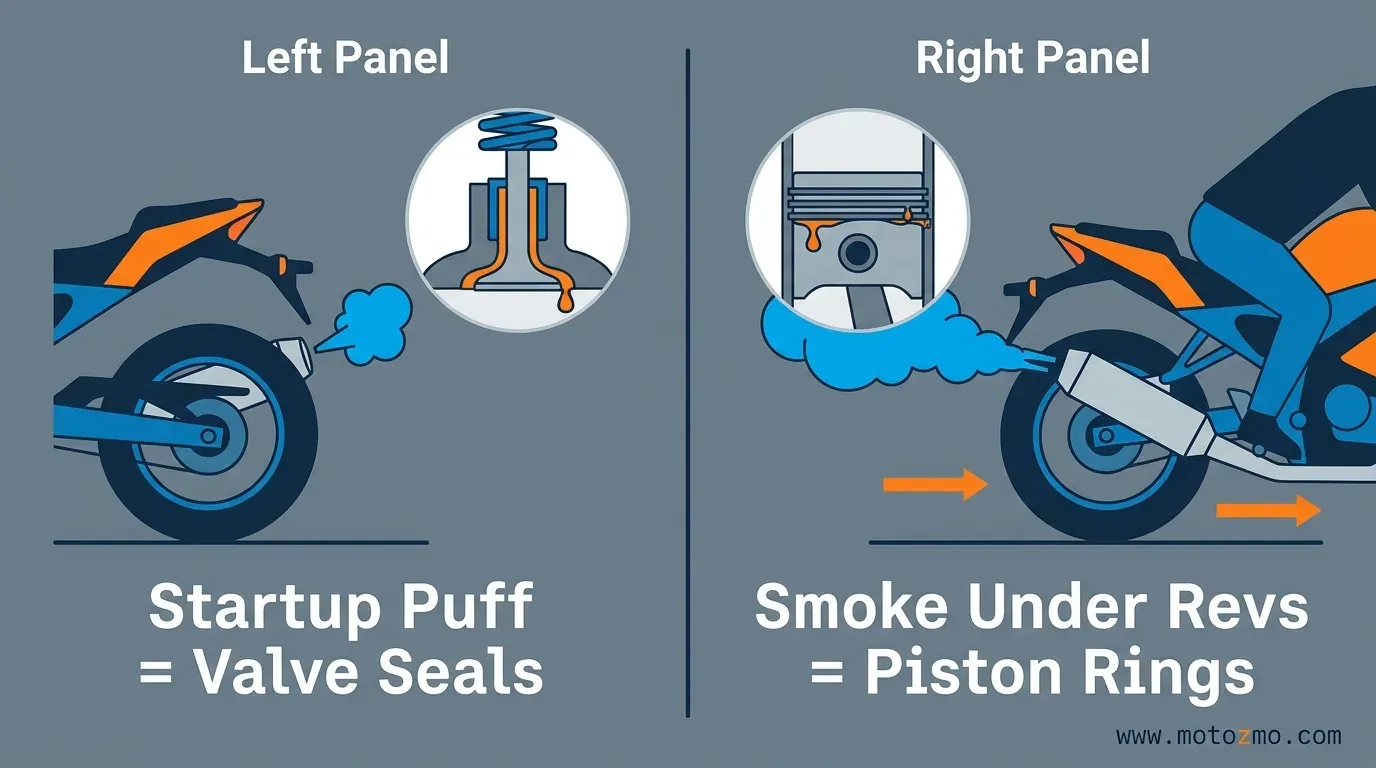
Once you know it’s genuinely oil, when the smoke shows up is the single best clue to where it’s coming from.
| When you see it | What’s happening | Likely cause |
|---|---|---|
| A puff right at startup that clears within a few seconds | Oil that pooled around the valve stems overnight burns off as the engine warms up | Worn valve seals |
| Smoke that shows up or gets worse under hard acceleration | Rising pressure in the cylinder forces oil past worn rings into the combustion chamber | Worn piston rings or cylinder wear |
| Smoke all the time, at idle and under load | Both of the above, or wear that’s gone further than a seal replacement alone will fix | Worth a compression test before you buy any parts |
Valve seals and piston rings fail for the same basic reason, rubber and metal both wear out with age and heat cycles, but they’re fixed in very different ways.
A valve seal job is a top-end repair. A ring job usually means pulling the cylinder and piston out completely, which is a bigger job with a bigger bill. For the full comparison, including which one is the more DIY-friendly repair, see our valve seals vs piston rings guide.
Other Causes Worth Ruling Out First
Before you assume it’s wear and start pricing parts, a few cheaper problems can cause the exact same blue smoke.
- Too much oil in the crankcase. Overfilling pushes oil up where it doesn’t belong and can force it past the rings even when they’re perfectly fine. Check your level cold, on level ground. Our guide on how much engine oil is too much covers exactly where that line sits.
- Old, dirty oil that’s never been changed on schedule. Oil that sits too long builds up carbon deposits around the rings, which can make them stick and stop sealing properly even if they’re not actually worn out yet. Our guide on how often to change motorcycle oil covers the intervals that actually prevent this.
- A clogged crankcase breather. This is the vent that relieves pressure inside the engine case. If it gets blocked, pressure builds up and pushes oil past seals that would otherwise hold it back just fine. It’s a cheap check, worth doing before you blame the rings.
- Riding style. Sustained high RPM increases the shear forces on your oil and speeds up wear on rings and bearings, which is exactly the kind of thing that turns a healthy engine smoky years earlier than it should be. Our guide on long rides at high RPM explains what’s actually happening inside the engine when you hold high revs for extended periods.
Engines that run consistently too hot or too cold wear their rings and cylinder walls faster too, since neither extreme lets the oil film do its job properly. If your bike’s been running hotter than normal lately, that’s worth chasing down alongside the smoke, not after it, according to independent automotive research group AA1Car.
How Much Oil Loss Should Worry You
A little oil consumption is normal for every four-stroke engine, even a healthy one. What matters is whether the amount you’re losing has changed. If your bike has always used a bit of oil between changes and that hasn’t shifted, you’re probably fine. If it’s suddenly using noticeably more than it used to, that’s the real signal, more than any single number.
Our guide on how much oil loss counts as normal breaks this down by engine age and mileage so you’re not guessing.
Confirming It Before You Buy Parts
A compression test or a leak-down test at a shop tells you, with actual numbers, whether the rings and valves are sealing the way they should. It’s a cheap test compared to the cost of buying and installing parts you didn’t need.
| Test | What it tells you |
|---|---|
| Compression test | Overall sealing of the cylinder, rings, and valves combined |
| Leak-down test | Pinpoints whether air is escaping past the rings, the valves, or somewhere else, more specific than a compression test alone |
If the numbers come back low, that’s your confirmation to move forward with a repair instead of guessing. If they come back normal, you’ve just saved yourself from an unnecessary teardown, and it’s worth looking harder at the cheaper causes above instead.
FAQ
Is it normal for an older motorcycle to smoke a little?
A bit more than a newer bike, yes, especially air-cooled engines with high mileage. It’s only a concern if the smoke is getting noticeably worse or showed up suddenly rather than gradually over years.
Can bad or old gas cause blue smoke?
No. Old fuel usually causes rough running, hesitation, or black smoke from poor combustion. Blue smoke specifically means oil, so if your gas is the problem, the smoke color will tell you it isn’t.