
Affiliate disclosure: This post may contain affiliate links. If you buy through a link on this page, MOTOZMO may earn a small commission at no extra cost to you. It helps keep our guides free. How we test and choose products.
There’s no single number that applies to every motorcycle, but as a starting point, a modern, well-sealed four-stroke should use well under half a quart between oil changes, and older air-cooled engines can normally use noticeably more than that without anything being wrong.
Search any motorcycle forum for this exact question and you’ll find riders arguing past each other, one person’s “totally normal” is another person’s “get that checked immediately,” and both of them can be right, because they’re talking about different engines. This article is part of our full guide to motorcycle leaking or burning oil, and it walks through why the number varies so much, a framework for judging your own bike instead of chasing a single figure, and how to tell routine wear from something worth looking into.
Why There’s No Single Right Answer
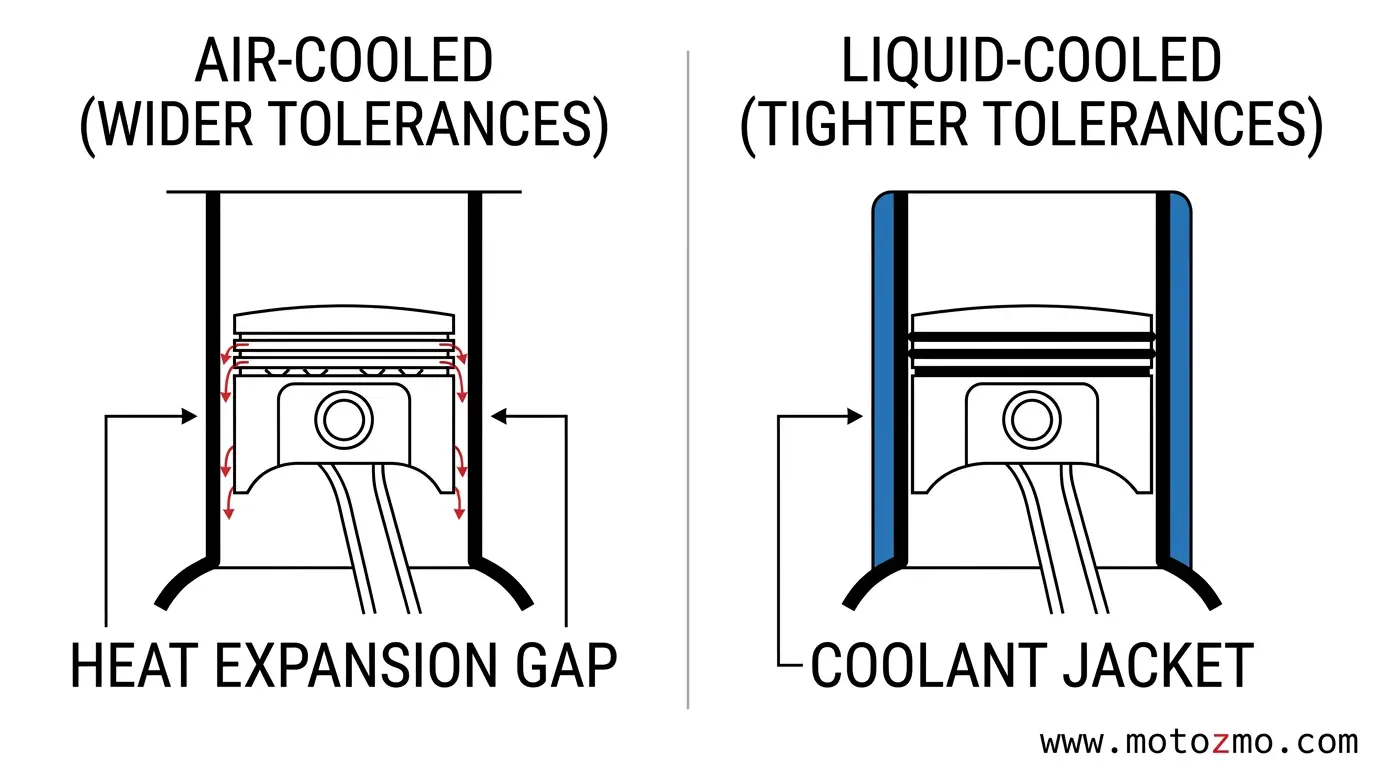
Engine design sets the baseline before you’ve even ridden a mile. Air-cooled engines run with looser manufacturing tolerances than liquid-cooled ones, partly because they need extra clearance to handle the wider temperature swings that come without a radiator managing heat for them.
Looser tolerances mean a bit more oil finds its way past the rings as a normal part of how the engine works, not a sign of a fault. A liquid-cooled engine built to tighter clearances simply has less room for that to happen.
Mileage plays a role too. Every engine’s tolerances open up gradually as parts wear, so an engine with 40,000 miles on it will typically use a bit more oil than the same engine did at 4,000 miles, even with nothing actually broken. That’s wear working as expected, not wear gone wrong.
There’s also a scale issue that’s easy to miss. A car engine usually holds four to six quarts of oil. Most motorcycle engines hold somewhere between two and four quarts, spread across fewer cylinders in some cases and more in others, but almost always with less total oil volume to work with. The same half a quart of consumption is a much bigger percentage of the total supply in a bike than it is in a car, which is why borrowing a car mechanic’s rule of thumb for your motorcycle can lead you astray in either direction.
A Framework by Engine Type, Not One Number
Instead of memorizing a figure, match your bike to the closest situation here.
| Engine type and situation | Typical normal range | Why |
|---|---|---|
| Modern liquid-cooled four-stroke, low to moderate mileage | Well under half a quart between changes | Tighter manufacturing tolerances |
| Modern liquid-cooled four-stroke, high mileage | Up to around half a quart | Normal wear opening up clearances over time |
| Air-cooled four-stroke, especially older or classic bikes | Half a quart or more | Looser tolerances by design, more so at sustained highway speed |
| Two-stroke | Doesn’t apply the same way | Oil is mixed with fuel on purpose, see our guide to burning oil and blue smoke for how that changes the picture |
If your bike doesn’t fit neatly into one of these, your owner’s manual is worth checking. Some manufacturers do publish a maximum acceptable consumption rate for their engines, and it’s a more reliable number than anything you’ll find in a forum thread.
The Trend Matters More Than the Number
Here’s the part most articles skip: the exact figure matters less than whether it’s changing. A bike that’s always used roughly the same amount of oil between changes is behaving consistently, and consistent is what you want, even if the number itself sits on the higher end of normal for its engine type. A bike that suddenly starts using twice what it used to is telling you something changed, even if the new number still sounds small in isolation.
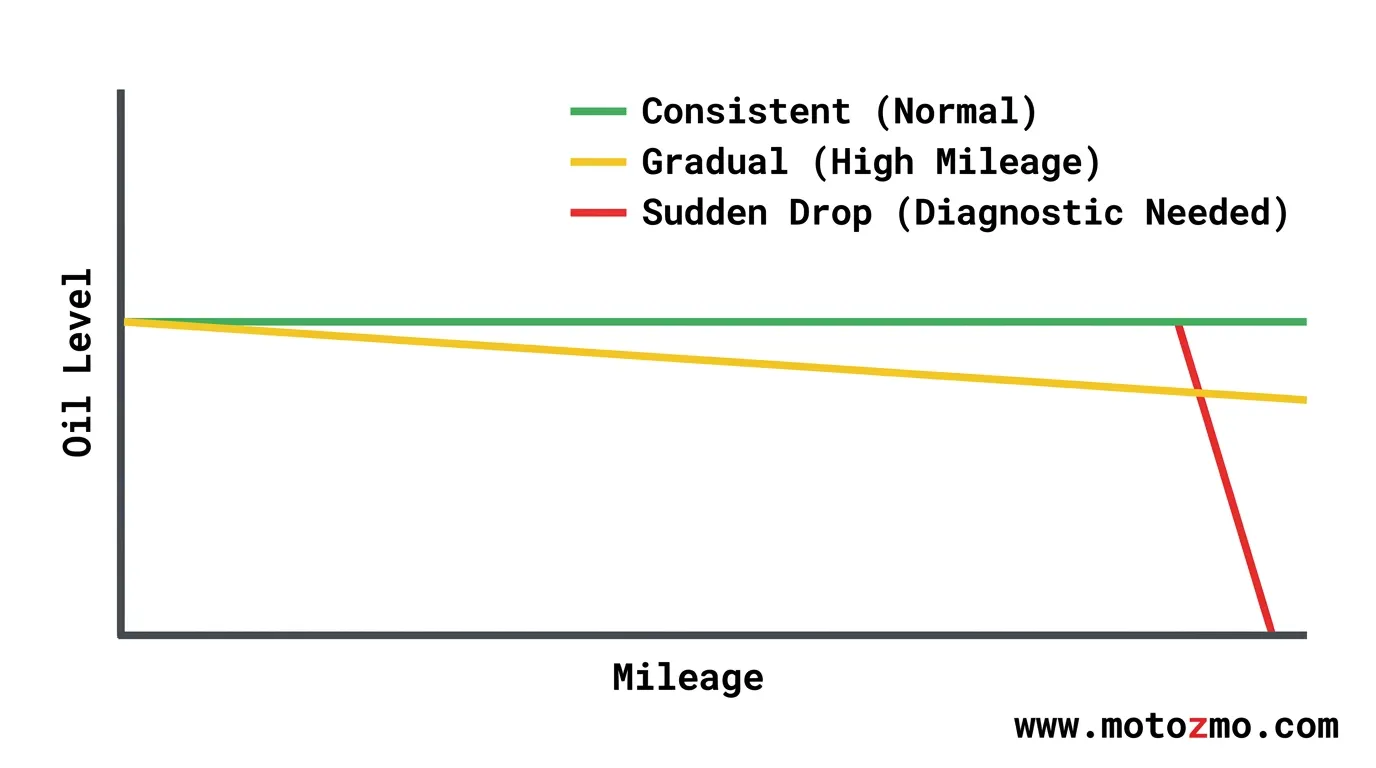
The easiest way to track this is to check your level at the same point in your oil change routine every time, right before you drain it, and jot the reading down or just keep it in your head.
Our guide to how often to change motorcycle oil covers the intervals that make this kind of tracking meaningful instead of noisy. Checking on a wildly inconsistent schedule makes trends much harder to spot.
When It’s Worth Investigating
| What you’re seeing | What to do |
|---|---|
| Consumption has stayed about the same for years | Nothing, this is just how your bike runs |
| Consumption doubled compared to last season, no smoke or puddle | Check the cheap causes first, our guide to burning oil above covers what to rule out before assuming the worst |
| Consumption rising and you’re also seeing smoke or a puddle | Time to actually diagnose rather than keep tracking, see our guide to oil leaks and the burning oil guide linked above |
How Manufacturers Define “Too Much”
Forum threads on this topic tend to be pure anecdote, one rider’s bike uses a quart every 4,000 miles and gets told that’s fine, another’s uses the same amount and gets told to sell the bike. What most riders don’t realize is that manufacturers don’t leave this to guesswork internally.
Technical service documents filed with regulators lay out an actual measured procedure, ride the bike a set distance, then test how much oil returns through specific points in the engine, and compare that against a documented acceptable amount before deciding whether something needs further diagnosis. One such service bulletin hosted by NHTSA lays out exactly this kind of test, checking oil return at a sensor opening after a set idle period and comparing it against a defined threshold. That’s a very different standard than “my buddy’s bike doesn’t use any, so yours shouldn’t either.”
Want Real Numbers Instead of Guessing? Send a Sample
If the tracking and the tables above still leave you unsure, there’s a more direct option most riders never consider: oil analysis. Blackstone Laboratories tests used oil samples and compares them against a large database of results from similar engines, which tells you whether the wear metals in your oil match what’s typical for your bike or whether something’s actually accelerating. It costs about the same as a decent oil filter, and it turns “I think this feels like a lot” into an actual comparison instead of a guess. It’s a genuinely useful tool if your bike sits in that gray zone where you’re not sure whether to worry.
The Other Direction: Could It be Overfilled Instead?
Before you spend any time worrying about consumption, it’s worth ruling out the opposite problem. Too much oil in the crankcase can look like a consumption issue, or even cause smoke that has nothing to do with worn rings, simply because there’s more oil than the engine has room for. Checking your level cold, on level ground, rules this out in under a minute.
Our guide to how much engine oil is too much covers exactly where that upper line sits and what happens if you cross it, the flip side of the same gauge this article is about.
FAQ
Does switching to synthetic oil reduce how much my bike uses?
It can help a little. Synthetic oil resists thinning out at high temperatures better than conventional oil, which can modestly reduce consumption on some engines. It won’t fix a genuine leak or worn rings, it just slows the rate a bit.
Should I go up an oil weight if my bike has started using a bit more than it used to?
Sometimes a heavier weight, within what your manual allows, can reduce consumption on an older engine with looser tolerances. Check your owner’s manual before changing weights, since it’s a workaround for wear, not a fix for it.