
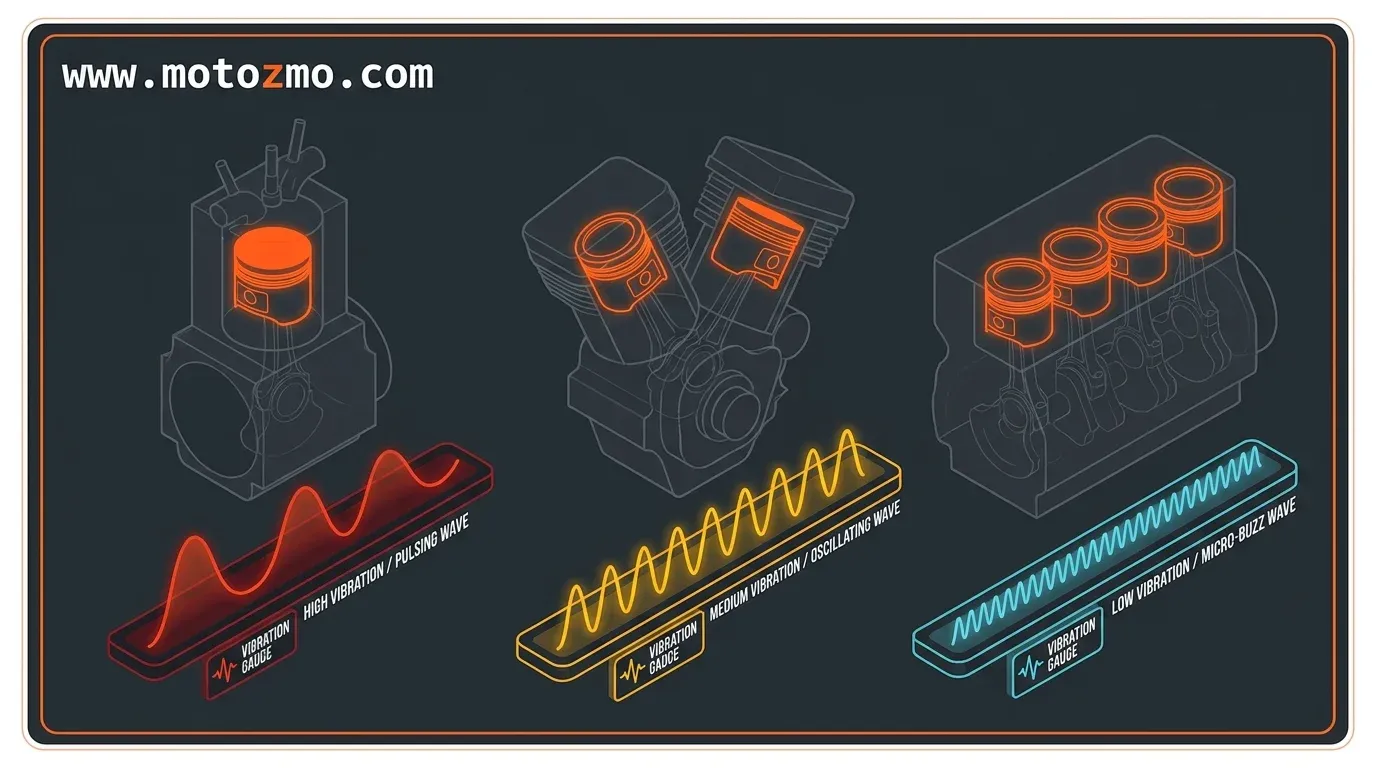
Some vibration is simply part of how your engine is built, and how much of it you feel depends heavily on how many cylinders you have and how they’re arranged. A single-cylinder engine shakes the most by design, since there’s only one piston and nothing built in to cancel out its motion. A V-twin sits in the middle, and how much it vibrates depends a lot on the angle between the two cylinders. An inline-four is usually the smoothest of the three. None of that means your bike has a problem.
This guide covers what’s normal for each layout, so you can tell “that’s just how my engine is” apart from “something’s actually changed.” For the wider picture on vibration and its other causes, see our main vibration troubleshooting guide.
How to Tell Which Type You Have
Look at the engine from the front. One cylinder sticking up or out means a single. Two cylinders arranged in a narrow V or Y shape, angled apart from each other, means a V-twin. Four cylinders lined up side-by-side in a row means an inline-four. If your two cylinders sit flat and side by side rather than angled, that’s a parallel twin, a different layout with its own set of variations covered briefly further down.
Our full guide to motorcycle engine types covers identification and layout in more depth if you’re still not sure what you’re looking at.
Single-Cylinder Engines: The Most Vibration by Design
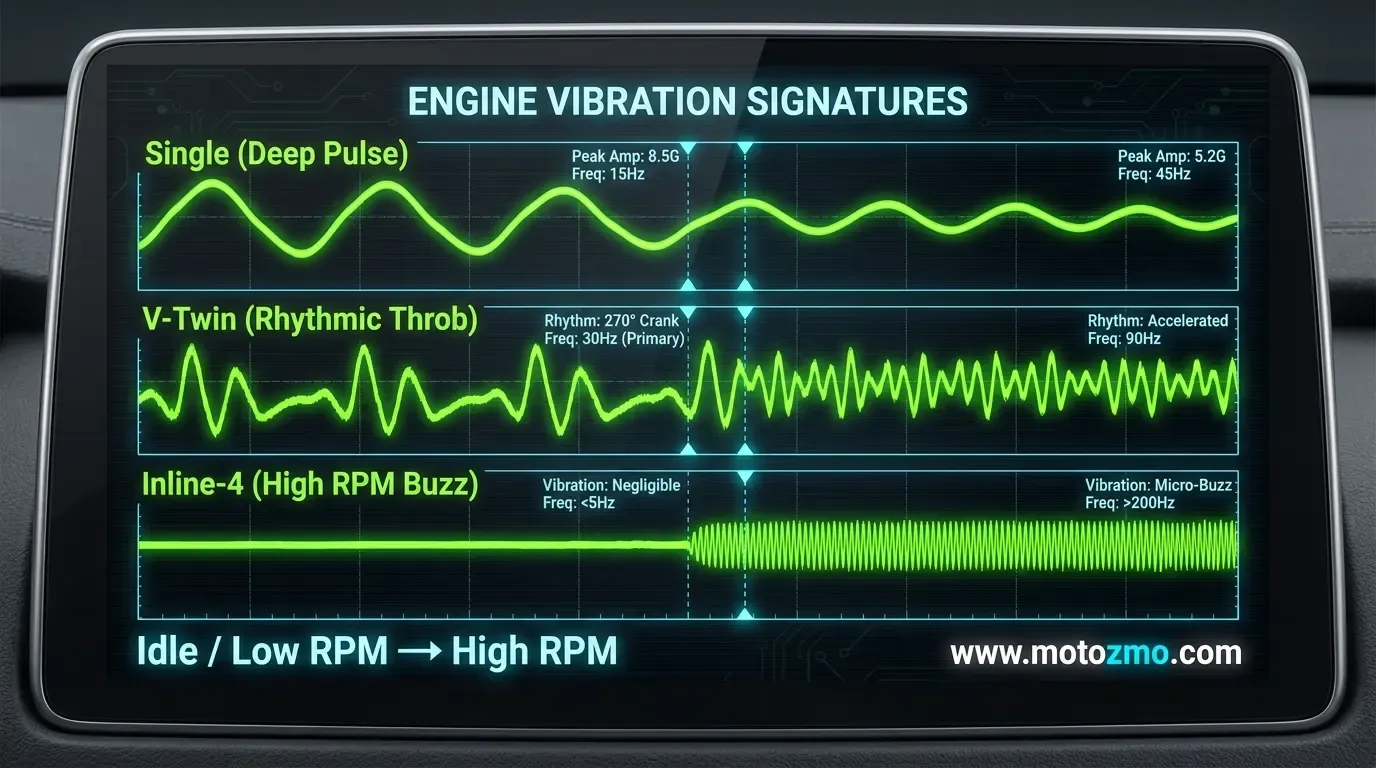
A single-cylinder engine, often called a thumper, has one piston moving up and down with nothing else in the engine to cancel out that motion. That’s the basic reason singles vibrate more than any other common layout: there’s simply no second piston moving the opposite way at the same time to smooth things out. This shows up as a strong, steady pulse, most noticeable at idle and low RPM, that many riders describe as feeling like the whole bike has a heartbeat.
Plenty of modern singles use a balance shaft, a weighted rod that spins the opposite way to cancel out most of that pulse. Bikes like the Royal Enfield Himalayan and many current dual-sport and adventure singles use this, and it noticeably softens the shake compared to an older air-cooled single without one. Even with a balance shaft, though, a single will never feel as smooth as a multi-cylinder engine, and that’s expected.
A lot of riders who buy their first thumper coming from a smoother bike assume something is wrong, when really they’re just feeling their engine’s normal character for the first time.
V-Twins: It Depends Heavily on the Angle
This is the layout where “normal” varies the most, because the angle between the two cylinders changes the physics.
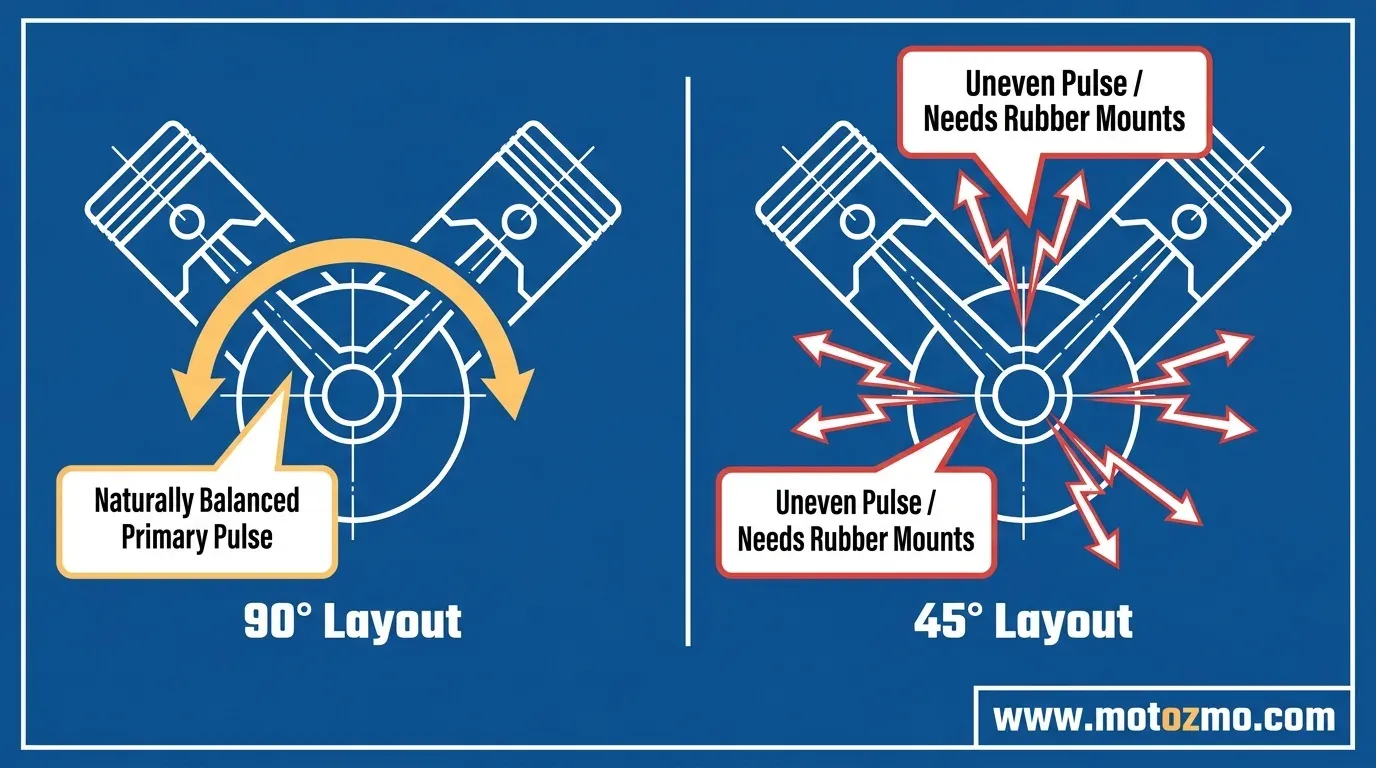
A 90-degree V-twin, sometimes called an L-twin (Ducati and most Moto Guzzis are the well-known examples), can be built with close to perfect balance for the basic up-and-down shake of the pistons. That doesn’t mean these engines feel smooth, though. They still carry a real secondary buzz on top of that, and because the two cylinders fire unevenly rather than in perfect rhythm, there’s a rocking, torque-reaction feel that’s especially noticeable at idle or when you blip the throttle. Moto Guzzi owners in particular often notice their bike rock side to side at a stop, which is normal for that engine, not a fault.
A 45-degree V-twin, the classic Harley-Davidson layout, is built with less inherent balance than a 90-degree design, which means more vibration by design, not less.
Combined with an uneven firing order, this is also where Harley’s signature “potato-potato” exhaust note comes from; it’s the sound of the same uneven pulse that creates the vibration. Most Harleys since the 1980s use rubber engine mounts to isolate a lot of that shake from the rider and frame, which is why a rubber-mounted Softail or Touring model feels noticeably calmer than an older solid-mounted engine of similar layout.
Either way, a Harley owner should expect to feel more pulse through the bike than a rider on a 90-degree twin, and that’s the engine doing exactly what it was designed to do.
Inline-Fours: The Smoothest, with a Caveat
With four cylinders lined up and a typical crank layout where the outer two pistons move together and the inner two move together in mirror image, most of the basic piston-driven shake cancels itself out. That’s the main reason inline-fours became the standard layout for sportbikes and became the “default” engine for so many street and sport bikes: they’re the smoothest common option out of the box, with no balance shaft required to get there.
That doesn’t mean zero vibration. There’s still a smaller, higher-pitched buzz that grows as the revs climb, since the cancellation isn’t perfect at every engine speed.
Riders on modern inline-fours, from a CBR600RR to a GSX-R1000, typically describe this as a buzz through the pegs and bars at higher RPM rather than a shake, and it’s a different feeling from what a single or V-twin produces at the same relative RPM. If you’re used to how smooth these engines are at idle and low RPM, a sudden shake down there, rather than the expected high-RPM buzz, is more worth a second look than the reverse.
Wikipedia’s overview of the V-twin engine and single-cylinder engine cover the underlying balance mechanics in more technical detail if you want to go further into the engineering side of this.
What About Parallel-Twins, Triples, and Boxers?
These aren’t part of the three layouts this guide focuses on, but they come up often enough to be worth a quick mention. Parallel-twins vary a lot depending on how the crankshaft is built: a 270-degree parallel twin, used on bikes like the Yamaha MT-07 and modern Triumph Bonnevilles, is tuned to feel and sound a lot like a 90-degree V-twin, even though the two cylinders sit side by side rather than in a V. Triples, Triumph’s signature layout, land somewhere between a twin and a four in character.
Boxer twins, BMW’s flat, horizontally opposed layout, balance the basic piston shake very well but have their own side-to-side rocking feel at idle, similar in spirit to what a Moto Guzzi rider feels. Our engine types guide covers all of these in more depth.
A Quick Way to Check If Your Baseline Still Matches
| Engine type | Normal character | Worth a second look if |
|---|---|---|
| Single | Strong, steady pulse, most noticeable at idle and low RPM | The pulse has clearly gotten worse, or you now feel it somewhere new, like the pegs when it used to be just the bars |
| 90-degree V-twin | Rocking or torque-reaction feel at idle and off-throttle, a buzz that builds with speed | A harsh vibration at one specific RPM that wasn’t there before, especially if it comes with noise |
| 45-degree V-twin (Harley) | A steady, felt pulse, more noticeable on solid-mounted engines than rubber-mounted ones | The vibration changes character rather than just intensity, or shows up somewhere it never used to |
| Inline-four | Light buzz that grows with RPM, smooth at idle and low RPM | Any real shake at idle or low RPM, since that breaks this layout’s normal pattern |
When It’s Not Just Your Engine’s Character
If what you’re feeling matches the normal pattern for your engine type above, there’s nothing to fix. If it doesn’t, especially if it showed up suddenly or has been getting worse, that’s a different situation. Our guide on vibration that shows up all of a sudden covers how to narrow down what changed, and if you’re hearing a grinding sound or feeling play in a wheel, that points toward a failing wheel bearing rather than anything to do with your engine’s layout.
And if your engine’s normal character is exactly that, normal, but you’d still like to take the edge off long-ride buzz, our guide to bar end weights and vibration dampeners covers ways to do that without needing anything to actually be wrong with the bike.