
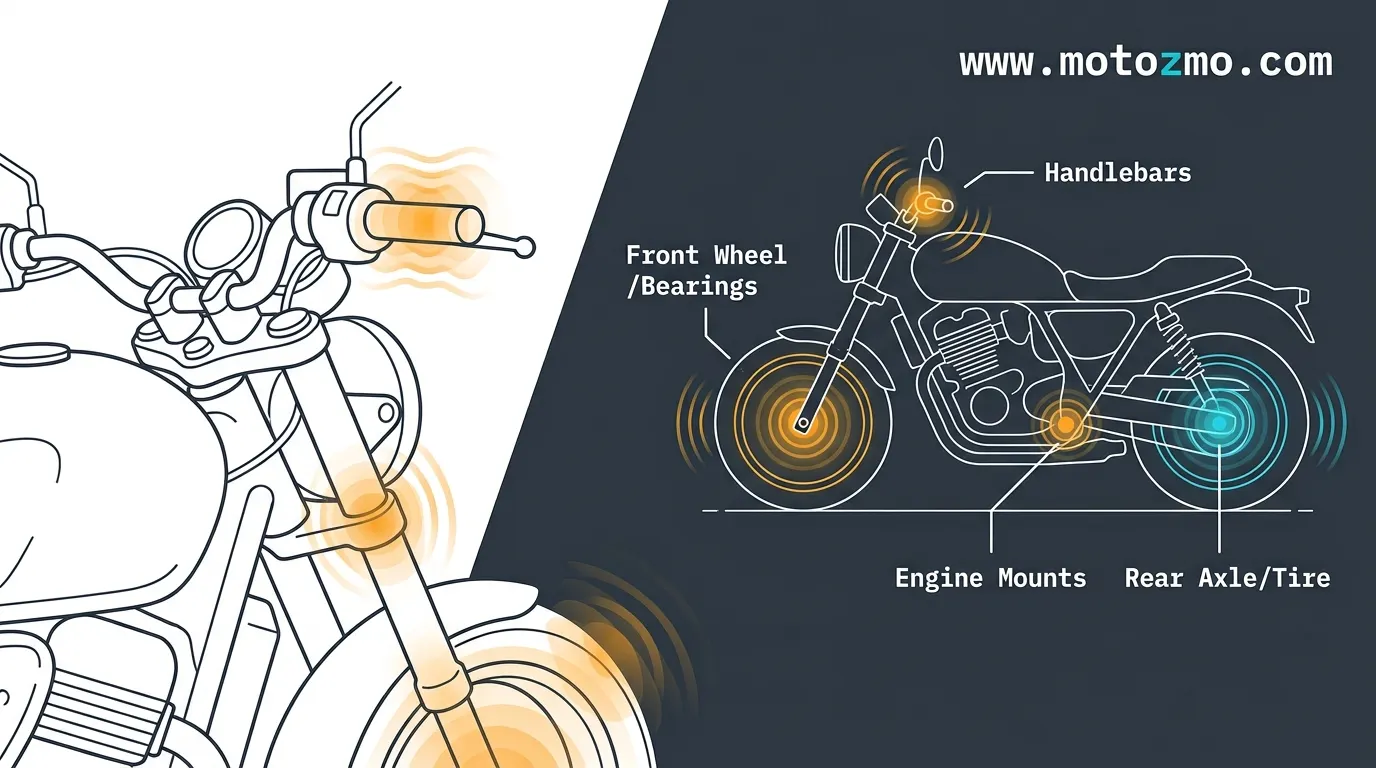
A motorcycle that starts vibrating more than it used to almost always means something changed, and you can find out what in about ten minutes. Every bike vibrates some. That’s just how an engine and two spinning wheels work. What matters is whether the vibration is new, whether it’s getting worse, and whether you can pin down exactly where you feel it and when it shows up. A rough idle that smooths out once you’re moving is usually nothing to worry about. A vibration that shows up at speed and keeps building the faster you go is a different story, and it’s worth checking before your next ride.
Below is a quick way to narrow down the cause, what each pattern usually means, and a straight answer on when it’s fine to keep riding and when it isn’t. For other symptoms, our motorcycle troubleshooting hub is the place to start.
Where Do You Feel It, and When?
Location and timing tell you more than almost anything else. Before you touch a wrench, pay attention to these two things on your next short ride (somewhere safe and familiar, not the highway).
| Where you feel it | When it happens | Most likely cause |
|---|---|---|
| Handlebars | At idle or low RPM, fades as you speed up | Loose or worn engine mount |
| Handlebars | Builds steadily above 50 mph or so | Front tire or wheel out of balance |
| Handlebars | Shakes at low speed (under 35 mph) and settles down higher up | Front wheel bearing, steering head bearing, or a cupped/worn front tire |
| Footpegs or seat | Steady buzz that grows with speed | Rear tire or wheel out of balance, or a worn rear wheel bearing |
| Whole bike | Only under hard acceleration | Engine issue: a misfire, a loose mount, or (on multi-cylinder bikes) a balance shaft chain out of sync |
| Whole bike | Started suddenly, right after hitting a pothole or curb | Bent rim or wheel (see our guide on vibration that shows up all of a sudden) |
| Front end | Comes with a wobble, a pull to one side, or a grinding sound | Wheel bearing wear or a wheel alignment problem |
| Brake lever or pedal | Only when you brake, pulses rather than buzzes | Warped brake rotor, not a wheel or engine issue |
This table gets you to the right section faster, but it’s a starting point, not a diagnosis. Plenty of these causes overlap, and the only way to be sure is to check the bike itself.
The Check You Can Do Before Anything Else
Most of this takes ten to fifteen minutes with the bike on a stand or the center stand down.
Tires first. Low tire pressure is the single most common cause of new vibration, and it’s the easiest thing to rule out. Check pressure cold, then look at the tread for flat spots, cupping, or uneven wear. A bike that’s been sitting for a few weeks can develop a flat spot just from its weight pressing on one contact patch. Our guides on checking your tires and knowing when to replace them cover this in more detail.
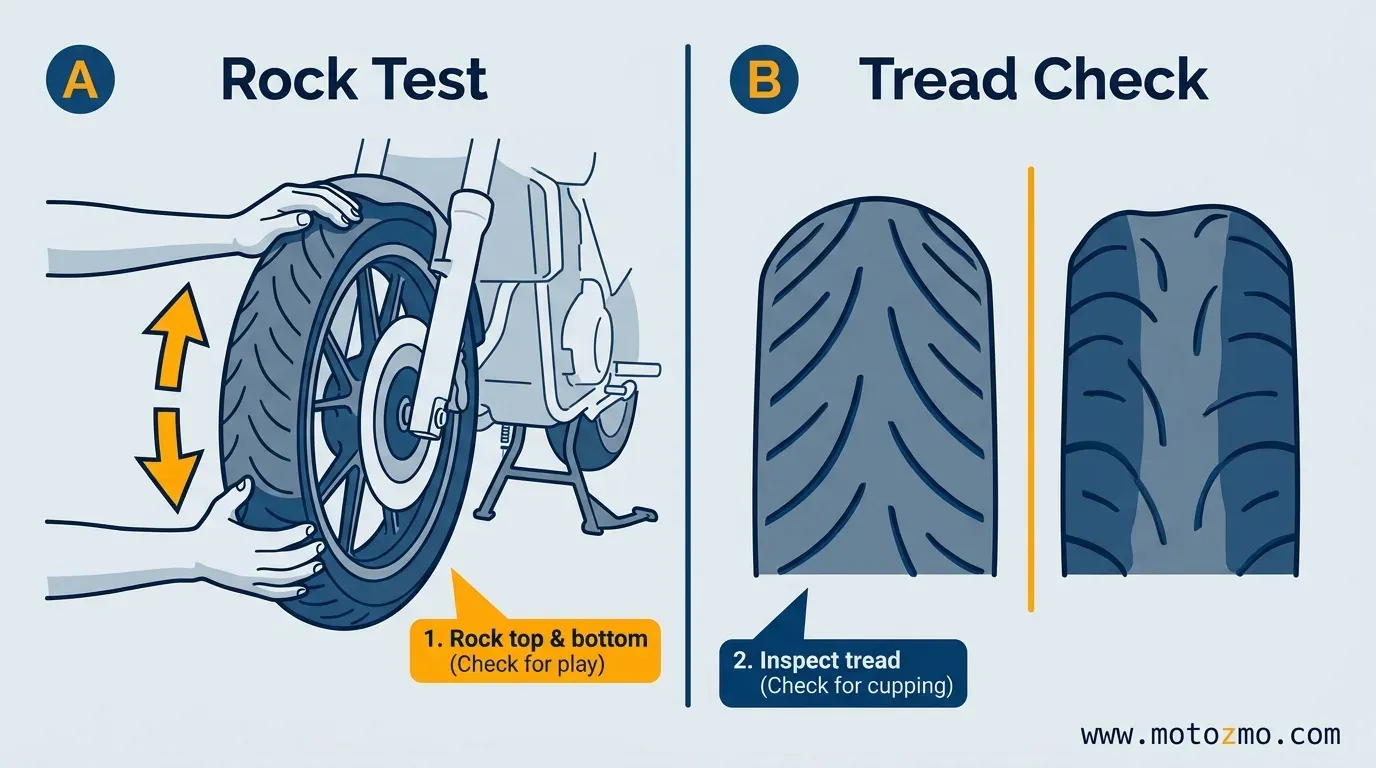
Wheels next. With the wheel off the ground, spin it by hand and watch for a wobble. Then grab it at the top and bottom and try to rock it side to side. There should be no play at all. Any looseness, grinding, or noise there points to a wheel bearing, and our signs of a bad wheel bearing guide walks through the full test. If you ride a bike with spoked wheels, a loose or broken spoke can throw the wheel out of true too. See are spoked wheels dangerous for what to check there.
Bolts and mounts. Constant engine buzz works fasteners loose over years of riding. Check axle nuts, engine mount bolts, and handlebar clamps for anything that’s backed off.
Two quick notes on what this article doesn’t cover. If what you’re feeling is more of a jerk or a snap under acceleration than a steady buzz, that’s usually the chain, not the wheel. See motorcycle chain skipping or slack. And if you’re hearing a new noise but not feeling any shake through the bars or pegs, you’re dealing with a noise problem, not a vibration one, and our engine noise when accelerating guide is the better starting point.
What’s Behind It
Tires and wheels. An unbalanced tire, a flat spot, uneven wear, or a bent rim all show the same pattern: vibration that gets worse the faster you go, usually felt through the bars if it’s the front wheel and through the seat or pegs if it’s the rear.
Wheel bearings. These sit inside the wheel hub and let the wheel spin freely on the axle. When they wear out, the wheel gets a small amount of play it shouldn’t have, and that shows up as a gritty vibration, a wobble, or a grinding sound that changes when you lean or turn. Bearings and tires cause a lot of the same symptoms, which is why it’s worth checking both rather than assuming it’s whichever one is cheaper to replace.
Engine and mounts. A loose or worn mount lets normal engine vibration travel into the frame instead of being absorbed. A fouled spark plug or a misfire changes the engine’s usual rhythm and can feel like a new, uneven shake, mostly under acceleration. On four-cylinder and some other multi-cylinder bikes, a stretched balance shaft chain can throw the counterweight out of sync with the crankshaft over tens of thousands of miles, which shows up as vibration that’s crept in gradually rather than appeared overnight.
Loose hardware. Sometimes it really is that simple. A loose axle nut, a loose handlebar clamp, or a missing bolt can all cause vibration that goes away the moment it’s tightened back down.
Brakes. A warped rotor causes a pulsing feeling through the lever or pedal when you brake, not a steady vibration while riding. It’s easy to mix the two up, but they point to different repairs.
How Much Vibration Is Normal for Your Engine
Some of this comes down to what’s under the tank rather than anything being wrong. A single-cylinder engine vibrates more by design than a four-cylinder one, simply because there’s one piston firing instead of several working together to cancel each other out. V-twins sit in between, and how much they buzz depends a lot on the angle between the cylinders.
If you’re not sure whether what you’re feeling is just your engine’s normal character, our normal vibration by engine type guide breaks down what to expect from a single, a V-twin, and an inline-four.
When to Stop Riding and Get It Checked
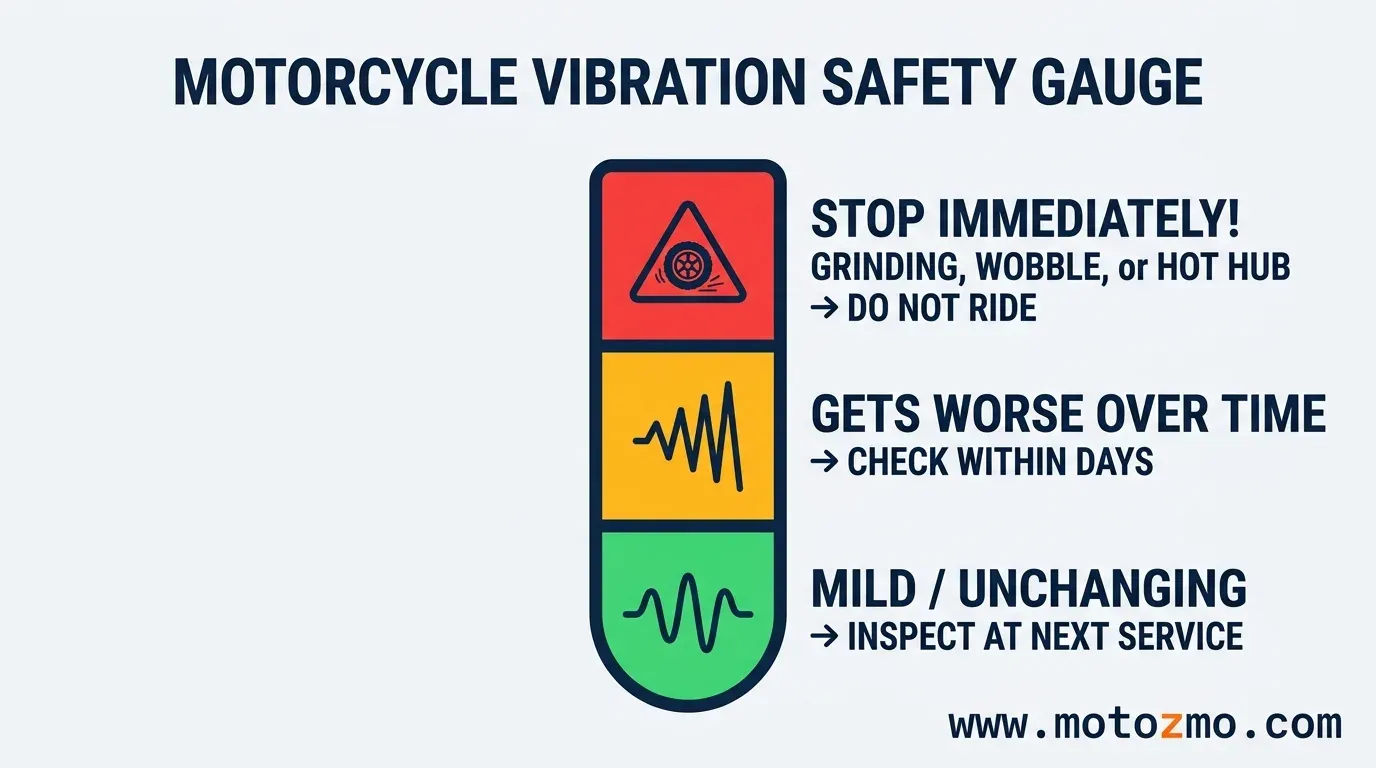
Not every vibration needs to end your ride right now. Here’s a rough way to sort it.
| What you’re noticing | Risk level | What to do |
|---|---|---|
| A mild, steady buzz that hasn’t changed in weeks | Low | Keep an eye on it, mention it at your next service |
| New vibration that’s getting worse ride by ride | Medium | Check tires, wheels, and mounts within the next few days |
| Vibration plus a grinding or growling noise, a wobble, or the bike pulling to one side | High | Don’t ride it again until you’ve checked the wheel bearings and wheels |
| Vibration plus a hot wheel hub, visible play when you rock the wheel, or a wheel that doesn’t spin freely | High, stop now | Get the bike to a shop rather than riding it there if you can help it |
Tire and wheel problems show up often enough in crash data that the National Highway Traffic Safety Administration recommends checking tire pressure, tread, and brakes before every ride.
The Motorcycle Safety Foundation’s T-CLOCS checklist is built around that kind of quick walkaround, and running through it before you ride catches most of what’s in this article before it turns into something worse.
Fixing It: What You Can Do Yourself
Tightening a loose bolt or mount is as easy as it sounds, and it’s worth owning a basic tool kit so you’re not caught without the right size wrench.
Tire and wheel balancing needs shop equipment, but it’s a quick, inexpensive job most tire shops can do while you wait. Wheel bearings are a more involved job. It’s doable in a home garage with a wheel bearing puller and driver kit, but if you’ve never pressed a bearing before, it’s a reasonable one to hand to a shop the first time around.
If the vibration is more of an annoyance than a real problem, mainly a buzz in your hands on longer rides, a set of bar-end weights or vibration dampeners can take the edge off without fixing an underlying cause that isn’t there in the first place.
Keeping It from Coming Back
Check tire pressure before rides that matter, and give the tires a real look, not just a glance, every few weeks. Check wheel bearings for play whenever the wheel is off for a tire change, and read up on how often wheel bearings need replacing so you’re not guessing. A five-minute check now is a lot cheaper than a wheel bearing that fails on the highway.